
Disclosure: VPNFin is reader-supported. If you buy a VPN through links on this page, we may earn a commission at no extra cost to you. This never affects our ratings — here’s our full disclosure.
PureVPN vs hideme comparisons usually come down to price and free use; hide.me is often searched as hideme. PureVPN, a British Virgin Islands service under GZ Systems, rebuilt trust after a 2017 FBI logs case with KPMG audits, and charges $58.20 for its first 27 months on Standard, then $47.95 a year, for 10 devices. Hide.me, from eVenture Ltd in Labuan, Malaysia, since 2012, had its no-logs policy audited in 2024, runs its own servers, allows 10 devices on paid plans and, since May 2026, offers a free plan without a data cap, our tables record.
This guide compares them on privacy, the free plan, features, price, devices and fit.
PureVPN vs Hideme on Privacy
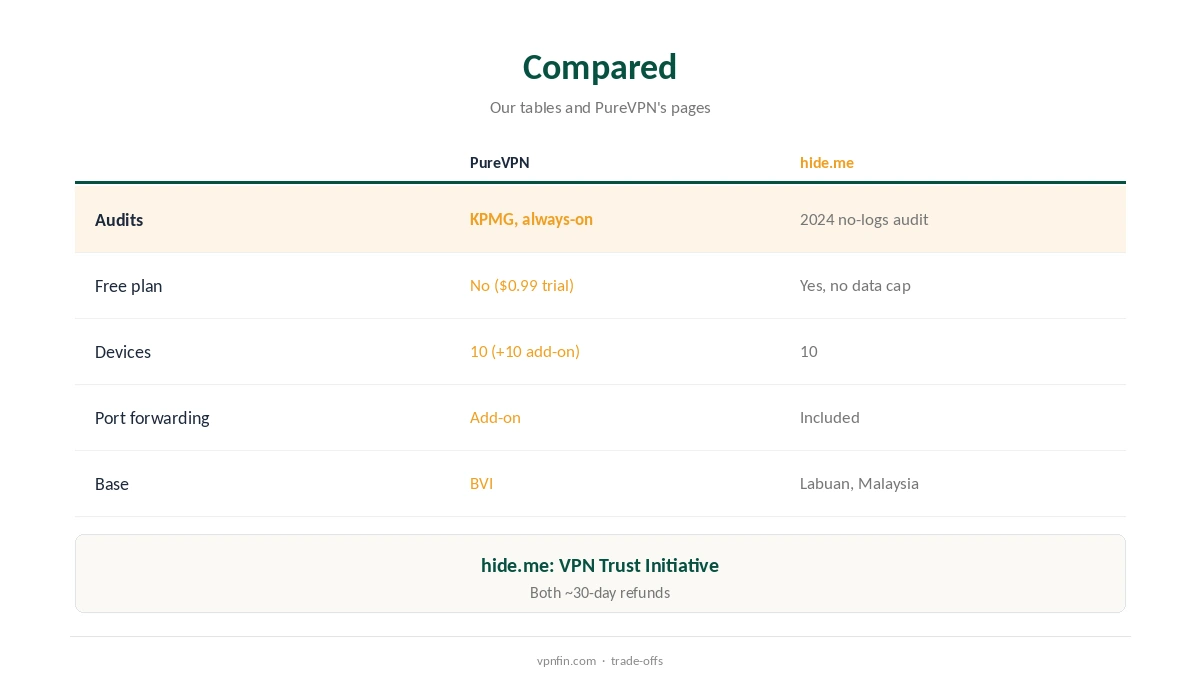
PureVPN rebuilt trust after its 2017 FBI case through KPMG’s always-on audits, which include unannounced checks. Hide.me had a no-logs audit in 2024, though sources name different auditors, and holds VPN Trust Initiative accreditation.
Hide.me runs its own servers rather than renting them from data centres. Our VPN audit tracker compares providers.
The Free Plan
Hide.me offers a free plan that needs no email address or card. Since May 2026 it has no data cap, with about eight locations, one device and reduced speed, findcheapvpns, CriticNest and Toolradar report; March and April reviews described a 10 GB limit.
PureVPN has no free plan, only a seven-day trial for $0.99 that turns into a full plan unless cancelled.
Features
Hide.me includes dynamic port forwarding, multi-hop, split tunnelling and a Stealth protocol among WireGuard, IKEv2, OpenVPN, SSTP and SoftEther, our tables record. PureVPN sells port forwarding and a dedicated IP as add-ons and adds a password manager and data removal on higher tiers.
For built-in tools, hide.me offers more without extra fees on its single paid plan.
PureVPN vs Hideme on Price, Devices and Servers
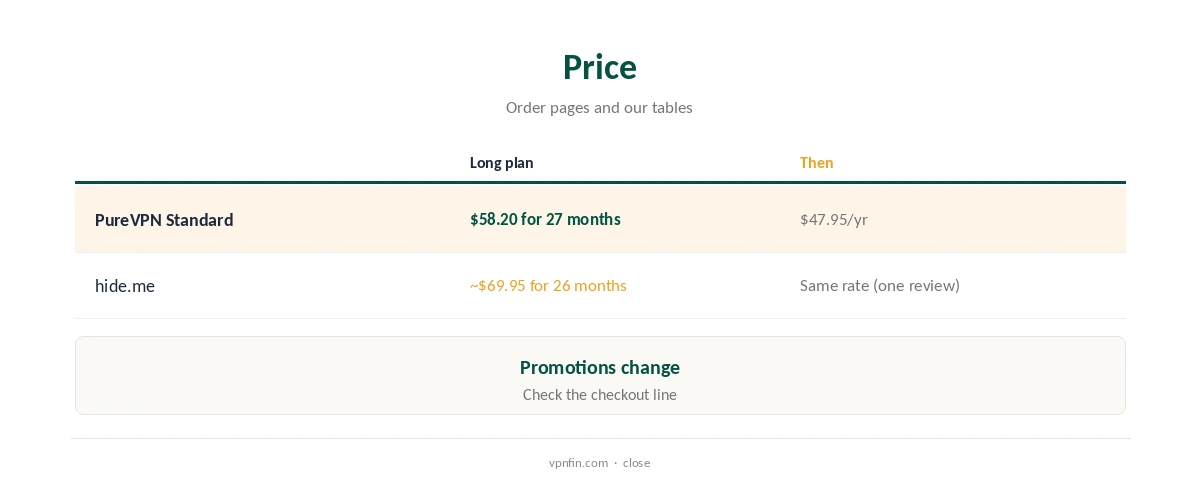
PureVPN’s Standard plan costs $58.20 for 27 months, then $47.95 a year. Hide.me costs about $2.69 a month on its 26-month plan, around $69.95 in total, or $54.95 for a year, and one review says it renews at the same price.
PureVPN is slightly cheaper up front; renewal costs are close enough that features should decide.
Both allow 10 devices on paid plans, and PureVPN sells 10 more as an add-on. Hide.me runs about 2,600 servers across roughly 91 locations in one count; PureVPN lists 6,500-plus servers in 88-plus locations.
Either covers a typical household, and a router counts as one device.
Streaming, Ownership and Jurisdiction
Hide.me’s Netflix US access depended on the server in a 2026 review, and its SmartGuard blocker did not work in one February test. PureVPN recommends switching to a streaming-optimised server when Netflix shows a proxy error.
Test your services within each refund window; both offer about 30 days.
PureVPN sits under GZ Systems in the British Virgin Islands; hide.me under eVenture Ltd in Malaysia’s Labuan territory. Neither is part of Kape or Nord Security.
Our VPN ownership guide explains why ownership matters.
Refunds and PureVPN’s Tiers
PureVPN refunds new purchases within 31 days, but not renewals, app-store or crypto payments. Hide.me offers 30 days on paid plans, our tables record.
Cancel PureVPN’s $0.99 trial before it ends if you do not want the plan, since renewals after a trial are not refundable.
Protocols and Platforms
Hide.me supports WireGuard, IKEv2, OpenVPN, SSTP and SoftEther, plus a Stealth protocol for networks that block VPNs, our tables record. PureVPN’s Linux app offers WireGuard and automatic protocol selection, its Snap listing says.
For everyday speed, WireGuard is the default choice on both services.
Hide.me covers Windows, macOS, Linux, iOS, Android, Android TV, Fire TV and routers. PureVPN adds a native Apple TV app and Linux apps with a graphical interface and a command line.
Both have apps for the common desktop, mobile and TV systems, so device choice rarely decides.
PureVPN splits its offer into three tiers. Beyond the VPN, Plus brings a password manager, and Max adds data removal, dark web monitoring and a small eSIM allowance, its order page shows.
Hide.me keeps one paid plan with different lengths, which makes its pricing simpler to compare and harder to overspend on.
Multi-Hop, Stealth and Linux
Hide.me includes multi-hop, which routes traffic through two servers, and a Stealth protocol for networks that block VPNs, our tables record. PureVPN does not list multi-hop among its standard features in the sources we read.
For censored networks or extra privacy layers, hide.me has more built in at no extra cost.
PureVPN’s Linux app has a graphical interface and a command-line tool, purevpn-cli, with commands to connect, pick a protocol and log out, its help pages show. Hide.me also lists Linux among its platforms. We put the two side by side in our PIA vs hide.me comparison.
Both suit Linux desktops; PureVPN documents its command line in more detail on its help site.
How We Research
This page draws on PureVPN’s order, trial and refund pages and our hide.me, audit and price tables built from reviews by findcheapvpns, CriticNest and Toolradar. We cross-checked these sources against each other, and where they conflict or something can’t be verified, we say so in the text rather than guessing. We checked time-sensitive figures, including prices in US dollars, on 8 October 2026. The main source we relied on is PureVPN’s refund policy. Our full approach lives on the About Us page.
PureVPN vs Hide.me FAQ
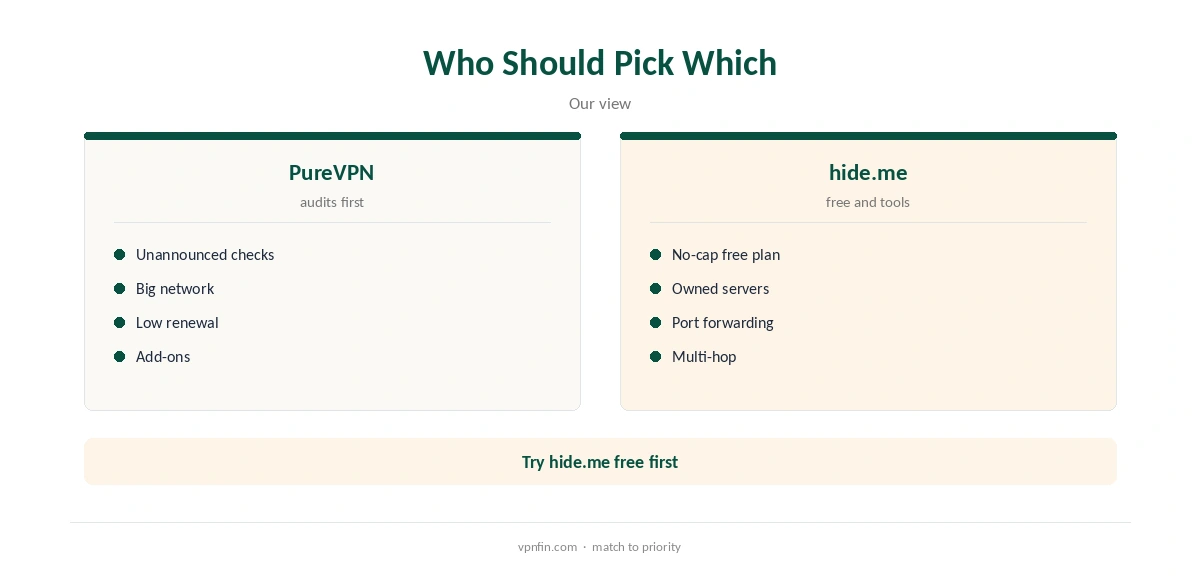
PureVPN for always-on audits; hide.me for its free plan and built-in tools.
Yes, with no data cap since May 2026, one device and reduced speed.
No; it offers a $0.99 seven-day trial.
Hide.me includes it; PureVPN sells it as an add-on.
PureVPN up front; renewals are close.
The Verdict
PureVPN vs hideme: PureVPN for unannounced KPMG audits and a big network; hide.me for a no-cap free plan, owned servers and port forwarding included.