
Disclosure: VPNFin is reader-supported. If you buy a VPN through links on this page, we may earn a commission at no extra cost to you. This never affects our ratings — here’s our full disclosure.
TunnelBear vs PrivateVPN pairs a VPN that proves its privacy every year with one that hands you the tools torrent users ask for. TunnelBear, owned by McAfee and based in Toronto, has had the security firm Cure53 audit it annually since 2017, allows unlimited devices and has a 2 GB monthly free plan. PrivateVPN, from Sweden, has no audit but includes port forwarding, SOCKS5 and free dynamic dedicated IPs.
This guide compares evidence, torrenting, devices, price, streaming and fit.
Proof or Tools
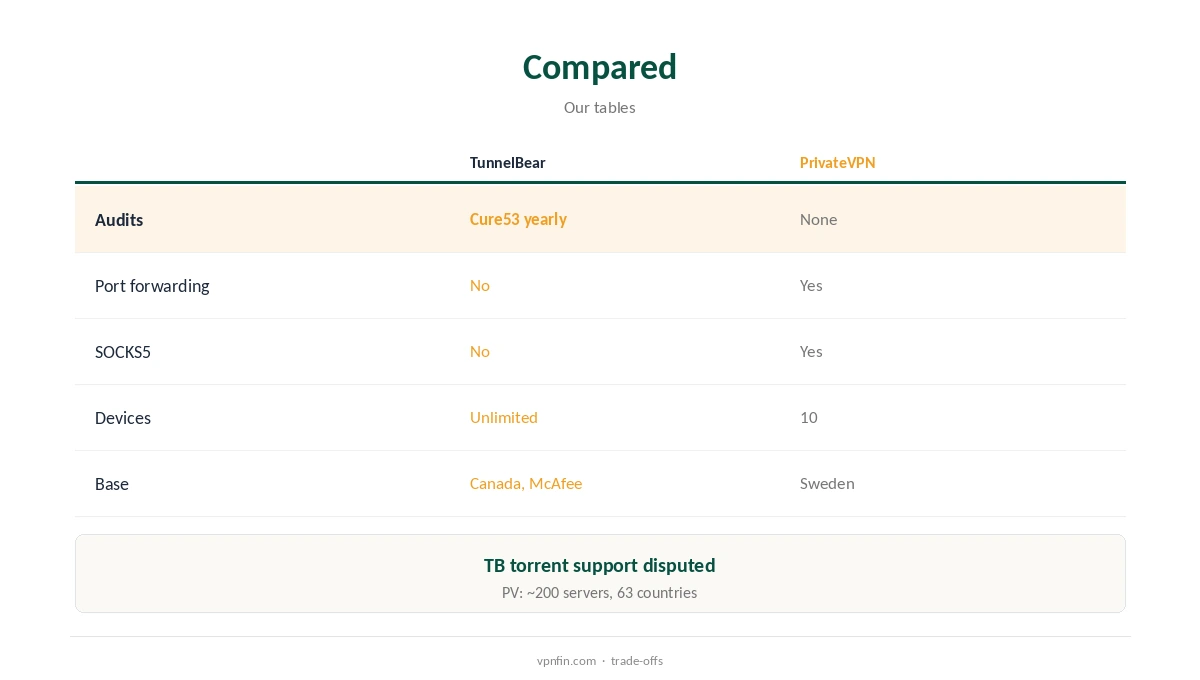
TunnelBear’s eight Cure53 audits by 2024 check its apps and systems again and again. PrivateVPN’s appeal is more practical: open ports, a proxy and a fixed IP address, but no outside check of its no-logs claim, and its servers use disks.
Decide which you value more before comparing prices. Our VPN audit tracker explains what repeat audits show.
TunnelBear vs PrivateVPN for Torrenting, and Devices
PrivateVPN’s port forwarding and SOCKS5 make it the stronger torrent pick. TunnelBear has neither, and testers disagree on its P2P support: Gizmodo completed a torrent, while VPNOverview listed P2P as not allowed.
Our TunnelBear torrenting guide sets out the disagreement.
TunnelBear allows unlimited devices on paid plans; PrivateVPN allows 10. A large household fits on TunnelBear without counting.
TunnelBear does not officially support routers, so its unlimited limit matters more.
Price, Refunds and Free Use
TunnelBear costs about $3.33 a month on three years, roughly $120, and refunds only the first year of a yearly plan bought on its site within 30 days. PrivateVPN costs around $2 a month on three years with a 30-day refund.
PrivateVPN is cheaper overall and has the broader, simpler refund policy.
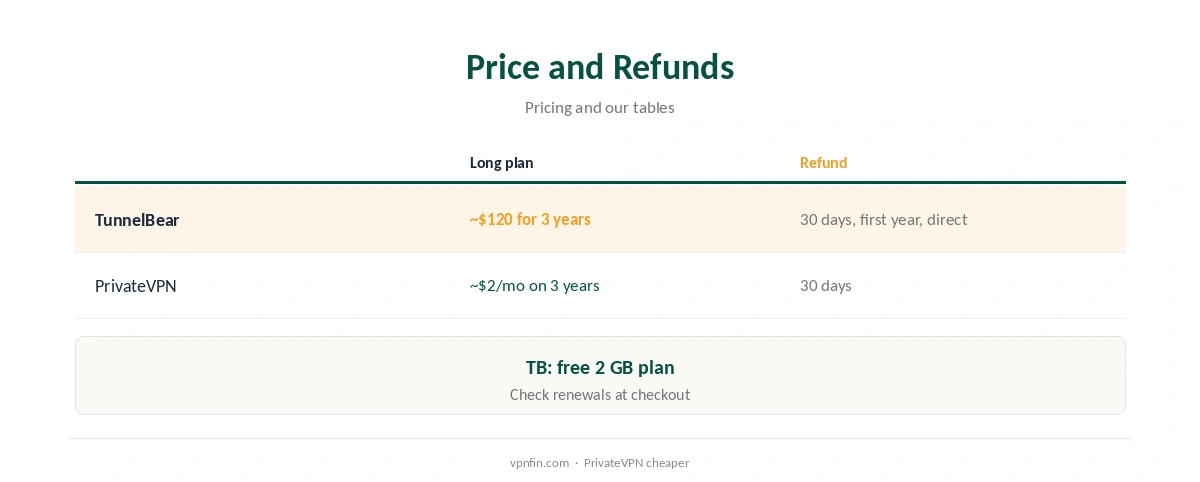
TunnelBear’s free plan gives 2 GB a month, and since early 2026 assigns your server automatically, TheBestVPN reports. PrivateVPN has no free plan.
Beginners can try TunnelBear at no cost, with no card required.
Streaming and Jurisdiction
Testers disagree on TunnelBear: Top10VPN found US Netflix and Disney+ working on paid plans, Cloudwards found most services blocked. PrivateVPN’s 63 countries give fewer options to try when a streaming service blocks one of its servers.
Test your own streaming services within each refund window first.
TunnelBear is in Canada and PrivateVPN in Sweden, both members of intelligence-sharing groups. Sweden’s data retention law does not apply to VPNs in its current form, a 2026 review notes.
Our Five Eyes guide explains the alliances.
Routers, TVs, Extensions and Account Security
TunnelBear has no TV apps and does not officially support routers, so televisions and consoles are hard to cover. Check PrivateVPN’s router guides for your model; a router running a VPN covers everything behind it as one device.
For living-room devices, a router is the route on either, and only PrivateVPN may support one.
TunnelBear’s Chrome extension protects browser traffic in 20 countries, its store listing says, and the service added two-factor sign-in in January 2025, Tom’s Guide notes. Check PrivateVPN’s app for its own account protections.
Extensions cover only the browser, so use the full desktop app for torrents and games.
Who Each Is For
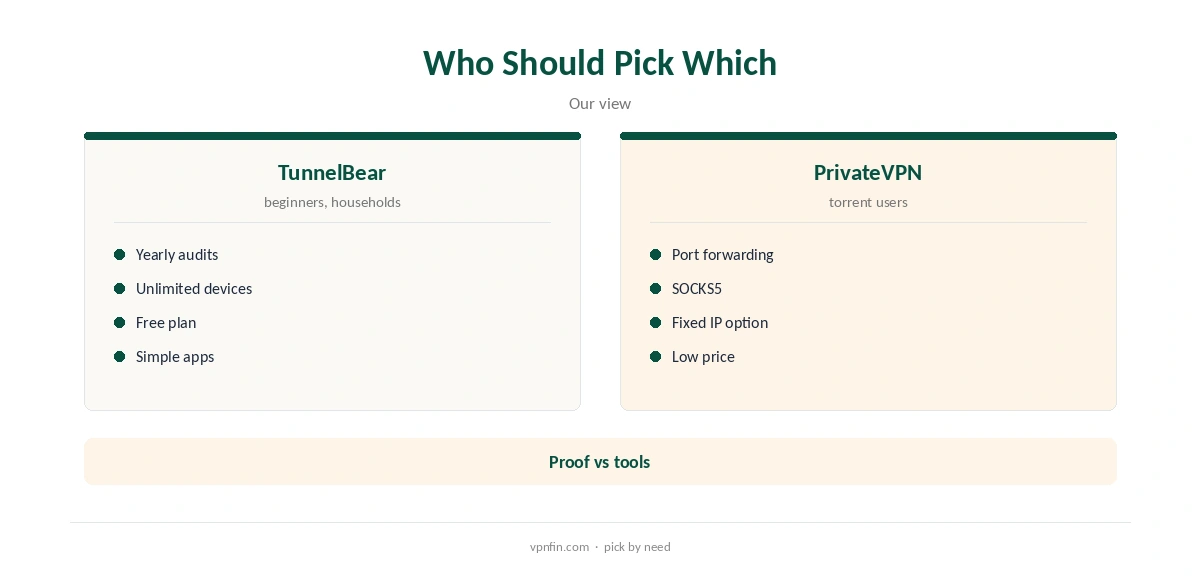
Beginners, families with many devices and anyone who wants yearly, outside proof of privacy fit TunnelBear. Torrent users who want open ports, a proxy and a fixed address at a low price fit PrivateVPN, accepting the lack of an audit.
Try TunnelBear free first if you are still unsure which suits you.
Censored Networks, Paying and Teams
TunnelBear’s GhostBear mode disguises its traffic, and it has offered free users in censored countries extra data, up to about 10 GB a month, our tables record. PrivateVPN offers a Stealth mode on Windows, macOS, iOS and Android, a 2026 review notes.
Both target filtered networks; test either from the network you will use.
TunnelBear takes cards on its website, with Google Pay and Apple Pay only through the app stores, Tom’s Guide notes, and sells a Teams plan from $5.75 per user a month. Check PrivateVPN’s payment options at its checkout.
TunnelBear’s Teams plan gives small businesses a separate, managed option.
Disk Servers and What They Mean
PrivateVPN runs its servers from disk rather than memory, our tables record. Disk servers can keep data unless configured not to, so an audit matters more for them, and PrivateVPN has none in our table.
TunnelBear’s yearly audits check how its systems actually handle user data in practice.
Two Ways to Test
TunnelBear lets you test for free on its 2 GB plan, then refunds the first year of a yearly plan bought on its site within 30 days. PrivateVPN has no free plan but refunds within 30 days, so you can test port forwarding and SOCKS5 with your own torrent client.
Whichever you try, run a DNS leak test and check that your kill switch stops traffic when you switch Wi-Fi off and on while connected.
How We Research
This page draws on TunnelBear’s terms, TheBestVPN’s, Gizmodo’s, Top10VPN’s and Cloudwards’ TunnelBear coverage and our PrivateVPN, audit and price tables. We cross-checked these sources against each other, and where they conflict or something can’t be verified, we say so in the text rather than guessing. We checked time-sensitive figures, including prices in US dollars, on 8 October 2026. The main source we relied on is TunnelBear’s terms of service. Our full approach lives on the About Us page.
TunnelBear vs PrivateVPN FAQ
TunnelBear for audits and devices; PrivateVPN for torrent tools.
Not in our table; TunnelBear has yearly Cure53 audits.
PrivateVPN, with port forwarding and SOCKS5.
Yes, 2 GB a month.
TunnelBear, with no limit.
The Verdict
TunnelBear vs PrivateVPN: TunnelBear for audited, simple privacy and many devices; PrivateVPN for cheap torrent tools.