
Disclosure: VPNFin is reader-supported. If you buy a VPN through links on this page, we may earn a commission at no extra cost to you. This never affects our ratings — here’s our full disclosure.
TunnelBear vs TorGuard is a comparison between the easiest VPN to start with and one of the most configurable. TunnelBear, owned by McAfee since 2018 and based in Toronto, has had its apps and infrastructure audited by Cure53 every year since 2017. It allows unlimited devices, offers a free plan of 2 GB a month and costs about $3.33 a month on a three-year plan. TorGuard, from VPNetworks LLC in Florida, has no audit but offers port forwarding, Stealth proxies, dedicated IPs and router apps. Under a 2022 settlement, it blocks BitTorrent on its US servers.
This guide compares ease, evidence, torrenting, censorship, price and fit.
Ease or Configuration
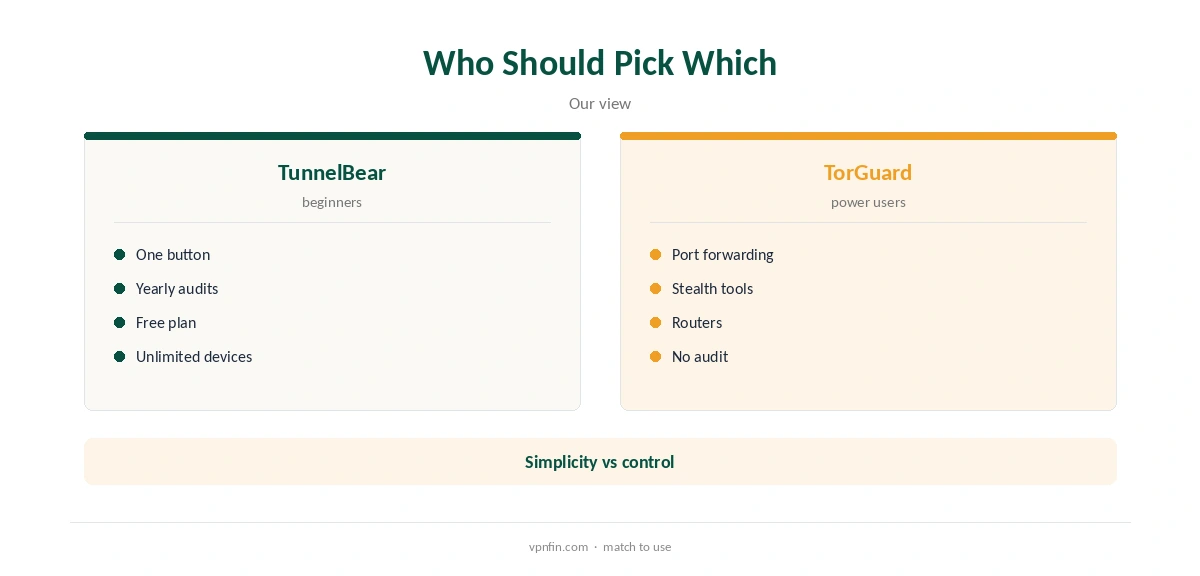
TunnelBear is built for people who want to press one button: its apps hide most settings, and its free plan lets beginners try a VPN without paying. TorGuard expects you to choose protocols, ports and proxies, and rewards that effort with more control.
Pick by how much you want to tinker with settings.
TunnelBear vs TorGuard on Evidence
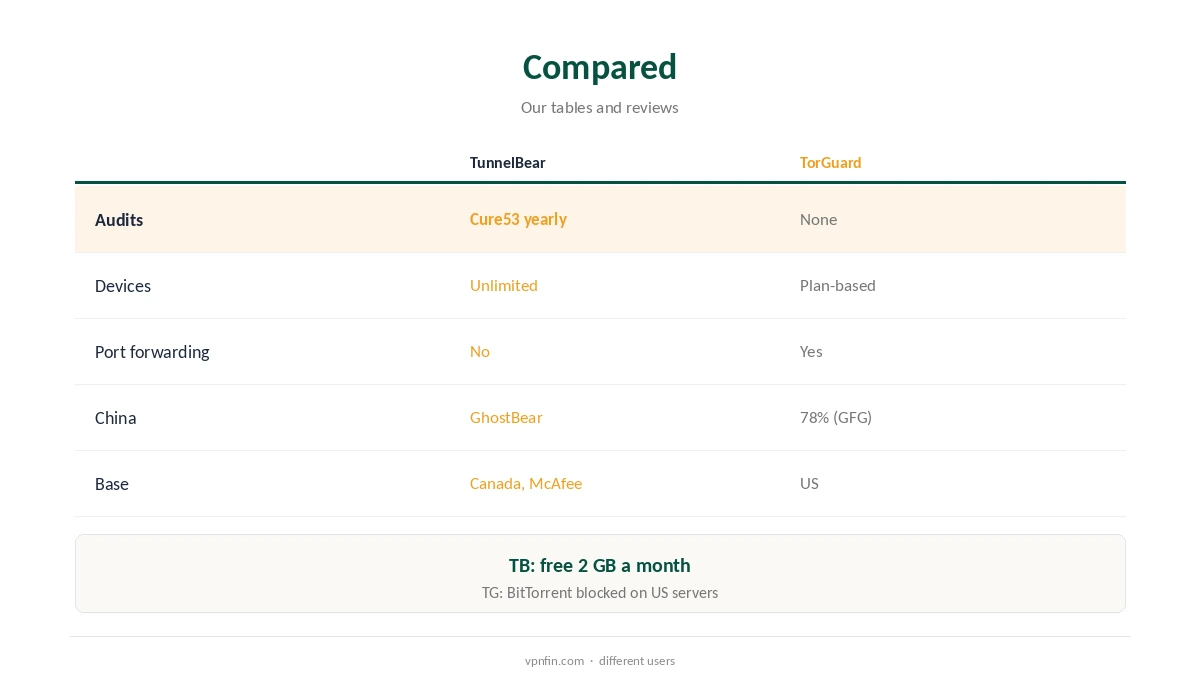
TunnelBear’s yearly Cure53 audits, the eighth in 2024, give its no-logs claim repeated outside checks. TorGuard has no audit in our table and uses closed-source clients.
Both are in Five Eyes countries, Canada and the US. Our VPN audit tracker compares records.
Torrenting
TorGuard offers port forwarding but blocks BitTorrent on US servers, so torrent users connect elsewhere. TunnelBear has no port forwarding or SOCKS5. Testers also disagree on whether its servers allow P2P reliably: Gizmodo completed a torrent through Greece, while VPNOverview reported P2P as not allowed.
For torrenting outside the US, TorGuard has the clearer tools. Our TunnelBear torrenting guide covers the disputes.
Censorship
TunnelBear’s GhostBear mode disguises VPN traffic, and its free plan has offered extra data, up to about 10 GB, to users in censored countries, our tables record. TorGuard’s Stealth VPN and Stealth Proxy rank it second for China at 78% success, GreatFirewallGuide found.
For China specifically, TorGuard has the stronger independent rating of the two.
Price, Refunds, Fixed IPs and Account Security
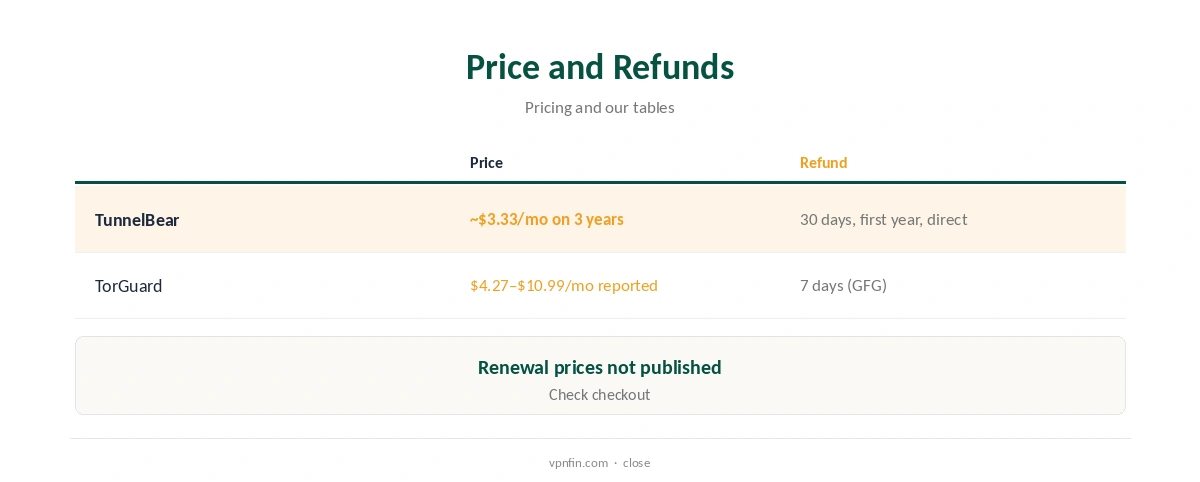
TunnelBear costs about $3.33 a month on three years, $9.99 monthly, and refunds only the first year of a yearly plan bought directly within 30 days. Reviewers report TorGuard’s standard tier at $4.27 to $10.99 a month, with a seven-day refund in GreatFirewallGuide’s listing.
Neither publishes a clear renewal price in our sources; check the figure at checkout.
Devices, Platforms and Free Use
TunnelBear allows unlimited devices but has no official router support or TV apps. TorGuard offers an OpenWrt router app and apps for Windows, Mac and Linux.
For TVs and consoles, TorGuard’s router route works better than TunnelBear’s apps.
TunnelBear’s free plan gives 2 GB a month; since early 2026, free users cannot choose a server, and split tunnelling is paid-only, TheBestVPN reports. TorGuard has no free plan.
Beginners can try TunnelBear at no cost before deciding.
Browser Extensions and Streaming
TunnelBear’s Chrome extension covers browser traffic only, in 20 countries, its store listing says, with extensions for Firefox and Edge too. TorGuard focuses on full apps and proxies rather than browser extensions in our sources.
Use the full app on either for anything beyond browsing, such as torrents or games.
Testers disagree on TunnelBear: Top10VPN found US Netflix and Disney+ working on paid plans, while Cloudwards found most major services blocked. TorGuard keeps streaming servers for a higher tier.
Test any streaming service you rely on within the refund window.
TorGuard sells dedicated IPs, useful for whitelisting or fewer CAPTCHAs; TunnelBear offers none in our sources. TunnelBear added two-factor sign-in in January 2025, Tom’s Guide notes.
Turn on two-factor sign-in wherever a VPN service offers it.
Ownership and Linux
McAfee has owned TunnelBear since March 2018. TorGuard is run by VPNetworks LLC in Orlando and sued NordVPN in 2019 over alleged attacks, a case dismissed on jurisdiction without a ruling on the merits.
Our VPN ownership guide covers why owners matter.
TorGuard offers a Linux app with WireGuard and OpenVPN guides for Ubuntu and similar systems, its downloads and support pages show. TunnelBear’s browser extension is the simplest way to use it on Linux.
For a full Linux setup, TorGuard covers more.
Matching Each to a Situation
A student on campus Wi-Fi who wants something simple and audited fits TunnelBear’s free plan. A torrent user wanting open ports fits TorGuard on non-US servers, and a traveller to China fits TorGuard’s Stealth Proxy.
Match the service to the job you need done rather than to its brand.
TunnelBear’s Refund Fine Print
TunnelBear’s 30-day guarantee covers only the first year of a yearly plan bought on its own site. Monthly plans, Teams and purchases through the App Store or Google Play fall outside it, and it does not promise partial refunds, its terms say.
Buy directly on the website if you might want your money back.
How We Research
This page draws on TunnelBear’s terms, Tom’s Guide’s, TheBestVPN’s and Gizmodo’s TunnelBear coverage, GreatFirewallGuide’s TorGuard review and our TorGuard tables. We cross-checked these sources against each other, and where they conflict or something can’t be verified, we say so in the text rather than guessing. We checked time-sensitive figures, including prices in US dollars, on 8 October 2026. The main source we relied on is TunnelBear’s terms of service. Our full approach lives on the About Us page.
TunnelBear vs TorGuard FAQ
TunnelBear for beginners and audits; TorGuard for power users and China.
No; TunnelBear has yearly Cure53 audits.
TorGuard outside the US, with port forwarding.
Yes, 2 GB a month.
TunnelBear, with no limit.
The Verdict
TunnelBear vs TorGuard: TunnelBear for an audited, one-button VPN with a free start; TorGuard for configuration, torrenting outside the US and China.