
Disclosure: VPNFin is reader-supported. If you buy a VPN through links on this page, we may earn a commission at no extra cost to you. This never affects our ratings — here’s our full disclosure.
PureVPN vs TorGuard is a contest between a budget service with audits and a toolbox for advanced users. PureVPN, based in the British Virgin Islands and operated from Pakistan, has four KPMG audits in our table, allows 10 devices and renews at $47.95 a year. TorGuard operates from Florida, has no independent audit in our table, and blocks BitTorrent on its US servers after a 2022 settlement with film studios. It offers port forwarding, a SOCKS5 proxy, dedicated IPs and Stealth modes; GreatFirewallGuide ranked it second for China in 2026. Its refund window is seven days, against PureVPN’s 31.
This guide compares them on privacy, torrenting, price and fit.
PureVPN vs TorGuard on Privacy
PureVPN’s four KPMG audits give outside evidence; TorGuard has none. Our VPN audit tracker explains what each audit covers. Top10VPN reported in 2024 that Kaspersky’s VPN used PureVPN’s infrastructure under its own brand, a sign of how widely PureVPN’s network is used.
Torrenting
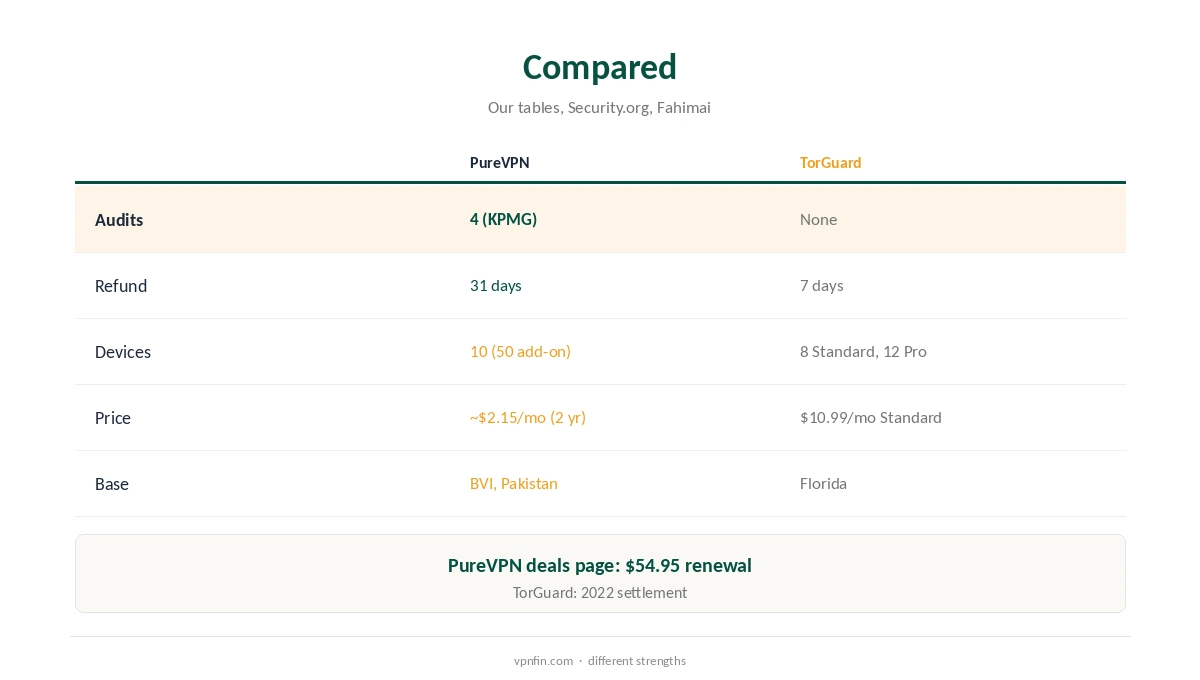
TorGuard offers port forwarding, a SOCKS5 proxy and dedicated IPs, but not on US servers for BitTorrent. PureVPN offers a SOCKS5 proxy as well, as our PureVPN SOCKS5 guide explains, and allows P2P on dedicated servers.
Price and Refunds
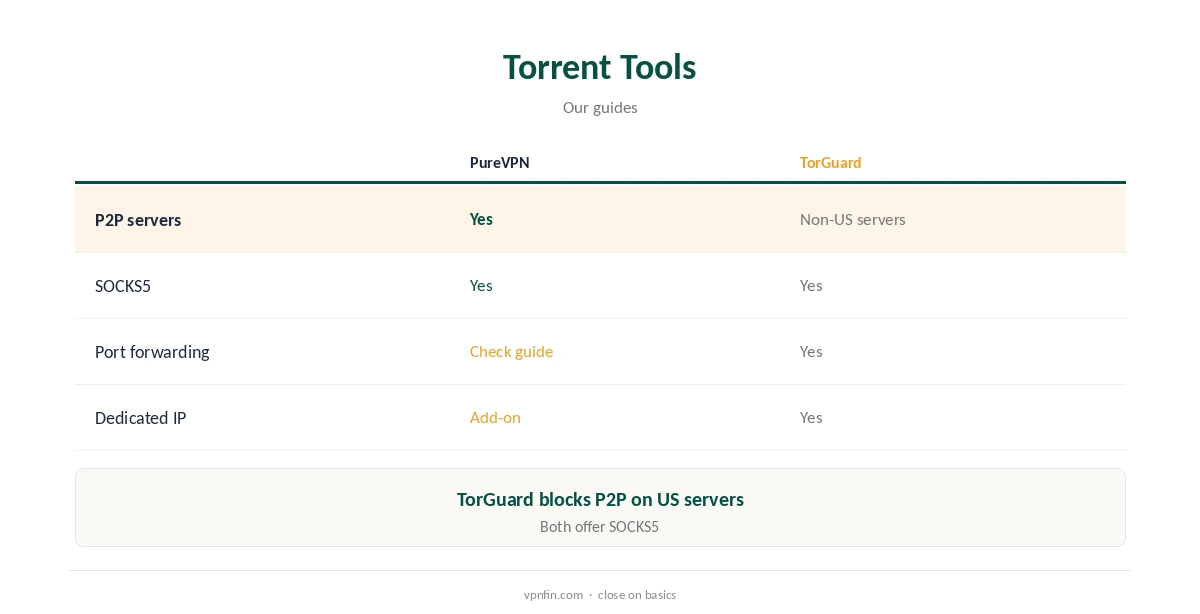
PureVPN costs about $2.15 a month on two years, around $52 up front, and renews at $47.95 a year on its order page; its deals page lists $54.95. TorGuard Standard costs $10.99 a month, Security.org lists. PureVPN refunds within 31 days; TorGuard within seven, case by case. Our PureVPN price guide covers the grids.
Devices
PureVPN allows 10 devices, up to 50 with a paid add-on. TorGuard Standard allows up to eight and Pro 12, Fahimai notes.
Ownership
PureVPN operates from Pakistan under a company registered in the British Virgin Islands. TorGuard is run by VPNetworks LLC in Florida, Tom’s Guide notes. Our VPN ownership guide explains why that matters.
Dedicated IPs
TorGuard’s Pro and Premium plans include a free dedicated IP, Security.org notes, and Standard users can rent one. PureVPN sells dedicated IPs as an add-on. Either helps with banking and allowlisted logins.
Value Over Two Years
PureVPN costs about $52 for two years in our table. TorGuard Standard at $10.99 a month costs far more over the same period unless you pick a longer term; our TorGuard cost guide lists its yearly prices.
Kill Switch Defaults
TorGuard’s kill switch starts off on desktop. PureVPN’s apps include a kill switch too; test either by switching Wi-Fi off and on while connected.
Linux and Raspberry Pi
TorGuard publishes OpenVPN guides for Ubuntu and Raspberry Pi, as our TorGuard Raspberry Pi guide explains. Check PureVPN’s Linux support pages before relying on them for a server.
Is PureVPN vs TorGuard a Close Call?
For most buyers, no: PureVPN’s audits, longer refund and low renewal make it the safer budget pick. TorGuard’s case rests on dedicated IPs, Stealth and router tools for advanced users.
Support
TorGuard lists 24/7 support. Check PureVPN’s support options during its 31-day window, ideally with a question about your own router or TV.
Families
Households with many devices fit PureVPN’s 10, or up to 50 with the add-on. Home networks with a seedbox or many TVs suit TorGuard’s router options.
Keeping It Updated
After app updates, recheck the kill switch and protocol, since updates can reset them.
Quick Rule
Audits and a low bill: PureVPN. Dedicated IPs, Stealth and router tools: TorGuard.
Strict Networks
TorGuard’s Stealth modes ranked second for China in GreatFirewallGuide’s 2026 testing. Our China VPN guide compares options for restrictive countries.
Apps and Ease of Use
Tom’s Guide and Cloudwards describe TorGuard’s apps as glitchy, and its kill switch starts off on desktop. PureVPN’s apps include streaming shortcuts and split tunnelling on Fire TV and Android TV, its release notes say.
Streaming
TorGuard needs Pro or Premium with a streaming IP for Netflix, as our TorGuard Netflix guide explains. PureVPN offers streaming-optimised servers in its apps.
Routers
TorGuard’s OpenWrt app and pre-flashed routers suit home networks with many devices. Our router setup guide explains the trade-offs for any provider.
Testing Both
PureVPN’s 31-day refund and seven-day paid trial give time to test. TorGuard’s seven-day refund is short, so test its Stealth and streaming IP on day one. Our TorGuard refund guide explains the rules.
Speed
Both run WireGuard in their apps. Test at your usual streaming or download time, since results vary by route and load.
Several Devices
PureVPN’s 10 devices, extendable to 50, suit large homes. TorGuard’s eight on Standard and 12 on Pro cover most families.
Quick Check
After installing either, run our DNS leak guide and turn on the kill switch; TorGuard’s starts off on desktop.
Who Should Pick Which
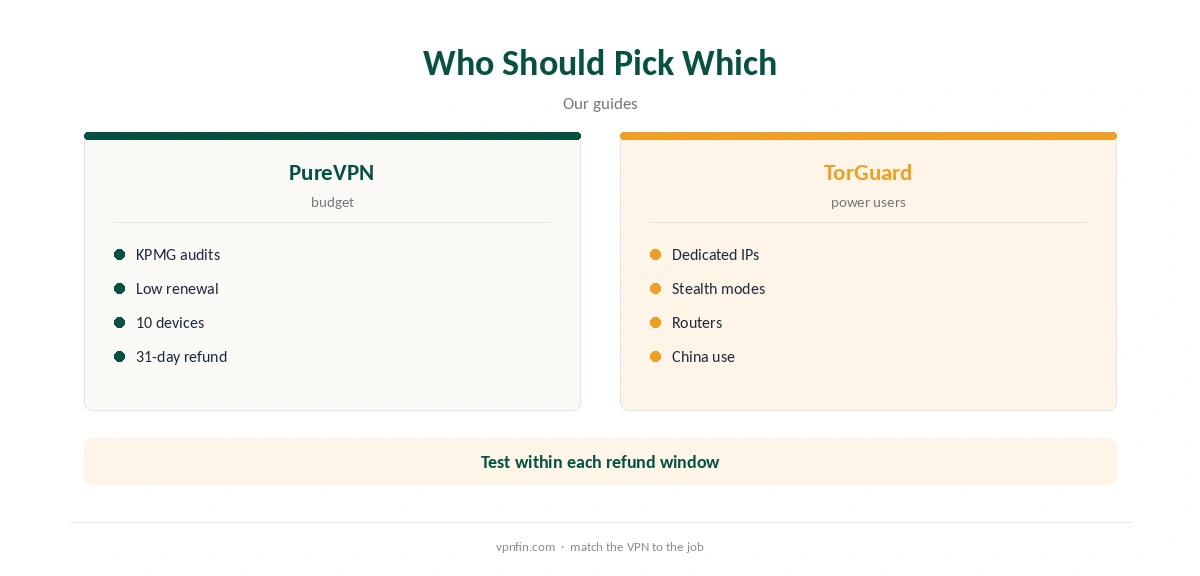
Pick PureVPN for audits, a low renewal and many devices. Pick TorGuard for dedicated IPs, Stealth and router tools. Our TorGuard alternatives guide lists other options.
How We Research
This page draws on our audit, price, refund and device tables, Security.org’s and Fahimai’s TorGuard coverage, GreatFirewallGuide, Top10VPN’s Kaspersky review and our PureVPN and TorGuard guides. We cross-checked these sources against each other, and where they conflict or something can’t be verified, we say so in the text rather than guessing. We checked time-sensitive figures, including prices in US dollars, on 8 October 2026. The main source we relied on is Security.org’s TorGuard guide. Our full approach lives on the About Us page.
PureVPN vs TorGuard FAQ
PureVPN for audits and price; TorGuard for power-user tools.
KPMG audited PureVPN four times; TorGuard has none in our table.
PureVPN, about $2.15 a month on two years.
The 31-day window belongs to PureVPN; TorGuard gives seven.
TorGuard ranked second for China in GreatFirewallGuide’s 2026 testing.
The Verdict
PureVPN vs TorGuard: PureVPN for audited, low-cost protection on many devices; TorGuard for dedicated IPs and strict networks.