
Disclosure: VPNFin is reader-supported. If you buy a VPN through links on this page, we may earn a commission at no extra cost to you. This never affects our ratings — here’s our full disclosure.
PureVPN vs Astrill compares a budget VPN that rebuilt trust through audits with a premium service built for restrictive networks. PureVPN, run by GZ Systems in the British Virgin Islands, reportedly handed logs to the FBI in 2017 despite a no-logs promise, then signed up to KPMG’s always-on audits; its fourth audit by 2024 found no logging of source or assigned VPN IPs. Astrill, run by Astrill Systems Corp. since 2009, has no independent audit, and reviewers place it in either the Seychelles or Liechtenstein. It costs $30 a month, $180 a year or $300 for two years, and is best known for working in China.
This guide compares them on privacy, China, price, devices, features and fit.
PureVPN vs Astrill on Privacy
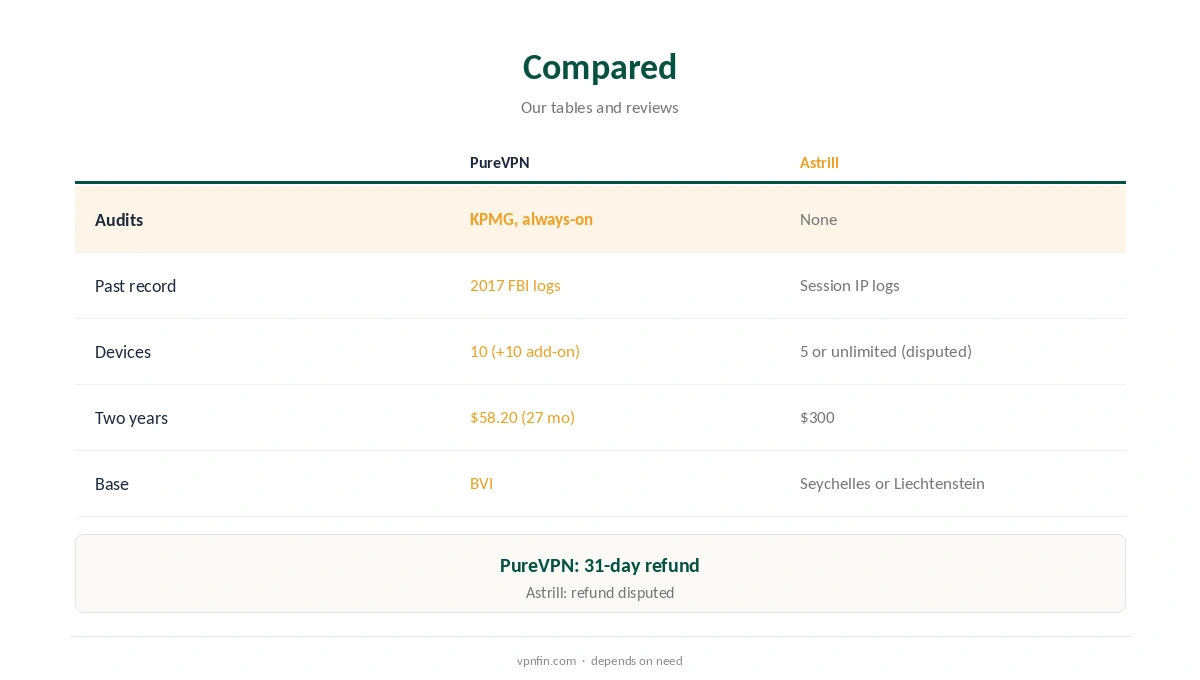
PureVPN’s record has a black mark from 2017 and several KPMG audits since, including unannounced always-on checks, our tables record. Astrill has no independent audit and keeps your IP address and connection time during a session, VPN.com reports, deleting them afterwards by its own account.
On present evidence, PureVPN’s audits give it the edge. Our VPN audit tracker explains what they cover.
China and Restrictive Networks
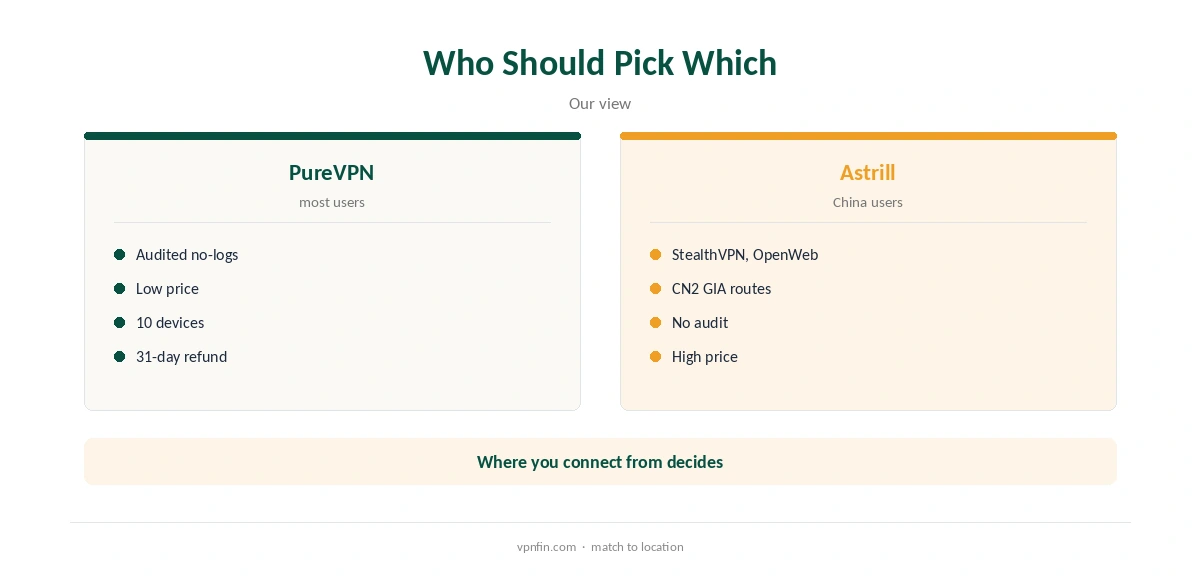
Astrill is the specialist here: GreatFirewallGuide rates its bypass confidence at 98% on China Telecom’s CN2 GIA network, using StealthVPN and OpenWeb. The sources we read do not present PureVPN as a China tool.
If you live in or travel to China, Astrill is the stronger choice despite its cost. Our China VPN guide covers alternatives.
Price Over Two Years
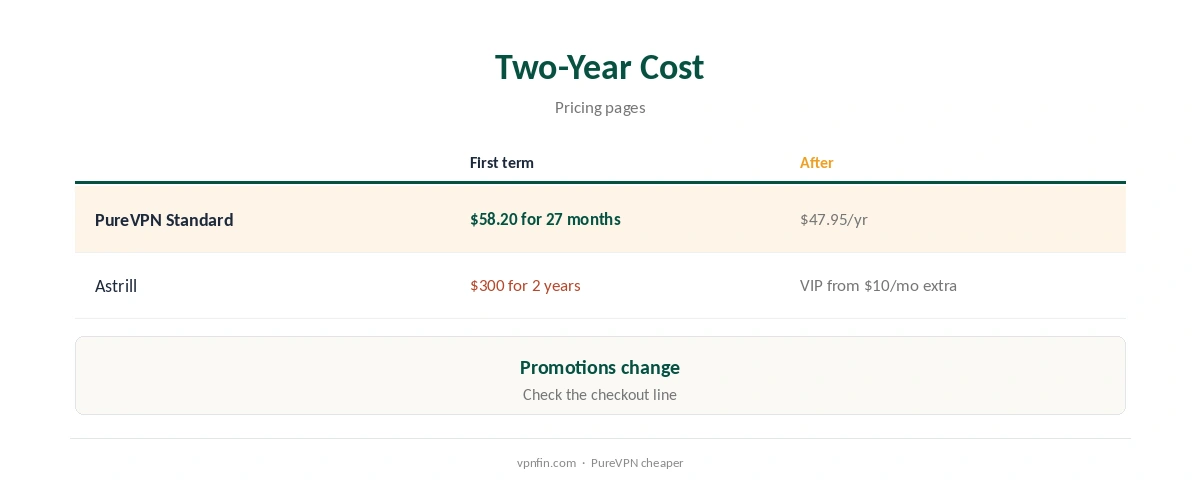
PureVPN’s Standard plan costs $58.20 for 27 months, then $47.95 a year. Astrill costs $300 for two years, more with its VIP add-on. PureVPN is roughly five times cheaper over two years.
PureVPN’s higher tiers add a password manager and, on Max, data removal and an eSIM allowance.
Refunds and Devices
PureVPN offers 31 days on new purchases, but not on renewals or app-store and some crypto payments, its refund policy says. Reviewers disagree on Astrill’s refunds: several report none, others seven days.
That makes PureVPN the safer choice if you want to test first.
PureVPN allows 10 devices, with a multi-login add-on for 10 more. Astrill’s page says unlimited in your household, while reviewers report five at once on the standard plan.
Both support routers, which cover every device behind them as one.
Features and Speed
PureVPN sells port forwarding and a dedicated IP as add-ons. Astrill includes port forwarding with StealthVPN, App Guard for chosen apps and VPN Sharing on Windows; its mobile apps have no kill switch, TechRadar notes.
Check which tier includes the features you need before paying for a higher one.
Security.org found Astrill’s latency rose sharply even as download speed held, and VPN.com measured large latency increases on Windows. Test latency-sensitive uses on both.
For streaming and browsing, download speed matters more than latency does.
Ownership, Jurisdiction and Payment
PureVPN is run by GZ Systems in the British Virgin Islands; sources place Astrill Systems Corp. in the Seychelles or Liechtenstein. Neither belongs to the big VPN groups such as Kape or Nord Security.
Our VPN ownership guide explains why that matters.
Trials
PureVPN offers a seven-day trial for $0.99 that turns into a full plan unless you cancel, its trial page says. Astrill’s Android listing describes seven days free without a card and a one-device free plan in Europe and North America.
Cancel PureVPN’s trial before it ends if you do not want the plan, since renewals after a trial are not refundable.
Platforms
PureVPN launched a native Apple TV app and offers Linux apps with a GUI and command line, our tables record. Astrill’s Mac app needs macOS 11 and Apple silicon from the Mac App Store, and it supports DD-WRT, Tomato and Asuswrt-Merlin routers.
Both cover Windows, Mac, iOS and Android with their own apps.
Astrill accepts cards, PayPal, Bitcoin, Monero and bank transfer, with a name and email at sign-up. PureVPN accepts cards and crypto, though crypto payments are not refundable, its money-back page notes.
Pick the payment method with refunds in mind before checkout.
Kill Switch and Leaks
Astrill’s mobile apps have no kill switch, only automatic reconnection, TechRadar notes, and VPN.com mentions one review reporting an IP leak over WireGuard, while PrivacyJournal found none. PureVPN’s apps include a kill switch on its main platforms.
Whichever you choose, run a leak test after setup and again after app updates.
PureVPN’s Tiers
PureVPN sells Standard, Plus and Max tiers: Standard adds a tracker blocker, Plus a password manager, and Max data removal, dark web monitoring and a 3 GB eSIM allowance, its order page lists. Astrill instead sells a VIP add-on with multi-hop and 100 GB of VIP traffic.
Most people only need PureVPN’s Standard tier, which already includes the VPN and tracker blocker.
How We Research
This page draws on PureVPN’s pricing and refund pages, Security.org’s, VPN.com’s, TechRadar’s and GreatFirewallGuide’s Astrill coverage, Astrill’s pricing page and our audit and price tables. We cross-checked these sources against each other, and where they conflict or something can’t be verified, we say so in the text rather than guessing. We checked time-sensitive figures, including prices in US dollars, on 8 October 2026. The main source we relied on is PureVPN’s refund policy. Our full approach lives on the About Us page.
PureVPN vs Astrill FAQ
PureVPN for audits and price; Astrill for China.
No; PureVPN has several KPMG audits.
It reportedly handed logs to the FBI in 2017, before its audits.
PureVPN, at $58.20 for 27 months against $300 for two years.
Astrill, with 98% bypass confidence on CN2 GIA in GreatFirewallGuide’s rating.
The Verdict
PureVPN vs Astrill: PureVPN for audited privacy at a low price; Astrill if China access matters more than cost and audits.