
Disclosure: VPNFin is reader-supported. If you buy a VPN through links on this page, we may earn a commission at no extra cost to you. This never affects our ratings — here’s our full disclosure.
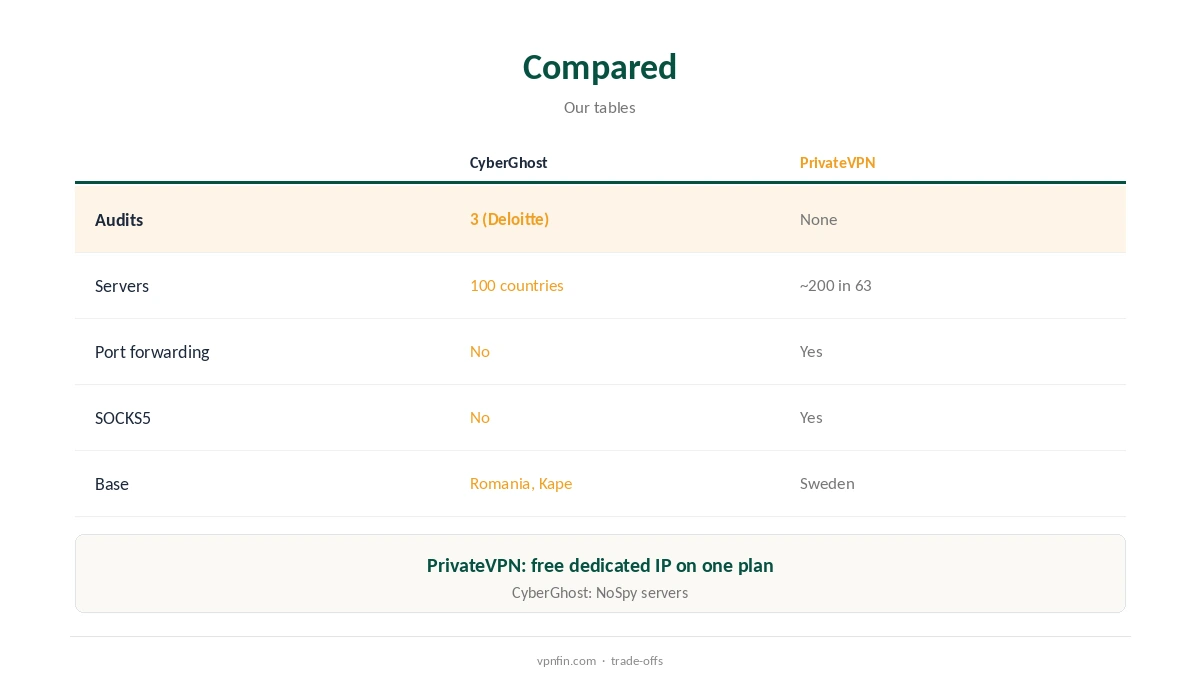
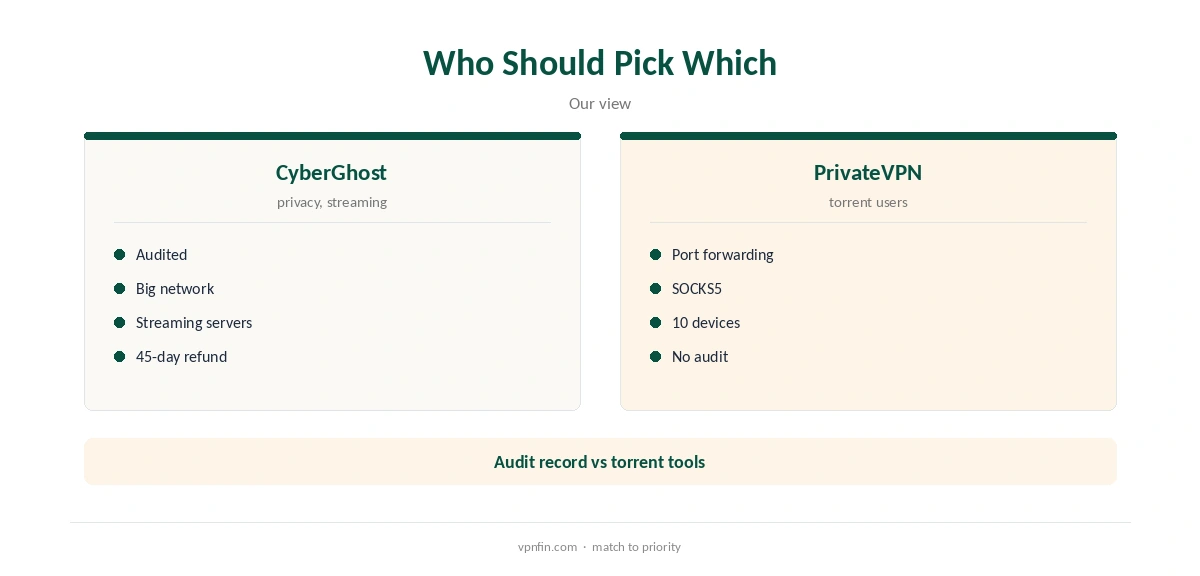
CyberGhost vs PrivateVPN pits a large, audited network against a small Swedish service with tools that torrent users like. CyberGhost, owned by Kape and based in Romania, has three Deloitte no-logs audits in our table, from 2022, 2024 and late 2025. It allows seven devices, renews at $56.94 a year after a 26-month first term, and gives 45 days to ask for a refund on longer plans. PrivateVPN, based in Sweden, has no independent audit in our table, runs about 200 servers in 63 countries on disk rather than memory, allows 10 devices, and includes port forwarding and a SOCKS5 proxy.
This guide compares them on privacy, network, features, price, streaming and fit.
CyberGhost vs PrivateVPN on Privacy and Jurisdiction
CyberGhost’s no-logs claim has three Deloitte audits. PrivateVPN’s has none, and its servers use disks rather than running from memory, our tables record, so its claim rests on trust.
CyberGhost also runs NoSpy servers in its own Romanian data centre, its site says. Our VPN audit tracker compares providers’ records.
Sweden is in the Fourteen Eyes intelligence-sharing group; Romania sits outside the main alliances. Jurisdiction matters less than whether a provider keeps data at all, which is why audits carry more weight in our view.
Our Five Eyes guide explains the alliances.
Network Size and Devices
CyberGhost lists servers in 100 countries; PrivateVPN runs about 200 servers in 63 countries, our tables record. CyberGhost’s bigger network gives more choice of cities and more room when servers get busy.
PrivateVPN’s smaller network can still cover common destinations well for most travellers.
Torrenting Tools and What SOCKS5 Adds
PrivateVPN includes port forwarding and a SOCKS5 proxy, both useful for torrent clients; CyberGhost has neither, though it runs dedicated P2P servers for torrent users. PrivateVPN also includes a free dedicated IP on one of its plans, our tables record.
CyberGhost sells a dedicated IP add-on from $5 a month. Our port forwarding guide explains the benefit.
Price and Refunds
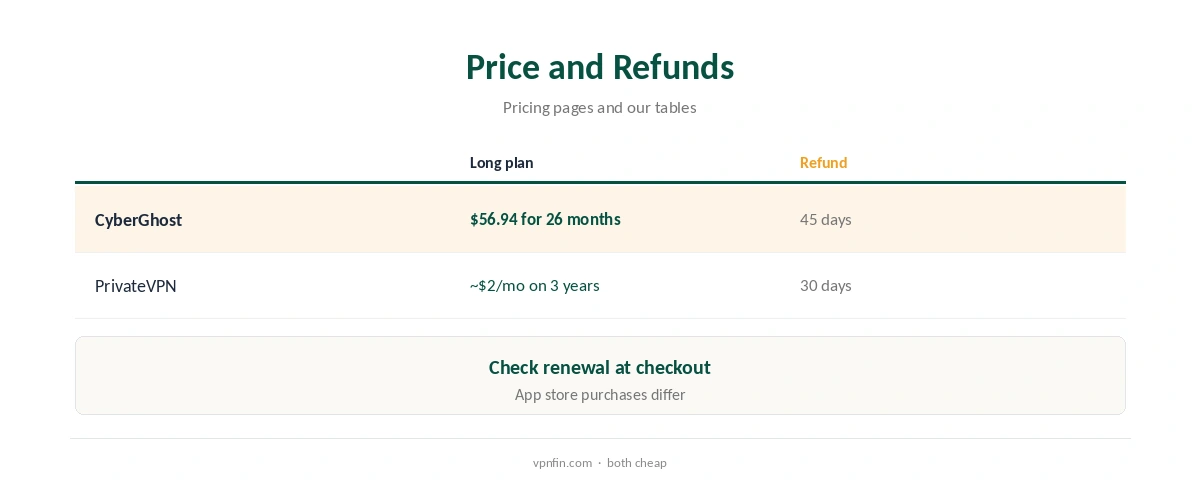
PrivateVPN costs around $2 a month on its three-year plan, with a 30-day refund. CyberGhost costs $56.94 for 26 months, then $56.94 a year, with 45 days to ask for a refund on longer plans.
Both are cheap on long plans; check the renewal terms shown at checkout before paying for several years at once.
PrivateVPN allows 10 devices, CyberGhost seven. Either covers a typical household, and a router running the VPN counts as one device on both.
Larger households have a little more room with PrivateVPN’s ten connections.
Streaming and Ownership
CyberGhost groups servers by streaming service in its apps, which makes it easy to pick one for Netflix or BBC iPlayer, Gizmodo notes. PrivateVPN has a smaller choice of locations for streaming.
Test your own services within each refund window, since streaming blocks change often and without notice.
Kape owns CyberGhost along with ExpressVPN, PIA and review sites including vpnMentor and Wizcase. PrivateVPN is a small Swedish company outside the big VPN groups, with no sister brands.
Our VPN ownership guide covers why that matters.
What Disk-Based Servers Mean
Servers that run from memory lose their stored data at every reboot, which limits what could survive a seizure. Disk-based servers can keep data unless the provider configures them not to, so a no-logs claim on disk servers rests more heavily on audits.
PrivateVPN has disk servers and no audit in our table; CyberGhost has three audits.
Trials and Testing
CyberGhost offers a free trial of 24 hours on Windows and macOS without a card, seven days on iOS and three on Android, its trial page says. PrivateVPN’s 30-day refund on its plans gives a similar window to test.
Try your torrent client, streaming services and usual home and travel networks before the window closes.
Extras and Add-Ons
CyberGhost sells a dedicated IP from $5 a month, as well as a Windows security suite and a password manager, and includes its ID Guard monitoring free, its pricing page lists. PrivateVPN includes a dedicated IP on one of its plans at no extra cost.
If a fixed address is the main need, PrivateVPN’s bundled option saves money every month.
A SOCKS5 proxy routes one app, usually a torrent client, through another address without encryption, so it can be faster than the full VPN. PrivateVPN includes one; CyberGhost does not.
For privacy, the encrypted VPN tunnel remains the safer choice; use the proxy only where raw speed matters more.
Kill Switch and Leaks
CyberGhost includes a kill switch on its main apps; check PrivateVPN’s settings for its equivalent before relying on it. Turn the feature on, then test by switching Wi-Fi off and on while connected, and run a DNS leak test after setup. Our PureVPN vs PrivateVPN comparison sets the two side by side.
Repeat the checks after app updates, which can quietly reset settings such as the protocol.
How We Research
This page draws on CyberGhost’s pricing and refund pages, Gizmodo on CyberGhost and our PrivateVPN, audit and price tables. We cross-checked these sources against each other, and where they conflict or something can’t be verified, we say so in the text rather than guessing. We checked time-sensitive figures, including prices in US dollars, on 8 October 2026. The main source we relied on is CyberGhost’s pricing page. Our full approach lives on the About Us page.
CyberGhost vs PrivateVPN FAQ
CyberGhost for audits and streaming; PrivateVPN for torrent tools.
Not in our table; CyberGhost has three audits.
PrivateVPN, along with SOCKS5.
CyberGhost, in 100 countries against PrivateVPN’s 63.
PrivateVPN, with 10 against seven.
The Verdict
CyberGhost vs PrivateVPN: CyberGhost for audited privacy, a bigger network and streaming; PrivateVPN for port forwarding, SOCKS5 and a free dedicated IP option.