
Disclosure: VPNFin is reader-supported. If you buy a VPN through links on this page, we may earn a commission at no extra cost to you. This never affects our ratings — here’s our full disclosure.
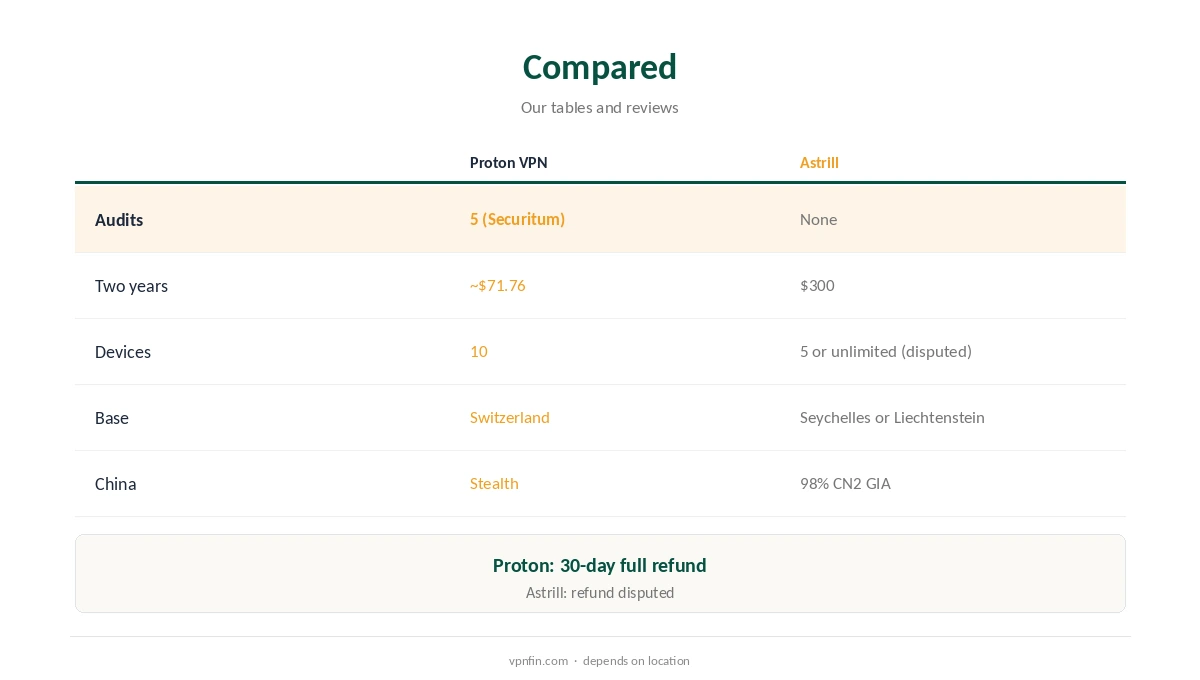
ProtonVPN vs Astrill sets a well-audited Swiss provider with a free plan against a premium service known for China. Proton VPN, from Proton AG in Switzerland, has five annual no-logs audits by Securitum, the latest published in June 2026. It costs about $71.76 for 24 months, then $83.88 a year, for 10 devices, with a full refund within 30 days and a free plan with no data cap. Astrill, an unaudited service from Astrill Systems Corp., charges $300 for two years; reviewers disagree on whether it is based in the Seychelles or Liechtenstein. Astrill keeps your IP address and connection time during a session, VPN.com reports. It says it deletes them once the session ends.
Below we compare privacy, China access, cost, devices, features and who each suits.
ProtonVPN vs Astrill on Privacy
ProtonVPN has five annual Securitum audits and open-source apps. Astrill has no independent audit, and Security.org notes that it logs IP addresses during sessions.
On evidence, Proton is clearly ahead. Our VPN audit tracker explains what audits cover.
ProtonVPN vs Astrill in China
Astrill’s strength is here: GreatFirewallGuide rates its bypass confidence at 98% on China Telecom’s CN2 GIA network, using StealthVPN and OpenWeb. Proton’s Stealth protocol can handle some deep packet inspection, its own support pages say, but it carries no comparable China rating in our sources.
If China is the reason for a VPN, Astrill is the safer bet. Our China VPN guide covers alternatives.
Price Over Two Years
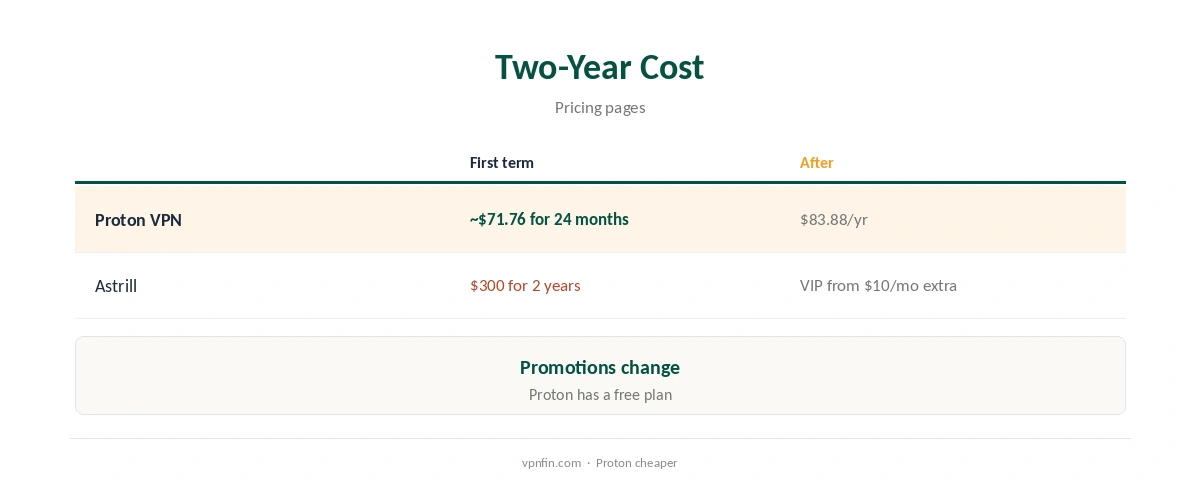
Proton costs about $71.76 for 24 months, then $83.88 a year. Astrill’s two-year plan is $300 before any VIP add-on is counted. Over two years, Astrill costs about four times as much as Proton.
Proton also has a free plan, which Astrill matches only with a one-device free plan in Europe and North America.
Refunds and Trials
Proton refunds in full within 30 days of the first purchase, once per user, its terms say. Reviewers disagree on Astrill: several report no refunds, others seven days, and its Android listing describes seven days free without a card.
Proton is the safer choice if you want to test before committing to a long plan.
Devices and Features
Proton allows 10 devices and adds Secure Core multi-hop, NetShield blocking and port forwarding. Astrill’s page says unlimited devices in your household while reviewers report five, and its desktop apps add App Guard and VPN Sharing; its mobile apps have no kill switch, TechRadar notes.
Proton’s feature set is broader for everyday privacy, while Astrill’s suits restrictive networks best.
Network, Streaming and Speed
Proton lists more than 19,700 servers in 145 countries, Tom’s Guide reported, and supports streaming on paid plans. Astrill covers 50-plus countries and does not market streaming servers.
For Netflix or BBC iPlayer, Proton’s paid plans are the better fit of the two.
Astrill’s downloads held up in Security.org’s tests but its latency climbed sharply, and VPN.com saw the same on Windows. Technerdo found Proton slightly slower than NordVPN on average.
Test latency-sensitive uses such as calls on both within any refund window.
Free Plans Compared
Proton’s free plan has no data cap and picks servers in up to 10 countries at random, for one device, without P2P, Secure Core or NetShield, its plans page and reviews note. Astrill’s Android listing describes a one-device free plan in Europe and North America and seven days free without a card.
Proton’s free plan has the wider reach for most people and no time limit on use.
Platforms, Paying and Signing Up
Proton has apps for Windows, Mac, Linux, iOS, Android, Android TV and Vega OS sticks, plus router guides. On Mac, Astrill’s App Store version requires Apple silicon and macOS 11 or later; for routers it supports DD-WRT, Tomato and Asuswrt-Merlin.
Both cover the main desktop and mobile platforms with their own apps.
Astrill takes card, PayPal, bank transfer and cryptocurrency including Monero, and asks for a name and email when you sign up. Proton’s terms exclude cash and bank transfer payments from refunds.
Choose the payment method with refunds in mind before checkout.
Multi-Hop and Split Tunnelling
Proton’s Secure Core routes paid users through servers in privacy-friendly countries before the exit server. Astrill’s multi-hop sits in its VIP add-on, from $10 a month with 100 GB of VIP traffic, its pricing page says.
Proton includes multi-hop in all its paid plans at no extra cost or data limit.
Astrill’s desktop apps split traffic by app and website, and its Smart Mode sends local traffic outside the tunnel. ProtonVPN’s Windows app has run split tunnelling alongside its kill switch since February 2026, while its iOS app has no split tunnelling.
Check how each handles the platform you use most before deciding between them.
How We Research
This page draws on Proton’s terms and support pages, Tom’s Guide’s and Technerdo’s Proton coverage, Security.org’s, VPN.com’s, TechRadar’s and GreatFirewallGuide’s Astrill coverage and our audit and price tables. We cross-checked these sources against each other, and where they conflict or something can’t be verified, we say so in the text rather than guessing. We checked time-sensitive figures, including prices in US dollars, on 8 October 2026. The main source we relied on is Proton VPN’s plans page. Our full approach lives on the About Us page.
Proton VPN vs Astrill FAQ
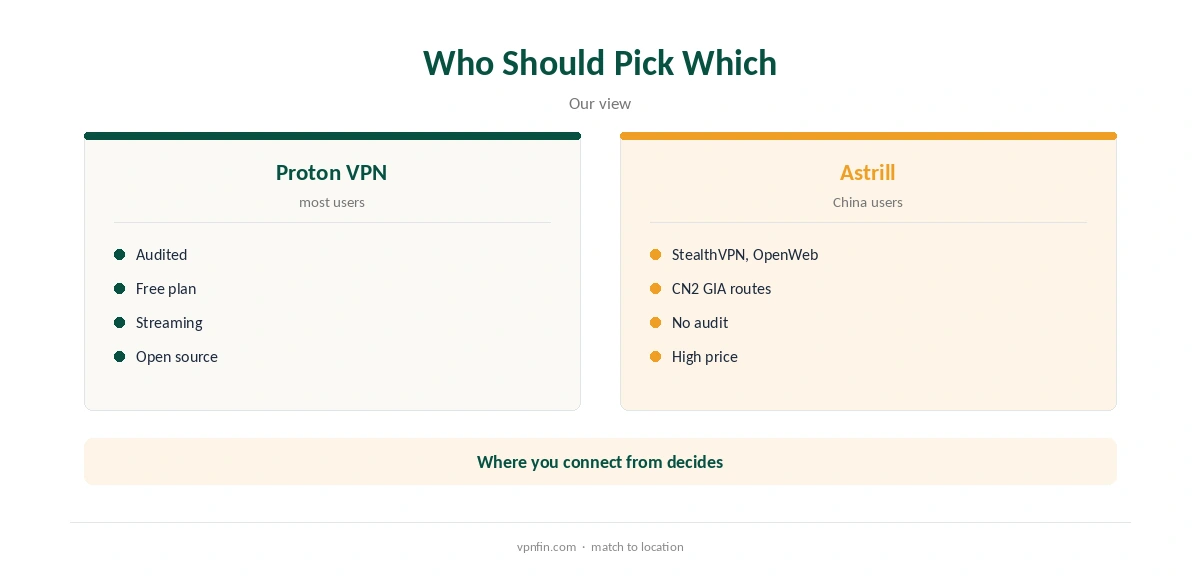
Proton for audits, price and streaming; Astrill for China.
No; Proton has five annual audits.
Astrill, rated 98% on CN2 GIA by GreatFirewallGuide.
Proton, about $71.76 for 24 months against $300 for two years.
Proton does; Astrill has a one-device free plan in Europe and North America.
The Verdict
ProtonVPN vs Astrill: Proton for audited privacy, a free plan and streaming; Astrill only if China access justifies its price and lack of audits.