
Disclosure: VPNFin is reader-supported. If you buy a VPN through links on this page, we may earn a commission at no extra cost to you. This never affects our ratings — here’s our full disclosure.
Proton VPN publishes its no-logs audit reports as open files anyone can download. No account, no NDA, no “available to subscribers.” That has now happened five years running, most recently in 2026.
Then there is the part the marketing does not lead with. Proton built its reputation on Swiss jurisdiction, and in July 2025 the company announced it was moving most of its physical infrastructure out of Switzerland — because of a surveillance ordinance its own CEO compared to Russian law.
This Proton VPN review covers the audit record, what the jurisdiction change actually means for you, the free plan that has no data cap, and a refund policy that two sets of sources describe differently.
Is Proton VPN Worth It in 2026?
Yes, if verifiable privacy is what you are buying. Five consecutive annual no-logs audits by Securitum, all published in full, plus every app open source. VPN Plus runs about $2.99 a month on the two-year plan and renews near $83.88 a year. The catch: independent speed results vary more than for any provider except PureVPN.
Proton VPN at a Glance
Pros
- ✔ Five consecutive no-logs audits, every report published openly without an NDA
- ✔ All apps open source on every platform — the code can be inspected, not just trusted
- ✔ Free plan with no data cap, no ads, and the same no-logs policy as paid
- ✔ Secure Core multi-hop, Tor over VPN, NetShield filtering and port forwarding included
- ✔ 20,000+ servers across 140+ countries on the provider’s own bare-metal hardware
- ✔ SOC 2 Type II attestation completed in July 2025, separate from the no-logs work
Cons
- ✖ The Swiss jurisdiction that anchors the marketing is being actively unwound by Proton itself
- ✖ Speed results range from 8% loss to mid-table depending on which lab you read
- ✖ Renewal rises from roughly $2.99 to about $6.99 a month after the first term
- ✖ Sources disagree on whether the 30-day guarantee returns your full payment
Five Audits, and Every Report Is Public
Most providers treat an audit as a press release. Proton treats it as a file.
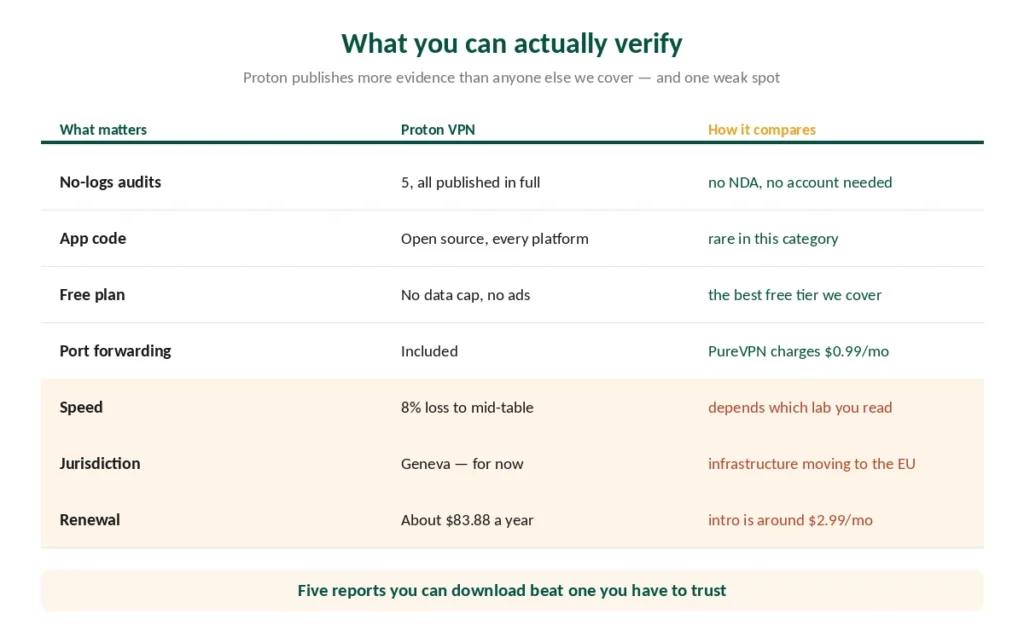
Securitum has audited the no-logs infrastructure five years in a row — 2022, 2023, 2024, 2025 and 2026 — and every report is linked from Proton’s own announcement as a downloadable document. No signup, no paying account, no non-disclosure agreement.
The 2025 engagement ran on site over three days in August. Auditors reviewed live production servers, configuration files, data-flow design and operating procedures, and interviewed engineering staff. The 2026 report concluded that the examined infrastructure did not log browsing activity, DNS queries, destination services or user-identifiable connection metadata.
⚠️ One detail worth more than the count. The audit checks whether an automated alert fires if a logging parameter is switched on. That tests the system against its own staff, not just against a snapshot — a rogue engineer could not quietly enable logging without tripping it. PureVPN goes further still, letting KPMG inspect without any notice at all.
Proton also states its no-logs policy has been tested in over 400 legal cases, where it was ordered to identify users and could not comply. That figure comes from the company’s own transparency reporting rather than court records we can independently count, so treat it as a provider claim with an unusually specific number attached. PIA’s three documented federal subpoenas are verifiable in a way this is not, and reasonable people weigh volume against verifiability differently.
A separate SOC 2 Type II attestation was completed in July 2025, covering operational security controls rather than logging. Mullvad publishes more reports still, though it asks you to give up rather more to get them.
The Swiss Problem
This is the section other reviews skip, and it undercuts the single fact everyone repeats about Proton.
Switzerland is revising its surveillance ordinance, the VÜPF. As drafted, services with as few as 5,000 users would have to identify customers with official documents, retain IP addresses for six months, and be technically capable of handing data over in readable form. Reporting on the draft notes that data retention of this kind is illegal for equivalent providers in Germany.
Proton’s response was to leave, at least physically. On 23 July 2025 the company announced it was moving most of its physical infrastructure out of Switzerland and investing over €100 million in the European Union. Its Lumo AI assistant moved first, to Germany. Founder Andy Yen told Swiss broadcaster RTS that the only country in Europe with a roughly equivalent law is Russia.
⚠️ What this means practically. The ordinance is still in consultation and not yet in force, and Proton AG remains headquartered in Geneva. Nothing has changed for your account today. But “Swiss privacy” is now a claim with an expiry date attached, and the company acting on that is Proton. If jurisdiction is your deciding factor, our legality guide covers how much it actually decides.
Another Swiss provider, PrivadoVPN, has completed its move to Iceland for the same reason. This is a category-wide shift, not a Proton-specific stumble — what the ordinance would require, and where every provider we review actually sits.
Another provider left Switzerland entirely over the same proposal — PrivadoVPN went to Iceland, and only one of the two announced it.
Speed: The Numbers Do Not Agree
Independent results for Proton VPN scatter more widely than for almost any provider, and the scatter is the honest answer.
Security.org measured an 8% download loss and placed Proton first for upload speed in that round. TechRadar recorded 1,475 Mbps locally on WireGuard and 1,548 Mbps on a UK-to-US route, the highest intercontinental figure in its testing. CyberInsider reported roughly 88% speed retention in 2026.
Against that: Salon’s testing recorded 76 to 124 Mbps on nearby servers with ping to Australia exceeding 300 to 500 milliseconds, and rated Proton behind Surfshark and ExpressVPN on the same routes. One aggregator places Proton twelfth of twenty-two across pooled lab results. And in CNET’s testing, NordVPN lost 2.9% against Proton’s 16%.
The likely explanation is baseline, not error. A lab on gigabit fibre measuring percentage retention will flatter any modern WireGuard implementation; a lab on a 100 Mbps line testing long hops will not. Proton’s VPN Accelerator, which the company markets as adding up to 400% on distant routes, plausibly widens that spread further.
What holds across every result: Proton is fast enough for 4K, which needs 15 to 25 Mbps, and is not the provider you choose to win a benchmark. How much speed you actually lose puts these percentages in context.
The Free Plan Is Genuinely Free
Free VPNs usually monetise you instead of charging you. This one does not, and the difference is structural rather than promotional.
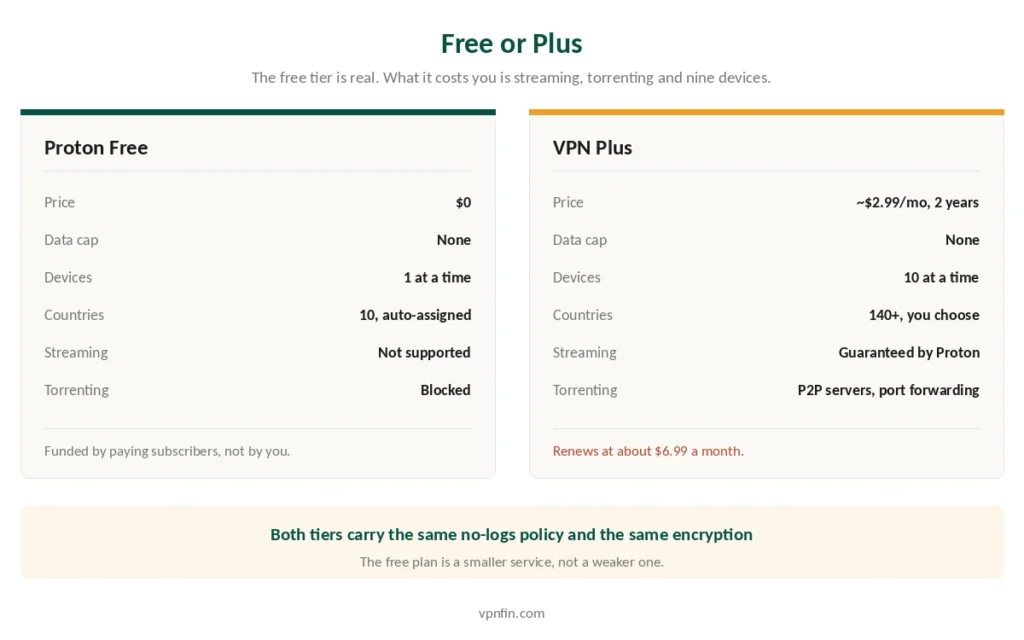
No data cap, no ads, no artificial throttle, and the same no-logs policy and encryption as the paid tier. The free tier is funded by paying subscribers, which is why it can exist without selling anything.
The limits are real: one device at a time, servers in ten countries assigned automatically rather than chosen, medium speed, no streaming servers, no P2P, no NetShield and no Secure Core.
⚠️ Free-tier BitTorrent is blocked at the network level, and the Securitum report notes this as the single exception to Proton’s no-inspection rule — the mechanism that enforces the block is the one place traffic is examined. Proton discloses it; most summaries of the audit do not mention it.
For how this compares against the other free tiers worth using, see our free VPN guide.
Streaming, Torrenting and Features
Streaming works on paid plans. Published testing reports Netflix libraries across ten or more regions, plus Disney+, Prime Video, BBC iPlayer and HBO Max. Proton guarantees Netflix access on Plus and Unlimited but explicitly does not guarantee it on free, where Netflix blocks the shared IP ranges.
Access shifts month to month across the whole category, which is why the refund window matters more than any review’s snapshot — our streaming guide explains the pattern.
Torrenting is allowed on designated servers, and port forwarding is included at no extra charge. Among providers we cover, that puts Proton alongside PIA and Windscribe, and ahead of PureVPN, which sells the same feature as a $0.99 add-on.
Secure Core routes traffic through a hardened server in a privacy-friendly country before it exits, which is Proton’s version of multi-hop — how double VPN actually works covers what it does and does not buy you. Tor over VPN is one click in the app rather than a separate browser. Surfshark has no equivalent, though it beats Proton on device count.
Stealth protocol disguises VPN traffic for restrictive networks. NetShield blocks ads, trackers and malware at DNS level.
⚠️ What is missing: no device-to-device networking equivalent to NordVPN’s Meshnet, and no dedicated IP option for consumers.
Pricing and the Renewal Step
VPN Plus costs around $2.99 a month on the two-year plan, billed upfront at roughly $71.76. The one-year plan runs about $3.99 to $4.99 a month depending on the current promotion, and month-to-month is $9.99.
Renewal is the number to note. After the two-year term, VPN Plus renews at approximately $83.88 a year — about $6.99 a month, roughly double the intro rate. That is milder than NordVPN’s $139.08 and steeper than CyberGhost’s $56.94; the four-year maths for the whole category is here.
Proton Unlimited adds Mail, Drive, Pass and Calendar premium for about $7.99 a month on two years, $9.99 on one year, or $12.99 monthly. If you would otherwise pay for a password manager and encrypted storage separately, the bundle changes the calculation entirely.
⚠️ The refund question has two answers. Proton’s own pricing FAQ states a money-back guarantee on all subscriptions requested within the first 30 days. Several reviewers who have gone through the process report receiving a prorated refund covering only the unused portion, and Proton’s terms do refer to unused-portion refunds. We could not reconcile these, and the difference is real money on a two-year plan. Ask explicitly for a full refund under the 30-day guarantee, and read what support confirms in writing before cancelling. Our free trial guide covers the conditions that decide any VPN refund.
What We Don’t Love
The jurisdiction pitch outruns the facts. Proton’s site still sells Swiss privacy as a headline feature while the company relocates infrastructure away from Switzerland. Both are defensible individually; together they need explaining, and the marketing does not.
Server counts are inconsistent across sources. Proton’s own site says 20,000+ servers in 140+ countries; recent reviews cite 17,200, 18,100 and 20,522 across 120, 129 and 148 countries. We use the official figure and note that the others exist.
Full-disk encryption rather than RAM-only. Proton runs bare-metal servers it owns outright, with disk encryption instead of the diskless architecture NordVPN and PIA advertise. Proton argues ownership beats rented RAM-only hardware. It is a genuine architectural disagreement, not a flaw, but you should know the two are not the same claim. ExpressVPN’s TrustedServer approach was tested by a real seizure in 2017, which neither architecture argument can match.
Refund terms that need a conversation. A guarantee you have to argue for is a weaker guarantee.
How We Research
This review draws on Proton’s official pricing and server documentation, the published Securitum no-logs reports and Proton’s own audit announcement, contemporaneous reporting on the Swiss VÜPF revision from named outlets including The Record, Tom’s Guide and heise, and speed results from named independent testers including Security.org, TechRadar, CyberInsider, Salon and CNET — cross-checked and verified at publication. We don’t run our own speed tests. Where results conflicted, most sharply on speed and refunds, we present both and say what we think explains the gap rather than picking the flattering figure. Our full approach lives on the About Us page.
Proton VPN FAQ
Yes, with real limits rather than hidden costs. There is no data cap, no advertising and no throttle, and the free tier carries the same no-logs policy and encryption as paid. What you give up: one device at a time, servers in ten countries assigned automatically, no streaming servers, no torrenting and no ad blocker. It is funded by paying subscribers.
Proton AG remains headquartered in Geneva, but in July 2025 it announced it was moving most of its physical infrastructure out of Switzerland, citing a proposed surveillance ordinance that would require user identification and six months of IP retention. The rule is not yet in force. Legally nothing has changed for subscribers; strategically, Proton is hedging against it.
Five times, in consecutive years from 2022 through 2026, all by the European security firm Securitum. Every report is published as a downloadable file with no account or NDA required. The audits cover live production servers, configuration files and staff procedures, not just the written privacy policy.
Results vary widely by testing conditions. Security.org measured an 8% download loss and TechRadar recorded over 1,400 Mbps locally, while other labs placed Proton mid-table and CNET measured a 16% loss against NordVPN’s 2.9%. Every result clears the 15 to 25 Mbps that 4K streaming needs.
VPN Plus is the VPN alone at roughly $2.99 a month on two years. Proton Unlimited adds premium Mail, Drive, Pass and Calendar for about $7.99 a month on the same term. If you already pay for a password manager or encrypted storage, Unlimited usually costs less than buying those separately.
Yes on paid plans, using designated P2P servers, and port forwarding is included at no extra charge — useful if you seed on private trackers. The free tier blocks BitTorrent at network level. Proton’s published audit identifies this block as the one exception to its no-inspection policy.
Proton VPN
The Verdict
Five consecutive no-logs audits published in full without an NDA, open-source apps on every platform, and a free tier with no data cap. Speed results vary sharply between labs, and the Swiss jurisdiction Proton is known for is one the company itself is moving away from.
Final Verdict: 4.6/5
The audit record is the reason to buy it. Five consecutive years, every report downloadable without an account, and open-source apps on every platform. No competitor we cover matches that combination on verifiability.
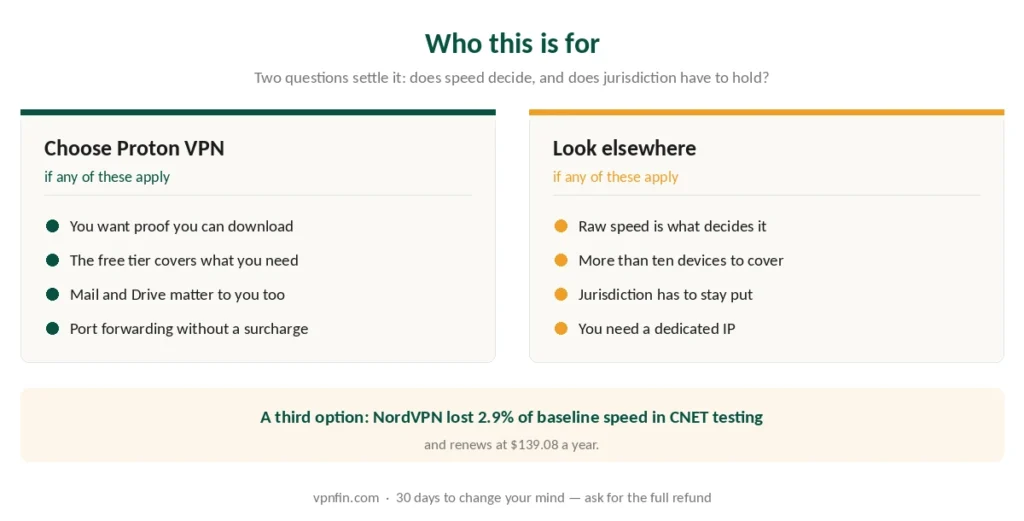
Choose it if you want privacy claims you can check rather than trust, you would use the Mail and Drive bundle anyway, or you want a free tier that does not monetise you.
Skip it if raw speed decides it — NordVPN’s 2.9% loss is the benchmark and Proton does not reach it — or if you need a jurisdiction that will read the same in three years as it does today.