
Disclosure: VPNFin is reader-supported. If you buy a VPN through links on this page, we may earn a commission at no extra cost to you. This never affects our ratings — here’s our full disclosure.
TorGuard vs ZoogVPN compares two ways to get past blocked networks at very different prices. TorGuard, from Florida, offers Stealth protocols and a Stealth proxy, open ports on request and plans for 8, 12 or 30 devices, Security.org notes. ZoogVPN, from Patras, Greece, offers its Shadow protocol, a free plan of 10 GB a month and a two-year plan around $59.99. Neither has an independent no-logs audit in our sources.
This guide compares stealth tools, free use, torrenting, evidence, price, devices and fit.
TorGuard vs ZoogVPN on Stealth
Abroad, these tools can decide whether a VPN connects at all.
At home, you need neither tool.
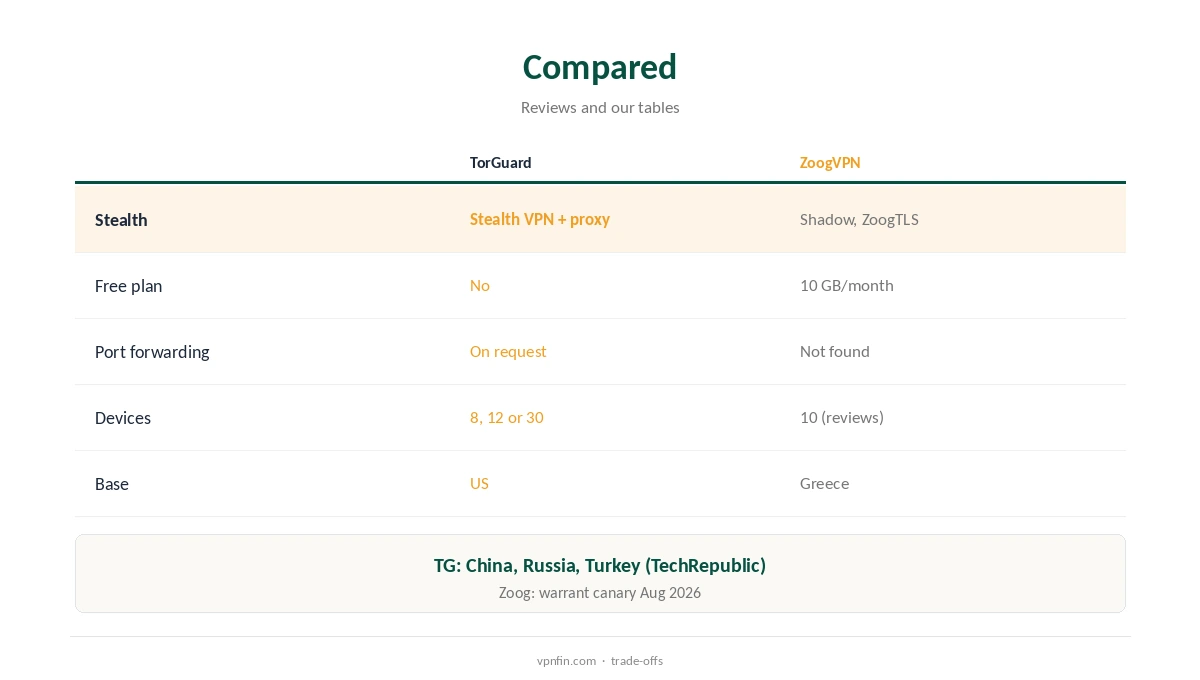
TorGuard’s Stealth options include SSTP, OpenVPN obfuscation and OpenConnect. Paired with its Stealth proxy, they got past firewalls in China, Russia and Turkey in TechRepublic’s test. ZoogVPN’s Shadow and ZoogTLS protocols aim at the same problem, findcheapvpns and listify note.
TorGuard has the more specific test evidence from the hardest networks; ZoogVPN lets you try its tool free.
Free Use
Paid ZoogVPN plans switch to stronger AES-256 encryption.
The allowance resets each month.
Use it to test Shadow on the network you plan to use.
ZoogVPN’s free plan gives 10 GB a month on one device, with ads on Android and AES-128 encryption rather than its paid AES-256. TorGuard has no free plan.
Only ZoogVPN lets you try it without paying.
Torrenting and Home Servers
Bind your client to the VPN and check its IP before downloading.
Secure any service you expose through an open port.
TorGuard lets you request open ports from its dashboard, Security.org notes, though it blocks BitTorrent on its US servers under a 2022 settlement. We found no port forwarding for ZoogVPN in our sources.
For open ports, choose TorGuard on a non-US server.
Evidence
Without an audit, you rely on each company’s word.
A warrant canary is a statement updated regularly to show no secret orders have arrived.
TorGuard has no independent no-logs audit, fahimai notes. ZoogVPN has none either, findcheapvpns found. Its Android app did pass Google Play’s security review, and its warrant canary was current to August 2026.
Our VPN audit tracker lists providers with outside checks.
Price
Introductory prices hide the real cost, so compare renewals too.
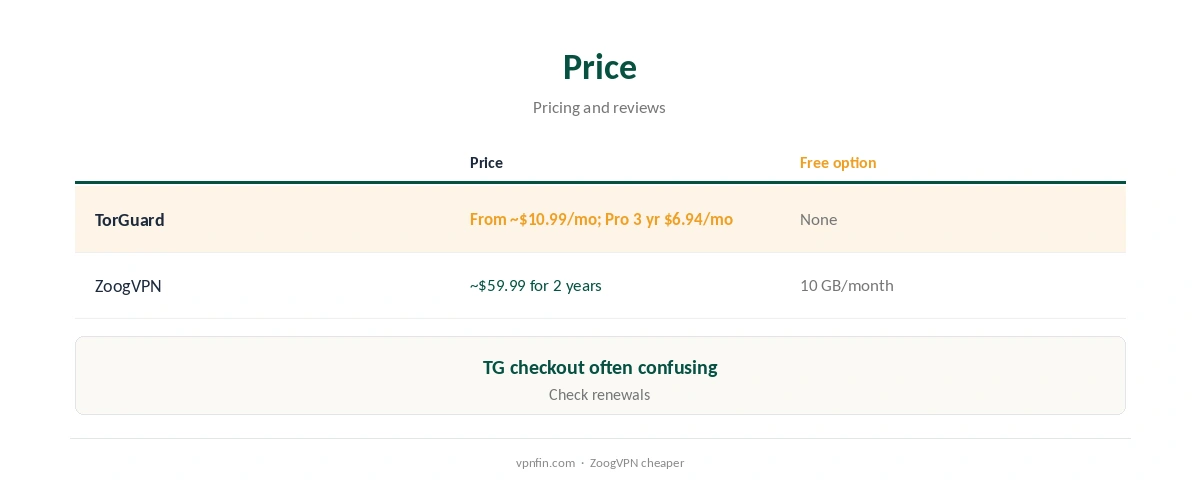
Reviewers often call TorGuard’s checkout confusing, so check the final total.
ZoogVPN costs about $59.99 for its two-year plan. TorGuard starts around $10.99 a month, fahimai lists, and its three-year Pro plan works out to $6.94 a month, Security.org notes.
ZoogVPN is far cheaper. Our renewal price guide compares renewals.
Devices and Platforms
Routers count once.
Count every phone, laptop, TV and console first.
A router running either VPN counts as one device.
TorGuard’s plans cover 8, 12 or 30 devices and include a Linux app with WireGuard and an OpenWrt router app, our tables record. ZoogVPN allows 10 devices on paid plans in several reviews and lists Linux, Fire TV and router setups.
For a large home network, TorGuard’s top tier goes furthest.
Apps and Support
Repeat any kill switch test after app updates.
Phone support helps when setting up ports or routers.
TorGuard has two kinds of kill switch but no split tunnelling, Security.org notes, and offers phone support, its Capterra listing says. ZoogVPN documents a kill switch and leak protection.
Test any kill switch by switching Wi-Fi off and on while connected.
Who Each Is For
Owners differ too: VPNetworks LLC and Zoog Services.
Both work on filtered networks; test before you travel.
Neither suits people who need audited proof.
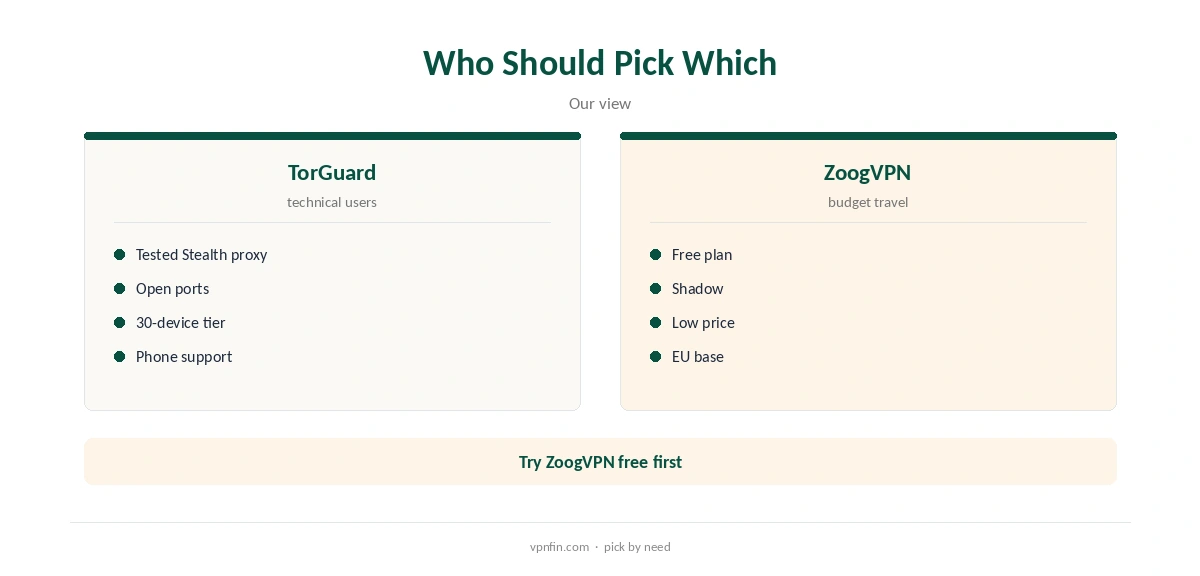
TorGuard suits technical users who need open ports, a tested Stealth proxy and many devices. ZoogVPN suits budget travellers who want a free start and Shadow for filtered networks.
Try ZoogVPN free first; pay for TorGuard if you need its tools.
Streaming, Payments, Jurisdiction and Fixed IPs
TorGuard’s Pro plan includes a streaming IP, TechRepublic notes, while ZoogVPN’s small network gives fewer locations to try when a service blocks one. One 2026 review notes ZoogVPN accepts Alipay and WeChat Pay.
Check payment options and refund rules together before buying.
TorGuard is run from Florida, in a Five Eyes country. ZoogVPN is based in Greece, an EU member, so European privacy rules, including the GDPR, cover it.
Neither base replaces an audit. Our VPN ownership guide explains why.
TorGuard sells dedicated IPs, which help with sites that block shared VPN addresses and with remote access. We found no dedicated-IP option for ZoogVPN in our sources.
Most home users do not need one.
Upgrading From Free
Check the renewal price too.
ZoogVPN’s paid plan also removes Android ads.
Moving to ZoogVPN’s paid plan unlocks all locations, AES-256 encryption and more devices. TorGuard has no free tier, so everything starts on a paid plan. We put the two side by side in our Astrill vs ZoogVPN comparison.
Test ZoogVPN free, then decide whether you need TorGuard’s extra tools.
How We Research
This page draws on Security.org’s and TechRepublic’s TorGuard reviews, fahimai’s TorGuard coverage, findcheapvpns’ ZoogVPN safety check and listify’s 2026 VPN comparison. We cross-checked these sources against each other, and where they conflict or something can’t be verified, we say so in the text rather than guessing. We checked time-sensitive figures, including prices in US dollars, on 8 October 2026. The main source we relied on is Security.org’s TorGuard review. Our full approach lives on the About Us page.
TorGuard vs ZoogVPN FAQ
TorGuard for open ports and tested stealth; ZoogVPN for price and a free plan.
Yes, 10 GB a month on one device.
TorGuard’s Stealth proxy got through in TechRepublic’s test.
Neither has an independent no-logs audit.
ZoogVPN, at about $59.99 for two years.
The Verdict
TorGuard vs ZoogVPN: TorGuard for tested stealth, open ports and many devices; ZoogVPN for a free start and a low price.