
Disclosure: VPNFin is reader-supported. If you buy a VPN through links on this page, we may earn a commission at no extra cost to you. This never affects our ratings — here’s our full disclosure.
The number on a VPN checkout page is almost never the price of the VPN. It is the price of the first term, after which the subscription renews at a different figure that appears nowhere in the advertising.
We have now calculated that figure for ten providers on the same basis. The increase ranges from nothing at all to 3.4 times, and the provider with the steepest rise is the one we rate highest.
This is not a scandal — introductory pricing is a customer-acquisition cost across the whole category, and every provider discloses the renewal figure somewhere in its terms. But nobody puts it next to the advertised price, so here it is.
The Short Answer
Budget for the second-year figure, not the first. That is the price you will pay for as long as you keep the subscription.
The steepest increase belongs to NordVPN, from about $3.39 a month to $11.59 — and it renews at $139.08 a year, the highest here.
One provider never raises it at all. Mullvad has charged €5 a month since 2009, which makes it mid-priced rather than cheap.
Every Renewal Price, Same Basis
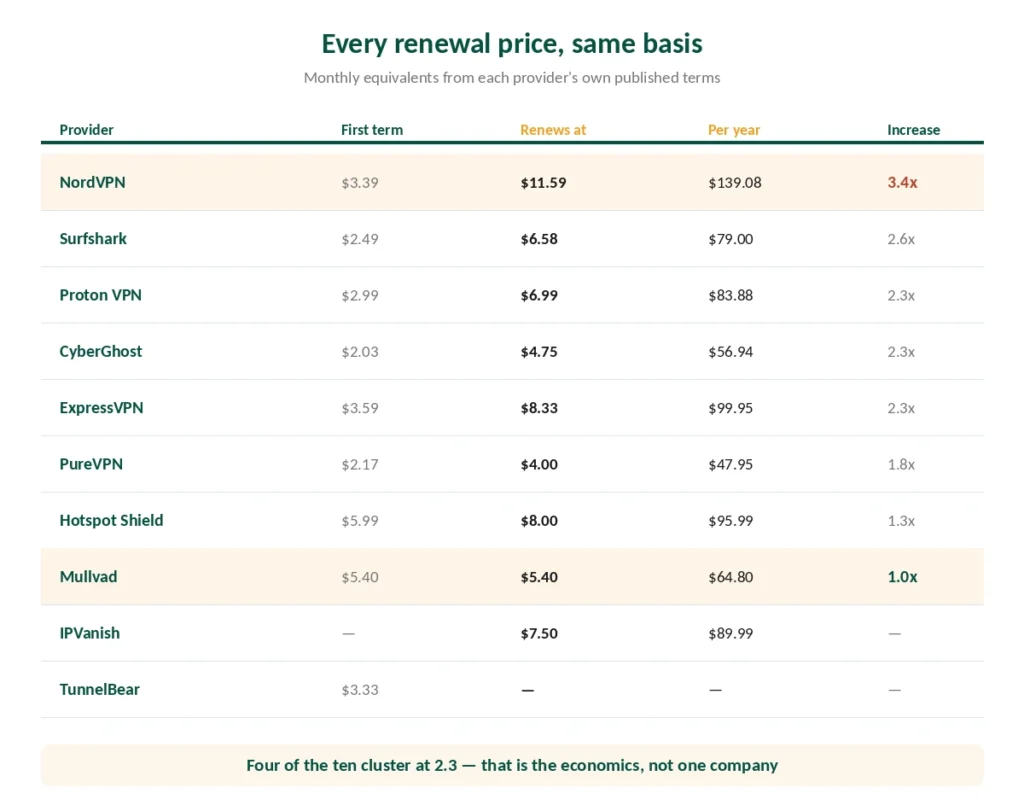
Monthly equivalents, calculated from each provider’s own published terms.
| Provider | First term | Renews at | Per year | Increase |
|---|---|---|---|---|
| NordVPN | $3.39 | $11.59 | $139.08 | 3.4× |
| Surfshark | $2.49 | $6.58 | $79.00 | 2.6× |
| Proton VPN | $2.99 | $6.99 | $83.88 | 2.3× |
| CyberGhost | $2.03 | $4.75 | $56.94 | 2.3× |
| ExpressVPN | $3.59 | $8.33 | $99.95 | 2.3× |
| PureVPN | $2.17 | $4.00 | $47.95 | 1.8× |
| Hotspot Shield | $5.99 | $8.00 | $95.99 | 1.3× |
| Mullvad | $5.40 | $5.40 | $64.80 | 1.0× |
| IPVanish | — | $7.50 | $89.99 | — |
| TunnelBear | $3.33 | — | — | — |
⚠️ Two gaps, and we would rather leave them blank than guess. IPVanish publishes its renewal figure but its promotional rate moves too often to state one. TunnelBear documents no separate renewal price at all, which is unusual and might simply mean it does not raise them. PureVPN’s figure also depends on tier: Standard renews at $47.95 and Plus at $69.95, which most comparisons collapse into one number.
Why Every Provider Does This
Worth understanding, because it explains why the practice will not stop.
Acquiring a subscriber costs more than a month of subscription. Advertising, affiliate commissions and app-store fees are all paid upfront, so the first term is often sold below cost. The renewal is where the provider recovers it.
The multiplier clusters around 2.3. Surfshark, Proton VPN, CyberGhost and ExpressVPN all land within a few percentage points of doubling and then some. That consistency suggests the number reflects the economics of the category rather than any one company’s greed.
NordVPN is the outlier at 3.4. It also has the deepest first-term discount, so the two facts are the same fact viewed from different ends.
⚠️ Nobody is hiding it. Every renewal figure here comes from the provider’s own terms or checkout page. The complaint is not concealment but placement: the number that matters appears where nobody reads, and the number that does not appears in the headline. Neither number, incidentally, predicts how good the provider is — we checked. One provider prints both figures on its own pricing page: Norton VPN renews at roughly double the first year, and says so before you buy.
The Claim to Watch: “Flat Renewal”
CyberGhost is frequently described as renewing at the price you paid, and the sentence is technically defensible while being practically wrong.
The two-year plan costs about $56.94 for 28 months. It then renews at $56.94 for 12 months. The dollar figure repeats; the period does not. Your monthly cost goes from $2.03 to $4.75.
Reviewers see the same number on both lines and call it flat. We made the same error ourselves and corrected it — our CyberGhost comparison sets out the arithmetic, and even at $4.75 a month it remains the gentlest renewal we track.
⚠️ Check the period, not just the amount. A renewal quoted per year against a first term quoted per month is not a comparison.
What It Adds Up To
Four years is long enough for the renewal to dominate the total, which is why we calculate it that way.
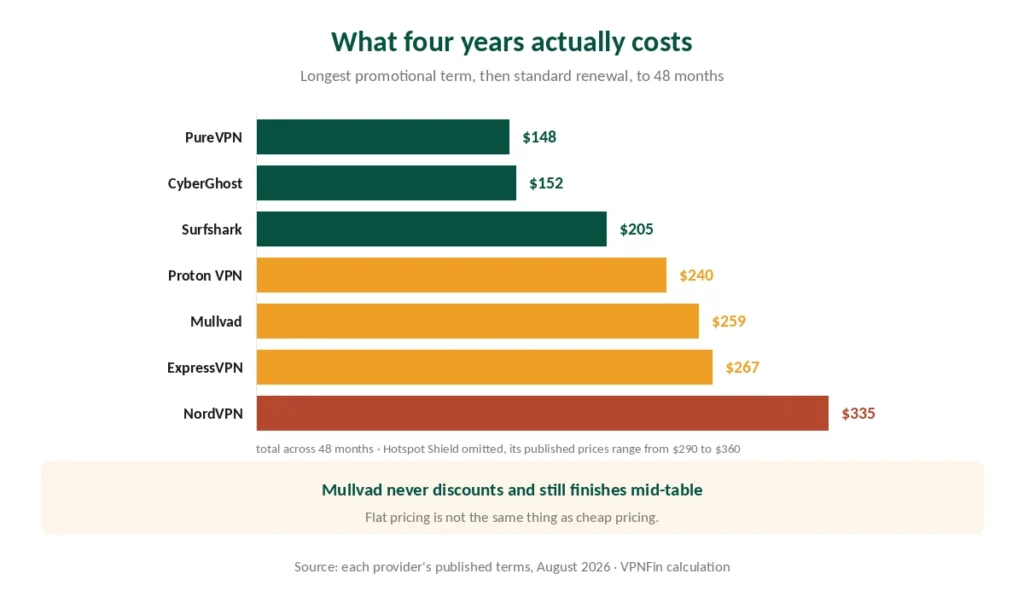
Cheapest across four years: PureVPN at about $148 and CyberGhost at about $152, within a few dollars of each other — and TunnelBear at $160 makes the bottom of the table a three-way tie in practice.
Most expensive: NordVPN at about $335. Hotspot Shield could be higher or lower — its published prices put it anywhere between $290 and $360, which is why we left it off the chart and why the two are worth comparing directly.
In between: Surfshark $205, Proton VPN $240, and then Mullvad and ExpressVPN seven dollars apart at $260 and $267.
⚠️ Note where Mullvad lands. A provider with no discount at all finishes mid-table, ahead of two that advertise far lower monthly rates. Flat pricing is not the same as cheap pricing, and our cheap VPN guide ranks the whole category on this basis.
How to Pay Less Than the Renewal Price
Three approaches, in order of how well they work.
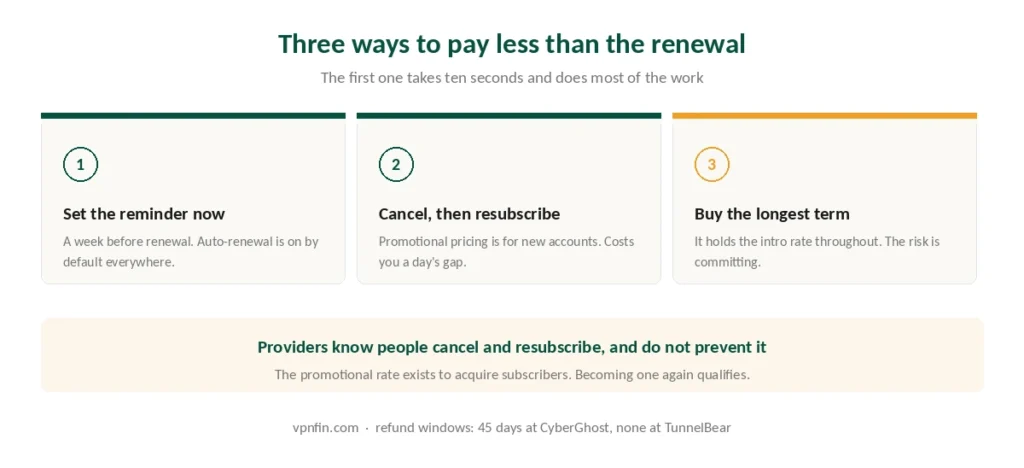
Put the renewal date in your calendar the day you subscribe. Auto-renewal is enabled by default at every provider here, and the charge arrives without warning at a figure you last saw two years ago. A reminder set for a week before is the entire technique.
Cancel before renewal and resubscribe as a new customer. Promotional pricing is for new subscriptions, so letting one lapse and starting another restores it. It costs you a gap of a day or two and whatever configuration you had saved. Providers know people do this and do not prevent it — and it works better than the student discount, which reduces the first term and never this one.
Buy the longest term you are confident about. A two or three-year plan holds the introductory rate for its full duration, which is the only legitimate way to keep it. The risk is committing to a provider you may want to leave — and month-to-month pricing is a worse deal, not a safer one. Waiting for Black Friday is not a fourth approach: the seasonal discount applies to the first term as well, and never to this figure.
Which is why the renewal sits beside the introductory price in our main ranking, rather than in a footnote under it.
⚠️ Refund windows are not a pricing strategy, but they are worth knowing. CyberGhost and Hotspot Shield give 45 days, most others 30, and TunnelBear gives none at all — refunds there are decided case by case, which matters more than its low price suggests.
The One That Does Not Do It
Mullvad has charged €5 a month since 2009. No tiers, no annual discount, no promotional rate, no renewal increase, and no way to pay less by committing longer.
The stated reasoning is that discounts for long commitments extract money from people who stop using the service. Whether you find that principled or merely inflexible, the effect is that the price on the day you sign up is the price four years later.
⚠️ It also means Mullvad looks expensive next to a first-term rate and reasonable next to a renewal. Against NordVPN it is $75 cheaper across four years while costing more per month, which the two compared directly sets out in full.
How We Research
Every figure here comes from our own reviews and comparisons, where each was verified against the provider’s published terms or checkout page at the time of writing and recorded with its source. We calculated the monthly equivalents and four-year totals ourselves on a single consistent basis: longest advertised term at the promotional rate, followed by standard renewal, to a total of 48 months. We don’t run our own speed tests and we do not quote figures we could not source. Where a provider’s pricing varied too widely across published sources to state a single number, as with Hotspot Shield, we give the range and say so. Our full approach lives on the About Us page.
VPN Renewal FAQ
At nine of the ten providers we track, yes. The increase clusters around 2.3 times the promotional monthly rate, ranging from 1.3 times at Hotspot Shield to 3.4 times at NordVPN. Mullvad is the exception, charging the same €5 a month it has charged since 2009.
Mullvad. It sells one plan at one price with no tiers, no annual discount and no renewal increase. That makes it mid-priced rather than cheap: across four years it comes to roughly $260, more than CyberGhost or PureVPN but less than NordVPN.
No, though it is often described that way. The two-year plan costs about $56.94 for 28 months and then renews at $56.94 for 12 months. The dollar amount repeats but the period halves, so the monthly cost rises from roughly $2.03 to $4.75.
Set a calendar reminder for a week before the renewal date, since auto-renewal is enabled by default everywhere. You can then cancel and resubscribe as a new customer to restore promotional pricing, or buy the longest term you are comfortable committing to, which holds the introductory rate throughout.
PureVPN at roughly $148 and CyberGhost at about $152, calculated as the longest promotional term followed by standard renewal across 48 months. NordVPN is the most expensive of the providers with confirmed figures, at about $335, because its renewal is both the highest and the steepest increase.
The Verdict
Read the renewal figure before the advertised one. It is in the terms at every provider here, and it is the price you will actually live with.
Expect roughly 2.3 times the first-term rate. Four of the ten cluster there, PureVPN and Hotspot Shield rise less, NordVPN rises considerably more, and Mullvad does not rise at all.
And set a calendar reminder on the day you subscribe. Auto-renewal is on by default everywhere, and a week’s notice is the difference between choosing to pay the second-year price and discovering you already have.