
Disclosure: VPNFin is reader-supported. If you buy a VPN through links on this page, we may earn a commission at no extra cost to you. This never affects our ratings — here’s our full disclosure.
PrivateVPN vs StrongVPN compares two older, unaudited VPNs that each do one job unusually well. StrongVPN, launched in 2005 and owned by Ziff Davis, offers Smart DNS for consoles and had the lowest local ping of 59 VPNs in Top10VPN’s 2026 tests. PrivateVPN, from Sweden, gives free port forwarding, dynamic dedicated IPs and a Stealth mode for about $2 a month.
This guide compares torrenting, consoles, speed, stealth, price and fit.
PrivateVPN vs StrongVPN: Different Specialities
Count consoles and torrent needs first; that usually settles it.
Neither is a bad pick; they serve different jobs.
PrivateVPN’s strengths sit with torrenting and fixed addresses: it forwards ports at no extra cost and allows P2P on every server, Comparitech notes. StrongVPN’s strengths sit with the living room and gaming: Smart DNS for consoles and very low ping.
Decide which job matters more.
Consoles, TVs and Speed
Pick the closest location for the best result.
A router covers consoles with either.
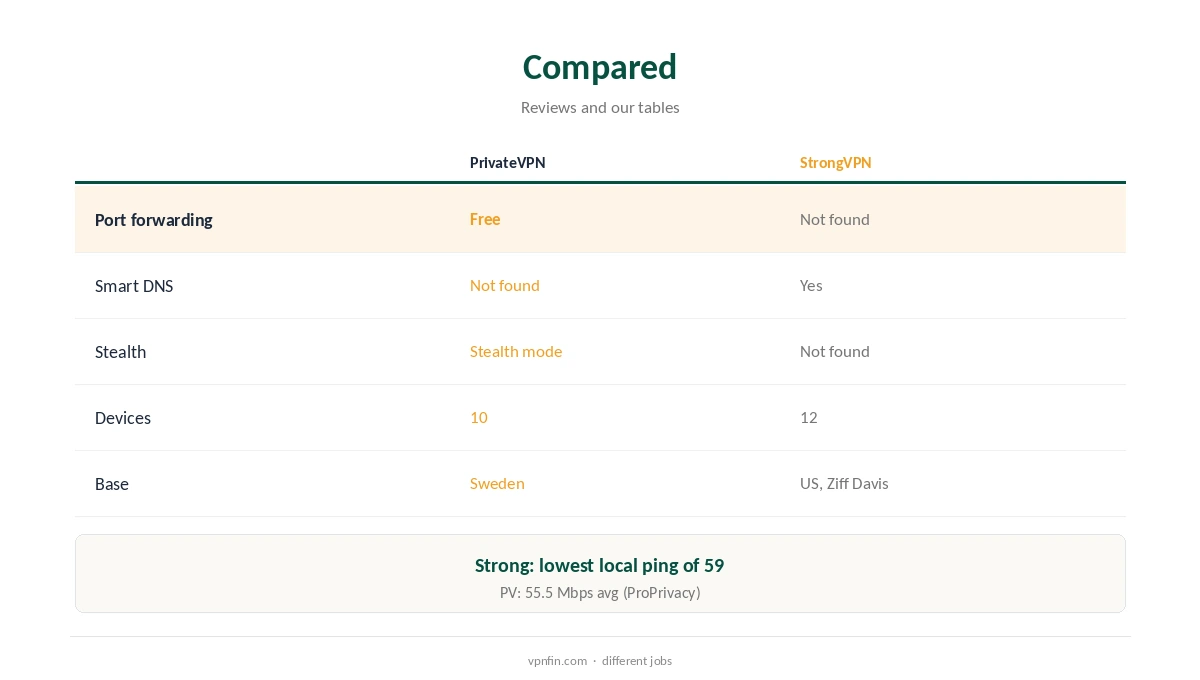
StrongVPN’s Smart DNS lets a games console or smart TV reach streaming services without an app, and it has a Fire TV app. We found no Smart DNS for PrivateVPN in our sources, so consoles need a router running it.
Smart DNS adds no encryption, so it suits streaming rather than privacy.
Ping matters most in games and calls.
Top10VPN found StrongVPN had the lowest local ping of the 59 VPNs it reviewed. ProPrivacy measured PrivateVPN averaging 55.5 Mbps, with bursts to 663 Mbps.
For gaming and calls, StrongVPN is the faster pick.
Stealth and Fixed IPs
A fixed IP can reduce CAPTCHAs on busy sites.
At home, stealth is rarely needed.
A fixed IP can cut CAPTCHAs.
PrivateVPN offers a Stealth mode on Windows, macOS, iOS and Android, and free dynamic dedicated IPs, a 2026 review notes. We found no obfuscation feature for StrongVPN in our sources.
For filtered networks, PrivateVPN has the specific tool.
Evidence
A fresh audit from either would change this picture.
Weigh that before paying for a long plan.
Neither publishes an outside report on its logging.
Without an audit, you rely on each company’s word.
Neither has an independent no-logs audit: Comparitech says PrivateVPN’s policy has not been externally verified, and Top10VPN notes StrongVPN’s apps are unaudited.
Our VPN audit tracker lists audited providers.
Price
Ask before paying.
Compare totals over the term you keep.
Avoid StrongVPN’s monthly plan if you want a refund.
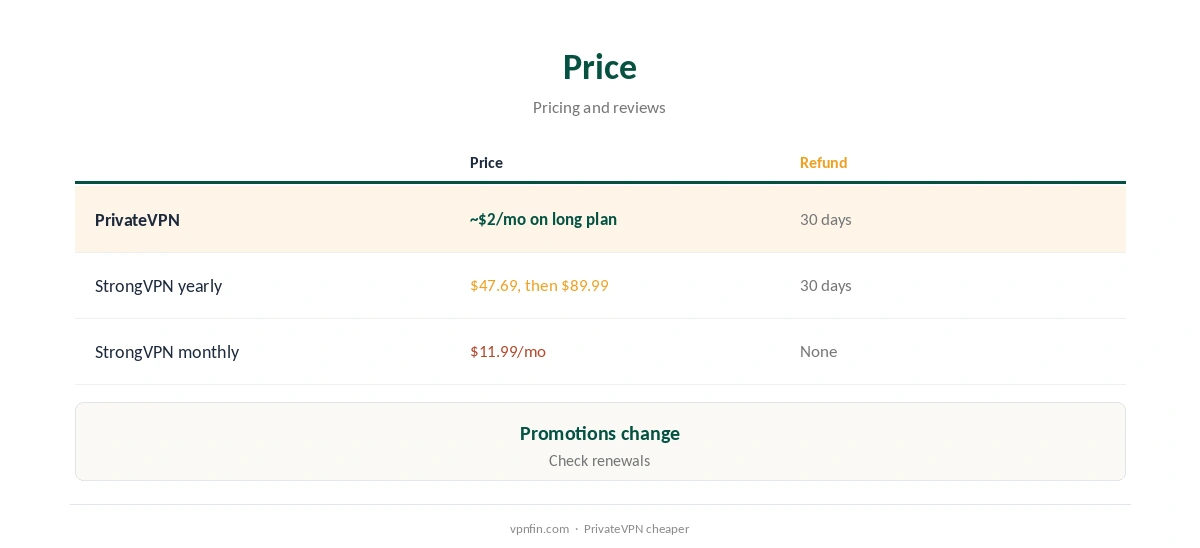
PrivateVPN costs about $2 a month on its longest plan, Comparitech notes. StrongVPN costs $47.69 for the first year, then $89.99, and refunds only yearly plans within 30 days.
PrivateVPN is far cheaper. Our renewal price guide compares renewals.
Devices, Apps, Base and Owners
Drop Wi-Fi briefly to test the kill switch.
StrongVPN covers 12 devices and PrivateVPN 10. StrongVPN’s split tunnelling works only on Android, and its kill switch is off by default, Top10VPN notes; PrivateVPN has no split tunnelling at all.
Turn on and test the kill switch on whichever you choose.
PrivateVPN is based in Sweden, under the GDPR but inside the 14 Eyes. Ziff Davis owns StrongVPN in the US, alongside IPVanish.
Our VPN ownership guide explains why owners matter.
Port Forwarding Detail and Streaming
Allow only trusted IPs to reach an open port.
One 2026 review adds a caveat: port forwarding works on selected locations when you use OpenVPN, so check the Advanced view, which shows whether the current server offers a port, ProPrivacy notes. StrongVPN does not offer port forwarding in our sources.
Seeders should check the Advanced view before starting a download.
StrongVPN does best with US services, Top10VPN found, unblocking HBO Max at the first try. One 2026 review rates PrivateVPN’s streaming as weak.
For streaming, StrongVPN has the stronger results.
Platforms, Support, Linux and Refunds
PrivateVPN offers 24/7 support, Tekpon notes.
PrivateVPN covers Windows, Mac, iOS, Android, Linux and routers with 24/7 support, Tekpon notes. StrongVPN offers a Fire TV app and a WireGuard generator for routers.
Both can cover a whole home from the router.
PrivateVPN lists Linux among its platforms, Tekpon notes. Reviewers disagree on StrongVPN’s Linux app, though its WireGuard generator works with Linux setups. PrivateVPN refunds within 30 days; StrongVPN refunds only yearly plans.
Linux users should confirm support on each download page.
Who Each Is For
Test first.
Count your consoles and torrent needs first.
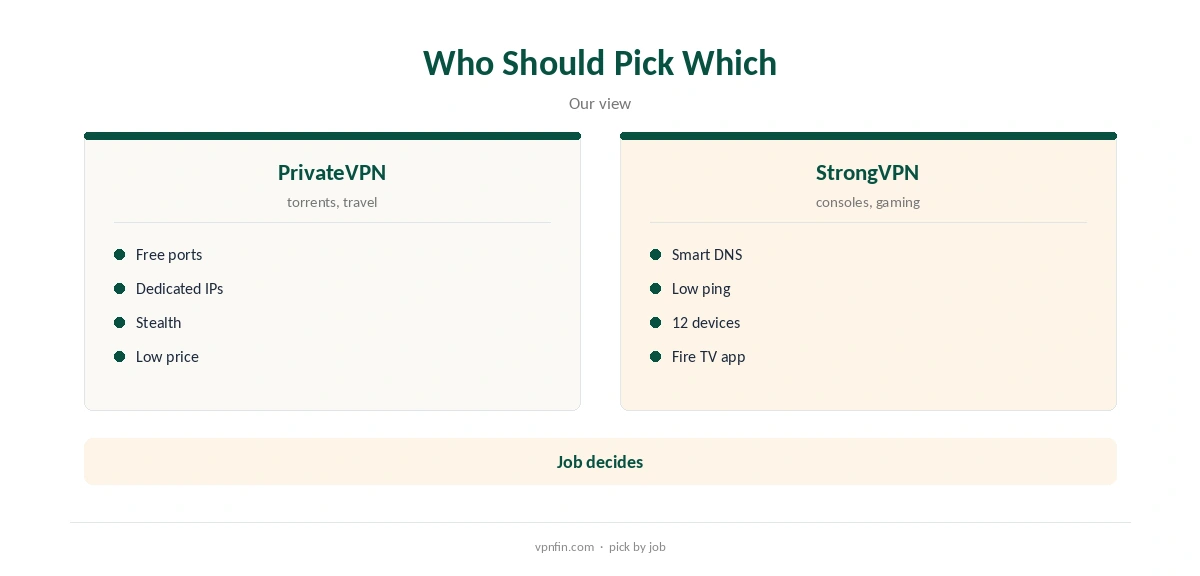
PrivateVPN suits torrent users, self-hosters and travellers who want ports, a fixed IP and Stealth for little money. StrongVPN suits gamers and console owners who want Smart DNS and the lowest ping.
Neither suits anyone who needs audited proof.
Monthly Plans and Detail
PrivateVPN’s monthly plan starts around $8.99, Capterra lists; StrongVPN’s costs $11.99 with no refund. PrivateVPN’s Advanced view also shows the protocol, port availability and session data, ProPrivacy notes. For a head-to-head, see our StrongVPN vs hide.me comparison.
For short trips, PrivateVPN’s monthly plan costs less.
How We Research
This page draws on Comparitech’s and ProPrivacy’s PrivateVPN coverage, a 2026 PrivateVPN review and Top10VPN’s StrongVPN review. We cross-checked these sources against each other, and where they conflict or something can’t be verified, we say so in the text rather than guessing. We checked time-sensitive figures, including prices in US dollars, on 8 October 2026. The main source we relied on is Comparitech’s PrivateVPN review. Our full approach lives on the About Us page.
PrivateVPN vs StrongVPN FAQ
PrivateVPN for torrents and price; StrongVPN for consoles and speed.
PrivateVPN, at no extra cost.
StrongVPN.
Neither has an independent no-logs audit.
PrivateVPN, at about $2 a month.
The Verdict
PrivateVPN vs StrongVPN: PrivateVPN for free ports, fixed IPs and Stealth at a low price; StrongVPN for Smart DNS and low ping.