
Disclosure: VPNFin is reader-supported. If you buy a VPN through links on this page, we may earn a commission at no extra cost to you. This never affects our ratings — here’s our full disclosure.
Hotspot Shield vs StrongVPN is best judged in the living room. StrongVPN, launched in 2005 and now owned by Ziff Davis, includes Smart DNS for consoles and TVs, allows 12 devices and had the lowest local ping of 59 VPNs in Top10VPN’s 2026 tests. Hotspot Shield, from Point Wild, sells speed through its Hydra protocol and a free daily allowance, but its free plan excludes smart TVs and routers, Tom’s Guide notes. Neither has an independent no-logs audit in our sources.
This guide compares TVs and consoles, speed, evidence, free use, price, refunds and fit.
Hotspot Shield vs StrongVPN for TVs and Consoles
For privacy on a console, a router running the full VPN is the better option.
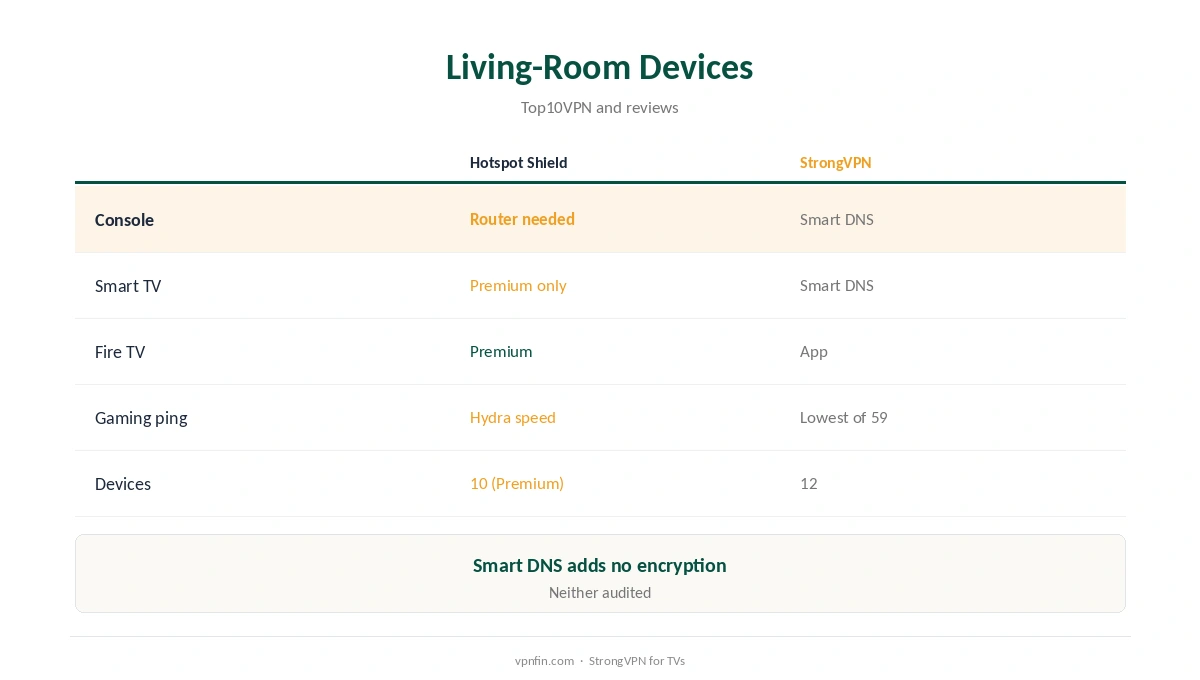
StrongVPN’s Smart DNS lets a PlayStation, Xbox or smart TV reach streaming services without a VPN app, and Top10VPN rates the feature highly; StrongVPN also has a Fire TV app, though no Android TV or Apple TV app. Hotspot Shield covers TVs only on Premium, and we found no Smart DNS for it in our sources.
Smart DNS changes DNS lookups only and adds no encryption, so it suits streaming rather than privacy.
Gaming and Speed
Test both at the same time of day for a fair comparison.
Ping matters most in games and calls; download speed matters most for streaming and large files.
Top10VPN’s 2026 tests found StrongVPN had the lowest local ping of the 59 VPNs it reviewed, with strong long-distance speeds. Hotspot Shield credits its speed to Hydra and WireGuard, a 2026 review notes, and its split tunnelling works only with Hydra, Cloudwards adds.
For online games and calls, StrongVPN’s ping is the stronger argument.
Evidence
Neither has a recent outside check.
An audit checks systems against the privacy policy. Without one, you rely on the company’s word.
StrongVPN has no audit in our table, and Top10VPN notes its apps are unaudited and lack post-quantum encryption. Hotspot Shield has no independent no-logs audit; its policy records session length, bandwidth and device hashes, a 2026 review notes.
If proof matters, look at audited providers in our VPN audit tracker.
Free Use
StrongVPN’s yearly plan carries a 30-day refund, which is its closest thing to a trial.
The daily reset suits a little browsing every day.
Hotspot Shield’s free plan gives 500 MB a day on a US location with ads, at about 2 Mbps. StrongVPN has no free plan.
Only Hotspot Shield lets you use it without paying.
Price and Refunds
Avoid StrongVPN’s monthly plan if you want a safety net while testing.
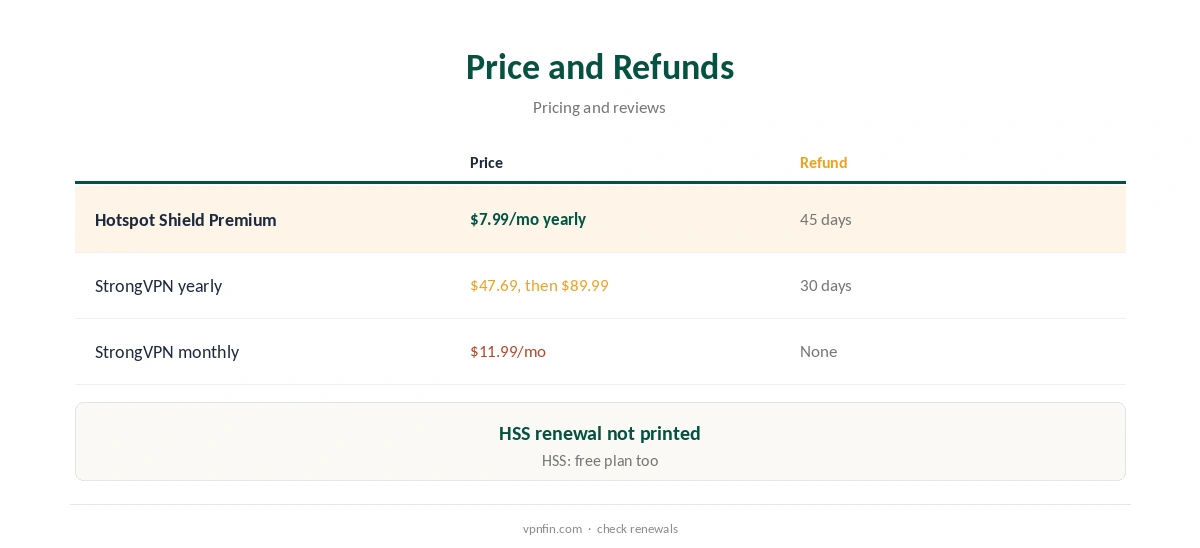
Hotspot Shield Premium costs $7.99 a month on a yearly plan, with 45 days for refunds, though vpnprograms notes it does not print its renewal price. StrongVPN costs $47.69 for the first year, then $89.99, and refunds only yearly plans within 30 days; its $11.99 monthly plan gets no refund.
Hotspot Shield gives the longer refund window. Our renewal price guide covers renewals.
Devices
Families with 11 or 12 devices fit StrongVPN without a router.
Count every phone, laptop, TV and console first.
StrongVPN allows 12 devices; Hotspot Shield Premium allows 10, one review notes, and its free plan one.
A router running StrongVPN counts as one device; Hotspot Shield’s free plan does not cover routers at all.
Kill Switch, Split Tunnelling and Owners
Test it by switching Wi-Fi off and on while connected.
StrongVPN’s kill switch is off by default, Top10VPN notes, and its split tunnelling works only on Android. AllAboutCookies found every Hotspot Shield plan includes a kill switch with a notification when it is active.
Turn on and test the kill switch on whichever you choose.
Both groups own media or other products as well as VPNs.
Ziff Davis owns StrongVPN alongside IPVanish and publications such as PCMag and CNET. Point Wild, formerly Pango and Aura, owns Hotspot Shield.
Our VPN ownership guide explains why owners matter.
Who Each Is For
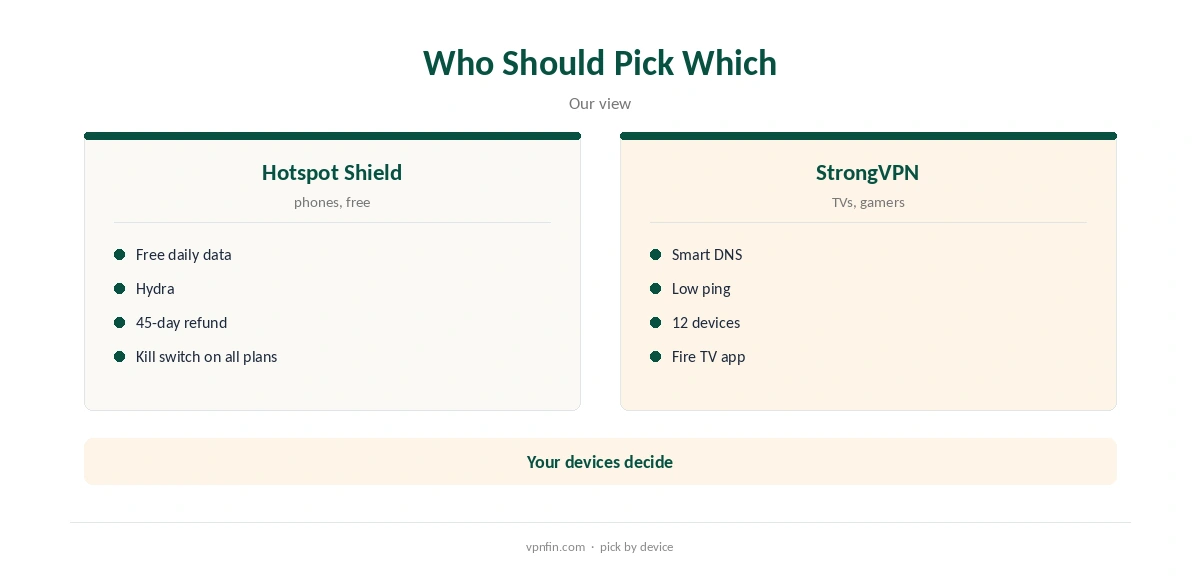
StrongVPN suits console owners who want Smart DNS, gamers who value low ping and households of up to 12 devices. Hotspot Shield suits people who want a free daily allowance on a phone or laptop and a 45-day refund if they upgrade.
For a living room full of devices, StrongVPN fits better overall.
Streaming and Protocols
StrongVPN works best for US services, Top10VPN found, unblocking HBO Max on the first attempt and US Netflix most reliably from its Chicago server, while BBC iPlayer was unreliable. Hotspot Shield’s free plan does not suit streaming, vpnprograms notes.
For streaming on a TV, StrongVPN’s Smart DNS is the simplest route.
StrongVPN uses WireGuard by default, also offers OpenVPN and IKEv2, and provides a WireGuard configuration generator for routers. Hotspot Shield runs its closed-source Hydra protocol alongside WireGuard and IKEv2, Tom’s Guide notes.
StrongVPN’s generator makes manual router setups easier.
How We Research
This page draws on Top10VPN’s StrongVPN review, vpnprograms’, AllAboutCookies’, Cloudwards’ and Tom’s Guide’s Hotspot Shield reviews and a 2026 Hotspot Shield review on logging. We cross-checked these sources against each other, and where they conflict or something can’t be verified, we say so in the text rather than guessing. We checked time-sensitive figures, including prices in US dollars, on 8 October 2026. The main source we relied on is Top10VPN’s StrongVPN review. Our full approach lives on the About Us page.
Hotspot Shield vs StrongVPN FAQ
StrongVPN for consoles, TVs and gaming; Hotspot Shield for a free plan.
Not in our sources; StrongVPN does.
Neither has an independent no-logs audit in our sources.
StrongVPN, the lowest of 59 VPNs in Top10VPN’s tests.
StrongVPN, with 12.
The Verdict
Hotspot Shield vs StrongVPN: StrongVPN for the living room and gaming; Hotspot Shield for free mobile use and a longer refund.