
Disclosure: VPNFin is reader-supported. If you buy a VPN through links on this page, we may earn a commission at no extra cost to you. This never affects our ratings — here’s our full disclosure.
TorGuard vs Norton VPN compares a toolkit for power users with a VPN built for the mass market. TorGuard, run by VPNetworks LLC in Florida, offers port forwarding on request, Stealth modes and plans for 8, 12 or 30 devices, Security.org notes, but has no independent no-logs audit, fahimai notes. Norton VPN, from Gen Digital, has two no-logs audits, a 60-day refund and Plus at $29.99 for the first year, Tom’s Guide reports.
This guide compares evidence, tools, censorship, devices, refunds, price and fit.
TorGuard vs Norton VPN on Evidence
An audit is a snapshot in time; yearly audits show practices holding.
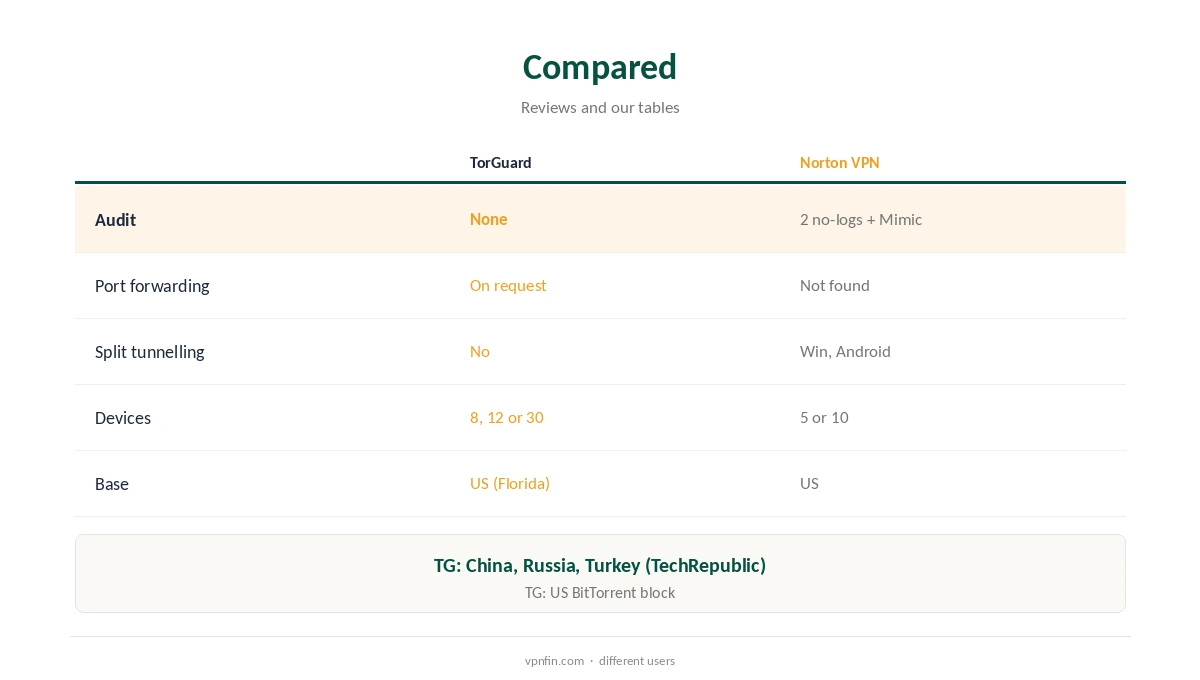
Norton’s no-logs policy has been checked twice, in 2024 and October 2025, and its Mimic protocol in December 2025, and Norton says the audits will continue yearly. TorGuard has no independent no-logs audit, fahimai notes.
For outside proof, Norton is ahead. Our VPN audit tracker compares providers.
Tools for Power Users
Secure any service you expose through an open port, TechRepublic advises, and allow only trusted IPs.
TorGuard lets you request an open port from its dashboard, useful for torrenting and remote access, and offers dedicated IPs. It has no split tunnelling or multi-hop, Security.org notes, but provides two kinds of kill switch. Norton offers split tunnelling on Windows and Android, plus IP Rotation and Double VPN.
Torrent users and self-hosters get more from TorGuard; everyday users get more from Norton’s simpler extras.
Censored Networks
Pack a backup.
Test from the network you will use before relying on either.
TorGuard’s Stealth protocols include SSTP, OpenVPN obfuscation and OpenConnect, and with its Stealth proxy got past firewalls in China, Russia and Turkey, TechRepublic found. Norton’s Mimic disguises VPN traffic as HTTPS and sees significant use in some regions, Tom’s Guide reports.
Both target filtered networks; TorGuard has more tested evidence from the hardest ones.
TorGuard vs Norton VPN on Devices
The 30-device tier suits people running home servers or a small office network, Security.org notes.
A router running either VPN counts as one device.
TorGuard’s plans cover 8, 12 or 30 devices, Security.org lists, the largest aimed at home servers or small networks. Norton’s Standard and Plus plans cover five, and Ultimate 10.
For many devices, TorGuard’s higher tiers go further.
Price and Refunds
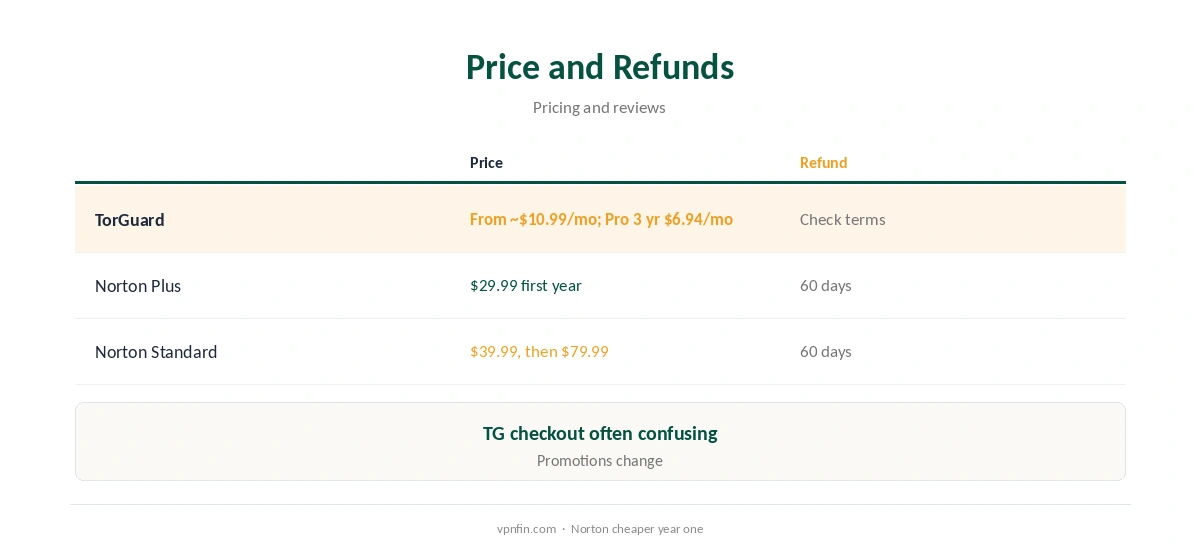
Read TorGuard’s refund terms before buying, since reviews flag its checkout as confusing.
TorGuard starts around $10.99 a month, fahimai lists, and its three-year Pro plan works out to $6.94 a month, Security.org notes. Norton Plus costs $29.99 for the first year, with 60 days for refunds, and Standard renews at $79.99.
Norton is far cheaper in year one. Our renewal price guide compares renewals.
Torrenting Caveat
Bind your torrent client to the VPN and check its IP before downloading.
TorGuard blocks BitTorrent on its US servers under a 2022 settlement with film studios, our tables record, so torrent users must connect to other countries. We found no torrent-specific tools such as port forwarding for Norton in our sources.
Pick a non-US TorGuard server for torrents.
Ease of Use
Test first.
Port requests are made from TorGuard’s website dashboard, not the app.
Nearly every TorGuard review flags its checkout as confusing, fahimai notes, and its apps expect you to choose protocols and ports. Norton’s apps connect in one tap and often come bundled in Norton 360 suites.
Beginners will find Norton far simpler.
Who Each Is For
Both are US-based, so neither escapes Five Eyes jurisdiction.
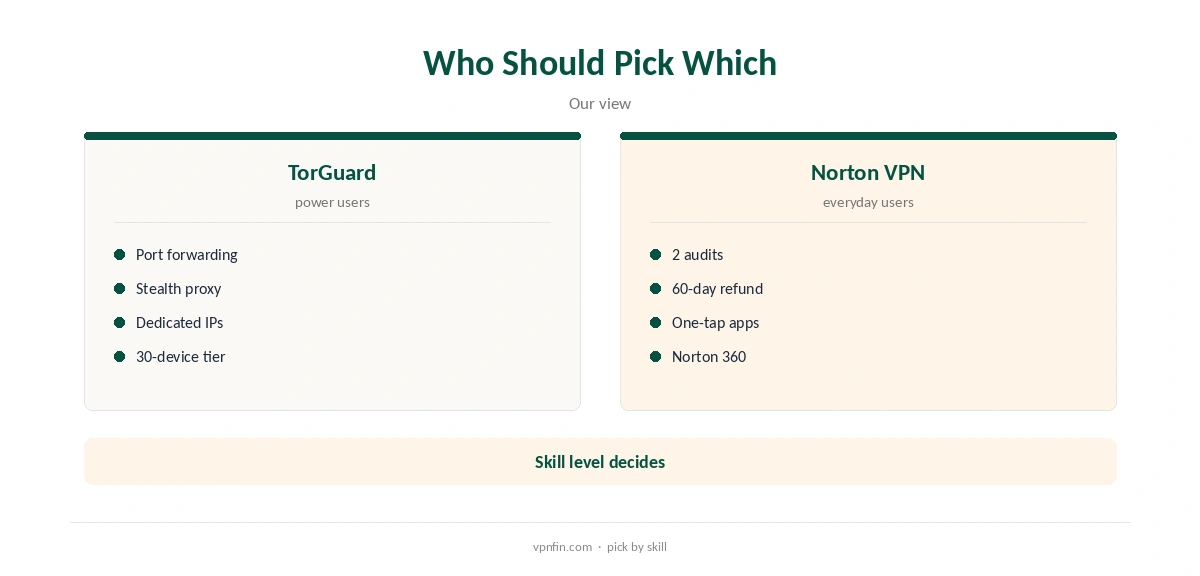
TorGuard suits technical users, torrent users outside the US and travellers to heavily filtered countries. Norton suits people who want audited, simple protection, a long refund window and a cheap first year.
Owners differ too: VPNetworks LLC for TorGuard, Gen Digital for Norton.
Fixed and Streaming IPs
Dedicated IPs cost extra on TorGuard.
TorGuard sells dedicated IPs, and its Pro plan includes a streaming IP, TechRepublic notes, which helps with services that block shared VPN addresses. Norton goes the other way with IP Rotation, which changes your address during a session for privacy.
Pick by whether you want a stable address or a changing one.
Linux and Support
Phone support is unusual among VPNs and helps when setting up ports.
TorGuard offers a Linux app with WireGuard, our tables record, and email, help-desk and phone support, its Capterra listing notes. We found no Norton VPN app for Linux in our sources, and its Mac app lacks WireGuard and OpenVPN.
Linux users have a clearer path with TorGuard.
Streaming
A fixed streaming IP is less likely to be flagged than a busy shared server.
Tom’s Guide highlights Norton VPN’s strong streaming unblocking. TorGuard’s Pro plan adds a streaming IP, TechRepublic notes, a fixed address meant to look less like shared VPN traffic.
Test the services you use within each refund window.
How We Research
This page draws on Security.org’s and TechRepublic’s TorGuard reviews, fahimai’s TorGuard coverage, Tom’s Guide’s reports on Norton VPN’s 2025 changes and Security.org’s Norton coverage. We cross-checked these sources against each other, and where they conflict or something can’t be verified, we say so in the text rather than guessing. We checked time-sensitive figures, including prices in US dollars, on 8 October 2026. The main source we relied on is Security.org’s TorGuard review. Our full approach lives on the About Us page.
TorGuard vs Norton VPN FAQ
TorGuard for power tools and stealth; Norton for audits, ease and refunds.
No independent no-logs audit; Norton has two.
No, Security.org notes.
TorGuard’s Stealth proxy got through in TechRepublic’s test.
Norton, with 60 days.
The Verdict
TorGuard vs Norton VPN: TorGuard for ports, stealth and many devices; Norton for audited, simple protection and a long refund window.