
Disclosure: VPNFin is reader-supported. If you buy a VPN through links on this page, we may earn a commission at no extra cost to you. This never affects our ratings — here’s our full disclosure.
Ireland is where Europe’s privacy law actually gets enforced. Eight of the ten largest fines ever issued under the General Data Protection Regulation came from a single office in Dublin.
None of those cases had anything to do with VPNs, and that is the useful part. The strongest privacy protection an Irish reader has is not something you buy, and the things you can buy do not do its job.
Why the Enforcer Is Irish
Meta, Google, TikTok, LinkedIn, Apple and Microsoft all have their European headquarters in Dublin. Under the regulation’s one-stop-shop mechanism, that makes the Irish Data Protection Commission their lead supervisory authority for the whole European Economic Area.
So a decision taken in Dublin binds those companies across Europe. Not only in Ireland — everywhere the regulation applies.
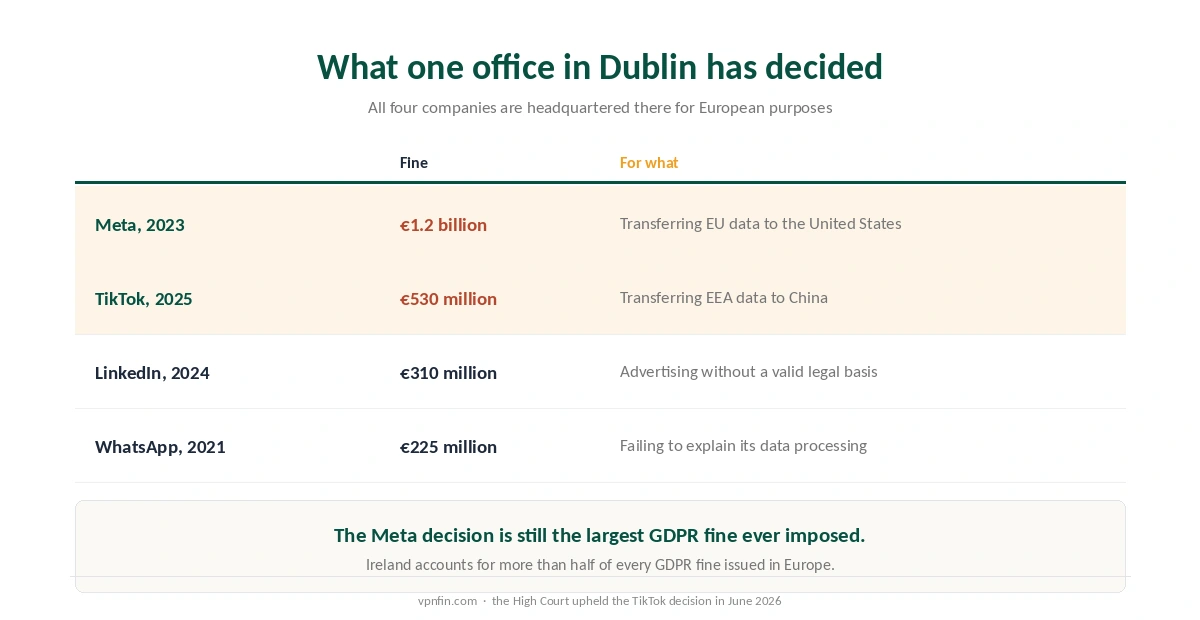
Cumulative fines from that one commission reach €4.04 billion since 2018, which is more than half of every GDPR fine issued anywhere in Europe.
⚠️ It is a structural accident rather than a national choice. Ireland attracted the headquarters for tax and language reasons; the regulatory role followed.
What Has Actually Been Decided
Meta, 2023: €1.2 billion for transferring European user data to the United States without an adequate legal basis. It remains the largest fine ever imposed under the regulation.
TikTok, May 2025: €530 million for transferring European Economic Area user data to China through remote access, and for failing to explain those transfers to users. The first data-transfer fine to China from any European member state.
LinkedIn, 2024: €310 million. WhatsApp, 2021: €225 million.
⚠️ The TikTok decision was tested and held. The Irish High Court upheld the findings and the fine in June 2026, and no other European authority objected to the draft decision when it was circulated.
Which Protects You, and From What
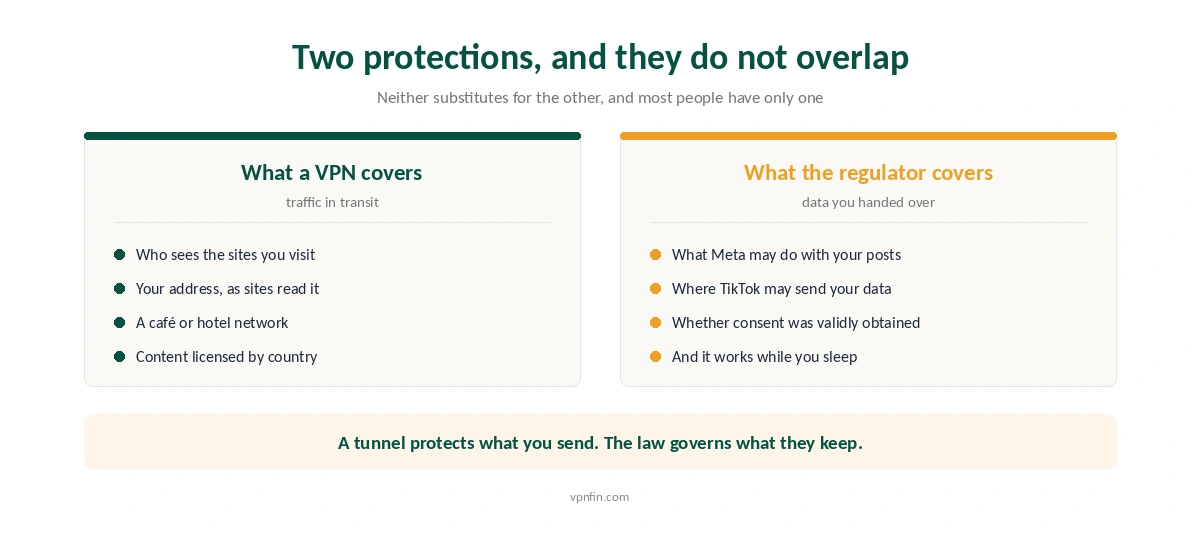
A VPN covers traffic in transit. Who can see the sites you visit, what address those sites read, and whether a café network can watch you — that is the whole of it.
The regulator covers data you handed over deliberately. What a platform may do with your posts, where it may send them, and whether your consent was validly obtained.
⚠️ Neither substitutes for the other, and most people have only one. Routing your traffic through Amsterdam does not change what Meta already holds, and a Dublin decision does not stop a hotel network reading your requests.
The distinction matters when you read marketing. Providers describe VPNs in language borrowed from data protection, and the gap between the two is where most misunderstanding lives.
The Case That Shows Both Limits
Worth setting out carefully, because it comes from the commission’s own published decision.
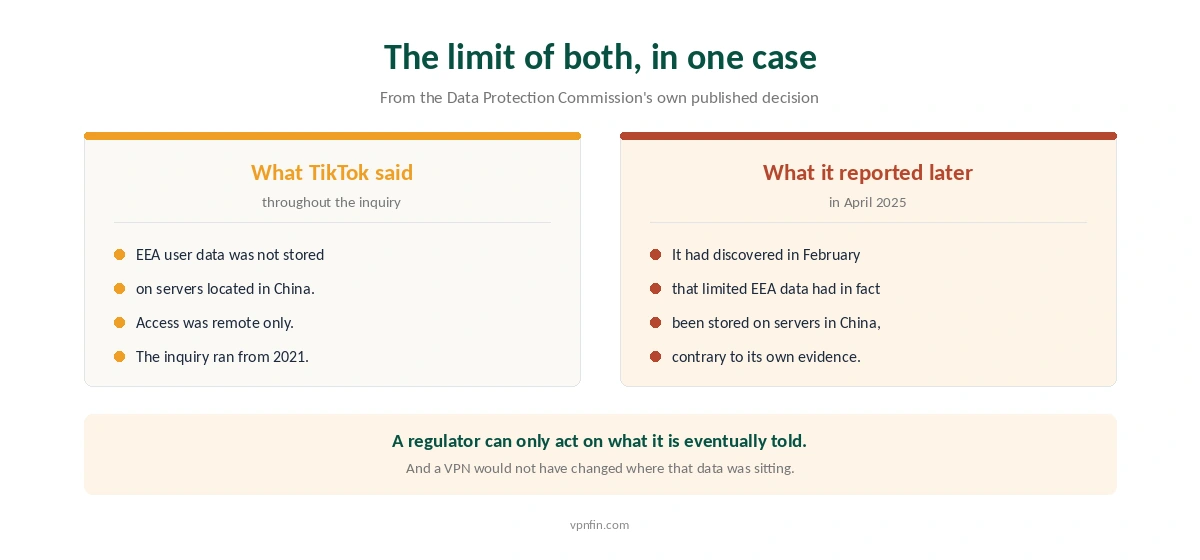
Throughout the inquiry, which began in 2021, TikTok told the regulator that European user data was not stored on servers in China. Access from China was remote, the company said, rather than storage there.
In April 2025 the company informed the commission otherwise. It had discovered in February that limited European data had in fact been stored on servers in China, contrary to the evidence it had given.
⚠️ A regulator can only act on what it is eventually told. The fine landed, the court upheld it, and the discrepancy still emerged from the company rather than from an inspection.
And no VPN would have altered where that data was sitting. It was given to the platform voluntarily, in the ordinary course of using it — which is the category a tunnel never touches.
The Jurisdiction, Which Is Genuinely Good
Ireland sits outside the Five, Nine and Fourteen Eyes arrangements, which is unusual in Western Europe — Britain, France, Germany, the Netherlands, Denmark, Norway, Sweden, Belgium, Italy and Spain are all inside one of them.
There is no mandatory data retention reaching VPN providers, and no Irish law restricts using, buying or installing one.
⚠️ But no major provider is based there. A good jurisdiction only helps if a company chooses it, and we weigh jurisdiction below audits for exactly that reason.
The servers that matter are there regardless. Dublin hosts the European infrastructure of most large platforms, so Irish datacentres hold a great deal of European data whether or not anyone in Ireland uses a VPN.
The Ordinary Reasons, Which Have Not Changed
RTÉ Player is geo-restricted to Ireland, so an Irish licence payer abroad loses access to national broadcasting — the same structure as the British arrangement we examined, and one of the commonest reasons anyone here buys a VPN.
Public networks. Airports, trains, cafés — the one case where the benefit is unambiguous.
Streaming catalogues differ by country, and the Irish libraries are smaller than the American ones on most platforms — our streaming guide covers which services notice.
And your internet provider’s visibility. Regulation governs platforms; it does not stop your provider seeing which domains you requested.
Which Providers Suit an Irish Reader
NordVPN scores highest on our scale, with six audits and the lowest measured speed loss of the providers we cover.
Proton VPN has five audits published in full and a free tier with no data cap, which suits anyone who only needs it while travelling.
Surfshark covers unlimited devices, and its Irish servers are among the better-provisioned in the market.
⚠️ Test inside the refund window. Every provider we rank gives at least thirty days, and the refund is a separate request from cancelling.
How We Research
This guide draws on the Data Protection Commission’s own published decision of 2 May 2025 for the TikTok findings, the fine and the sequence in which the company disclosed the storage discrepancy, on the European Data Protection Board’s publication of the same decision for the Article 46 reasoning, on reported Irish High Court and Supreme Court outcomes through June 2026 for the appeals, and on DLA Piper’s annual survey and published enforcement trackers for the cumulative figures and the ranking of the largest fines. Figures for fines are as reported in 2026 and appeals remain possible, so treat them as accurate on the date shown. We do not run our own tests. Our method lives on the About Us page.
Ireland VPN FAQ
Yes. No Irish law restricts using, buying or installing one, and there is no mandatory data retention reaching VPN providers. Ireland also sits outside the Five, Nine and Fourteen Eyes intelligence-sharing arrangements, which is unusual in Western Europe.
Because Meta, Google, TikTok, LinkedIn, Apple and Microsoft all have their European headquarters in Dublin. Under the regulation’s one-stop-shop mechanism, that makes the Irish Data Protection Commission their lead supervisory authority for the whole European Economic Area, so its decisions bind them across Europe.
No. A VPN covers traffic in transit — who sees the sites you visit and what address they read. What a platform may do with data you gave it is governed by law rather than by encryption, which is what the Irish commission enforces.
RTÉ Player is geo-restricted to Ireland, and a VPN changes the address a service reads. Whether that access is within the service’s terms is a contractual matter rather than a legal one, and the same is true of every national broadcaster we have examined.
No major one. The jurisdiction is genuinely favourable — outside the intelligence arrangements, with no retention obligation reaching providers — but a good jurisdiction only helps if a company chooses to register there, and none of the large providers has.
The Verdict
Ireland enforces Europe’s privacy law because six of the largest platforms are headquartered there. A single office in Dublin has issued more than half of every GDPR fine in Europe, and eight of the ten biggest.
That protection is real and it is not a VPN. It governs what companies may do with what you gave them; a tunnel governs who can watch what you send. Reading one as the other is the most common mistake in this subject.
Buy one for the ordinary reasons. National broadcasting when you travel, public networks, and an internet provider that sees less — the jurisdiction is good and the regulator is busy either way.