
Disclosure: VPNFin is reader-supported. If you buy a VPN through links on this page, we may earn a commission at no extra cost to you. This never affects our ratings — here’s our full disclosure.
Is a VPN legal in Hong Kong? Yes. No law bans VPNs, and there is no mainland-style Great Firewall. But the legal picture around them has tightened. On 23 March 2026 the government changed the implementing rules of the National Security Law so that refusing to hand over passwords or help decrypt data for the police is a criminal offence, the intelligence firm Strider reported. That applies to residents, visitors and people transiting the airport.
A VPN encrypts traffic on the way out; it does nothing about a device the police can seize. This page explains what is legal, what the security laws reach, and what changed in 2026.
Is a VPN Legal in Hong Kong? The Short Answer
Using a VPN is legal. No Hong Kong law prohibits VPNs, and people use them widely for work, public Wi-Fi and privacy.
Content is where the law bites. The 2020 National Security Law and the 2024 Safeguarding National Security Ordinance, known as Article 23, criminalise certain publications and acts. A VPN does not change what they cover.
Your devices are the new risk. Since March 2026, refusing to unlock a device or share passwords in a national security case is an offence, per Strider. Our guide to a VPN for Hong Kong covers the practical side.
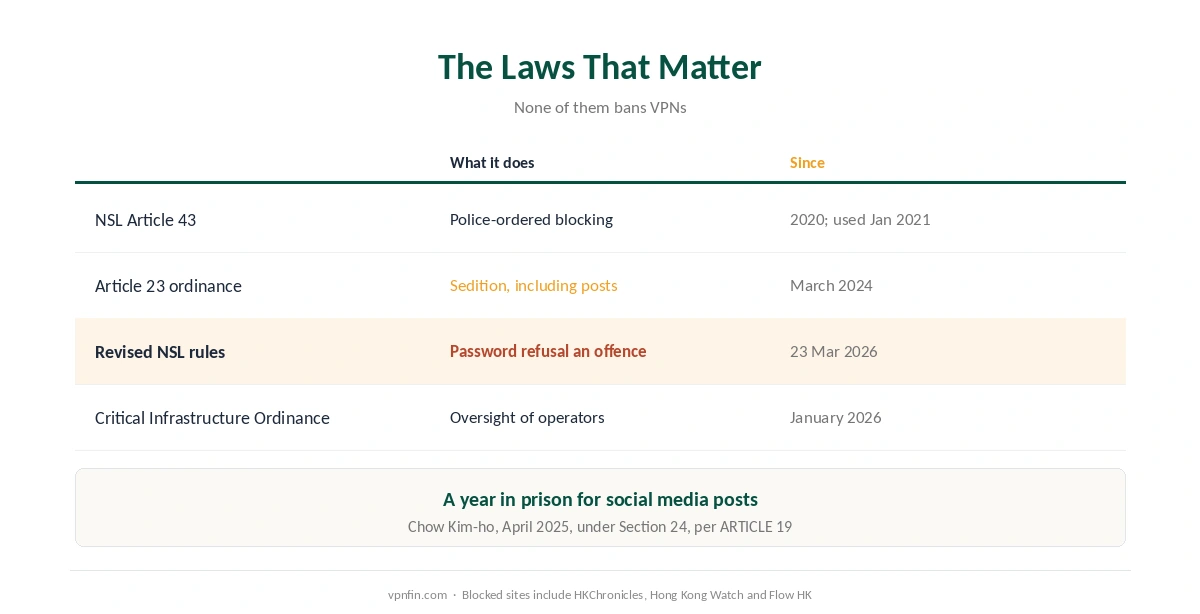
The Laws That Matter
| Law | What it does | Since |
|---|---|---|
| National Security Law, Article 43 | Lets police order providers to block sites | 2020; first used January 2021 |
| Safeguarding National Security Ordinance (Article 23) | Sedition and other offences, including online posts | March 2024 |
| Revised implementing rules | Refusing passwords or decryption help is an offence; device seizure | 23 March 2026 |
| Critical Infrastructure Protection Ordinance | Oversight of infrastructure operators | January 2026 |
Blocking happens through providers, which is why people ask whether a VPN is legal in Hong Kong at all. Police first used Article 43 in January 2021 to have providers cut access to HKChronicles, the South China Morning Post reported. Later blocks included Hong Kong Watch in 2022 and the outlet Flow HK in 2024, Hong Kong Free Press reported.
Posts have led to prison. In April 2025 Chow Kim-ho was jailed for a year for social media posts under Section 24 of the 2024 ordinance, which covers publications with seditious intention, ARTICLE 19 reported.
Is a VPN Legal in Hong Kong After the 2026 Rule Change?
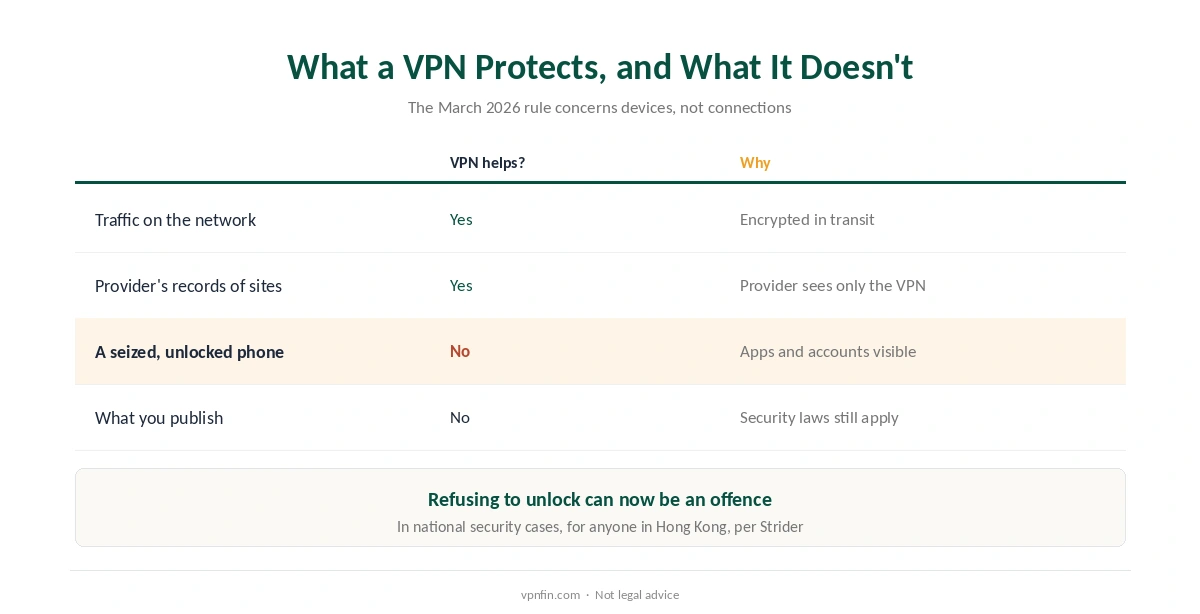
Encryption in transit is not the issue. A VPN hides your traffic from your provider, as our guide to what a VPN hides explains. The March 2026 rules concern what is stored on your devices and whether you must unlock them.
It covers visitors and transit passengers. Strider notes the offence applies to anyone in Hong Kong, including those transiting Hong Kong International Airport. Travellers heading on to mainland China with work devices should know the rule exists, as our travel guide advises for restricted destinations generally.
A provider’s logs matter less than your device. A no-logs VPN such as NordVPN keeps nothing to hand over, as our no-logs guide explains, but a seized, unlocked phone can reveal which apps and accounts you use.
Why ChatGPT and Others Are Unavailable
That is not censorship by Hong Kong. OpenAI cut off Hong Kong, Macau and mainland China in July 2024, and TikTok left of its own accord, as our Hong Kong guide explains. Google’s Gemini became available natively in March 2026.
Using a VPN for them is a terms issue, not a legal one. Our guide to country-restricted AI services covers why companies block regions.
How Hong Kong Compares
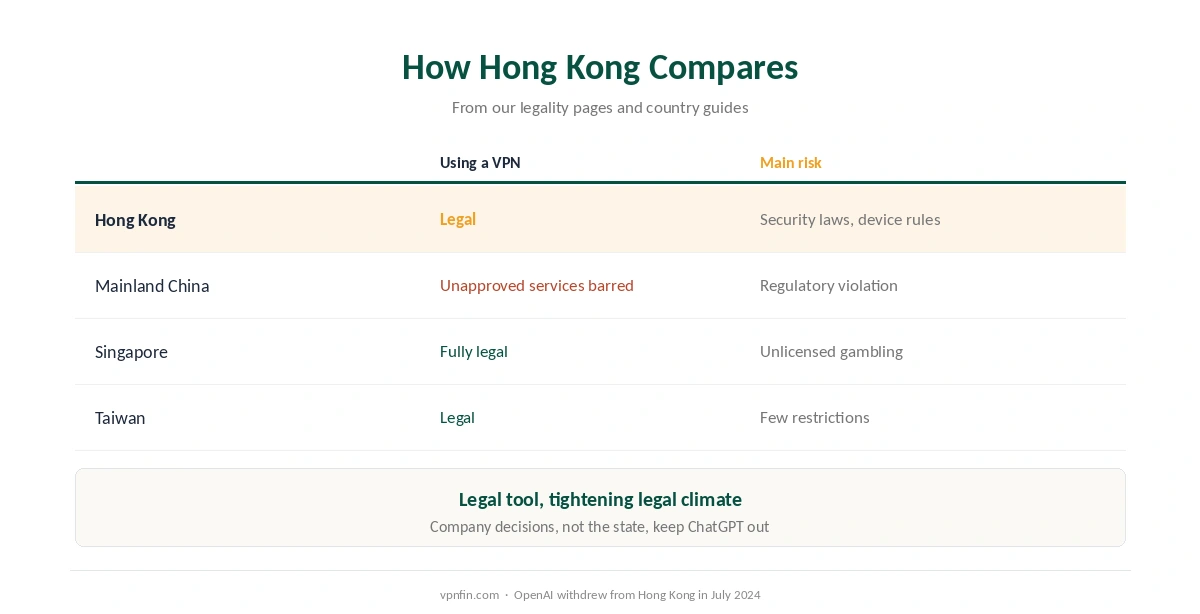
Mainland China treats unapproved VPN services as a regulatory violation, as our China legality page explains; Hong Kong does not.
Singapore and Taiwan are more open still. Singapore draws its main line at gambling, and Taiwan has no Great Firewall and places no limits on VPN use.
So is a VPN legal in Hong Kong compared with its neighbours? Yes, but the security laws make it the most restrictive of the three on content. Our country-by-country guide compares every country we cover.
How We Research
The March 2026 rule changes come from Strider, the first Article 43 block from the South China Morning Post, later blocks from Hong Kong Free Press and a VPN-browser company’s 2026 guide, and the sedition conviction from ARTICLE 19. We are not lawyers, and this is not legal advice. We name each source where used; all were read on 27 September 2026. Our full approach lives on the About Us page.
Hong Kong VPN Legality FAQ
Yes. No Hong Kong law bans VPNs. What you publish or share can still fall under the National Security Law or the 2024 Safeguarding National Security Ordinance.
The National Security Law’s implementing rules changed on 23 March 2026. Refusing to hand over passwords or help decrypt data for police is now an offence, per Strider.
Yes. Strider notes it applies to residents, visitors and people transiting Hong Kong International Airport.
Some. Police can order providers to block sites under Article 43 of the National Security Law, first used against HKChronicles in January 2021.
OpenAI withdrew service from Hong Kong in July 2024. It was the company’s decision, not a Hong Kong government block.
The Verdict
A VPN is legal in Hong Kong, and using one for work, privacy or travel raises no legal issue.
The security laws reach what you publish, and since March 2026 they reach your passwords too. A VPN protects your connection, not a seized device.