
Disclosure: VPNFin is reader-supported. If you buy a VPN through links on this page, we may earn a commission at no extra cost to you. This never affects our ratings — here’s our full disclosure.
When ChatGPT says it is not available in your country, the wording sounds like a verdict on your account. But it is not. Instead, it describes the connection your request arrived on.
And turning on a VPN often makes things worse. The layer in front of these services scores each address for reputation. Because VPNs use shared datacentre ranges, those addresses score badly by default.
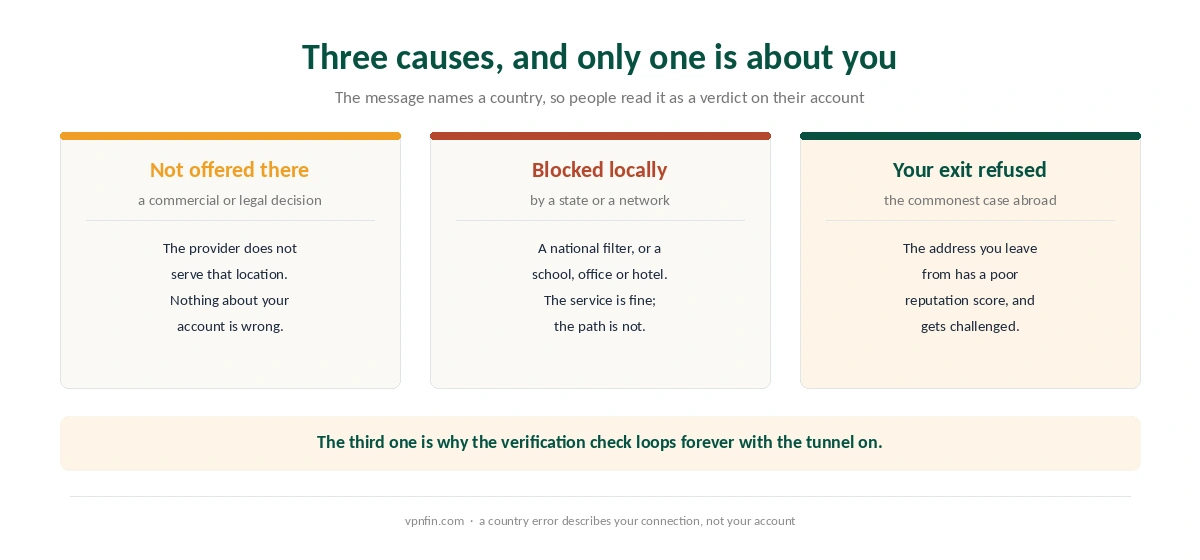
Three Causes, One Message
The service is not offered where you are. That is a commercial or legal decision by the provider. So it says nothing about your account, and nothing about what a tunnel does.
Something local is blocking it. A national filter, or a school, office, hotel or carrier network. The service works; the path does not.
Your exit address is being refused. The commonest version among people already using a VPN, and the one that produces a verification check that loops forever.
⚠️ Those three need different responses. However, one error message hides which you have. That is why most advice on this subject is wrong for most readers.
Why a Connected VPN Gets Refused
These services sit behind bot mitigation. It scores every connection on the reputation of its address. Commercial VPN servers live in hosting address space, and so do scrapers. Therefore those ranges start with a poor score.
Shared exits make it worse. One address serves many people at once, so heavy use by a few gets the whole address challenged or rate-limited for everyone on it.
⚠️ This is the same mechanism as streaming detection, pointed at a different target — and it is why one server works while another does not on every platform we have examined.
Symptoms to recognise: a human-verification check that never completes, an access-denied page, being signed out every few minutes, or a request that fails only when the tunnel is up — and a slow response is a different problem entirely.
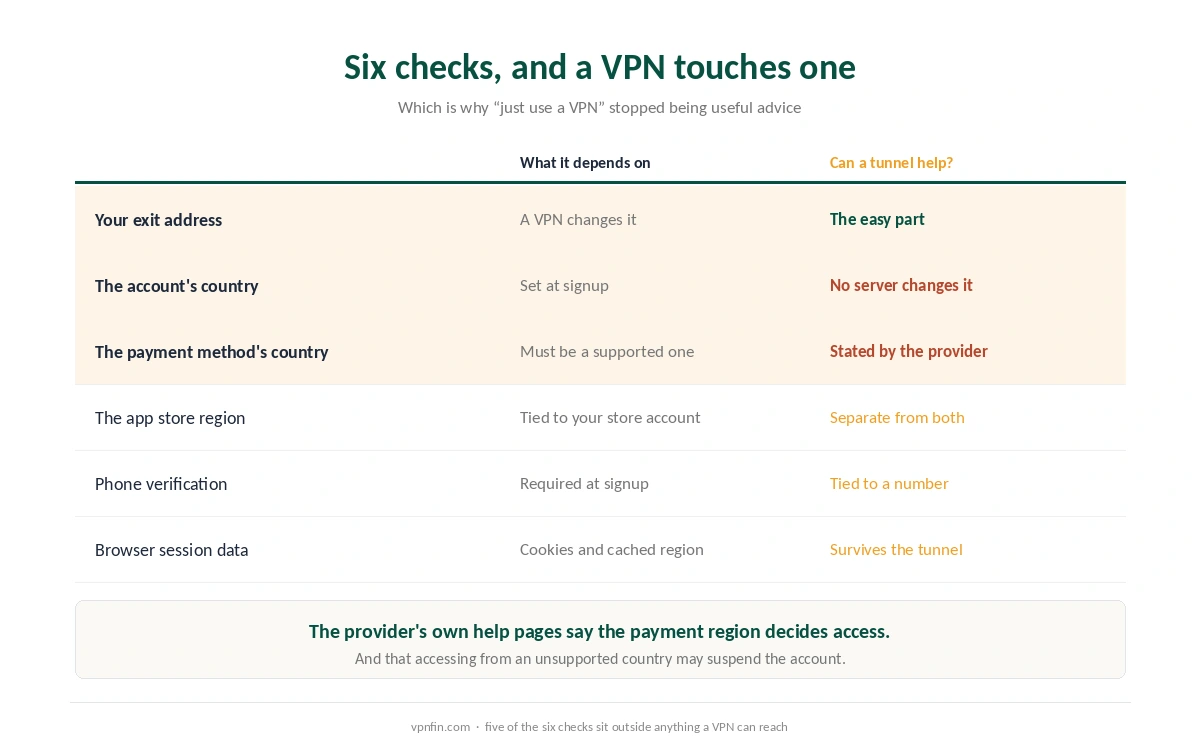
Six Checks, and a VPN Touches One
The exit address is the easy part. Everything else sits outside anything a tunnel can reach.
The account’s country, the payment method’s country, the app store region, phone verification at signup, and cached session data all influence access independently of where your traffic appears to come from.
⚠️ OpenAI’s help pages are explicit about two. First, access from an unsupported country may get the account blocked or suspended. Second, a payment method from outside the supported list will block you outright.
Which is the same shape we found elsewhere. HBO Max reads the country of your card; Peacock reads the address and the card together. A tunnel answers one question out of several.
Which Countries, and Why They Differ
Commonly cited as unsupported in 2026: mainland China, Russia, Iran, Syria, North Korea, Cuba, and the Crimea, Donetsk and Luhansk regions. The set changes, so trust the provider’s own published list over any secondary account, including this one.
The reasons are not the same. In some cases the provider blocks the location to comply with United States export controls. In others the state blocks the service from its side. Mainland China is the case where both apply at once.
⚠️ Hong Kong is the surprising entry. The internet there is open, and the service has been listed as unsupported since 2024 — reporting attributes this to alignment with export control policy, which treats it in the same category as the mainland.
And Italy was a different kind of case entirely, a temporary regulatory suspension over data protection rather than a standing restriction — the distinction our legality guide keeps returning to.
The Line We Will Not Cross
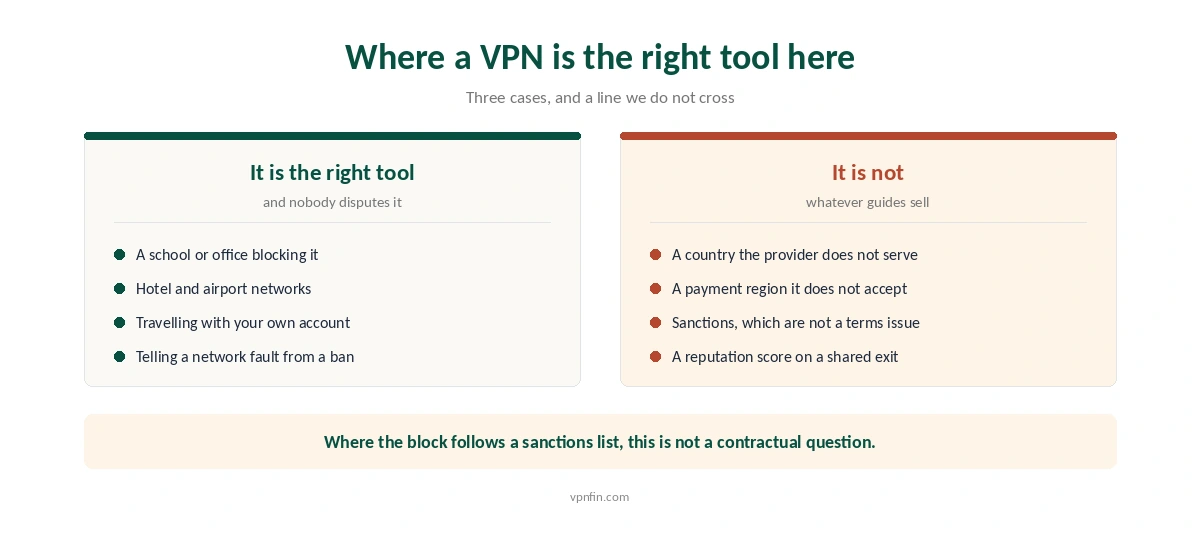
Where the block follows a sanctions list, this is not a terms-of-service question. Iran, North Korea, Syria, Cuba and the occupied Ukrainian regions are on that list, and circumventing an export control is a different category of act from breaching a subscription agreement.
So we do not describe the workarounds. Virtual phone numbers, virtual payment cards and shared accounts are all sold for this purpose by companies that also publish the guides recommending them. We are naming that they exist and stopping there.
⚠️ And the provider states the consequence itself. Its help pages say access from an unsupported country may result in the account being blocked or suspended — the risk a reader takes, whatever a guide implies. Our main ranking covers the providers worth using where a VPN genuinely is the right tool.
This is a firmer line than we draw for streaming, and the reason is the sanctions rather than the terms. For platforms it is a contract; here it is sometimes law.
Where a VPN Is Genuinely the Answer
A network blocking the service. Campus wifi, a corporate network, a hotel or an airport — the case a VPN was built for, and the commonest one in practice.
Travelling with your own account. Your subscription, your usual country, a connection somewhere else — the ordinary case, and the least disputed one.
Diagnosing which of the three causes you have. An error that disappears on a different network was local; one that follows you was not.
⚠️ If a filter refuses the tunnel itself, that is a separate setting — obfuscation exists for exactly that, and no laboratory tests whether it works.
How We Research
This guide draws on OpenAI’s own help centre article for the statements about unsupported countries, payment methods and account suspension, on published accounts from 2026 for the commonly cited list of unsupported regions and the Hong Kong position, and on technical write-ups for the address-reputation mechanism behind the verification loop. Several sources on this subject sell the workarounds they recommend — virtual numbers, virtual cards and shared accounts — and we have not reproduced their instructions. One source we excluded entirely made unverifiable product claims about model capabilities alongside its access advice. The list of unsupported regions changes, so treat any list including ours as a snapshot. We do not run our own tests. Our method lives on the About Us page.
Country Error FAQ
Because of where your connection appears to come from, not because of your account. Three different situations produce the same message: the provider does not serve that location, something local is blocking the service, or the address you are exiting from is being refused.
Because the bot-mitigation layer scores address reputation, and commercial VPN servers sit in hosting address space that carries a poor default score. Shared exits compound it — heavy use by a few people gets the whole address challenged for everyone on it.
It changes one of at least six checks. The account’s country, the payment method’s country, the app store region, phone verification and cached session data all matter independently. OpenAI’s help pages also state that access from an unsupported country may result in the account being blocked or suspended.
Accounts published in 2026 commonly cite mainland China, Russia, Iran, Syria, North Korea, Cuba and the Crimea, Donetsk and Luhansk regions. The set changes, so the provider’s own published list is what to check.
The provider’s terms prohibit access from unsupported countries and state the account may be suspended. Where the restriction follows a sanctions list — Iran, North Korea, Syria, Cuba and the occupied Ukrainian regions — it is not only a terms question, and we do not cover workarounds for those cases.
The Verdict
The message is about your connection, not your account. Three different causes share one wording, and knowing which you have decides whether a VPN is relevant at all.
For people already using one, the VPN is usually the cause. Shared datacentre addresses score badly with bot mitigation, which is why the verification check loops rather than passing.
And where the restriction follows a sanctions list, we stop. That is a firmer line than we draw for streaming platforms, and it is drawn where the law is rather than where the terms are.