
Disclosure: VPNFin is reader-supported. If you buy a VPN through links on this page, we may earn a commission at no extra cost to you. This never affects our ratings — here’s our full disclosure.
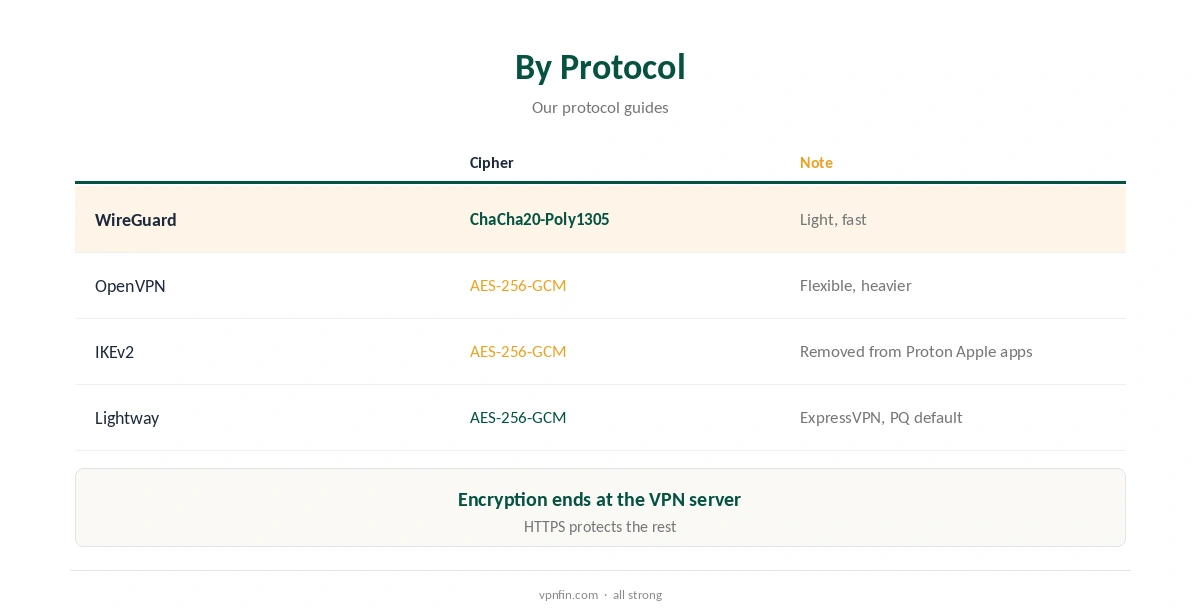
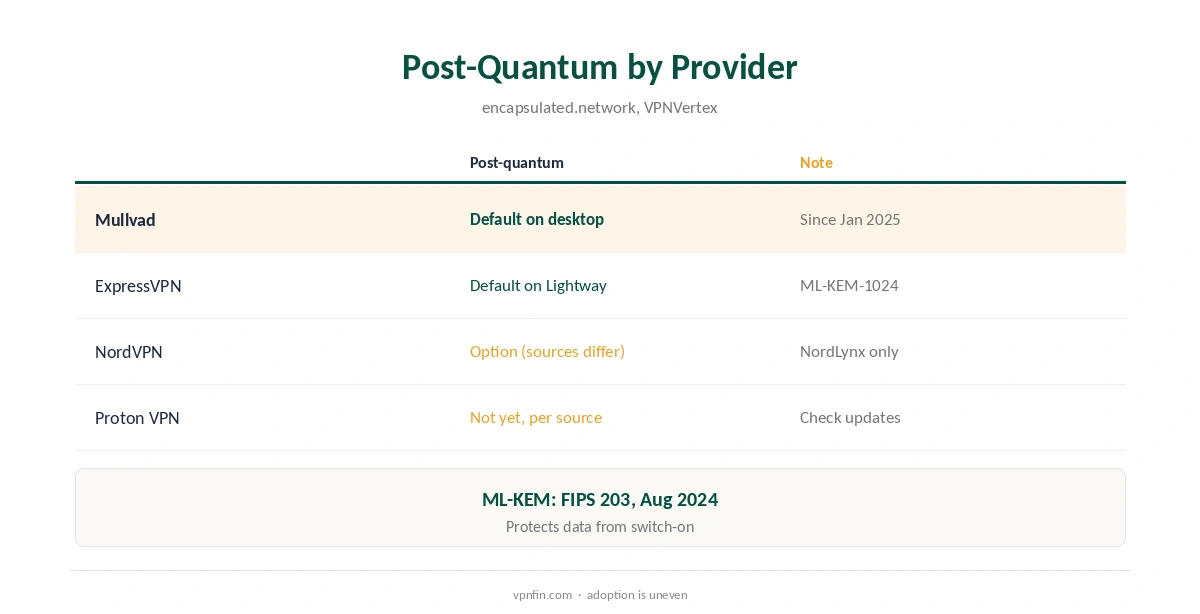
VPN encryption scrambles traffic between your device and the VPN server, so your internet provider and anyone on the same Wi-Fi cannot read it. Modern VPNs use one of two ciphers: AES-256-GCM, common with OpenVPN, IKEv2 and ExpressVPN’s Lightway, or ChaCha20-Poly1305, used by WireGuard. A key exchange sets up fresh keys for each session. Since NIST published ML-KEM as FIPS 203 in August 2024, providers have begun adding post-quantum key exchange: Mullvad on desktop by default since January 2025, our tables record.
This guide explains the parts of VPN encryption, what they protect and what to check.
What VPN Encryption Protects
Encryption covers the path from your device to the VPN server. After the server, traffic travels to websites as normal, protected only by HTTPS where sites use it. Our guide to what a VPN hides covers what remains visible.
The Ciphers
AES-256-GCM and ChaCha20-Poly1305 are both considered strong. ChaCha20 runs fast on phones without AES hardware, which is one reason WireGuard is light on battery. Our AES-256 vs ChaCha20 guide compares them in depth.
Key Exchange and Forward Secrecy
Before data flows, the app and server agree keys, using methods such as Curve25519 in WireGuard. Fresh keys per session mean that a key stolen later cannot unlock past sessions, a property called forward secrecy.
Post-Quantum VPN Encryption
Encapsulated.network notes Mullvad turned on post-quantum key exchange by default on desktop in January 2025, ExpressVPN by default on Lightway, and NordVPN as an option; sources disagree on whether NordVPN’s is default. VPNVertex found NordVPN’s works only on NordLynx. Our post-quantum VPN guide explains the threat.
Protocols and Encryption
WireGuard uses ChaCha20; OpenVPN and IKEv2 usually use AES-256-GCM. Proton removed IKEv2 and OpenVPN from its Apple apps, keeping WireGuard and Stealth. Our WireGuard vs OpenVPN guide compares the protocols.
Is VPN Encryption Ever Broken?
The failures we cover in our guides come from leaks, logging or outdated apps, not from breaking AES-256 or ChaCha20. Keep apps updated and pick providers that have had their no-logs claims audited, as our VPN audit tracker shows.
Harvest Now, Decrypt Later
Comparitech describes the threat that quantum computers could later decrypt recorded traffic, with some experts expecting that capability in the early 2030s. Post-quantum key exchange protects data only from the moment you switch it on.
Encryption and Speed
Strong encryption costs little on modern devices. VPNSmith measured WireGuard at about 3 to 5% CPU on a phone, against 12 to 18% for OpenVPN, which also explains the battery difference.
Encryption on Routers
A router VPN encrypts traffic for every device at home, but only between the router and the VPN server. Our router setup guide explains the set-up.
VPN Encryption vs HTTPS
HTTPS encrypts traffic between your browser and a website; a VPN encrypts everything between your device and its server. Together they hide content from your local network and your provider, while the VPN also hides which sites you visit from them.
Obfuscation and Encryption
Obfuscation does not add stronger encryption; it disguises encrypted VPN traffic so filters do not recognise it. Our obfuscation guide explains the difference.
Audits and Code
Strong ciphers matter only if the app implements them correctly. WireGuard’s small codebase is easier to review, and providers publish audits of their apps; our protocol guides cover both.
VPN Encryption and the Law
Some countries restrict VPNs or require providers to log, as India’s CERT-In rules did in 2022. Encryption protects content, but local law decides what a provider must keep. Our VPN legality guide covers the rules.
Quick Rule
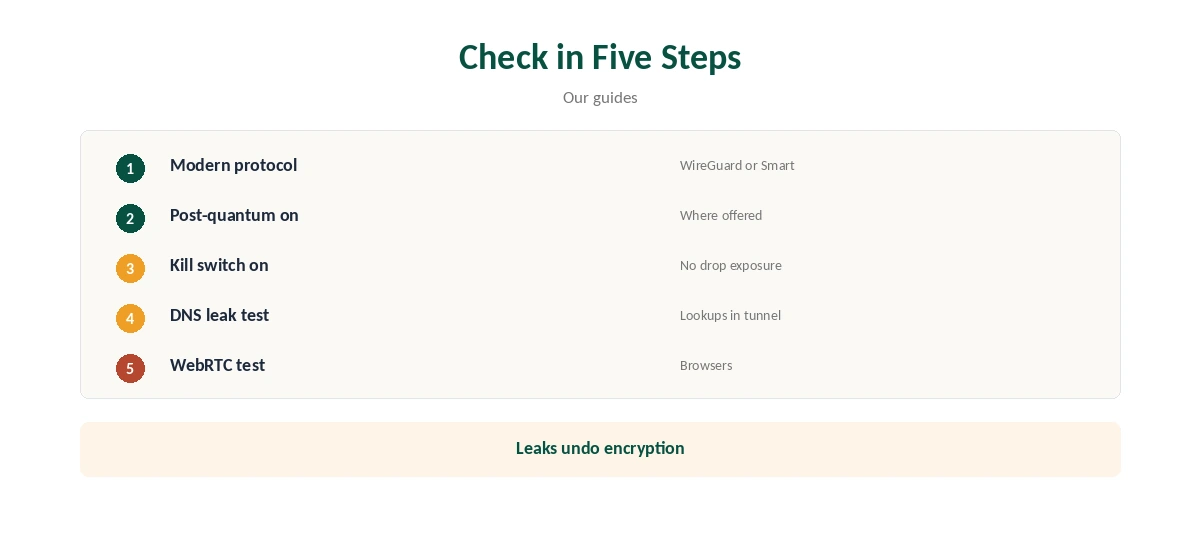
Modern protocol, post-quantum on where offered, kill switch on, leak tests run. Those four steps matter more than choosing between AES and ChaCha20.
Is VPN Encryption Enough for Privacy?
Not on its own. Encryption hides content in transit, but accounts, cookies and fingerprints still identify you. Our guide to whether a VPN can be traced covers the gaps.
Encryption on Free Plans
Reputable free plans, such as Proton’s, use the same encryption as paid plans; the limits are servers and features, not ciphers.
Encryption Strength Labels
Marketing pages often say military-grade encryption. That usually means AES-256, the same standard most reputable providers use; it is not a reason to choose one provider over another.
Keeping It Updated
Encryption libraries and protocols improve over time. Update the app so it uses current versions.
Who Needs to Think About This
Most users only need a modern protocol and the kill switch. Journalists and others facing well-funded adversaries should add post-quantum options, audited providers and careful account habits, since encryption cannot protect what accounts reveal.
Checking Your Settings
Keep Smart Protocol or WireGuard unless you need obfuscation, turn on post-quantum options where offered, keep the kill switch on, and run a leak test. Encryption fails quietly if traffic leaks outside the tunnel. Our guide to VPN Protocols covers WireGuard, OpenVPN, IKEv2 and the proprietary ones.
How We Research
This page draws on encapsulated.network’s and VPNVertex’s 2026 post-quantum coverage, Tom’s Guide, Comparitech and our protocol and cipher guides. We cross-checked these sources against each other, and where they conflict or something can’t be verified, we say so in the text rather than guessing. We checked time-sensitive figures, including prices in US dollars, on 8 October 2026. The main source we relied on is Comparitech’s post-quantum guide. Our full approach lives on the About Us page.
VPN Encryption FAQ
AES-256-GCM or ChaCha20-Poly1305, with a key exchange for each session.
Both are strong; ChaCha20 is faster on phones without AES hardware.
Only between your device and the VPN server.
A key exchange designed to resist future quantum computers, such as ML-KEM.
Mullvad by default on desktop, ExpressVPN on Lightway, NordVPN as an option.
The Verdict
VPN encryption is strong across reputable providers; the weak points are leaks and logs, not the ciphers. Turn on post-quantum options where offered and test for leaks.