
Disclosure: VPNFin is reader-supported. If you buy a VPN through links on this page, we may earn a commission at no extra cost to you. This never affects our ratings — here’s our full disclosure.
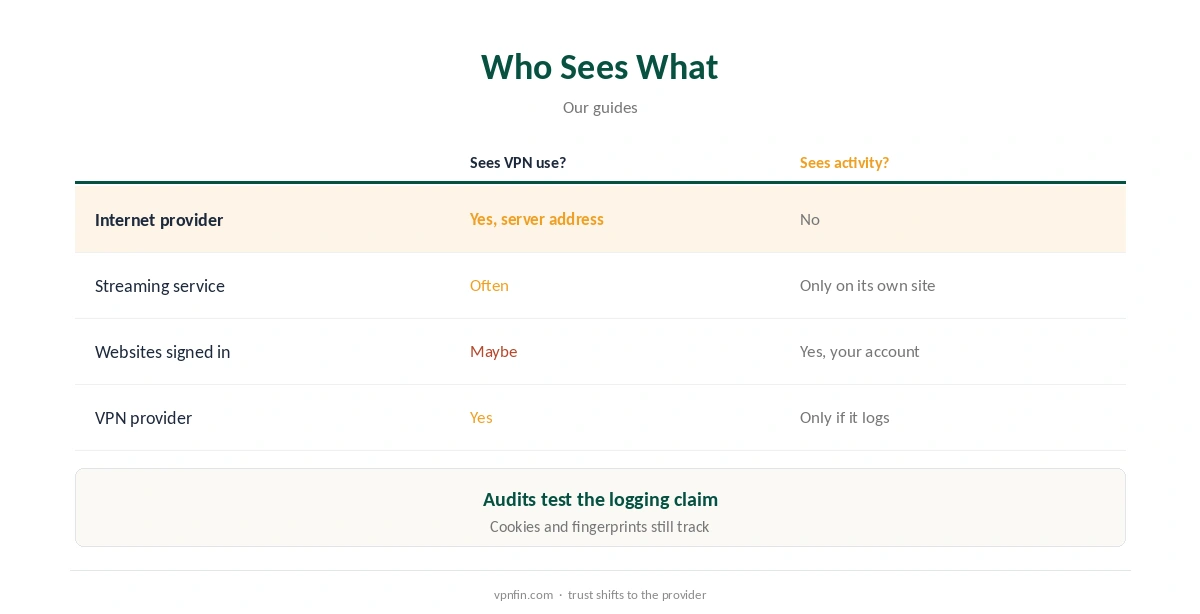
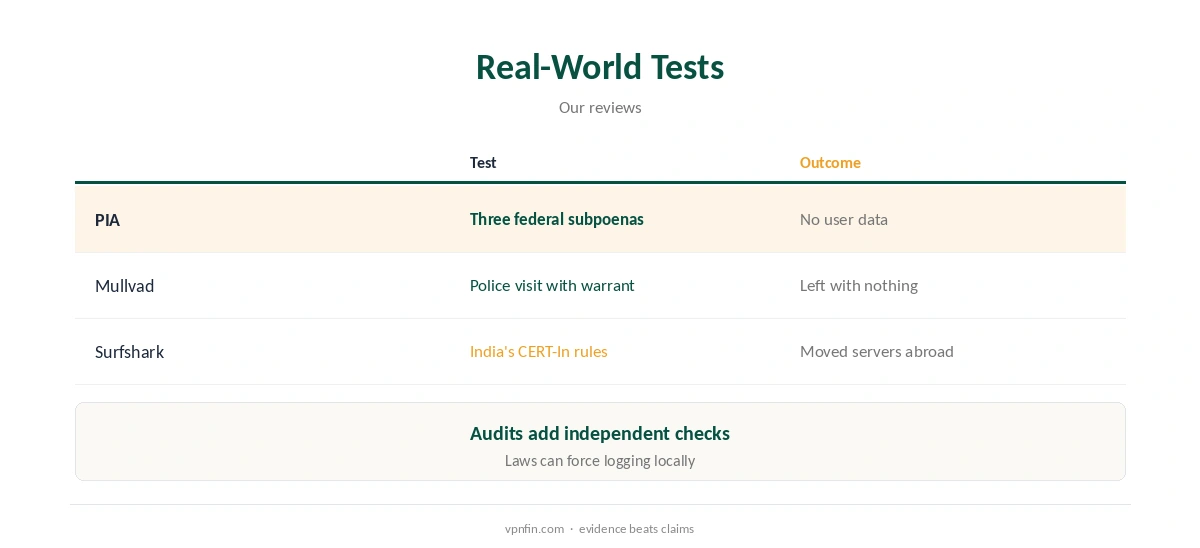
Can VPN use be traced? Two questions hide in that one. Whether someone can tell you use a VPN: often yes, since your internet provider sees a connection to a VPN server, and streaming services and some governments detect VPN traffic. Whether anyone can trace your activity back to you: that depends on what the provider keeps and on leaks. PIA’s no-logs claim survived three federal subpoenas that produced no user data, and Mullvad’s survived a police visit that left with nothing.
This guide separates detection from tracing and shows how to close the gaps.
Can VPN Use Be Detected?
Your internet provider sees that you connect to a VPN server’s address and how much data you send, though not what is inside. Streaming services keep lists of VPN addresses, and BitsFromBytes reports Netflix added route and DNS mismatch checks in 2026. China’s and Russia’s filters use deep packet inspection against VPN protocols, our tables record.
Can VPN Activity Be Traced to You?
Only through logs, leaks or mistakes. A court can order a provider that keeps connection or activity logs to hand them over. That is why audits matter: our VPN audit tracker shows which providers had their no-logs claims checked.
Court and Raid Records
Three federal subpoenas to PIA produced no user data, and officers who visited Mullvad with a warrant left with nothing, our reviews record. Both are tests of the claim beyond an audit. Our PIA review and Mullvad review cover each.
Leaks That Undo a VPN
A DNS leak sends lookups outside the tunnel, and a WebRTC leak can reveal your real address in a browser. A dropped tunnel without a kill switch exposes traffic until it reconnects. Our DNS leak guide and WebRTC leak guide explain the tests.
What a VPN Never Hides
Accounts you sign in to still know it is you, and cookies and browser fingerprints follow you across sites. Our guide to what a VPN hides covers the full list.
Closing the Gaps
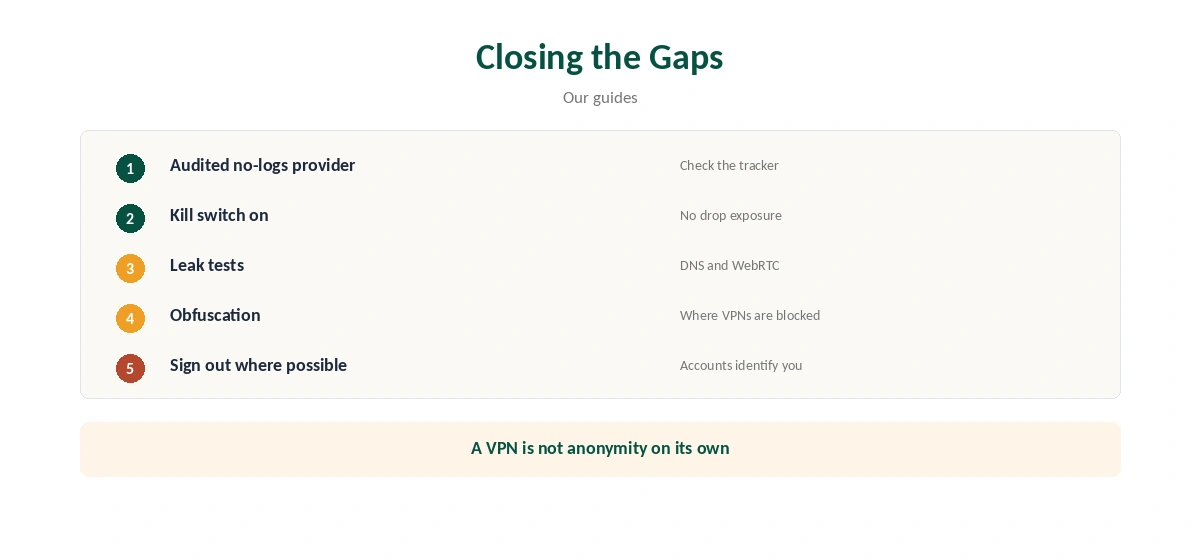
Choose an audited no-logs provider, turn on the kill switch, run leak tests, use obfuscation where networks block VPNs, and sign out of accounts you do not need.
Can VPN Use Be Traced by Your Employer or School?
On a managed laptop or network, administrators may see that you connect to a VPN and may block it. Device management software can also record activity before it reaches the VPN, so a VPN does not hide activity on a work device.
Payment Trails
Paying by card links your name to the subscription, though not to what you do through it. Mullvad accepts cash by post and AirVPN cryptocurrency for buyers who want no payment link.
Obfuscation
Obfuscation disguises VPN traffic as ordinary web traffic, which helps where networks block VPNs. Proton’s Stealth and NordVPN’s obfuscated servers are examples; NordVPN shares an owner, Nord Security, with Surfshark. Our obfuscation guide explains how it works.
Testing Your Own Setup
Open our VPN test page after connecting to confirm the address changed, then run the DNS and WebRTC leak tests.
Can VPN Use Be Traced Through Your Accounts?
Yes, if you sign in. Google, social networks and shops identify you by account, whatever IP address you use. A VPN changes the address, not who you are signed in as.
Browser Fingerprints
Sites can recognise a browser by its settings, fonts and screen size, even across IP addresses. Privacy-focused browsers reduce that; a VPN alone does not.
Which Providers to Trust
Look for audited no-logs claims, a public record under legal pressure, and a jurisdiction you understand. Our VPN ownership guide explains why the owner matters.
Can VPN Servers Be Seized?
Police can seize a server. Providers running RAM-only servers, such as Surfshark, hold nothing on disk to recover, Wikipedia notes for Surfshark’s network. Audits test whether the claim holds.
Quick Rule
Detection: assume it is possible. Tracing: depends on logs, leaks and accounts. Close the last two yourself.
Public Wi-Fi
On a shared network, other users and the network owner cannot read your traffic through the tunnel, though they can see that you use a VPN. Our public Wi-Fi guide covers the risks.
Several Devices
Each device leaks or protects on its own. Run the leak tests on every phone and computer you use, not only the first one you set up. For what its audits and history show, see our page on whether Windscribe is safe.
Keep It Updated
Update the app regularly, since fixes often close leak paths found after release.
Laws That Force Logging
India’s CERT-In rules from 2022 required VPN providers with servers there to log users for 180 days, so providers such as Surfshark moved to virtual Indian servers hosted abroad. Where a provider keeps its servers decides what local law can force it to keep. Our guide to VPN for Journalists covers evidence, obfuscation and the limits.
How We Research
This page draws on our audit, court-record and leak guides, BitsFromBytes on Netflix detection, our China and Russia tables and Surfshark’s CERT-In announcement. We cross-checked these sources against each other, and where they conflict or something can’t be verified, we say so in the text rather than guessing. We checked time-sensitive figures, including prices in US dollars, on 8 October 2026. The main source we relied on is Surfshark’s CERT-In announcement. Our full approach lives on the About Us page.
Can VPN Be Traced FAQ
Yes; it sees the server address and data volume, not the contents.
Only if logs exist or something leaks; audited no-logs providers limit that.
Yes; they use address lists and, at Netflix, route and DNS checks.
PIA’s, through three subpoenas that produced no user data.
Not if you are signed in; the account still identifies you.
The Verdict
Can VPN use be traced? Detection is often possible; tracing activity to you depends on logs and leaks. Pick an audited provider, use the kill switch and test for leaks.