
Disclosure: VPNFin is reader-supported. If you buy a VPN through links on this page, we may earn a commission at no extra cost to you. This never affects our ratings — here’s our full disclosure.
ProtonVPN vs FastestVPN is really a question of how you want to pay as little as possible. Proton offers a free plan with no data cap, backed by five annual Securitum audits of its no-logs policy, and paid plans at about $71.76 for two years. FastestVPN skips subscriptions for a one-off lifetime payment that promotions have put between $23 and $40, with a single 2023 audit by Altius IT.
This guide weighs free against lifetime, then privacy, features, devices and streaming.
ProtonVPN vs FastestVPN: Free Plan or Lifetime Deal
Proton’s free tier costs nothing, has no time limit and no data cap, but covers one device, picks a server for you from up to 10 countries, and leaves out P2P, Secure Core and NetShield. FastestVPN’s lifetime plan costs money once and then unlocks its full service on 10 devices.
Light users can stay on Proton free indefinitely; heavier users comparing paid options should weigh the two costs below, including renewals.
What Four Years Cost
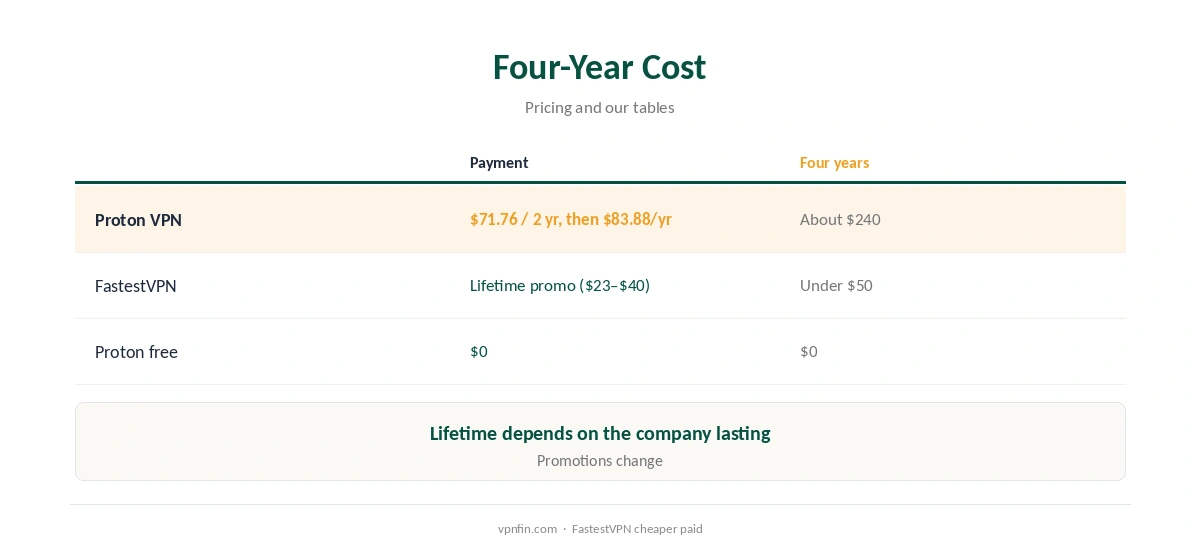
Proton’s paid plan costs about $71.76 for the first two years and $83.88 a year after that, roughly $240 over four years in total. A FastestVPN lifetime plan bought on promotion costs under $50 in total.
The catch is longevity: a lifetime plan only pays off while the company operates and honours it. Our renewal price guide explains the trade-off.
ProtonVPN vs FastestVPN on Privacy
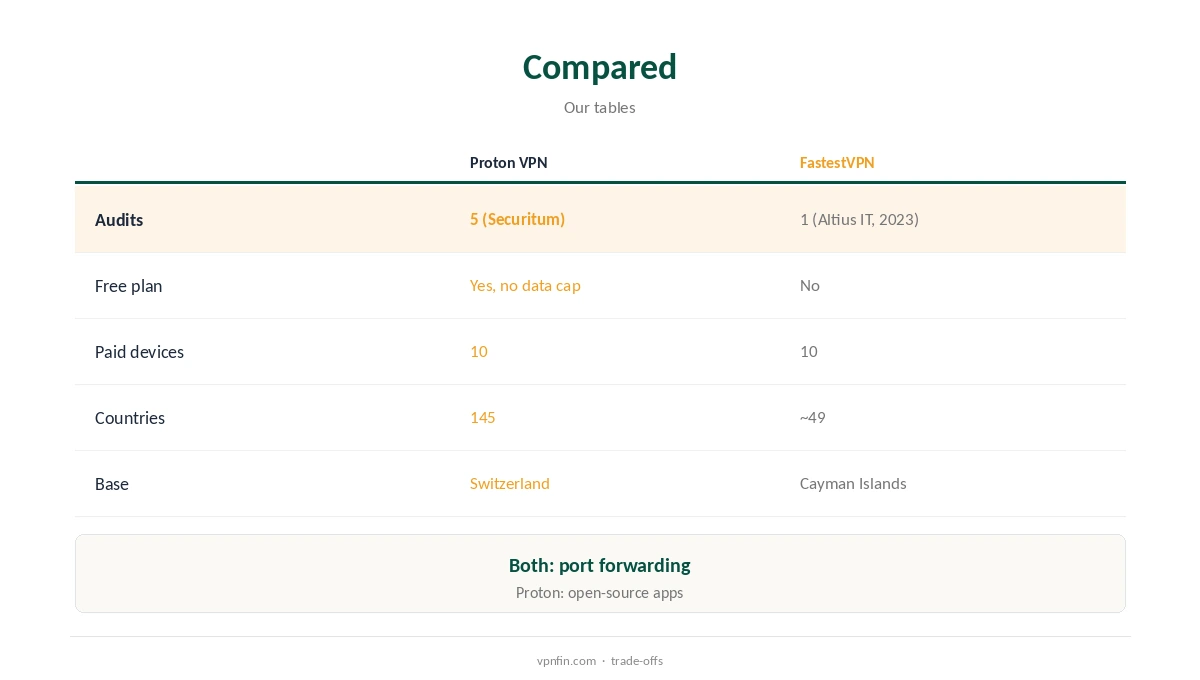
Proton has published five yearly no-logs audits, the latest in June 2026, and its apps are open source. FastestVPN’s one audit dates from 2023 and has not been repeated in our table, and it states the Cayman Islands as its base while its browser extension lists a Houston developer.
For evidence that practices hold over time, Proton is well ahead. Our VPN audit tracker compares records.
Features
Both include port forwarding. Proton adds Secure Core multi-hop, NetShield blocking and its Stealth protocol on paid plans. FastestVPN bundles an ad blocker in its browser extension and offers WireGuard, IKEv2 and OpenVPN, with no split tunnelling on iOS or macOS.
Proton’s feature list is longer and better documented on its support site.
Devices, Network and Streaming
Both allow 10 devices on paid plans. Proton lists more than 19,700 servers in 145 countries, Tom’s Guide reported; FastestVPN runs about 800 servers in roughly 49 countries.
Travellers needing unusual countries will find many more on Proton’s network.
Proton supports streaming on paid plans only; its free servers do not block Netflix but carry no guarantee. Several reviews found FastestVPN worked with streaming services, our tables record.
Test your own streaming services within each refund window.
Refunds
Proton refunds paid plans in full within 30 days of the first purchase, once per user, excluding cash and bank transfers. Check FastestVPN’s refund terms for lifetime deals at checkout.
Proton’s free plan also lets you test its apps before paying anything.
Platforms
Proton has apps for Windows, Mac, Linux, iOS, Android, Android TV and Amazon’s Vega OS sticks. FastestVPN offers a Mac App Store app, browser extensions for Chrome, Firefox and Edge, an Android app for TV boxes and command-line guides for Linux.
Proton’s free plan works on its TV apps too, though streaming support needs a paid plan with more countries.
Restrictive Networks, and Who Runs Each
Proton’s Stealth protocol and Smart protocol help when a network blocks VPNs, its support pages say. FastestVPN lists IKEv2, WireGuard, TCP and UDP on Mac, and we found no dedicated obfuscation feature in our sources.
For censored networks, Proton has the better-documented tools in our sources.
Proton AG is a Swiss company outside the big VPN groups. FastestVPN states the Cayman Islands as its base, while its Chrome extension lists Fastest Technology LLC in Houston.
Our VPN ownership guide explains why that matters.
Port Forwarding in Practice
Proton’s Windows app shows the active forwarded port and lets you save profiles with port forwarding switched on, its release notes say, which makes setting up a torrent client easier. FastestVPN includes port forwarding as part of its service, our tables record.
Confirm the port is open in your client’s settings after connecting, then run a quick test download.
Linux and Support
Proton’s official Linux app supports Debian and Ubuntu with GNOME, Fedora and Arch, with a Snap build that lacks Stealth, split tunnelling and ARM support, its setup guide says. FastestVPN supports Linux through OpenVPN on the command line, with WireGuard files available on request from its support address.
Proton is the easier choice for Linux desktops of the two.
Proton offers live chat to paid subscribers, its release notes confirm, and a support form for everyone else. FastestVPN’s guides point users to email support for some setups, such as WireGuard on Linux.
Test support response times during each refund window.
How We Research
This page draws on Proton’s plans page and terms, Tom’s Guide’s Proton coverage, FastestVPN’s support pages and our audit and price tables. We cross-checked these sources against each other, and where they conflict or something can’t be verified, we say so in the text rather than guessing. We checked time-sensitive figures, including prices in US dollars, on 8 October 2026. The main source we relied on is Proton VPN’s plans page. Our full approach lives on the About Us page.
Proton VPN vs FastestVPN FAQ
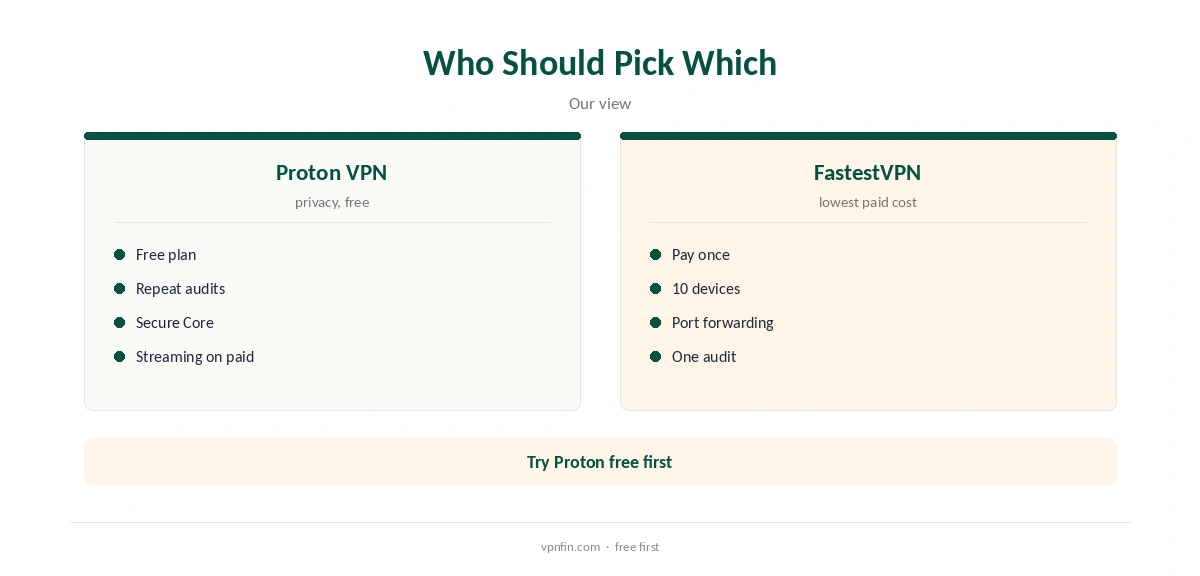
Proton for audits and a free plan; FastestVPN for the lowest paid cost.
For light use on one device, yes.
On price, yes, while the company keeps honouring it.
Proton, with five against FastestVPN’s one.
Yes.
The Verdict
ProtonVPN vs FastestVPN: start with Proton’s free plan; pay Proton for audited privacy and features, or FastestVPN once for the lowest long-term cost.