
Disclosure: VPNFin is reader-supported. If you buy a VPN through links on this page, we may earn a commission at no extra cost to you. This never affects our ratings — here’s our full disclosure.
TunnelBear vs Norton VPN compares two VPNs owned by antivirus companies. TunnelBear, owned by McAfee, has had Cure53 audit it every year since 2017, eight times by 2024, VPN.com notes, allows unlimited devices and has a 2 GB monthly free plan. Norton VPN, from Gen Digital, has two no-logs audits, a 60-day refund and Plus at $29.99 for the first year, Tom’s Guide reports.
This guide compares evidence, devices, free use, refunds, censorship tools, price and fit.
TunnelBear vs Norton VPN on Evidence
Publishing critical findings is a good sign: it shows the audits are real tests, not marketing.
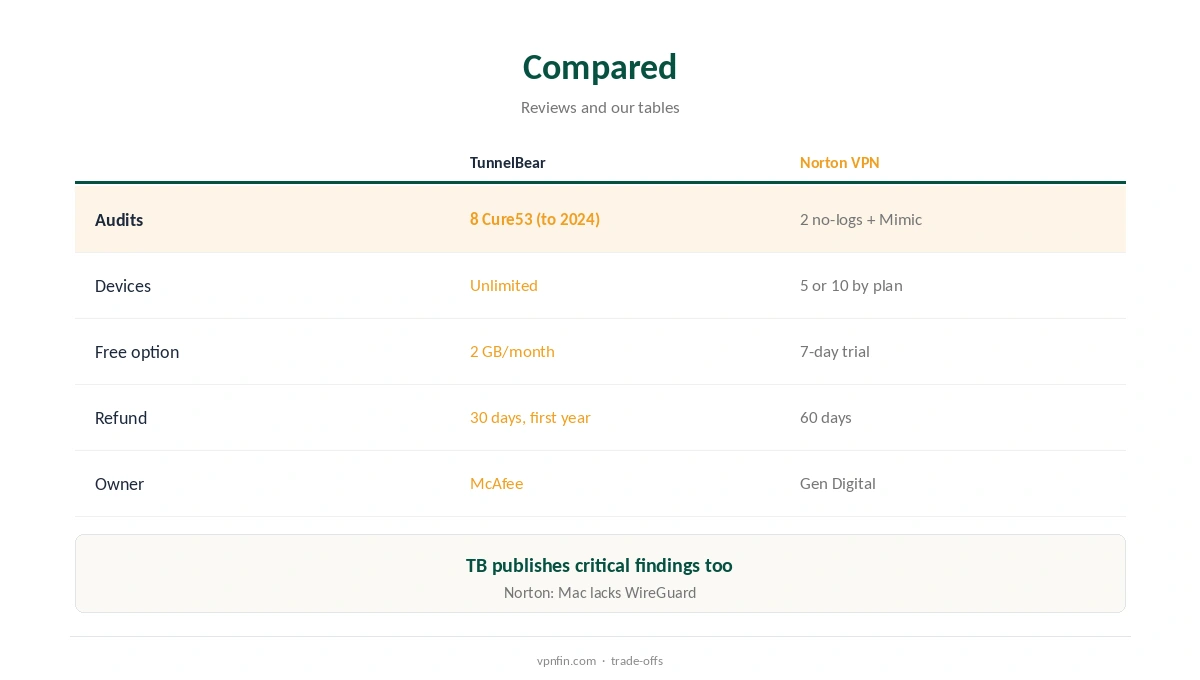
TunnelBear publishes its eight yearly Cure53 audits in full, VPN.com notes. Those reports are not always flattering: one Cure53 review found 32 issues, including two critical and eight high-severity vulnerabilities, TechRadar notes, and TunnelBear published it rather than hiding it. Auditors reviewed Norton’s no-logs policy in 2024 and October 2025, and its Mimic protocol in December 2025.
TunnelBear has the longer record and publishes the bad findings too. Our VPN audit tracker compares providers.
TunnelBear vs Norton VPN on Devices, Free Use and Trials
A router running either VPN counts as one device, though TunnelBear offers little router support.
TunnelBear allows unlimited devices on paid plans. Norton’s Standard and Plus plans allow five, and Ultimate allows 10, Security.org lists.
Families with many devices fit TunnelBear without upgrading tiers.
Use either to check speeds on your own connection before paying.
TunnelBear’s free plan gives 2 GB a month and, Gizmodo notes, closely resembles the paid version apart from the data cap. Norton has no free plan but offers a seven-day free trial, Experte notes.
TunnelBear’s free plan lets you test indefinitely; Norton’s trial unlocks the full service briefly.
Refunds and Price
Buy TunnelBear’s yearly plan on its website if you want the refund option.
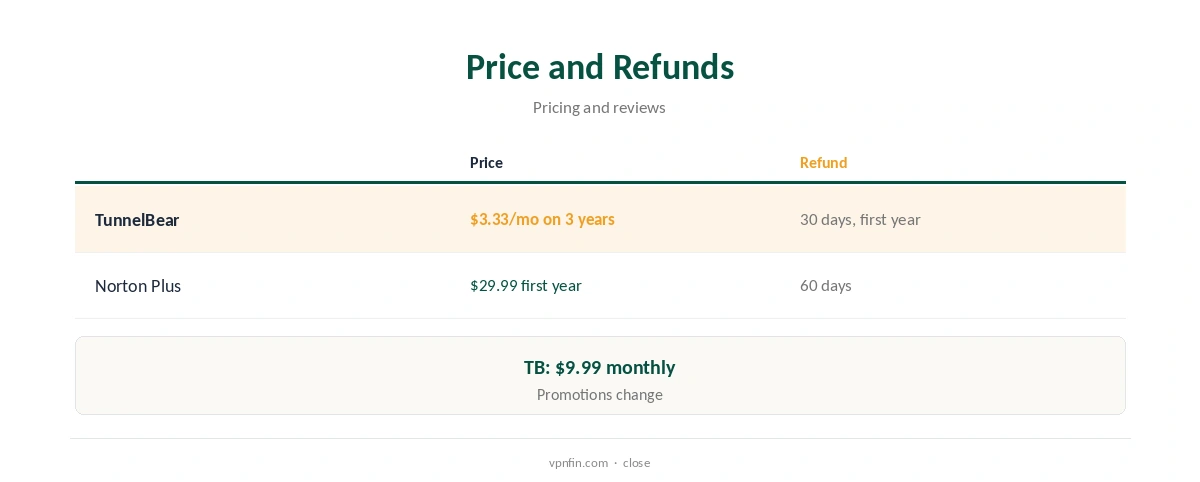
Norton gives 60 days for refunds, and Plus costs $29.99 for the first year. TunnelBear costs $9.99 monthly, $4.99 a month on a yearly plan or $3.33 a month on three years, TechRadar lists, and refunds only the first year of a yearly plan bought on its site within 30 days.
Norton has the longer refund window; TunnelBear’s three-year price is low. Our renewal price guide compares.
Censored Networks
Test from the network you will actually use.
At home, you need neither tool.
TunnelBear’s GhostBear mode disguises VPN traffic, VPN.com notes. Norton’s Mimic protocol disguises it as HTTPS, and Norton’s engineering director says it sees significant use in certain regions, Tom’s Guide reports.
Both have tools for filtered networks; test from the network you will use.
Platforms and Owners
Check apps first.
TunnelBear’s browser extensions cover Chrome, Firefox and Edge, our tables record.
TunnelBear offers little support for Linux, routers and games consoles, TechRadar notes. Norton’s Mac app lacks WireGuard and OpenVPN, and its apps have fewer features on Apple devices, Tom’s Guide notes.
Check support on the devices you use most.
Both owners also sell antivirus and identity products.
McAfee owns TunnelBear, based in Toronto. Gen Digital owns Norton alongside Avast, Avira, AVG and CCleaner, and Norton’s policy allows sharing data within the group, Security.org notes.
Our VPN ownership guide explains why owners matter.
Who Each Is For
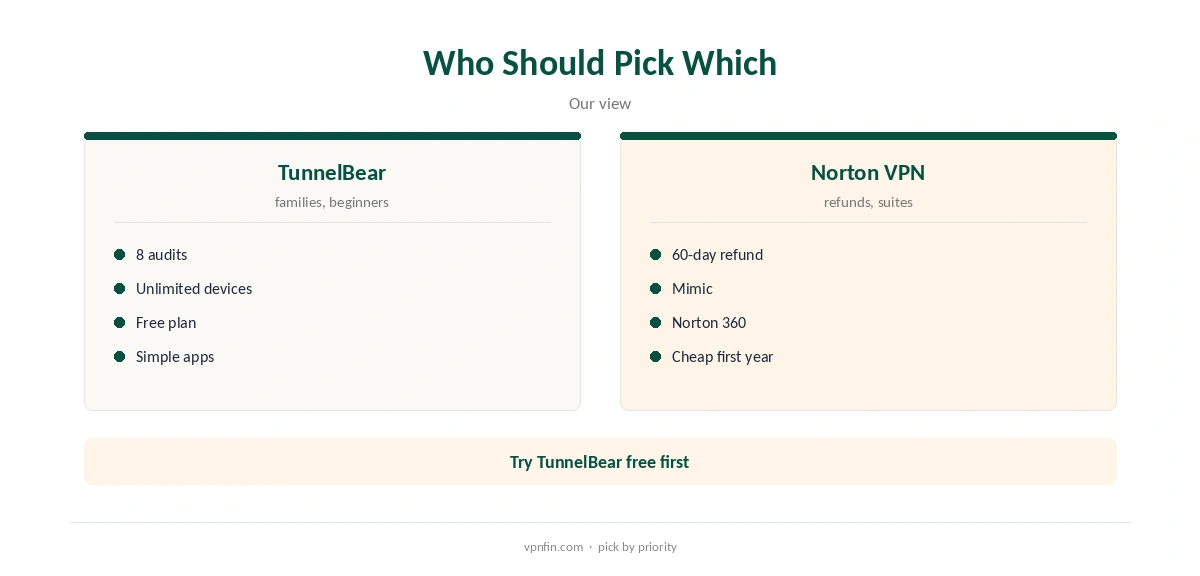
Both are easy for beginners; the deciding factors are device count, refund length and audit history.
TunnelBear suits beginners and families who want unlimited devices, a free plan and a long, published audit record. Norton suits Norton 360 users and anyone wanting a 60-day refund and Mimic.
Try TunnelBear free first if you are unsure.
Kill Switch, Split Tunnelling and Streaming
TunnelBear calls its kill switch VigilantBear, VPN.com notes. Norton offers split tunnelling on Windows and Android only, without an inverse mode, Security.org and PCWorld note.
Test any kill switch by switching Wi-Fi off and on while connected.
Tom’s Guide highlights Norton VPN’s strong streaming unblocking. Testers disagree on TunnelBear’s streaming, with some finding US Netflix working on paid plans and others finding most services blocked, our tables record.
For streaming first, Norton has the more consistent recent reviews.
Paying and Account Security
Card payments are usually the simplest to refund.
TunnelBear takes cards on its website and app-store payments on phones, but no longer accepts Bitcoin, TechRadar notes, and it added two-factor sign-in in January 2025, Tom’s Guide reported. Norton accounts sit inside the wider Norton ecosystem, often alongside Norton 360.
Turn on two-factor sign-in wherever it is offered.
Server Networks
Test a nearby server first.
TunnelBear runs more than 5,000 servers in 47 countries, VPN.com counts, while VPN.com lists Norton at more than 1,500 servers in over 30 countries. A larger network gives more cities to choose from and more options when a site blocks one. We put the two side by side in our TorGuard vs Norton VPN comparison.
Travellers to less common countries will find more on TunnelBear.
How We Research
This page draws on VPN.com’s, TechRadar’s and Gizmodo’s TunnelBear coverage, Tom’s Guide’s reports on Norton VPN’s 2025 changes, Experte’s Norton test and Security.org’s Norton coverage. We cross-checked these sources against each other, and where they conflict or something can’t be verified, we say so in the text rather than guessing. We checked time-sensitive figures, including prices in US dollars, on 8 October 2026. The main source we relied on is VPN.com’s TunnelBear review. Our full approach lives on the About Us page.
TunnelBear vs Norton VPN FAQ
TunnelBear for audits, devices and a free plan; Norton for a long refund window.
Eight yearly Cure53 audits by 2024.
TunnelBear, with no limit on paid plans.
Norton, with 60 days.
Yes, 2 GB a month.
The Verdict
TunnelBear vs Norton VPN: TunnelBear for published yearly audits, unlimited devices and a free plan; Norton for a long refund and Mimic.