
Disclosure: VPNFin is reader-supported. If you buy a VPN through links on this page, we may earn a commission at no extra cost to you. This never affects our ratings — here’s our full disclosure.
Almost every VPN leases its servers from datacentre operators. These two do not — they own and run the machines your traffic crosses, which is the reason to consider either of them.
Between them they have one independent audit, published in 2018. It belongs to VyprVPN, it predates that company’s sale to a different owner in a different country, and StrongVPN has never commissioned one at all.
The Short Answer
StrongVPN if you want a dedicated IP address and twelve device slots, from a provider that owns its hardware.
VyprVPN if you want your own resolver. VyprDNS keeps lookups inside its own infrastructure, which removes one cause of leaks outright.
⚠️ For most buyers the answer is neither. Our privacy ranking excludes unaudited providers, which removes one of these two immediately and leaves the other resting on a report from before it changed hands.
What Owned Hardware Actually Settles
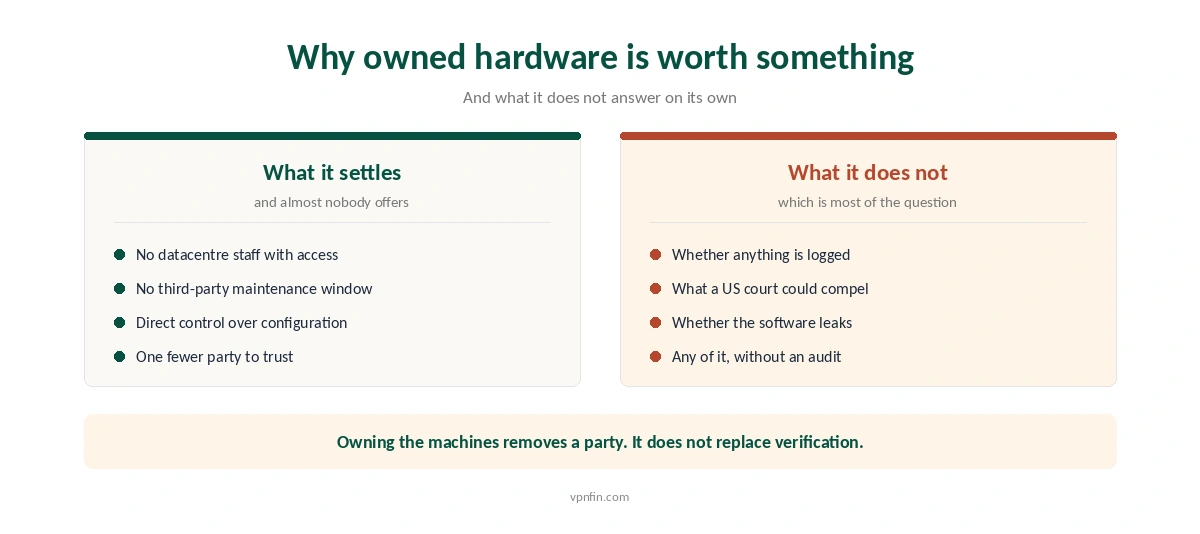
It removes a party from the arrangement. A leased server sits in somebody else’s building, where somebody else’s staff maintain it and nobody audits who walks past the rack.
And it gives the provider direct control over configuration and load rather than a support ticket to a hosting company.
⚠️ What it does not settle is everything else. Whether anything is logged, what a United States court could compel, and whether the client software leaks are separate questions — and none of them is answered by hardware.
NordVPN’s answer to the same worry is different. It leases capacity and runs RAM-only servers, so the machines hold nothing when powered down — which we compared directly.
The Audit Position, Which Is Thin on Both Sides
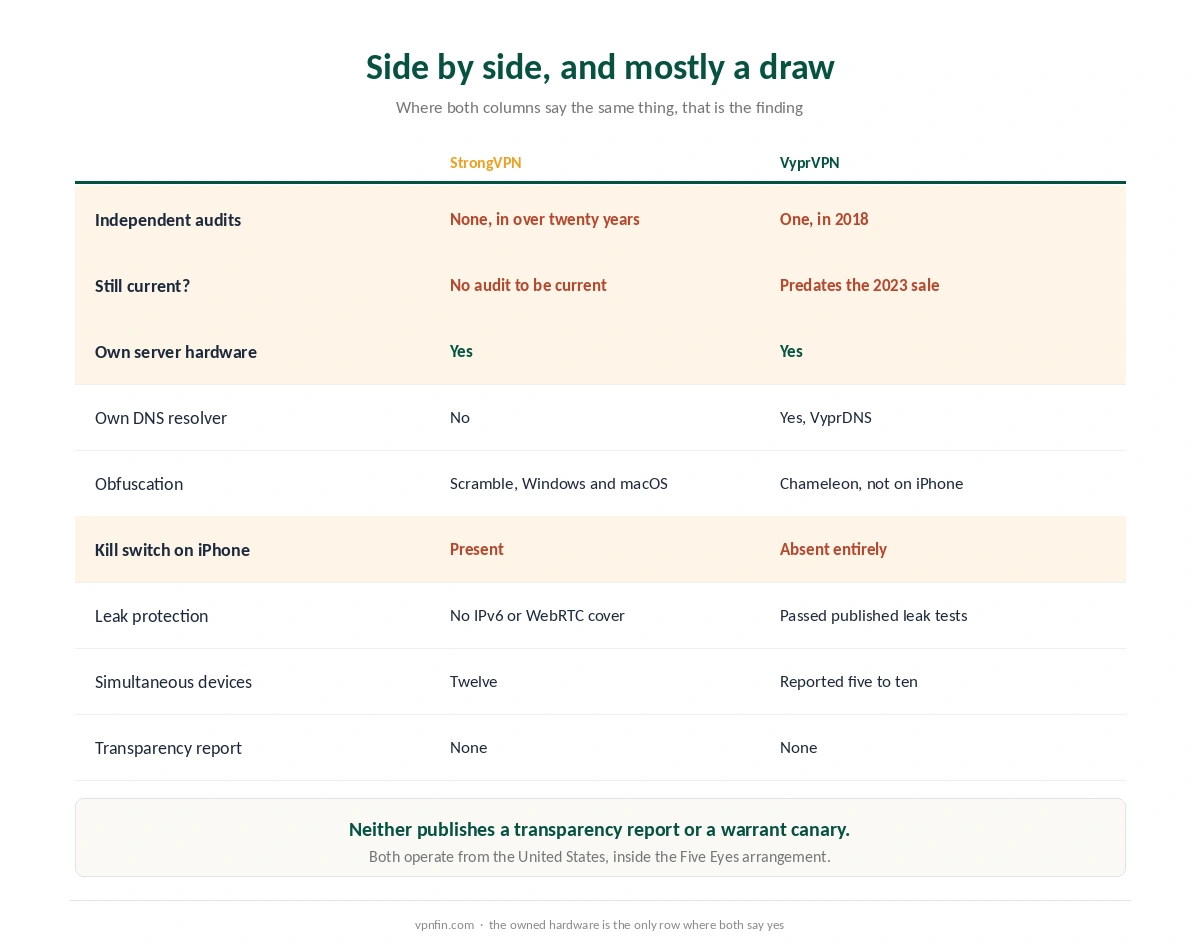
VyprVPN commissioned the first no-logs audit anyone in this market paid for, in 2018. Leviathan Security found the kill switch storing user IP addresses, and the report confirms the fault was fixed.
Then it stopped, and in 2023 a Texas company bought the service — moving it out of Switzerland and into United States jurisdiction. The only verification on record describes a different owner, in a different country.
StrongVPN has published nothing in more than twenty years: no audit, no transparency report, no warrant canary.
⚠️ Neither publishes a transparency report. Both are American, and in that jurisdiction the absence means you cannot tell whether anyone has demanded anything of either.
Where They Genuinely Differ
The resolver. VyprDNS keeps lookups inside VyprVPN’s infrastructure instead of handing them to a third party, which addresses one of the causes of DNS leaks by design. StrongVPN has no equivalent.
⚠️ Leak protection runs the other way. StrongVPN provides no cover against IPv6 or WebRTC leaks, while published reviews report VyprVPN passing leak tests — so each has a gap the other does not.
The iPhone verdict is one-sided. VyprVPN offers neither its obfuscation protocol nor a kill switch on iOS. StrongVPN has a kill switch there — the feature that prevents exposure when a tunnel drops.
Both offer obfuscation under their own names, Scramble and Chameleon, and neither has ever been independently tested — as is true of every implementation in this market.
Devices, Speed and Price
StrongVPN allows twelve simultaneous connections, which is more than either market leader permits — and for a household a router makes that number matter less than it looks.
⚠️ VyprVPN’s device figure is reported inconsistently, between five and ten across published reviews. Neither provider appears in our device table at all, which is a gap on our side.
Speed favours StrongVPN slightly. Reviewers describe VyprVPN’s as its weakest area, with one publication placing it twenty-sixth of thirty tested. They call StrongVPN adequate rather than fast.
StrongVPN’s renewal is the figure to watch: reported at $47.69 for the first year and $89.99 afterwards, with no refund window at all on the monthly plan — and a renewal is not covered by any guarantee.
Who Each Is For
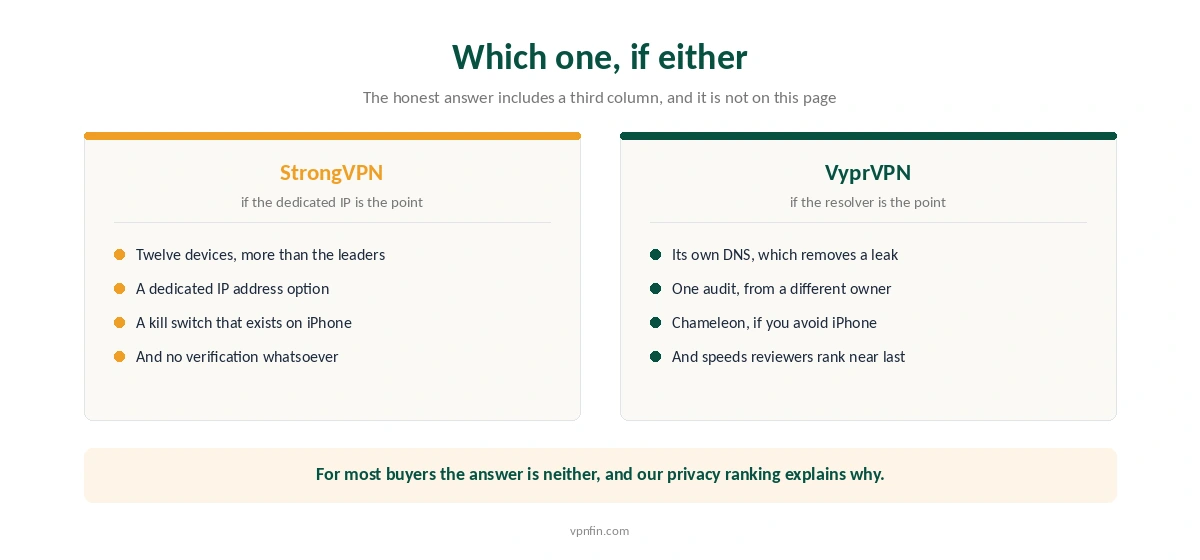
StrongVPN for a dedicated IP from owned hardware, on an annual plan rather than a monthly one, if you accept that nothing about its no-logs claim has ever been checked.
VyprVPN for the resolver and the obfuscation, if you are not on an iPhone and can live with speeds that reviewers rank near the bottom.
⚠️ And neither if verification is your criterion. Mullvad publishes annually and had its office searched; Private Internet Access answered three federal demands with nothing. Both answered the question with evidence rather than with hardware.
How We Research
Audit counts, auditors and jurisdictions come from our own published table. Feature details, the 2018 Leviathan findings, the 2023 acquisition and the platform gaps come from our reviews of both providers, which name their sources. Device figures for VyprVPN differ between published reviews and we have given the range rather than choosing; neither provider currently appears in our device table, which we are noting as our own gap. Publications we name in the individual reviews supply the speed placements; we measure nothing ourselves. Neither provider has been tested by a court, and no independent laboratory tests obfuscation at either — both limitations appear in the article rather than only here. Our method lives on the About Us page.
StrongVPN vs VyprVPN FAQ
Both do, which is unusual — most providers lease capacity from datacentre operators. It removes a third party with physical access to the machines, and it is the main reason either provider is worth considering.
Only VyprVPN, once, by Leviathan Security in 2018. That audit predates the company’s 2023 sale to a Texas owner, so it describes a different company in a different jurisdiction. StrongVPN has published no audit in over twenty years.
StrongVPN, because VyprVPN offers neither its Chameleon obfuscation nor a kill switch on iOS. A kill switch is what prevents your real address being exposed when the tunnel drops, so its absence matters more than the missing obfuscation.
No. StrongVPN belongs to Ziff Davis, alongside IPVanish and publications including PCMag and CNET. VyprVPN was sold by Golden Frog to Certida LLC of Texas in 2023. Both end up under United States jurisdiction by different routes.
Only for the specific features described here. Neither publishes a transparency report or a warrant canary, both operate from inside the Five Eyes arrangement, and between them they have one audit from eight years ago. Providers with stronger published evidence exist at similar prices.
The Verdict
Owning the machines is a real answer to a real question, and these are the two places in our catalogue where it is the headline claim. Most providers lease their capacity instead.
It answers one question out of several. Hardware says nothing about logging, about what a court could compel, or about whether the client leaks — and on that last point the two providers have opposite gaps.
One audit between them, and it is from 2018. If that is the standard you are choosing on, this comparison has no winner and the answer is somewhere else entirely.