
Disclosure: VPNFin is reader-supported. If you buy a VPN through links on this page, we may earn a commission at no extra cost to you. This never affects our ratings — here’s our full disclosure.
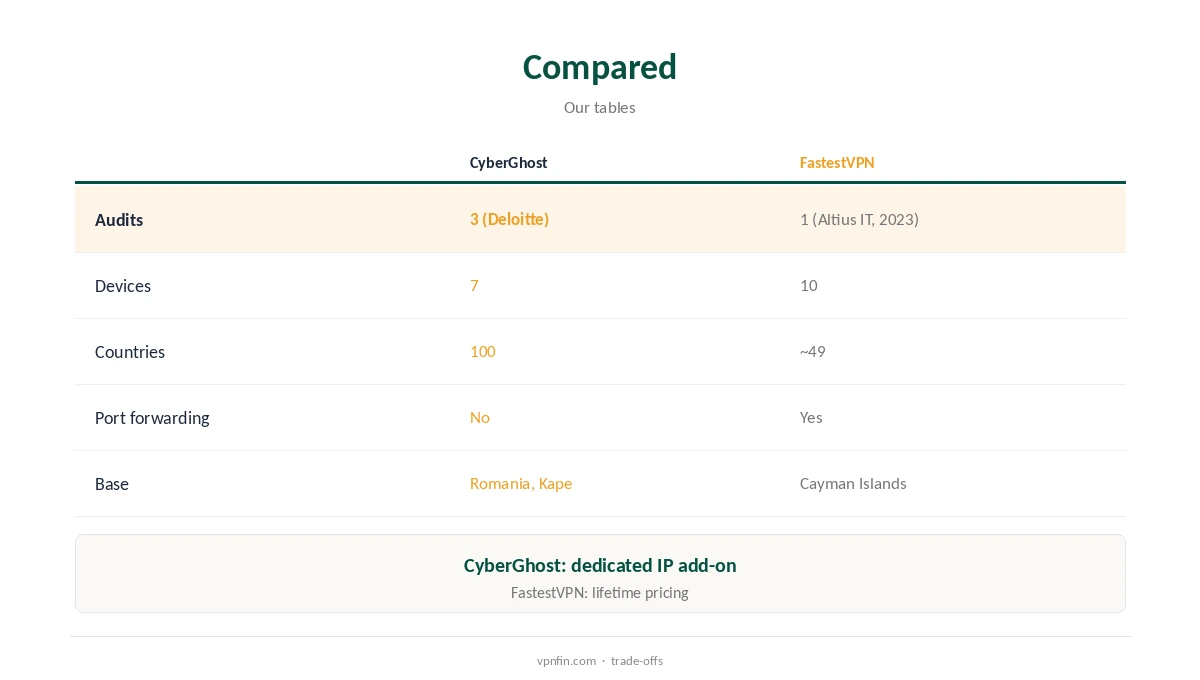
CyberGhost vs FastestVPN compares a mainstream subscription VPN with a budget service sold mostly on lifetime deals. CyberGhost, owned by Kape and based in Romania, has three Deloitte no-logs audits in our table, from 2022, 2024 and late 2025. It allows seven devices, renews at $56.94 a year after a 26-month first term, and gives 45 days to ask for a refund on longer plans. FastestVPN, based in the Cayman Islands, has one audit, by Altius IT in 2023, allows 10 devices and sells lifetime plans that sources have listed at $23, $35 and $40 within a single year.
This guide compares them on privacy, price over time, devices, features, streaming and fit.
CyberGhost vs FastestVPN on Privacy
CyberGhost’s three Deloitte audits span 2022 to late 2025, so its no-logs claim has been checked more than once. FastestVPN’s single Altius IT audit dates from 2023 and has not been repeated in our table.
Repeat audits matter because they show practices holding over several years. Our VPN audit tracker compares providers.
Lifetime Plan or Subscription, and Cost Over Four Years
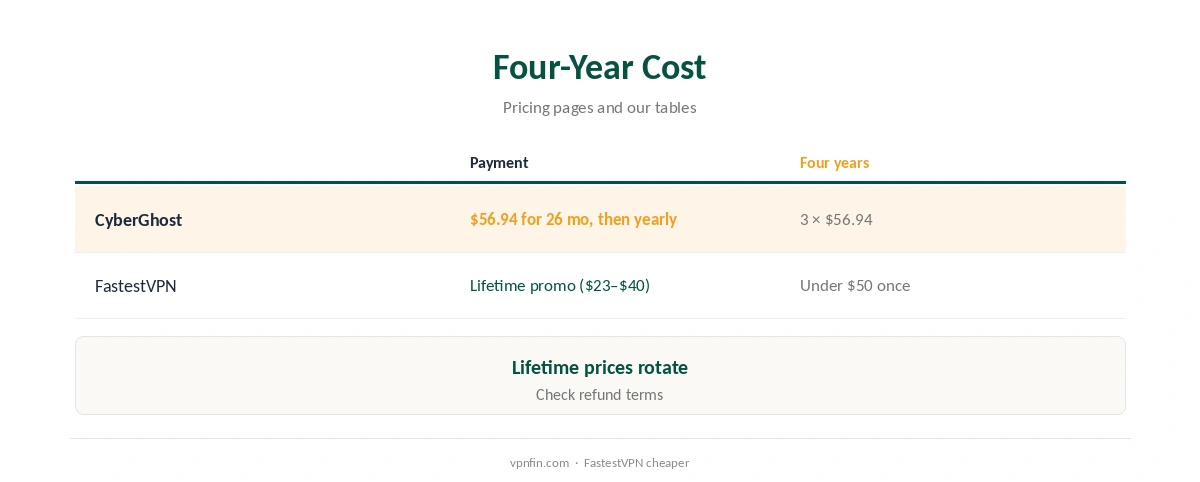
FastestVPN’s lifetime plan is a one-off payment whose price rotates with promotions. CyberGhost charges $56.94 for its first 26 months and then $56.94 a year.
A lifetime plan only pays off if the company keeps running and keeps honouring the plan; a subscription lets you leave if the service slips. Our renewal price guide explains the trade-off.
Over four years, CyberGhost takes three payments of $56.94: the first 26-month term, then two yearly renewals. A FastestVPN lifetime plan bought on promotion costs well under $50 once.
On price alone, FastestVPN wins clearly, as long as you accept its thinner audit record and the lifetime-plan risk.
Devices and Servers
FastestVPN allows 10 devices, with some reports of 15 on a higher lifetime tier in our tables, and runs about 800 servers in roughly 49 countries. CyberGhost allows seven devices and lists servers in 100 countries.
Larger households fit better on FastestVPN; travellers wanting more countries and cities fit better on CyberGhost.
Features and Streaming
FastestVPN includes port forwarding, which CyberGhost lacks; CyberGhost offers a dedicated IP add-on from $5 a month and streaming-labelled servers. FastestVPN has no split tunnelling on iOS or macOS, our tables record.
Torrent users who want open ports for better seeding lean towards FastestVPN. Our port forwarding guide explains why it matters.
CyberGhost groups servers by streaming service in its apps, Gizmodo notes. Several reviews found FastestVPN worked with streaming too, our tables record, though with fewer locations to choose from.
Test your own streaming services within each refund window.
Refunds and Trials
CyberGhost gives 45 days on plans of six months or more and 14 days on monthly plans; purchases through app stores follow the store’s rules. Check FastestVPN’s current refund terms at checkout, especially on lifetime deals.
Keep your order numbers either way, since refund requests go faster with them.
Ownership
Kape owns CyberGhost, ExpressVPN and PIA, and review sites including vpnMentor and Wizcase. FastestVPN’s browser extension lists Fastest Technology LLC in Houston as its developer, while the service states the Cayman Islands as its base.
Our VPN ownership guide explains why that matters.
Platforms
FastestVPN has a Mac App Store app for macOS 10.15 and later with WireGuard, IKEv2, TCP and UDP, browser extensions for Chrome, Firefox and Edge, and command-line setups for Linux, its support pages show. CyberGhost covers Windows, Mac, iOS, Android, Fire TV and Android TV, though not Vega OS sticks.
Both support routers for TVs and consoles without apps.
CyberGhost offers a free trial of 24 hours on Windows and macOS without a card, seven days on iOS and three on Android, its trial page says.
For FastestVPN, check the refund terms that apply to lifetime deals at checkout before buying, and keep the confirmation email.
Browser Extensions and Linux
FastestVPN’s Chrome extension protects Chrome’s traffic and includes an ad blocker and WebRTC leak protection that you turn on in its settings, its support pages say; extensions also exist for Firefox and Edge. They cover only the browser, not the whole device.
For full protection, use the desktop app on either service.
Extras and Add-Ons
CyberGhost sells a dedicated IP from $5 a month, plus a Windows security suite and a password manager, and includes its ID Guard monitoring at no extra cost, its pricing page lists. FastestVPN bundles port forwarding and an ad blocker.
Add-ons raise CyberGhost’s price quickly, so count only the ones you will actually use.
FastestVPN supports Linux through OpenVPN on the command line, with WireGuard configuration files available on request from its support team, its guides explain. That suits technical users more than beginners.
Our CyberGhost vs PureVPN page compares two providers with Linux apps.
How We Research
This page draws on CyberGhost’s pricing and refund pages, Gizmodo on CyberGhost, FastestVPN’s support pages and Chrome Web Store listing, and our FastestVPN, audit and price tables. We cross-checked these sources against each other, and where they conflict or something can’t be verified, we say so in the text rather than guessing. We checked time-sensitive figures, including prices in US dollars, on 8 October 2026. The main source we relied on is CyberGhost’s pricing page. Our full approach lives on the About Us page.
CyberGhost vs FastestVPN FAQ
CyberGhost for audits and streaming; FastestVPN for price and port forwarding.
On price, yes; it depends on the company keeping it honoured.
CyberGhost, with three against FastestVPN’s one.
FastestVPN, with 10 against CyberGhost’s seven.
No; FastestVPN does.
The Verdict
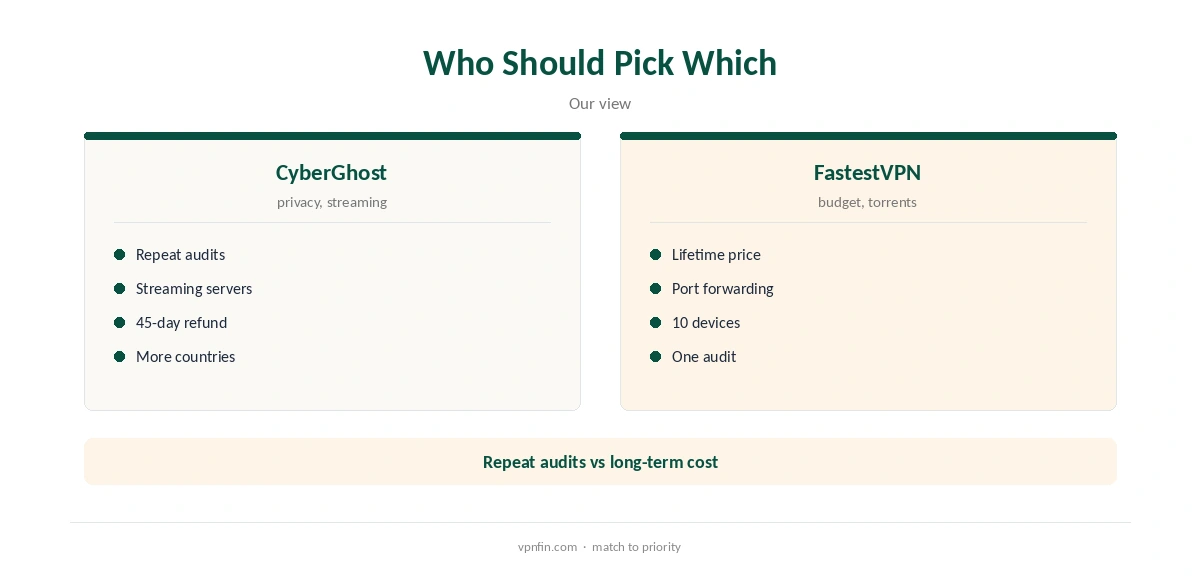
CyberGhost vs FastestVPN: CyberGhost for a stronger audit record and streaming; FastestVPN for the lowest long-term cost and port forwarding.