
Disclosure: VPNFin is reader-supported. If you buy a VPN through links on this page, we may earn a commission at no extra cost to you. This never affects our ratings — here’s our full disclosure.
CyberGhost sells on price, and the price holds up under inspection — which is not something we can say about every budget VPN. This CyberGhost review covers the 45-day money-back guarantee, the longest in the category, and three no-logs audits by Deloitte Audit Romania. It also covers the number almost no review prints: the renewal rate. Three consecutive reviews documented renewals that triple or quadruple the intro price. CyberGhost is the one that doesn’t — $56.94 a year, the same sum you paid upfront, just annually instead of biennially. What you trade for that is speed.
Is CyberGhost Worth It in 2026?
Yes, if streaming and price matter more than raw speed. CyberGhost covers 7 devices, runs one of the largest server networks in the category, and its no-logs policy has passed three Deloitte audits. The 45-day refund window is genuinely the longest available. The trade-off is real: independent testers measure roughly 31–38% speed loss, well behind the leaders.

CyberGhost at a Glance
Pros
- ✔ 45-day money-back guarantee on plans of six months or longer — the longest in the category
- ✔ Renewal costs the same as the intro term, unlike every major rival
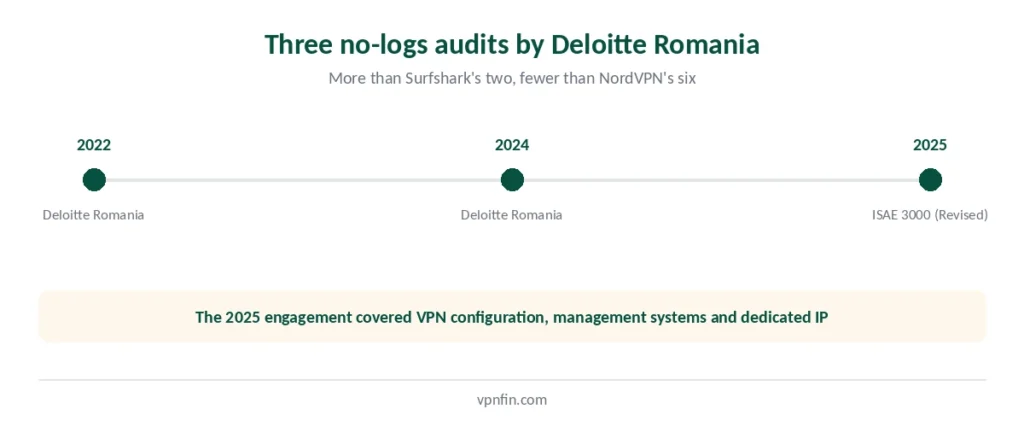
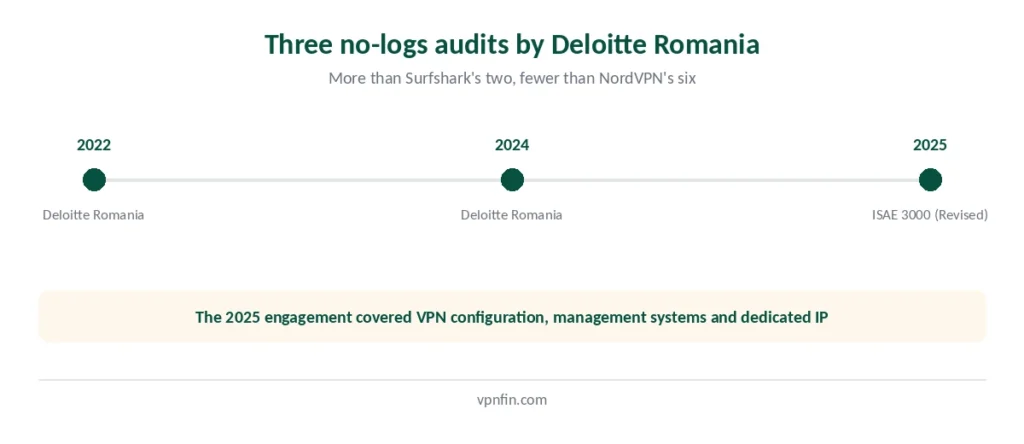
- ✔ Three no-logs audits by Deloitte Audit Romania: 2022, 2024, and 2025
- ✔ Romanian jurisdiction, outside the 5, 9, and 14 Eyes arrangements
- ✔ Free trials that need no payment card — 24 hours desktop, 3 days Android, 7 days iOS
- ✔ Streaming servers labelled by platform, so you pick Netflix rather than guess a city
Cons
- ✖ Independent tests put speed loss at 31–38%, behind every provider ranked above it here
- ✖ Only 7 simultaneous devices, the lowest limit among the major providers
- ✖ No multi-hop routing and no port forwarding
- ✖ Owned by Kape Technologies — the same parent as ExpressVPN and PIA
Speed & Performance
Speed is where the low price shows, and the honest summary is that CyberGhost is adequate rather than competitive.
Independent results cluster in a consistent band. One tester measured a 31% average loss on WireGuard over a gigabit line, against 15% for NordVPN and 21% for ExpressVPN in the same round. Another recorded speeds never dropping more than 34% in January 2026 testing — an improvement on the 46% that same lab had measured previously. A third found a 38% average loss specifically on long-distance servers. A fourth ranked CyberGhost tenth of 22 VPNs tested, at 612 Mbps on a 1 Gbps connection with 25 ms latency.
Those numbers agree with each other, and they agree on the shape of the problem: distance hurts CyberGhost more than it hurts the leaders, and the variance between sessions is wider. One tester logged a ±38 Mbps stability spread, noting that top-ranked providers hold tighter bands.
What that means in practice is less dramatic than the percentages suggest. 4K streaming needs around 25 Mbps. A 34% loss on a 300 Mbps line still leaves roughly 200 Mbps. You will notice CyberGhost on large file transfers and competitive gaming, and you will not notice it while watching anything. If speed is your first criterion rather than your third, our full NordVPN review covers the provider with the best independent record.
Streaming & Torrenting
Streaming is the reason to buy CyberGhost, and the implementation is smarter than the competition’s.
Rivals offer a list of cities and let you guess which one still works with Netflix. CyberGhost labels servers by platform — you pick Netflix, Disney+, Hulu, HBO Max, or BBC iPlayer from a menu. Independent testers report these working reliably: one unblocked six of eight platforms attempted, with Peacock and DAZN the failures; another verified access across 16 Netflix libraries.
Platforms and providers trade moves every month, so no result is permanent — which is what the 45-day window is genuinely for. Buy, test your specific libraries, and take the money back if they fail. Six weeks is enough time to be sure rather than hopeful.
Torrenting runs on dedicated P2P servers, and independent testers counted 87 of CyberGhost’s 100+ locations supporting P2P. The app doesn’t label which ones, so check the server list on the website before connecting. One tester measured 432 Mbps download on well-seeded torrents over WireGuard, with a 10 GB file completing in just over three minutes against 1 minute 22 on an unprotected line. Port forwarding is not available, which limits seeding ratios — see our torrenting guide for the one provider that offers it.
Security & Privacy: Three Audits and a Romanian Base
CyberGhost’s privacy case is stronger than its budget positioning suggests, and it rests on two things that are checkable.
Deloitte Audit Romania has examined the no-logs claim three times — in 2022, again in 2024, and a third engagement completed in 2025 under the ISAE 3000 (Revised) standard. The most recent review covered VPN configuration, management systems, and the token-based dedicated IP technology, and confirmed that server configurations align with the no-logs policy. That places CyberGhost above Surfshark’s two assurance reports and below NordVPN’s six. Like most of the industry, the full reports sit inside a subscriber account rather than in public.
The jurisdiction is a genuine advantage. CyberGhost operates from Bucharest under Romanian law, outside the 5, 9, and 14 Eyes intelligence-sharing arrangements. Romania rejected the EU Data Retention Directive twice, in 2009 and 2014, so there is no domestic obligation to retain user data.
The quarterly transparency reports put numbers on that. In the first quarter of 2025 alone, CyberGhost recorded 105,332 DMCA complaints and three police requests, and complied with none of them — because, per the company, there was nothing logged to hand over. Set against a provider that stopped publishing in 2019, fifteen years of quarterly reporting is the clearer signal.
Encryption is AES-256, with a kill switch, DNS leak protection, and split tunneling. NoSpy servers, housed in CyberGhost’s own Romanian data centre with staff-only physical access, are an unusual addition at this price. Two gaps worth naming: there is no multi-hop routing, and no built-in malware blocker in the standard subscription — the Windows Security Suite costs an extra dollar a month.
One conflict we could not resolve: sources disagree on whether the entire fleet runs RAM-only. Several reviewers state it does; at least one states it does not. CyberGhost’s own materials emphasise NoSpy and audit results rather than making a fleet-wide RAM-only claim, so we are not repeating one.
Features and Device Limits
CyberGhost sells one product rather than tiers. Every plan includes every VPN feature, with servers in 100 countries and support for OpenVPN, IKEv2 and WireGuard across all of them. That removes the comparison headache ExpressVPN’s three-tier structure creates.
The device limit is the weak point: 7 simultaneous connections, the lowest among the major providers. NordVPN, ExpressVPN and PureVPN all allow 10, Surfshark allows unlimited — and PureVPN sells a paid add-on that raises its own limit to 50. For a single user this is irrelevant; for a household with two people and a smart TV it is a real constraint.
The optional extras are priced separately. A dedicated IP costs around $60 a year and uses a token system designed so CyberGhost cannot link the address back to your account. The Windows Security Suite, which adds antivirus and a privacy tool, is about a dollar a month on top of the subscription.
Apps & Usability
The apps cover Windows, macOS, iOS, Android, Linux, Fire TV, and browsers, and the design assumes you do not want to read a manual. Server filtering by purpose — streaming, torrenting, gaming — is the standout, and the platform labels make it genuinely faster to get what you came for.
The rough edges are real but minor. OpenVPN connections run noticeably slower than WireGuard, so leave the protocol on automatic. Device registration is clumsier than rivals’. Our setup walkthrough covers the steps in order. And reviewers have flagged trackers in the Android app, which is worth knowing for a privacy product even though it concerns analytics rather than VPN traffic.
Pricing: The Renewal That Doesn’t Bite
Two-year pricing runs about $2.19 a month, billed as roughly $56.94 upfront for a term that runs 26 months with the bonus period included. Promotions rotate — we found the same plan quoted at $2.03, $2.11, and $2.19 across recent sources — so check the figure at checkout. Six months costs $41.94, and month-to-month runs $12.99.
Now the number that matters, and that almost nobody prints. CyberGhost’s own checkout page states it plainly: the subscription renews at $56.94 for the first two years and yearly thereafter. That works out to about $4.75 a month.
Read that against the rest of this category. Surfshark’s entry plan renews at roughly $79 a year, ExpressVPN’s at $99.95, its top tier at $199.95. CyberGhost charges the same total on renewal that you paid upfront — you simply pay it annually instead of every two years. It is still a price increase per month, and auto-renewal is on by default. But it is the mildest renewal structure among the providers we have examined, and after three reviews documenting the opposite, it deserves to be said clearly. Our cheap VPN guide puts that into four-year totals, where CyberGhost comes second by a few dollars.
| Provider | Renewal price | Per month | Tier |
|---|---|---|---|
| NordVPN | $139.08/yr | ~$11.59 | Basic |
| Surfshark | ~$79/yr | ~$6.58 | Starter |
| ExpressVPN | $99.95/yr | ~$8.33 | Basic |
| CyberGhost | $56.94/yr | ~$4.75 | 2-year |
| PureVPN | $47.95/yr | ~$4.00 | Standard |
| IPVanish | $89.99/yr | ~$7.50 | Essential |
| Windscribe | ~$69/yr | ~$5.75 | Pro |
| Proton VPN | ~$83.88/yr | ~$6.99 | VPN Plus |
| Mullvad | ~$65/yr | ~$5.40 | flat, no tiers |
| Norton VPN | $79.99/yr | ~$6.67 | Standard |
| Hotspot Shield | ~$95.99/yr | ~$8.00 | Premium annual |
Refunds and Card-Free Trials
The refund terms are equally unusual. The 45-day money-back guarantee applies to six-month and two-year plans, dropping to 14 days on monthly billing, and only when you buy direct from CyberGhost rather than through an app store. On top of that there are free trials requiring no payment card at all: 24 hours on Windows and macOS, 3 days on Android, 7 days on iOS. We compare every provider’s trial and refund terms in our free trial guide. Nearly every competitor requires card details for a trial, and one costs almost exactly the same while offering no refund window at all.
Claiming that refund is a separate action from cancelling, and doing only the first is the common mistake.

What We Don’t Love
Three things, and one of them belongs in the open rather than in a footnote.
The speed deficit is genuine. Every independent tester places CyberGhost behind the leaders, and the gap widens with distance. The 7-device limit is the lowest in the category at a moment when rivals are raising theirs. And the absence of multi-hop and port forwarding means power users will hit walls that the price does not excuse.
The fourth item is ownership. CyberGhost was acquired in 2017 by Kape Technologies — the same company that owns ExpressVPN and Private Internet Access. Four of the five providers in our rankings sit in same-parent pairs — Kape holds ExpressVPN and PIA, Nord Security holds NordVPN and Surfshark — and we would rather you heard that from us than discovered it later. Kape’s earlier corporate history, under its former name, has drawn scrutiny from privacy commentators. Against that: CyberGhost has commissioned three independent audits since the acquisition, publishes quarterly transparency reports, and has not had a confirmed breach of its VPN infrastructure. Whether shared ownership across brands concerns you is a judgment we are not going to make for you.
How We Research
This review draws on CyberGhost’s official documentation, checkout terms, and privacy hub, the published Deloitte audit announcements, quarterly transparency reports, and speed results from named independent testers — cross-checked against one another, with time-sensitive figures verified at publication. Where sources conflicted, as they did on server counts, intro pricing, and RAM-only infrastructure, we say so in the text rather than picking the convenient answer. Our full approach lives on the About Us page, and you can see how CyberGhost places against alternatives in our current top 5 rankings.
CyberGhost FAQ
CyberGhost’s checkout page states the subscription renews at $56.94 for the first two years and yearly thereafter — about $4.75 a month. That is the same total you paid upfront, charged annually instead of biennially. It is the mildest renewal structure among the major providers, where rivals commonly renew at $79 to $199.95 a year.
Seven simultaneous connections, the lowest limit among the major providers. NordVPN and ExpressVPN allow 10 on their entry plans, and Surfshark allows unlimited. You can install the apps on as many devices as you like — only simultaneous connections count against the limit.
Yes, three times, all by Deloitte Audit Romania — in 2022, 2024, and 2025. The most recent engagement was conducted under the ISAE 3000 (Revised) standard and examined VPN configuration, management systems, and the dedicated IP technology, confirming that server configurations align with the no-logs policy. Full reports are available inside a subscriber account.
Yes, with conditions. It applies to six-month and two-year plans bought directly from CyberGhost; monthly billing gets 14 days, and app-store purchases follow those stores’ rules. Reviewers who tested it report refunds honoured without argument. There are also free trials that need no payment card — 24 hours on desktop, 3 days on Android, 7 days on iOS.
Kape Technologies, which acquired CyberGhost in 2017 and also owns ExpressVPN and Private Internet Access. Each brand operates separately, and CyberGhost’s operations remain in Bucharest. Kape’s earlier corporate history has drawn scrutiny; CyberGhost has since commissioned three independent audits and publishes quarterly transparency reports.
Comfortably. Independent testers measure 31–38% speed loss, which sounds severe but still leaves far more bandwidth than 4K needs. The gap shows on large file transfers and competitive gaming rather than video. CyberGhost’s platform-labelled streaming servers are designed for exactly this use case.
CyberGhost
The longest refund window and the one renewal that doesn’t punish you
CyberGhost is the cheapest route to audited privacy and reliable streaming, with a 45-day guarantee and card-free trials that let you verify everything at no risk. Three Deloitte audits back the no-logs claim. The trade-offs are speed and a seven-device limit.
Final Verdict: 4.3/5
CyberGhost earns fourth place in our rankings on a specific argument: it is the cheapest way to get audited privacy and reliable streaming, and it is the only major provider whose renewal price does not punish you for staying. The 45-day guarantee and card-free trials mean you can verify every claim here at no risk, which is more than most of this category allows.
Choose it if: streaming is your main use, you want the longest possible window to test before committing, and 7 devices covers your household. Skip it if: you need top speeds, where NordVPN leads — we compare the two directly here. Have more devices than seven? That’s exactly what our Surfshark review is about, and our head-to-head weighs it against everything CyberGhost wins on.