
Disclosure: VPNFin is reader-supported. If you buy a VPN through links on this page, we may earn a commission at no extra cost to you. This never affects our ratings — here’s our full disclosure.
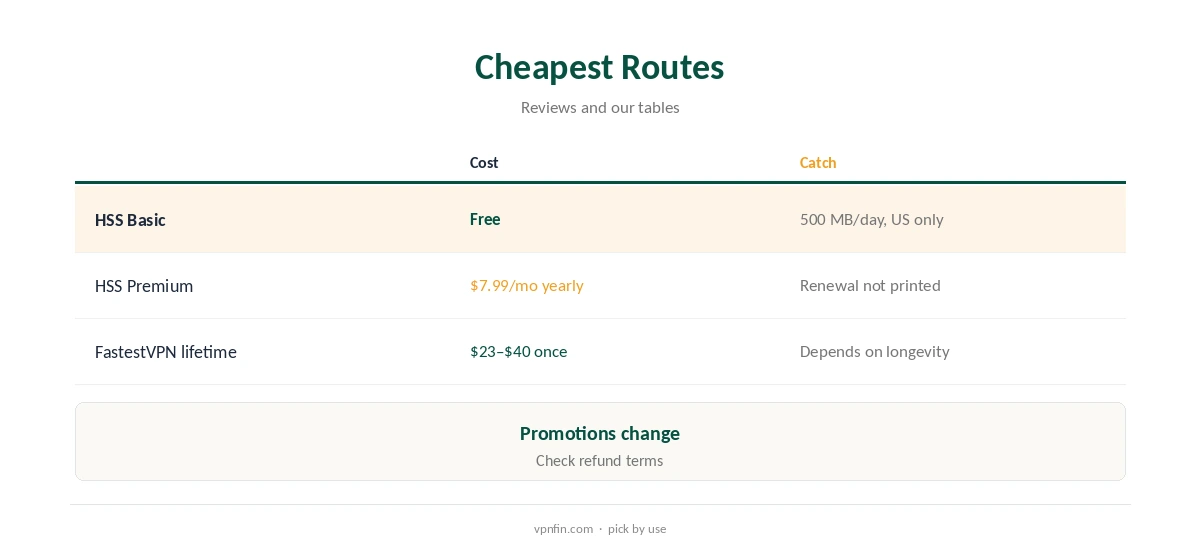
Hotspot Shield vs FastestVPN is a contest between two cheap routes to a VPN. Hotspot Shield gives you a free Basic plan capped at 500 MB a day on a US location with ads, and charges $7.99 a month on a yearly Premium plan. FastestVPN asks for one payment, which promotions have set between $23 and $40, for lifetime access on 10 devices.
Neither offers strong audit evidence: Hotspot Shield has no independent no-logs audit, FastestVPN one from 2023. This guide compares cost, logging, tools and fit.
The Cheapest Route
For occasional browsing, Hotspot Shield’s free plan costs nothing, though 500 MB a day covers little video. For regular use, a FastestVPN lifetime deal bought on promotion costs less than a single year of Hotspot Shield Premium.
The lifetime plan pays off only while FastestVPN keeps operating and honouring it. Our renewal price guide explains the risk.
Hotspot Shield vs FastestVPN on Logging and Torrenting
Hotspot Shield’s policy excludes linking identity to activity but still records session length, bandwidth and device hashes, a 2026 review notes. FastestVPN’s one audit, by Altius IT in 2023, has not been repeated in our table.
Neither gives the repeat, independent checks that providers such as Proton or Mullvad publish. Our VPN audit tracker lists them.
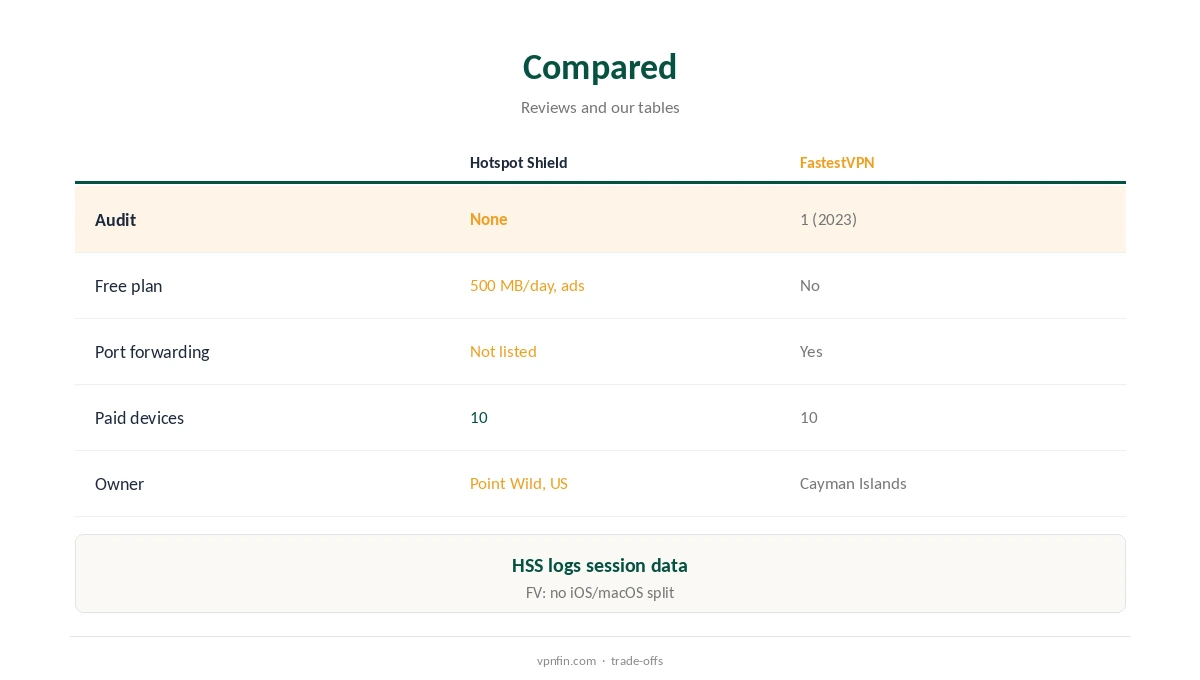
FastestVPN includes port forwarding and lists P2P servers. Hotspot Shield offers no port forwarding in the sources we read.
Torrent users get more from FastestVPN. Our torrenting guide covers audited options.
Apps and Protocols
Hotspot Shield runs its proprietary Hydra protocol alongside WireGuard and IKEv2, with split tunnelling for apps and sites on Windows and Android. FastestVPN offers WireGuard, IKEv2 and OpenVPN, with no split tunnelling on iOS or macOS.
Both have Android apps for TV boxes; Hotspot Shield’s free plan does not cover smart TVs or routers, Tom’s Guide notes.
Devices and Refunds
FastestVPN allows 10 devices; Hotspot Shield Premium also allows 10, one review notes, while its free plan allows one.
For a household on a budget, FastestVPN’s lifetime plan covers the same number of devices without yearly bills.
Hotspot Shield gives 45 days for refunds on Premium. Check FastestVPN’s terms for lifetime deals before paying, since they decide how much you can test risk-free.
Keep receipts for either.
Ownership, and Who Should Avoid Both
Point Wild, formerly Pango and Aura, owns Hotspot Shield in the US. FastestVPN names the Cayman Islands as its base, while its Chrome extension lists Fastest Technology LLC in Houston.
Our VPN ownership guide explains why that matters.
Kill Switch and Streaming
AllAboutCookies found every Hotspot Shield plan includes a kill switch and split tunnelling, with a notification when the kill switch is active. FastestVPN’s Mac app turned its kill switch on by default in 2023, our tables record.
Test either by switching Wi-Fi off and on while connected.
Hotspot Shield’s free plan does not suit streaming, vpnprograms notes, so streaming means paying for Premium. Several reviews found FastestVPN worked with streaming services, our tables record.
Test the services you use within each refund window.
Linux and Browser Extensions
Hotspot Shield’s Linux version is command-line only, with Hydra and no split tunnelling or kill switch, a 2026 review notes. FastestVPN supports Linux through OpenVPN on the command line and offers Chrome, Firefox and Edge extensions with an ad blocker and WebRTC protection.
FastestVPN gives Linux and browser users noticeably more.
If you need audited proof of a no-logs policy, neither fits well. Our Mullvad vs FastestVPN page compares FastestVPN with a provider that has more than 10 audits.
Light users who accept the trade-offs will find both cheap enough to try.
What 500 MB a Day Covers, and Ads
Half a gigabyte a day suits email, messaging, maps and occasional pages, but HD video would use it in well under an hour. Hotspot Shield’s free plan is also limited to about 2 Mbps, a 2026 review notes.
For anything heavier, the comparison is really Premium against FastestVPN’s lifetime plan.
Hotspot Shield’s free plan carries ads, and its privacy policy allows it to derive your approximate location, Cloudwards notes. FastestVPN has no free plan, so there is no ad-funded tier to weigh.
Paying removes Hotspot Shield’s ads.
Speed
Hotspot Shield credits its speed to Hydra and WireGuard, a 2026 review says. We found no recent independent speed figures for FastestVPN in our sources, so test it on your own line during any refund window.
Pick a nearby server on either for the best results, and avoid peak evening hours when testing.
Support
Hotspot Shield’s free plan comes without one-on-one support, Tom’s Guide notes; Premium adds it. FastestVPN’s guides send users to its support email for some setups, such as WireGuard on Linux.
Test response times before relying on either.
How We Research
This page draws on vpnprograms’, AllAboutCookies’ and Tom’s Guide’s Hotspot Shield reviews, a 2026 Hotspot Shield review on logging, FastestVPN’s support pages and our price and audit tables. We cross-checked these sources against each other, and where they conflict or something can’t be verified, we say so in the text rather than guessing. We checked time-sensitive figures, including prices in US dollars, on 8 October 2026. The main source we relied on is AllAboutCookies’ Hotspot Shield review. Our full approach lives on the About Us page.
Hotspot Shield vs FastestVPN FAQ
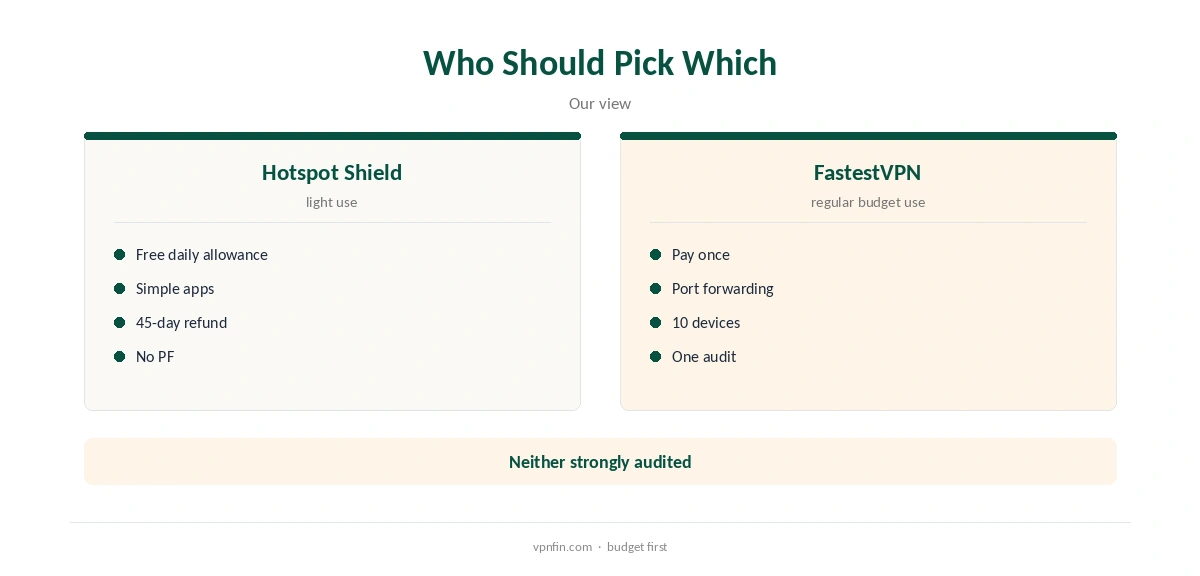
Hotspot Shield free for light use; FastestVPN’s lifetime plan for regular use.
FastestVPN once, in 2023; Hotspot Shield has no independent no-logs audit.
FastestVPN, with port forwarding.
500 MB a day on a US location, with ads.
Both allow 10 on paid plans.
The Verdict
Hotspot Shield vs FastestVPN: Hotspot Shield free for light, occasional use; FastestVPN once for the cheapest regular VPN with port forwarding.