
Disclosure: VPNFin is reader-supported. If you buy a VPN through links on this page, we may earn a commission at no extra cost to you. This never affects our ratings — here’s our full disclosure.
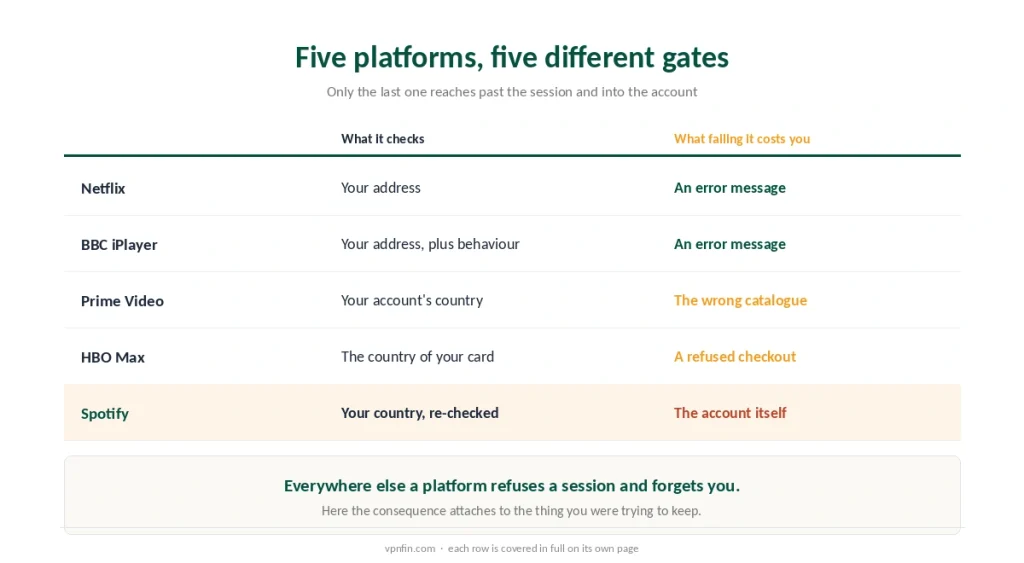
Netflix shows you an error. Prime Video shows you the wrong catalogue. HBO Max refuses your card.
Spotify changes your account. It is the one platform in this series where the warnings about losing something are describing observed behaviour rather than a clause nobody enforces.
What Spotify’s Own Rules Actually Say
Worth starting with the primary source, because most guides on this subject never quote it.
Your country is set by where you were when you signed up. Spotify’s support documentation states that plainly, and it is the anchor for everything else.
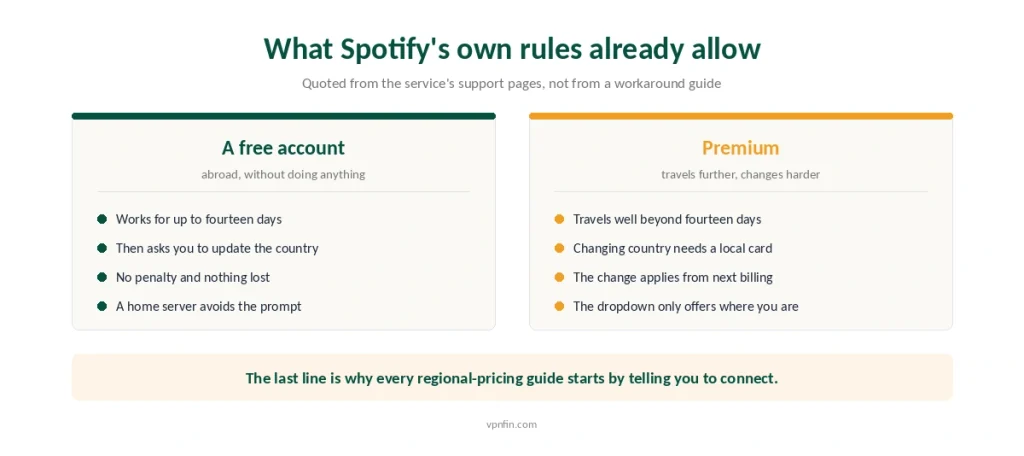
A free account works abroad for up to fourteen days. After that the settings need updating to the country you are in.
Premium travels for longer, and changing your country requires a payment method issued in the new one, with the change taking effect from the next billing date.
⚠️ The country dropdown only offers a region while you are physically in it. That single design choice is why every “trick” guide begins with connecting a VPN, and it is also why Spotify knows exactly what such a connection is for.
Travelling: Already Allowed, and Simple
The case most readers actually have, and it needs no cleverness at all.
Connect to a server in your home country. Your library, your playlists and your pricing behave exactly as they do at home, and nothing about your account changes — which is all a VPN ever does.
Premium subscribers can travel well beyond fourteen days. The limit applies to free accounts, and even then the remedy is a settings change rather than a penalty.
Some catalogue differences are licensing rather than blocking. Podcasts and a handful of albums vary by country, and a home-country server restores them.
⚠️ This is the whole answer for most people. Our travel guide covers the rest of the habit — install and pay before you fly, and test the connection at home.
Where the Enforcement Is Real
Here the honest reporting diverges sharply from the rest of this series.
Netflix shows an error and stops. Amazon blocks the server, not the customer. Published accounts describe no pattern of terminations on either.
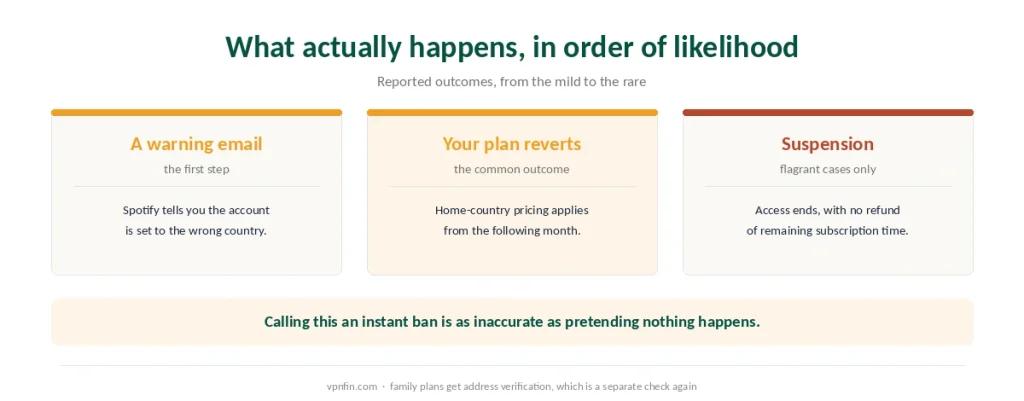
Spotify acts on the account instead. Reported outcomes range from a warning email, to the plan being switched back to home-country pricing from the following month, to suspension or termination in flagrant cases, without a refund of remaining time.
Family plans get address verification. If the members cannot demonstrate a shared address, people get removed from the plan.
⚠️ The common outcome is the middle one. Users describe being told their subscription reverted to their own country’s price — irritating, recoverable, and a long way from losing a library. Overstating this as “instant ban” is as inaccurate as pretending nothing happens.
What We Will Not Publish
The dominant genre of article on this query is a step-by-step guide to paying Turkish or Indian prices from elsewhere.
We are not writing that. It requires setting a country you do not live in, buying gift codes for that market, and keeping a payment method that matches — a sequence built on a false statement of residence.
The risk is not theoretical here, which is the difference from the streaming pages. Spotify’s stated remedy touches the account and the money in it.
And the savings are smaller than they look once a recurring workaround, a gift-code supply and the chance of reversal are priced in.
⚠️ Legality is not the issue. Using a VPN is lawful and this is a contractual matter, exactly as with every platform we cover. The difference is that this contract gets enforced.
Where Spotify Is Blocked Entirely
A separate problem with a separate answer.
The service is unavailable in a number of countries, some through censorship rather than commercial choice. For a resident of one of them, a VPN is the only route to the service at all.
That is a different question from regional pricing, and it is the case where the rules in your own country matter more than any provider comparison, because the rules where you are decide what is sensible.
If You Are Choosing a Provider
For the travelling case, which is the one worth paying for — and our streaming guide covers the same providers against video platforms.
NordVPN for reliability, highest on our scale at 4.8, with servers in enough countries that your home market is covered whatever it is.
Surfshark for a household with unlimited connections, which matters when phones, laptops and a car all hold the same account.
ExpressVPN for coverage if your home country is a small one that most providers skip.
⚠️ Free services are the wrong tool. Small shared address pools get flagged, and the reasons run well past music.
How We Research
This guide draws first on Spotify’s own support documentation for the country-at-signup rule, the fourteen-day allowance on free accounts and the payment-method requirement when changing region, then on RH-ITsec and VPN-Tools for the reported enforcement outcomes including warning emails, forced reversion to home pricing and account suspension, on Sharesub for the behaviour of the country dropdown and the billing-date delay, and on Private Internet Access for the count of countries where Spotify is unavailable. Most of those secondary sources are published by companies selling VPN subscriptions and several set out the regional-pricing method in full, which we have deliberately not reproduced. We do not run our own tests. Our method lives on the About Us page.
Spotify VPN FAQ
Yes, and for the common case you barely need one. Spotify’s own rules let a free account work in another country for up to fourteen days, and Premium travels for longer. Connecting to a server in your home country keeps your library, playlists and pricing exactly as they are.
Using a VPN is not itself the problem. Using one to hold an account in a country you do not live in is, and Spotify’s reported responses range from a warning email to switching your plan back to home-country pricing, to suspension or termination without a refund in flagrant cases.
By where you were when you signed up. Changing it requires being physically present in the new country for the option to appear, and on Premium it also requires a payment method issued there, with the change taking effect from your next billing date.
Because it only offers regions you are physically in. That is a deliberate design choice rather than a bug, and it is the reason guides about regional pricing all begin by telling you to connect a VPN first.
Spotify asks you to update your country settings to where you are. Nothing is lost and no penalty applies. If you are travelling temporarily rather than moving, connecting to a home-country server avoids the prompt entirely.
The Verdict
For travelling, a VPN solves the problem cleanly and within the rules. Connect to your home country and Spotify behaves as it does at home.
For regional pricing, this is the one platform where the consequences are documented. Warning emails, forced reversion to home pricing, and suspension in the worst cases.
So the useful distinction is not technical but contractual. Everywhere else in this series a platform shows you an error. Here it changes the thing you were trying to protect.