
Disclosure: VPNFin is reader-supported. If you buy a VPN through links on this page, we may earn a commission at no extra cost to you. This never affects our ratings — here’s how we research.
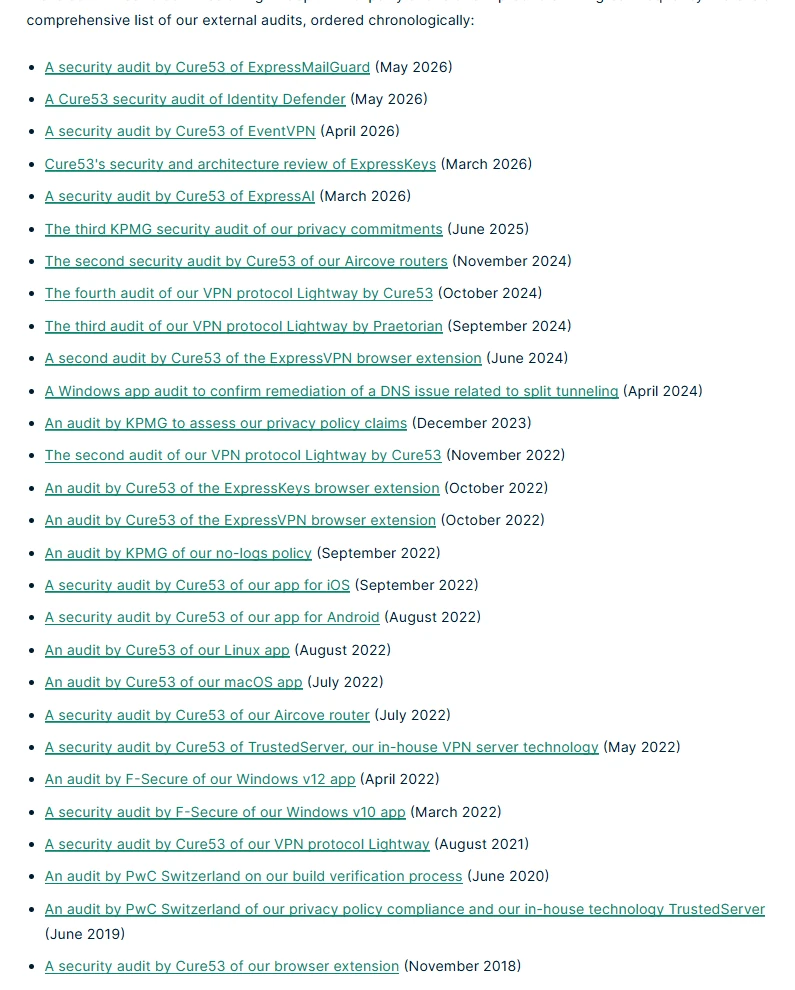
ExpressVPN has published more independent audit reports than any other VPN — 28 by its own published list, from PwC, KPMG, Cure53, and F-Secure. That record is the strongest argument for paying its prices, and this ExpressVPN review looks at what those audits actually certify, which is narrower than most write-ups suggest. The speed case is solid too: CNET measured an 18% average download loss, and the Lightway Turbo protocol pushes past that on short hops. The catch arrives at renewal, where the entry plan jumps to $99.95 a year and the top tier to $199.95.
Is ExpressVPN Worth It in 2026?
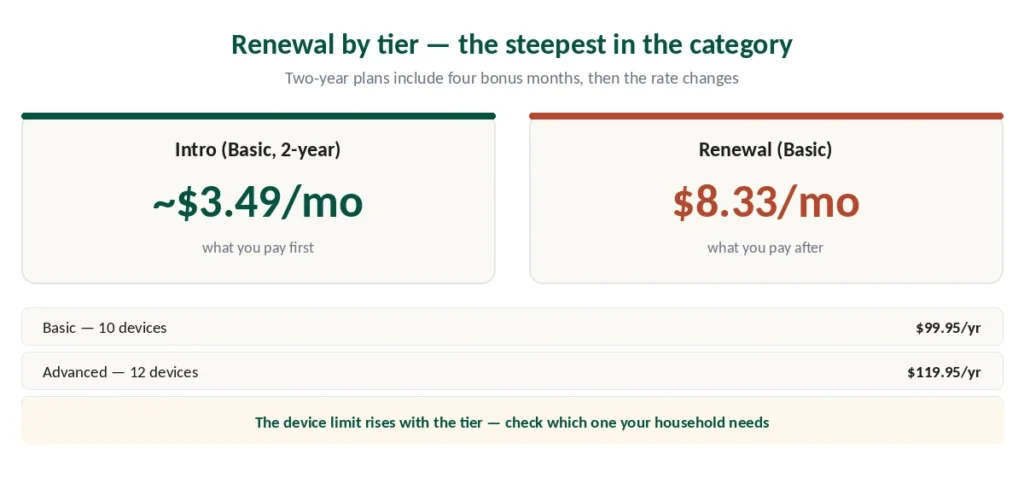
For most people, yes — if you buy the two-year term and set a reminder. ExpressVPN leads on audit volume, streaming reliability, and app polish, and its Lightway protocol is genuinely fast. The entry plan now starts near $3.49 a month, far below its old pricing. The catch is renewal: Basic converts to $99.95 a year.
ExpressVPN at a Glance
Pros
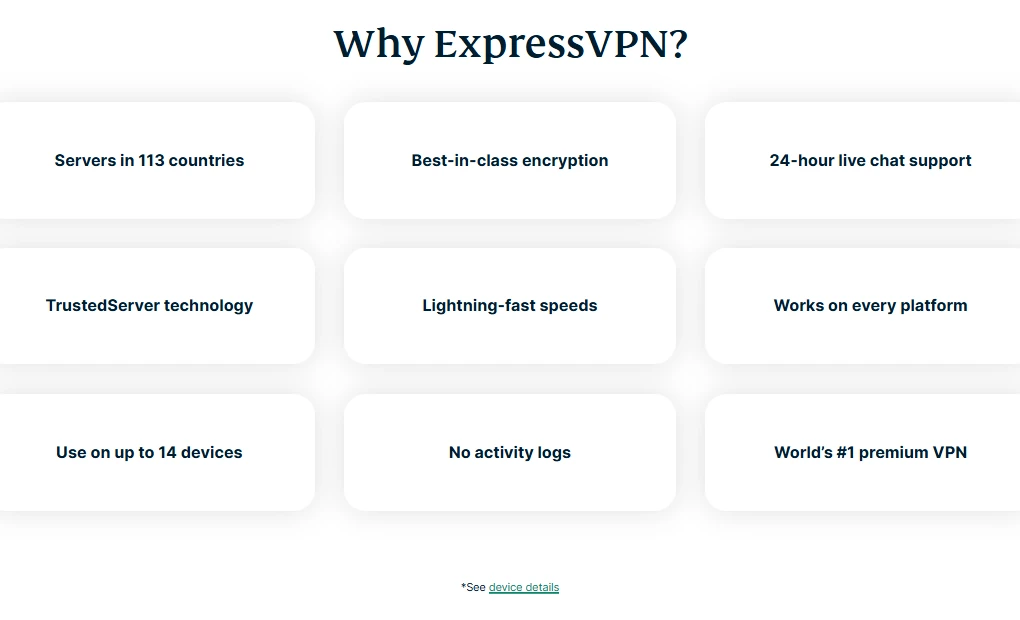
- ✔ 28 published third-party audit reports — more than any competitor discloses
- ✔ TrustedServer runs every server from RAM, reloading the OS on each reboot
- ✔ British Virgin Islands base, outside mandatory data-retention regimes
- ✔ Lightway protocol, rewritten in Rust and audited by Cure53 and Praetorian
- ✔ Reliable streaming access, including regions where many rivals fail
- ✔ Works in restrictive networks more consistently than most providers
Cons
- ✖ Renewal is the steepest in the category: $99.95 to $199.95 a year by tier
- ✖ Device limit depends on which tier you buy — 10, 12, or 14
- ✖ The company does not publish a server count, so the widely quoted “3,000+” can’t be checked
- ✖ Owned by Kape Technologies, whose earlier history draws reasonable questions
Speed & Performance
Speed is where ExpressVPN’s money goes, and the independent record supports the claim without making it the outright leader.
CNET’s testing calculated an 18% average download loss — behind NordVPN’s roughly 3% in the same round, ahead of most of the field. Other testers place it closer to the top. Reviewers running gigabit baselines report ExpressVPN holding 75–85% of base speed even on long-distance hops. Tom’s Guide measured the newer Lightway Turbo mode above 1,600 Mbps at peak, though that build currently runs on Windows only.
Lightway is the technical reason. ExpressVPN rewrote the protocol in Rust in early 2025, keeping the codebase around 2,000 lines — small enough to audit properly, which is the point. Turbo mode adds multi-lane parallel connections. In one May 2026 test run, US-to-US throughput came out above the unprotected baseline — which happens when the VPN route avoids congestion your ISP doesn’t.
The honest summary: ExpressVPN is consistently fast rather than record-setting, and consistency is what you notice day to day. If raw percentage retention is your priority, our full NordVPN review covers the provider with the better number.
Streaming & Torrenting
Streaming is ExpressVPN’s most reliable strength. CNET named it the best VPN for streaming in its March 2026 review. Reviewers consistently unblock Netflix across US, UK, and Australian libraries, plus BBC iPlayer, Disney+, and Amazon Prime Video. Coverage of 113 countries with roughly 170 locations means there’s usually a nearby option for whichever library you need.
No provider wins every month. Platforms and VPNs trade moves continuously, so treat any unblocking claim — including this one — as a snapshot, and use the 30-day refund window to confirm the specific service you care about.
ExpressVPN supports torrenting across the whole network rather than on a dedicated subset, which is simpler than NordVPN’s approach. Split tunneling lets you route the download client through the VPN while local services stay on your normal connection. Power users should know that port forwarding isn’t offered — only one provider in our top five has it. Its sibling under Kape has the same limitation — we compare the two directly.
Security & Privacy: The Most Audited — With One Caveat
ExpressVPN’s transparency record is the best in the category, and it deserves a precise description rather than a marketing one.
ExpressVPN’s trust center lists 28 independent audit reports, running from a Cure53 review of its browser extension in November 2018 through five separate Cure53 audits carried out between March and May 2026. The auditors include PwC Switzerland, KPMG, Cure53, F-Secure, and Praetorian. Set against a provider with none at all, the contrast is plainer than any argument about audit depth. The most recent privacy assessment is the third KPMG engagement, published in June 2025, which examined the TrustedServer system as of 28 February 2025.
Here is the part almost no review mentions. That KPMG engagement was conducted under ISAE (UK) 3000 Type 1. As Engadget noted in its coverage, a Type I audit examines the design and implementation of controls at a single point in time. A Type II audit would test whether those controls actually operated effectively over an extended period. KPMG’s finding — reasonable assurance that TrustedServer does not collect browsing history, traffic destinations, data content, DNS queries, or connection logs — is real evidence. It is evidence about architecture, not about months of operation.
That distinction matters if you are choosing a VPN on verification depth — but it is not a mark against ExpressVPN specifically. NordVPN describes its own sixth engagement, completed in December 2025, as a point-in-time assessment in exactly the same terms. No consumer VPN we have examined runs Type II engagements, which would test whether controls held over an extended period. It is an industry-wide limitation rather than a competitive difference, and we compare both records directly in our NordVPN vs ExpressVPN breakdown.
For how the whole market compares on published verification, see our count across every provider we review.
Structural Safeguards and Transparency
The structural safeguards are strong. TrustedServer runs every server from RAM with the operating system reloaded on each reboot, so nothing persists to disk. The British Virgin Islands base sits outside mandatory data-retention law. Encryption uses AES-256 and ChaCha20, with Network Lock as the kill switch (it cuts your internet if the VPN connection drops). There is also a real-world data point: when Turkish authorities seized an ExpressVPN server in 2017, they recovered no usable data.
ExpressVPN also publishes biannual transparency reports with actual counts rather than assurances. For July through December 2025 it recorded 155 requests from government, law enforcement, and civil parties, three warrants from government institutions, and 1,382,986 DMCA notices. None resulted in the disclosure of user-related data — which is the outcome the no-logs architecture is meant to produce, reported as a number rather than a promise.
Features — and Which Tier Has Them
ExpressVPN moved to three tiers, and the split is mostly about bundled extras rather than the VPN itself. All three share the same servers, the same Lightway protocol, and the same encryption.
Basic is the VPN alone, with 10 simultaneous connections. Advanced raises that to 12 and adds a password manager, identity monitoring, a tracker and adult-site blocker, secure email, and limited eSIM data. Pro allows 14 connections and adds a dedicated IP plus broader identity services.
The device count moving with the tier is unusual and worth checking before you buy. Rivals set one limit for every plan. If you have a household of devices, the entry tier may not be the tier you need — which changes the price comparison.
Beyond the Core VPN
Other tools worth knowing: split tunneling, obfuscation for restrictive networks, post-quantum protection, and Aircove, a router with the VPN built into its firmware — useful for devices that can’t run apps.
Apps & Usability
The apps are the most polished in the category, and that reputation is earned. One large connect button, sensible defaults, and advanced settings that stay out of the way until you look for them. Coverage spans Windows, macOS, iOS, Android, Linux, browsers, and routers.
The trade-off is depth. There’s no Double VPN equivalent, no port forwarding, and fewer configuration options than power users get elsewhere. ExpressVPN optimizes for people who want it to work without thinking about it. It hits that target better than anyone. See how to set it up and verify it works.
Pricing: The Renewal Is Steeper Than the Intro
Two-year plans include four bonus months, running 28 months in total, and pricing has come down. Basic now starts near $3.49 a month, against $4.99 a year earlier. Advanced and Pro run higher. Promotional rates rotate enough that sources quoting them disagree by a dollar or more — check the figure at checkout rather than trusting any review, including this one.
Long plans are billed upfront: the monthly figure is an equivalent, not a debit.
What Renewal Actually Costs
The renewal numbers are stable and worth memorizing. After the intro term, Basic renews at $99.95 a year, Advanced at $119.95, and Pro at $199.95. That is roughly $8.33, $9.99, and $16.66 a month respectively — the steepest renewal among the major providers. Auto-renewal is on by default.
| Provider | Renewal price | Per month | Tier |
|---|---|---|---|
| NordVPN | $139.08/yr | ~$11.59 | Basic |
| Surfshark | ~$79/yr | ~$6.58 | Starter |
| ExpressVPN | $99.95/yr | ~$8.33 | Basic |
| CyberGhost | $56.94/yr | ~$4.75 | 2-year |
| PureVPN | $47.95/yr | ~$4.00 | Standard |
| IPVanish | $89.99/yr | ~$7.50 | Essential |
| Windscribe | ~$69/yr | ~$5.75 | Pro |
| Proton VPN | ~$83.88/yr | ~$6.99 | VPN Plus |
| Mullvad | ~$65/yr | ~$5.40 | flat, no tiers |
| Norton VPN | $79.99/yr | ~$6.67 | Standard |
| Hotspot Shield | ~$95.99/yr | ~$8.00 | Premium annual |
Every plan carries a 30-day money-back guarantee. The iOS and Android app stores offer a 7-day free trial. See how that compares in our guide to VPN free trials.
What We Don’t Love
Three things, all specific. The renewal pricing is the highest in the category and pairs with default auto-renewal — a combination built to be forgotten. The device limit shifting between tiers muddies price comparisons, because the plan you actually need may not be the one in the headline. And ExpressVPN does not disclose how many servers it operates; the “3,000+” figure appears in review after review, but we could not verify it against any official source.
There is a fourth item that belongs in an honest review even though it isn’t technical. ExpressVPN is owned by Kape Technologies, a company whose earlier corporate history has drawn scrutiny — and which also owns CyberGhost and Private Internet Access. No audit has surfaced a technical problem connected to the ownership, and the audit program has continued and expanded since the acquisition. In 2025 ExpressVPN and the wider Kape Group secured ISO/IEC 27001 for information security management and ISO 9001 for quality management. They also hold ISO 18295-1 and 18295-2 for customer contact operations. Those certifications are awarded to the group rather than to the product, which is the level at which the ownership concern actually sits. Kape’s third VPN brand, PIA, is the one with the court record.
How We Research
This review draws on ExpressVPN’s official documentation and audit announcements, the KPMG assurance reports and Engadget’s independent coverage of them, and speed results from named testers including CNET and Tom’s Guide — cross-checked against each other, with time-sensitive figures verified at publication. Where sources conflicted, as they did on intro pricing and server counts, we say so rather than picking the flattering number. Our full approach lives on the About Us page, and you can see how ExpressVPN places against alternatives in our current top 5 rankings.
ExpressVPN FAQ
It depends on your tier, which is unusual. Basic covers 10 simultaneous connections, Advanced 12, and Pro 14. Every plan uses the same servers and protocol, so the difference is device count plus bundled extras. Check which tier your household actually needs before comparing prices against rivals.
Introductory pricing applies only to your first term. Basic then renews at $99.95 a year, Advanced at $119.95, and Pro at $199.95 — roughly $8.33, $9.99, and $16.66 a month. Auto-renewal is enabled by default, so note the renewal figure at purchase and set a reminder.
Twenty eight independent third-party audit reports by the company’s own count, from firms including PwC, KPMG, Cure53, and F-Secure. The most recent no-logs assessment was conducted by KPMG and published in June 2025 and covering the system as of February 2025. That is the largest published audit record among consumer VPNs.
Public reports say it works more consistently than most providers, thanks to server-side obfuscation that disguises VPN traffic. No provider can guarantee access on heavily censored networks, and what works one month may fail the next. The 30-day refund window is the practical way to test your own situation.
ExpressVPN is owned by Kape Technologies, which acquired it in 2021. The company’s earlier corporate history has drawn scrutiny from privacy commentators. ExpressVPN runs its own infrastructure and audit program, and the audits published since the acquisition have not surfaced technical issues tied to the ownership.
Independent results put them close, with the answer depending on route and platform. Lightway is ExpressVPN’s own protocol, rewritten in Rust in 2025 and kept to roughly 2,000 lines so it can be audited properly. Its Turbo mode adds parallel connections and has measured above 1,600 Mbps in testing, currently on Windows only.
ExpressVPN
The deepest audit record and the easiest apps — at the steepest renewal
ExpressVPN publishes more independent audit reports than any competitor and pairs that record with the most polished apps in the category. Streaming and restricted-network access are the most reliable we found. The price is what holds it back — not the intro rate, which is now competitive, but the renewal that follows it.
Final Verdict: 4.5/5
ExpressVPN earns third place in our rankings on a narrow, defensible argument: nobody publishes more independent verification, nobody makes streaming and restricted-network access this reliable, and the apps are the easiest in the category. The price is what keeps it from ranking higher — not the intro rate, which is now competitive, but the renewal that follows.
Choose it if: you want the deepest published audit record, you travel to places where VPNs get blocked, and you’ll either cancel before renewal or accept the annual price. Skip it if: you want the best speed-per-dollar, where NordVPN leads — see our full NordVPN review. Covering a large household? Our head-to-head with Surfshark explains why unlimited devices beats a tiered limit. If price is the deciding factor, CyberGhost costs less and renews far more gently. TunnelBear started the practice ExpressVPN now leads on, at $107 less across four years.
Against Private Internet Access the comparison gets awkward. Both belong to Kape Technologies, both were tested by outsiders rather than by an accountant, and one costs about twice the other.