
Disclosure: VPNFin is reader-supported. If you buy a VPN through links on this page, we may earn a commission at no extra cost to you. This never affects our ratings — here’s how we research.
The short answer is that using a VPN in Turkey is not a crime, and the reason is more interesting than the answer.
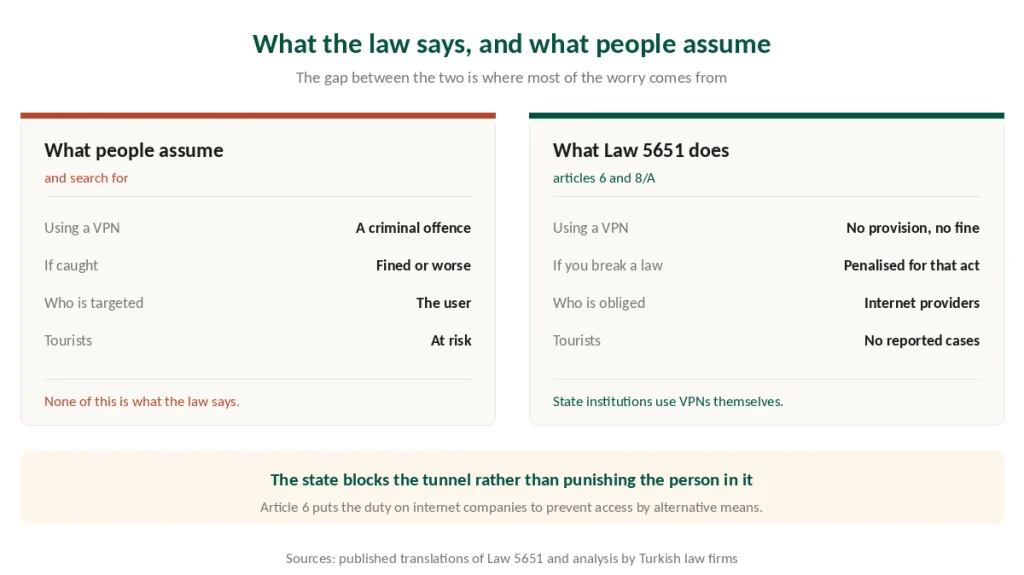
Turkey’s Internet Law No. 5651 does not prohibit VPNs. What it does is oblige internet service providers to prevent access to already-blocked websites by alternative means. The obligation sits with the provider. Article 8/A separately lets the regulator block content without a court order.
So the state blocks the tunnel rather than punishing the person in it. More than two dozen VPN services are unreachable from Turkish networks, and there are no reports of anyone being prosecuted for merely using one.
This guide covers what the law actually says, what that means in practice, and the proposal that could change it.
⚠️ We are not lawyers, and this is not legal advice. It is a summary of published law and reporting, and the situation changes.
The Short Answer
Using a VPN is lawful. Turkish law contains no article making VPN use itself an offence, and no fine attaches to it.
Penalties attach to what you do, not to how you connect. Illegal betting is penalised as illegal betting; the VPN is treated as a means of concealing evidence rather than as the offence.
Reaching a VPN is the hard part. Providers are blocked at the network level, and deep packet inspection drops recognisable tunnel traffic.
And it may change. A proposal announced in April 2026 would restrict use to authorised services only.
What Law 5651 Actually Says
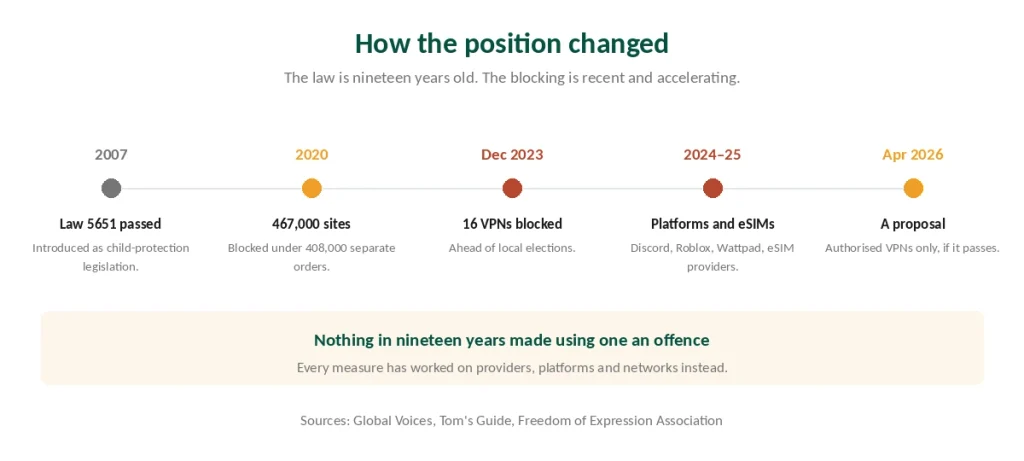
The framework dates from 2007 and was introduced as child-protection legislation.
Article 8/A allows the regulator to block access without a court order where content is deemed to endanger national security or public order.
Article 6 obliges internet providers to prevent access to blocked sites by alternative means. That is the clause under which VPN services themselves are blocked, and it is worth reading twice: the duty falls on the provider, not on you.
Nothing in the law makes using a VPN an offence. Two Turkish law firms publishing on the subject reach the same conclusion in near-identical terms — there is no explicit provision criminalising circumvention, and no fine exists for VPN use alone.
⚠️ What that leaves is the underlying act. One firm puts it plainly: a fine for unlawful betting is imposed for the betting, not for the VPN. In that framing the tunnel is a means of concealing evidence, which can aggravate a case rather than constitute one.
Turkish institutions use VPNs themselves for controlled remote access, which is the clearest available evidence that the technology is not the target.
What Is Actually Blocked
The scale is easier to grasp with numbers than with adjectives.
Websites. The Freedom of Expression Association reported more than 467,000 blocked by the end of 2020, under some 408,000 separate orders issued by 764 institutions. Its 2023 report put the running total near a million, with over 240,000 added in that year alone.
VPN providers. Sixteen services were blocked in December 2023 ahead of local elections; published counts in 2026 put the figure above twenty-five. The list includes every provider we rank — Proton VPN, NordVPN, Surfshark, ExpressVPN, CyberGhost, IPVanish, PureVPN, TunnelBear, Hotspot Shield and Private Internet Access among them.
Protocols. Deep packet inspection identifies OpenVPN, WireGuard and IPSec signatures and drops the traffic. That is why a provider can be reachable and still not connect — our protocol guide explains what those signatures are.
Platforms. Instagram, WhatsApp, X, YouTube and TikTok have all been restricted simultaneously during political events. Instagram was blocked for nine days in August 2024, affecting some 57 million users. Discord has been blocked since October 2024, Roblox since August 2024, and Turkey became the first country to block Wattpad in July 2024.
And eSIM providers, which almost nobody expects. Several international eSIM services have been unreachable from Turkish networks since July 2025, which matters because an eSIM is usually the answer to travel connectivity rather than a VPN.
The Proposal That Would Change This
Announced in April 2026, and worth understanding before it either passes or does not.
The plan would restrict use to authorised VPNs only. Reporting on it describes services that log user activity and provide it to authorities on request — which would make the permitted tools the opposite of what people buy a VPN for.
A separate measure would require identity verification through the government’s e-Devlet portal to use platforms including TikTok and YouTube.
News of the proposal reportedly produced a surge in VPN sign-ups, which is a rational response to a proposed restriction and also a measurable one.
⚠️ It is a proposal, not law, at the time of writing. We are flagging it because anyone deciding what to install before a trip should know it exists, and because the situation has changed repeatedly since 2016.
What This Means If You Are Visiting
Straightforward practical points, all concerning lawful use.
Install and test before you arrive. Provider websites are blocked from inside the country, so downloading an app once you land is unreliable. This is the single most useful thing on this page.
Expect your bank to notice. A login from Turkey triggers fraud systems, and a home-country server plus a travel notice filed in advance is the combination that avoids it — our banking guide covers the mechanism.
Hotel and café networks carry the usual risks, which have nothing to do with Turkey specifically. Our public Wi-Fi guide sets out what is genuinely at risk there.
Your eSIM may not activate. Sort connectivity out before departure rather than at the airport.
⚠️ We do not publish methods for evading network-level blocking, in Turkey or anywhere else. Rules change, enforcement is discretionary, and the consequences fall on the person in the country rather than on the site describing the technique.
How the Risk Actually Distributes
Worth stating precisely, because the honest answer is not the same for everyone.
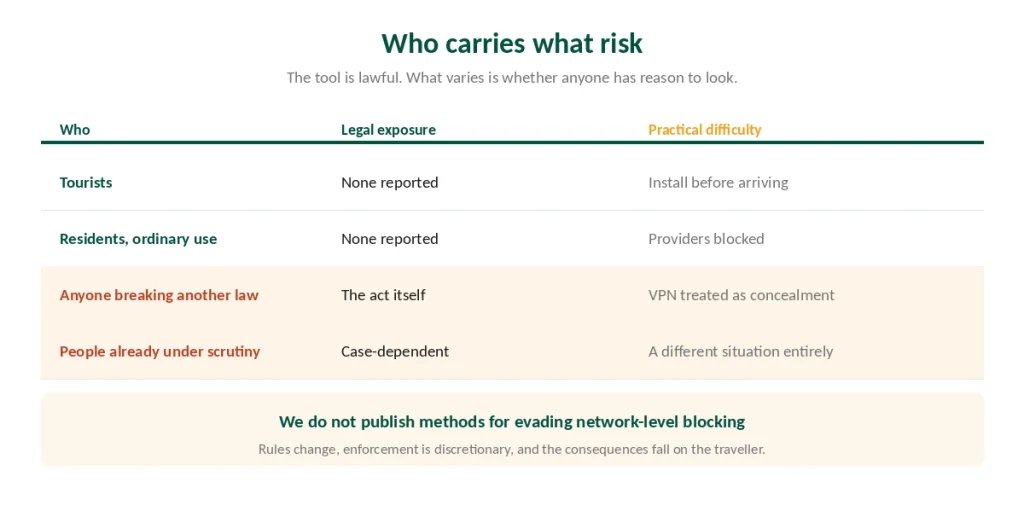
Tourists and short-term visitors face essentially no legal exposure from ordinary use. Published analysis describes prosecution as unlikely absent some other reason for attention.
Residents using a VPN for privacy, work or travel are in the same position under the law, and no reported case turns on VPN use alone.
People whose activity already attracts attention are in a different situation. Reporting notes that journalists and activists have faced prosecution in which the use of encrypted communications formed part of the case — not as the offence, but as evidence within one.
⚠️ That distinction is the whole picture. The tool is lawful. What varies is whether anyone has reason to look at you, and that has nothing to do with the tunnel.
How Turkey Compares
Placing it against the countries people ask about next.
Turkey blocks providers and leaves users alone. No licensing regime, no criminal provision, no reported prosecutions for use itself.
China operates a licensing system where unauthorised services are the target, and enforcement has fallen mainly on providers rather than visitors. Even so, China’s implementing rules set a fine for the individual, which Turkish law does not.
Russia took a different route. It blocks services wholesale and fines the people who advertise them, and its one provision aimed at a person penalises the search rather than the connection.
| Country | What the rule aims at | Reaches the user? |
|---|---|---|
| Turkey | The tunnel — ISPs must block | No |
| The UAE | Conduct behind an address | No |
| India | The provider's records | Not nationally |
| China | Provider, tunnel and user | Yes |
| Brazil | Nothing, until a court acts | For 39 days |
| Indonesia | Paperwork — registration | No |
| The UK | The destination you visit | No, and ministers said so |
| The US | The platform, state by state | No, in all twenty-seven |
| Russia | The search, not the tool | Only if you went looking |
| Australia | The platform, and the tunnel itself | No — platforms must detect it |
| France | The VPN provider itself | No, the orders bind five companies |
| Italy | The provider, by regulator order | No, but one VPN left the market |
| Spain | The provider, by injunction without a hearing | No, and only two firms were named |
| Germany | The provider's logfile, for three months | No, and the courts twice removed it |
Iran permits licensed services, which by design are the opposite of private. The UAE regulates neither the tunnel nor the company — it penalises what you do behind one, and the tool is never named in the statute.
India permits VPNs and requires providers to retain user data for five years, which changed which companies operate servers there — and district orders there reach users directly, which nothing in Turkish law does.
The pattern across all of them: business and institutional VPN use is permitted almost everywhere, including in the strictest jurisdictions. Our legality guide covers the wider picture and why the technology itself is rarely the thing being regulated.
How We Research
This guide draws on published translations of Turkish Internet Law No. 5651 including the articles cited, analysis published by two Turkish law firms on the legal status of VPN use, reporting from Global Voices and Tom’s Guide on provider blocking and proposed legislation, and figures from the Freedom of Expression Association’s EngelliWeb reports — cross-checked and verified at publication. We are not lawyers and this is not legal advice. We do not publish methods for evading network-level blocking, and where sources described such methods we excluded them. Our full approach lives on the About Us page.
Turkey VPN Legality FAQ
No. Turkish law contains no provision making VPN use itself an offence, and no fine attaches to it. Internet Law No. 5651 obliges internet service providers to block access to prohibited material, which is why VPN services are unreachable — but the obligation falls on the provider rather than on you.
Not for the VPN itself. Penalties attach to the underlying act — unlawful betting is penalised as unlawful betting, for example. In that framing the VPN is treated as a means of concealing evidence rather than as the offence, which can affect a case without constituting one.
Many are. Sixteen services were blocked in December 2023 and published counts in 2026 put the figure above twenty-five, including several major providers. Deep packet inspection also identifies OpenVPN, WireGuard and IPSec traffic signatures, so a reachable provider may still fail to connect.
Yes, and the practical advice is to install and test it before arriving, since provider websites are blocked from inside the country. Several international eSIM providers are also unreachable, so arrange connectivity before departure rather than at the airport.
A proposal announced in April 2026 would restrict use to authorised services, reportedly meaning ones that log activity and supply it on request. A separate measure would require identity verification through the government portal for some platforms. Neither was law at the time of writing, and the position should be checked before travelling.
The Verdict
Using a VPN in Turkey is lawful. No provision criminalises it, no fine attaches to it, and state institutions use the technology themselves.
The law works on providers instead. Article 6 of Law 5651 obliges internet companies to prevent access to blocked material by alternative means, which is how more than two dozen VPN services became unreachable.
Penalties follow the act, not the tunnel. Where a case exists, the VPN is characterised as a means of concealment rather than as the offence.
And the position is not settled. A proposal announced in April 2026 would permit only authorised services, and anyone planning a trip should check where that stands rather than relying on this page six months from now.