
Disclosure: VPNFin is reader-supported. If you buy a VPN through links on this page, we may earn a commission at no extra cost to you. This never affects our ratings — here’s our full disclosure.
Most streaming platforms ask one question: where are you connecting from. Prime Video asks three, and a VPN answers only one of them.
The other two are your account’s registered country and the locale of the payment method attached to it. Neither moves when you connect to another server, which is why this platform frustrates people who had no trouble with BBC iPlayer or Netflix. HBO Max sits one step further again, where the check happens at the checkout rather than the player.
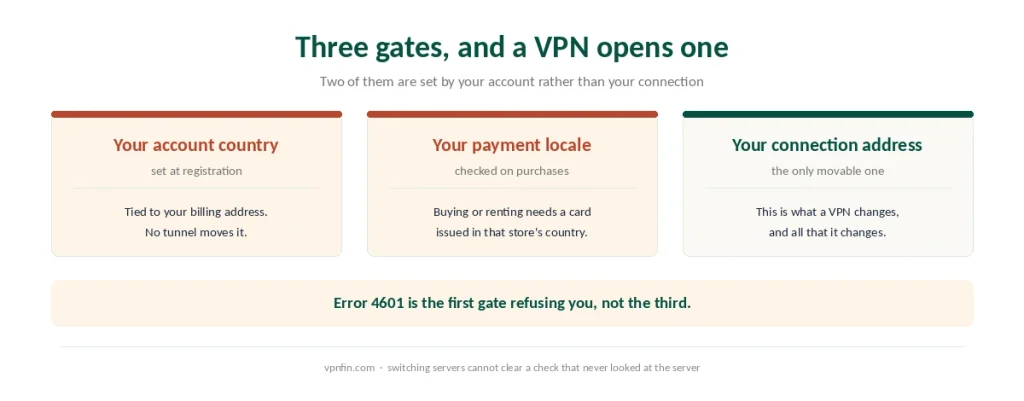
Three Gates, Not One
Your account country. Set when you registered, tied to your billing address, and unchanged by any tunnel — the same arrangement the PlayStation Store uses, and the opposite of Disney+, which reads the address instead.
Your payment method’s locale. Buying or renting anything requires a card issued in the country of the store you are using, which is a separate check again.
Your connection address. The only one a VPN touches — and moving it is the whole of what a VPN does.
⚠️ Error 4601 is the account gate refusing you, not the address gate. The message describes your device’s location differing from your Amazon account country, and switching servers will not clear it.
Why Amazon Is Better at This Than Anyone
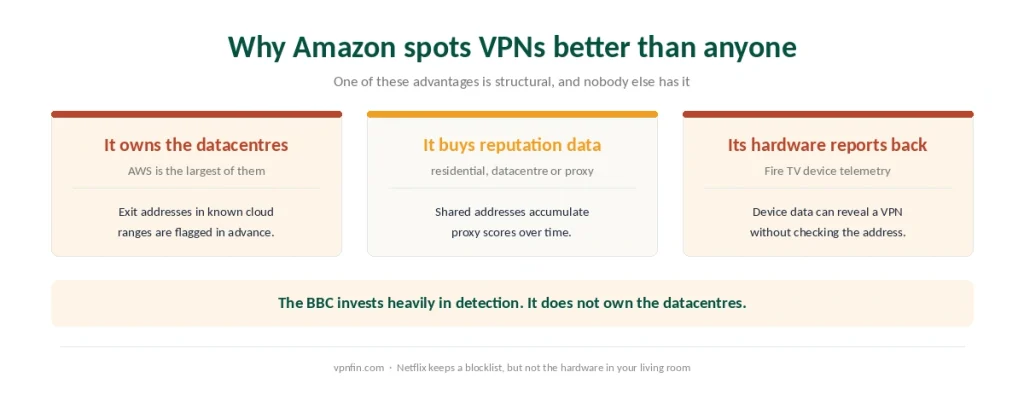
Three advantages, and the first is structural rather than technical.
Amazon owns AWS. The company operating the world’s largest cloud infrastructure has a live map of the datacentre address ranges that VPN providers rent. Exit addresses belonging to known datacentre networks are flagged before a content request is even processed.
It buys reputation scoring on top. Commercial databases score every address as residential, datacentre or proxy, and shared VPN addresses accumulate proxy scores as thousands of people route through them.
And its own hardware reports back. Prime Video apps on Fire TV devices send device fingerprint data to Amazon’s servers, which can reveal a VPN independently of the address check — particularly when the device’s account location and its connection location disagree over time. Fire TV sticks are the device most affected for exactly this reason.
⚠️ No other platform has all three. The BBC invests heavily in detection but does not own the datacentres; Netflix maintains a blocklist but not the hardware in your living room.
What Travelling Actually Looks Like
The common case, and the answer is less dramatic than the guides suggest.
Prime Video shows you the library of wherever you are. Go abroad and the catalogue changes; come home and it changes back. Nothing is lost.
A limited set of titles travels with you, mostly Amazon Originals, which stay available regardless of location.
Downloading before you leave is the reliable route. For a two-week trip that beats fighting detection from hotel wifi, and it costs nothing.
⚠️ Check your home catalogue before assuming you need another one. Titles move between regional libraries constantly, and the thing you are hunting abroad is sometimes already at home.
What Each Error Actually Means
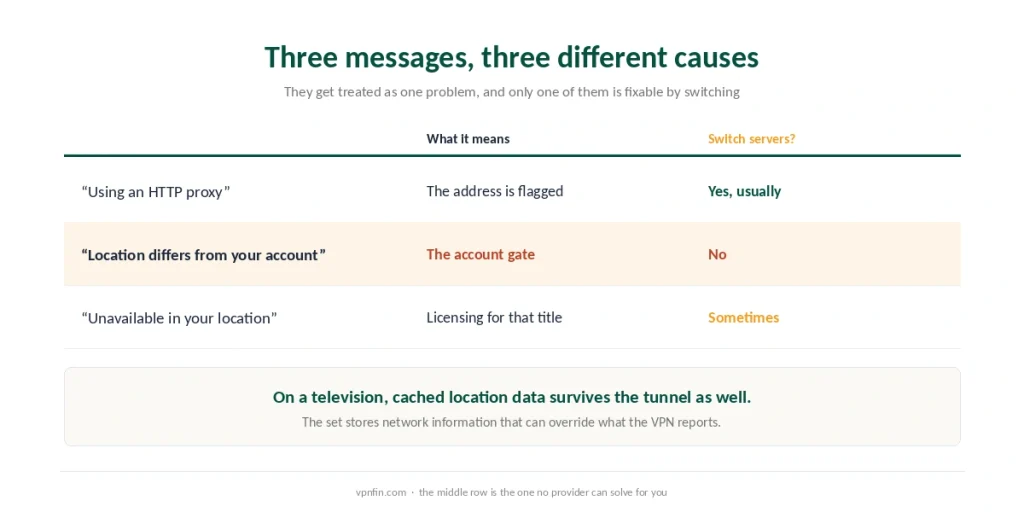
Three messages, three different causes, and they are treated as one problem far too often.
“Your device’s Internet connection is using an HTTP proxy.” The address gate. Amazon has identified the server as a VPN exit. A different server in the same country usually clears it.
“Your device’s location is different from your Amazon account country.” The account gate. No server change helps, because the check is not about the address.
“This video is currently unavailable to watch in your location.” Licensing for that specific title, which may fail even where the rest of the catalogue works.
⚠️ On a television, cached location data survives the VPN. A smart TV stores network and location information that can override what the tunnel reports — and the DNS field on those sets causes the same confusion when it is left behind.
What Is Not at Risk
Worth stating plainly, because the topic attracts a lot of vague warning.
Detection is address-specific, never account-specific. Amazon blocks the server, not the customer. Published accounts describe no history of accounts being banned for VPN use.
Using a VPN is lawful. Watching another region’s catalogue breaches Amazon’s terms of use, which is a contractual matter — the same distinction our legality guide draws for every platform.
We are not going to publish workarounds for the account gate, because changing a registered country and payment method to reach a catalogue is a different act from connecting through a server.
If You Are Choosing a Provider Anyway
A large pool of frequently rotated addresses matters more here than anywhere. NordVPN scores highest on our scale at 4.8 and is named most often in published testing for this platform.
Server count within one country is the specific thing to look for. When a US East address fails, a US West one often works, and that only helps if the provider has both.
Free services are not candidates. Small static address pools are flagged first, and the reasons to avoid them go well beyond streaming.
⚠️ Test inside the refund window. Every provider we cover offers at least thirty days, and on a platform with three separate checks that is the only meaningful trial — our streaming guide explains why we weight that so heavily.
How We Research
This guide draws on Cybernews for the distinction between the account region and the connection address, on Cloudwards for the travelling-content allowance and the payment-method requirement on purchases, on Flippendo for the description of Amazon’s detection layers including AWS range mapping, commercial reputation scoring and Fire TV device telemetry, on All Things VPN for the proxy error text and the observation that blocking is address-specific rather than account-specific, and on vpnMentor for the cached-location behaviour on smart televisions. Every one of those sources earns commissions from providers it names, so we have used them for platform behaviour rather than for rankings, and we have not reproduced the account-region methods some of them describe. We do not run our own tests. Our method lives on the About Us page.
Prime Video VPN FAQ
Because the catalogue follows your Amazon account’s registered country, not your connection. A VPN changes the address and nothing else, so an account registered in one country keeps showing that country’s entitlements regardless of the server you choose.
It is the account check refusing you: your device’s location differs from the country on your Amazon account. Switching to another server will not clear it, because the mismatch is between your account and your address rather than between your address and a blocklist.
It owns AWS, so it holds a live map of the datacentre ranges VPN providers rent. It also buys commercial reputation scoring for addresses, and its own Fire TV apps send device data that can reveal a VPN independently of the address check.
No published account describes that happening. Detection is address-specific: Amazon blocks the server rather than the customer. Accessing another region’s catalogue does breach Amazon’s terms of use, which is a contractual matter rather than a legal one.
Download them before you travel. Prime Video shows the library of wherever you are, a limited set of titles — mostly Amazon Originals — travels with you regardless, and downloads sidestep both the detection and the hotel wifi.
The Verdict
Prime Video is the platform where your address matters least. The account country and the payment locale are checked separately, and no tunnel moves either one.
Amazon is also structurally better at spotting VPNs than anyone else, because it owns the datacentres most of them rent and the streaming hardware in a great many living rooms.
Which makes the honest advice unusually simple. If you are travelling, download first. If you want a permanent second catalogue, a VPN alone will not deliver it, and the rest is a question about your account rather than your connection.