
Disclosure: VPNFin is reader-supported. If you buy a VPN through links on this page, we may earn a commission at no extra cost to you. This never affects our ratings — here’s our full disclosure.
Ziff Davis owns both of these. They sit in the same division, answer to the same American jurisdiction, and are sold as separate services.
One of them handed a user’s details to Homeland Security while advertising a no-logs policy. That one has since been audited twice and publishes quarterly reports. The other has never been caught doing anything, and has never been examined either.
The Short Answer
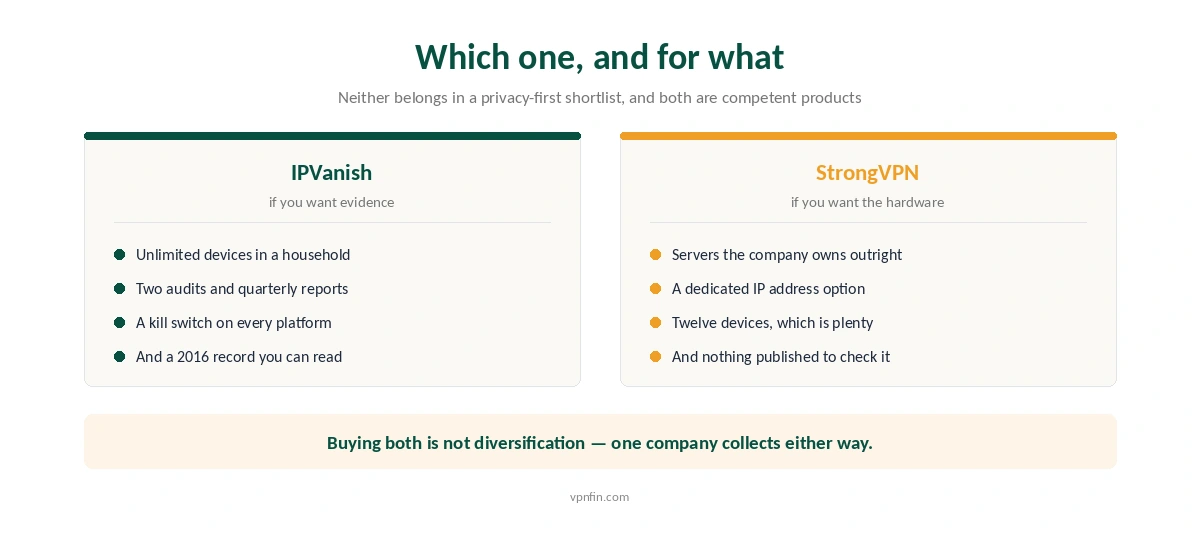
IPVanish if you want evidence. Two independent audits, quarterly transparency reports, unlimited devices and a kill switch on every platform.
StrongVPN if you want the hardware. It owns and runs its own servers rather than leasing capacity, which almost nobody does, and it offers a dedicated IP address.
⚠️ Neither belongs in a privacy-first shortlist. Both are American, both are owned by a media conglomerate, and our privacy ranking excludes unaudited providers — which removes one of them outright.
The Owner They Share
Ziff Davis holds both, through its NetProtect division. The chain runs Highwinds, then StackPath in 2017, then j2 Global — now Ziff Davis — in 2019.
The same company publishes PCMag, CNET, Mashable, IGN and ZDNet, and owns Speedtest — one group supplying the product, the measuring tool and the review.
⚠️ So buying both is not diversification. It is two subscriptions to one company, and the comparison pages that pit them against each other are comparing products, not companies.
What Happened in 2016
Worth setting out precisely, because it is the reason the audits exist.
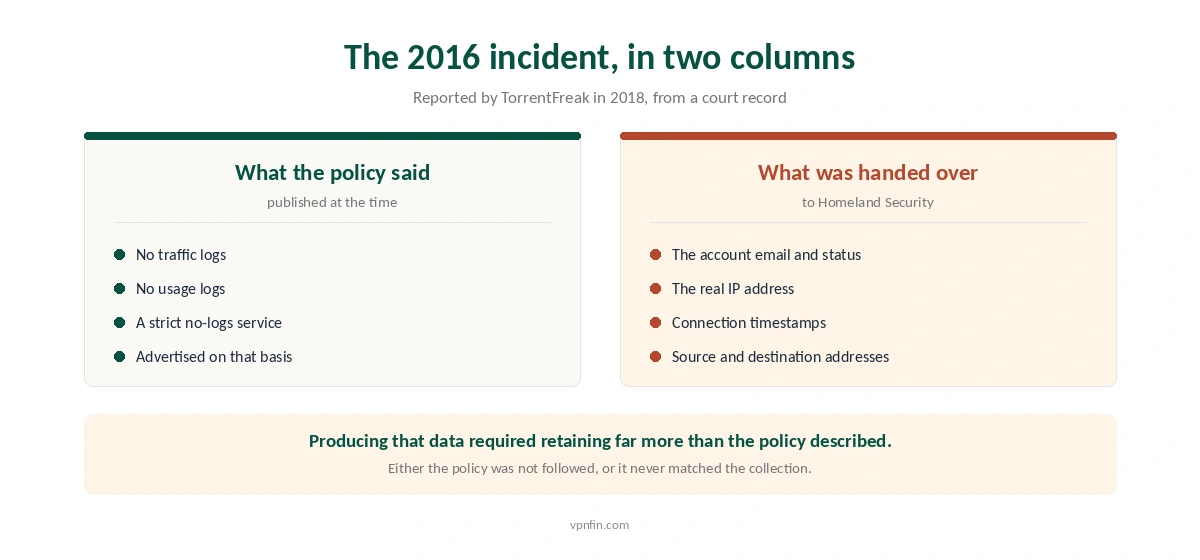
Homeland Security issued a summons of records to IPVanish, then operating under Highwinds, in a child exploitation investigation.
The company complied. Reporting describes the disclosure as including the account email and status, the real IP address, connection timestamps, and source and destination addresses.
Its published policy at the time stated no traffic or usage logs. Producing that data required retaining considerably more than the policy described — so either the policy was not followed, or it never matched what was collected.
⚠️ The case surfaced in 2018, through a court record reported by TorrentFreak, rather than through any disclosure by the company.
And the reassurance afterwards was carefully worded. The chief executive of the company that acquired it in 2017 said that at the time of the acquisition no logs and no logging systems existed. That statement says nothing about 2016.
What Came After It
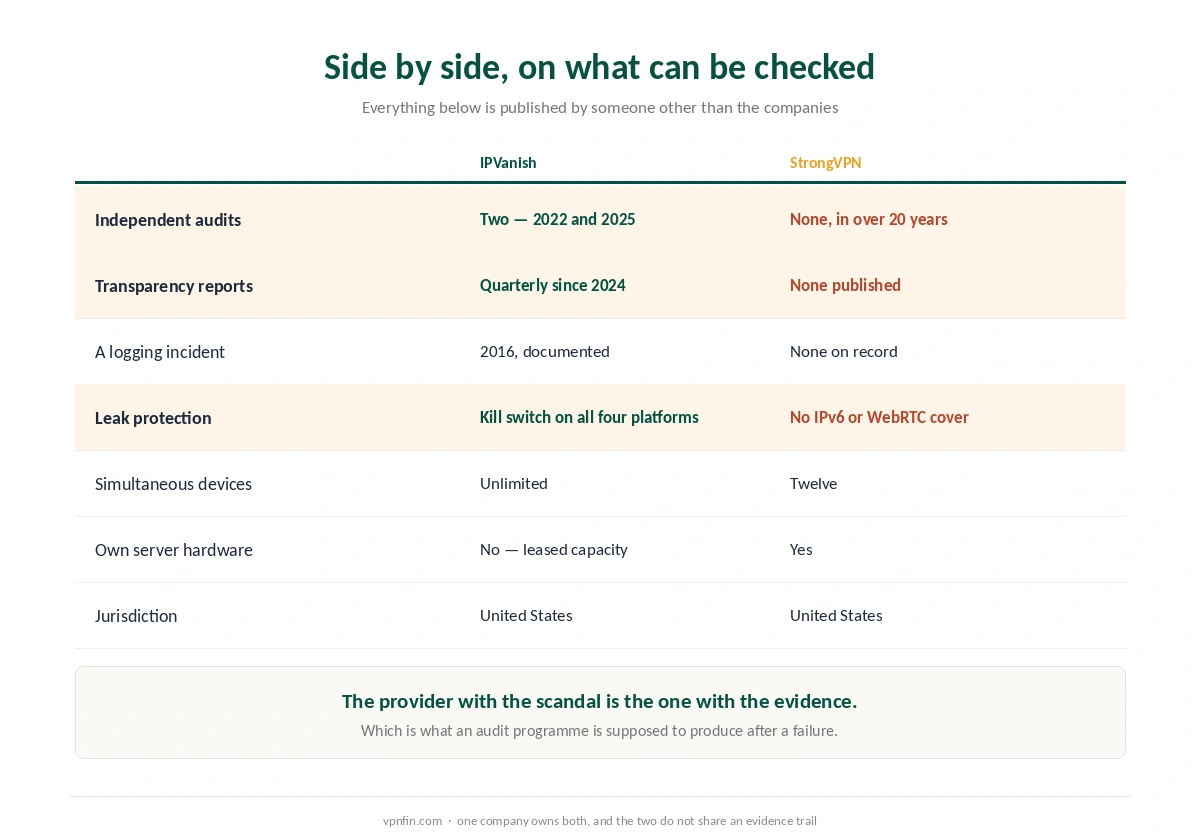
Leviathan Security Group audited the no-logs claim in 2022, and concluded the service was operationally consistent with its published policy.
Schellman Compliance audited it again in February 2025, with a broader scope, testing server configurations rather than interviewing staff. It reached the same conclusion.
Quarterly transparency reports began in 2024, documenting legal requests received and data disclosed — reported as zero throughout.
⚠️ That is what an audit programme after a failure is supposed to look like. It does not undo 2016, and an audit describes a company at a moment — but two reports three years apart is a pattern rather than a gesture.
And What StrongVPN Has Published
Nothing. No independent audit in more than twenty years of operation, no transparency report, and no warrant canary.
Its no-logs claim rests on its privacy policy alone, which is precisely the arrangement that failed at its sibling in 2016.
⚠️ It also provides no protection against IPv6 or WebRTC leaks, which affects ordinary use rather than hypothetical scenarios — two of the leak types we cover are simply unaddressed.
What it does have is unusual. It owns its server hardware rather than renting capacity from datacentre operators, which gives it direct control over the machines your traffic crosses.
Devices, Features and Price
IPVanish allows unlimited simultaneous connections; StrongVPN allows twelve. For a household that settles it, and twelve is more than NordVPN or ExpressVPN permit.
StrongVPN’s renewal is the figure to check. Reported at $47.69 for the first year and $89.99 for every year after — close to double, charged automatically, and the guarantee does not cover renewals.
⚠️ Our own tables disagree on IPVanish’s first-term price, which we are saying rather than choosing a figure. Check the checkout page, and compare the renewal rather than the introductory rate.
StrongVPN’s monthly plan carries no refund window at all. Buying monthly to test it cheaply leaves you with no way back, which is an unusual arrangement even in this market.
Who Each Is For
Take IPVanish for a household, and if evidence matters to you more than history. Unlimited devices, a kill switch everywhere, and a documented trail you can examine — including the part the company would rather you did not.
Take StrongVPN if the owned hardware or the dedicated IP is the point, and take the annual plan rather than the monthly one.
⚠️ Take neither if you are choosing on privacy. Mullvad publishes annually and has been searched by police; Proton has five audits and a non-profit owner. Both are outside this pairing entirely.
How We Research
This comparison draws on VPNCompare, All Things VPN and vpn.com for the 2022 Leviathan and February 2025 Schellman audits and the quarterly transparency reports, on reporting of the 2018 TorrentFreak disclosure for the 2016 summons and the data it produced, on published accounts of the StackPath chief executive’s statement after the 2017 acquisition, and on Comparitech, Security.org and Gizmodo for the StrongVPN feature set, pricing and refund terms. Ownership details come from our own map. Several of the publishers cited here sell VPN subscriptions or belong to groups that do, and one of them belongs to Ziff Davis itself — we use them for documented facts rather than for conclusions. Where our own tables disagree on a price, as they do for IPVanish, we have said so. We do not run our own tests. Our method lives on the About Us page.
IPVanish vs StrongVPN FAQ
They share an owner. Ziff Davis holds both through its NetProtect division, along with Encrypt.me and the WLVPN white-label platform. The brands run separately, but subscribing to both means paying one company twice.
IPVanish, on the available evidence. It has two independent no-logs audits, from Leviathan in 2022 and Schellman in 2025, plus quarterly transparency reports. StrongVPN has published no audit in over twenty years, and provides no IPv6 or WebRTC leak protection.
It matters as context. Under previous ownership the company disclosed a user’s email, real IP address and connection timestamps to Homeland Security while publishing a no-logs policy. The company has changed hands twice and commissioned two audits since. Whether that is sufficient is a judgement, and the record is public either way.
IPVanish allows unlimited simultaneous connections. StrongVPN allows twelve, which is still more than NordVPN or ExpressVPN permit and enough for most households.
Neither would appear in a privacy-first shortlist. Both operate from the United States inside the Five Eyes arrangement, and both belong to a media conglomerate that also owns publications reviewing VPNs. Mullvad, IVPN and Proton VPN are the providers with the strongest published evidence.
The Verdict
The one with the scandal is the one with the evidence. IPVanish was caught in 2016, and the response was two audits and quarterly reporting. StrongVPN has never been caught and has never been checked, which is not the same as being clean.
StrongVPN’s answer is its hardware. Owning the machines rather than renting them is a genuine structural claim, and it is the one advantage here that IPVanish does not have.
And one company banks either way. Whichever you choose, the money goes to the same place — which is worth knowing before reading any comparison of the two, including this one.