
Disclosure: VPNFin is reader-supported. If you buy a VPN through links on this page, we may earn a commission at no extra cost to you. This never affects our ratings — here’s how we research.
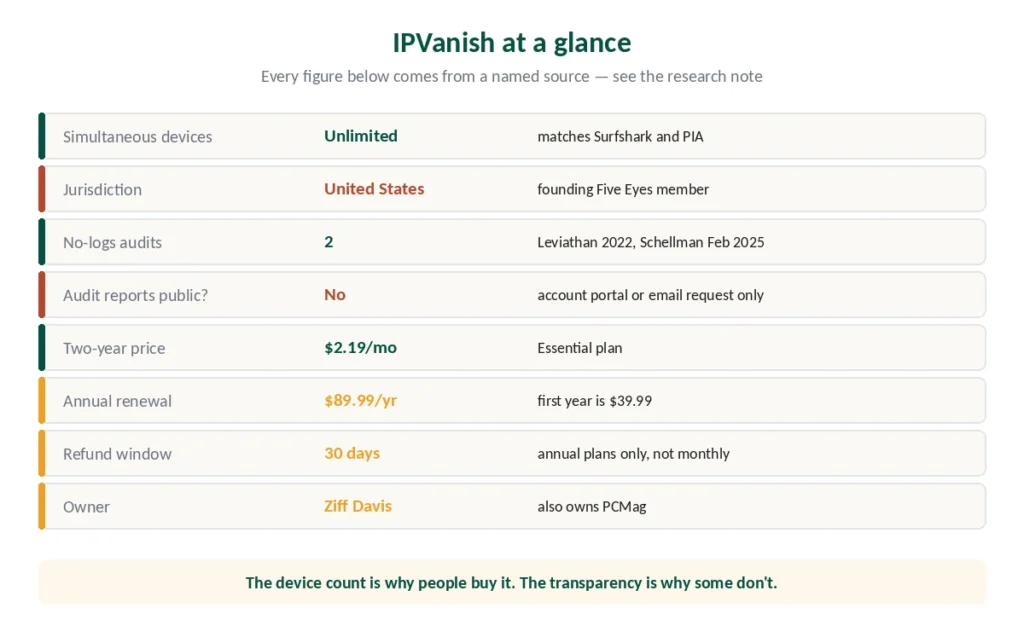
IPVanish sells unlimited simultaneous connections for $2.19 a month on a two-year plan, which puts it alongside Surfshark as one of only two mainstream providers with no device cap at all.
It also has two independent no-logs audits — and doesn’t publish either of them.
This IPVanish review covers what the audits examined, why you can only read them from inside a paid account, what happened in 2016 under a previous owner, and the renewal price that follows the first year.
Verdict at a Glance
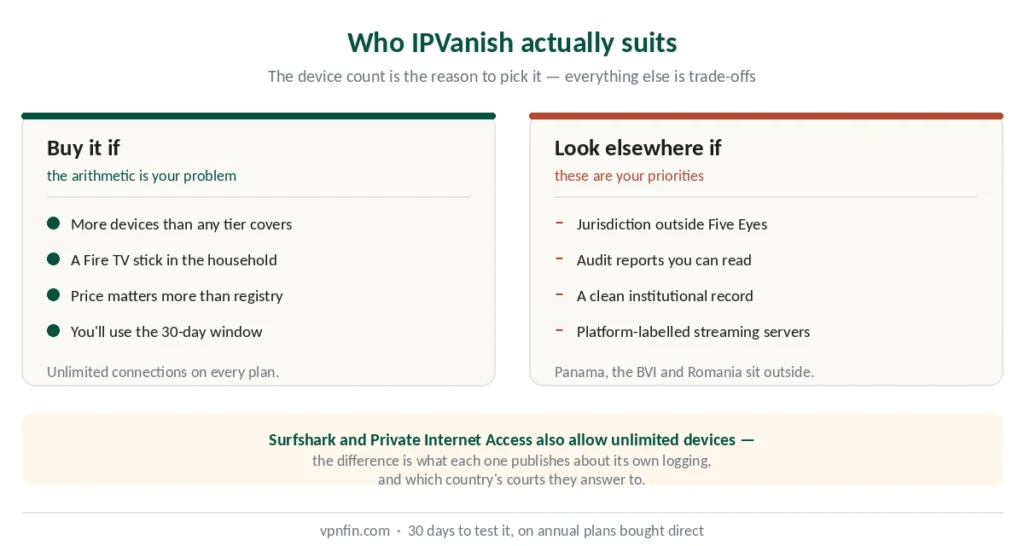
Buy it if you have more devices than any tiered plan covers and want the lowest price for that. Unlimited connections at $2.19 a month is genuinely competitive.
Skip it if jurisdiction matters to you — IPVanish is US-based, inside Five Eyes — or if a company that publishes audit summaries rather than audit reports doesn’t meet your bar.
The short version: the product works well, the current owner has commissioned real verification, and the transparency around that verification is weaker than the category leaders.
Unlimited Devices: The Actual Selling Point
Most providers cap simultaneous connections. NordVPN allows 10, ExpressVPN 10 to 14 depending on tier, CyberGhost just 7. Against NordVPN specifically, that’s the one category IPVanish wins outright.
IPVanish allows unlimited, on every plan including the cheapest. Windscribe matches that too, and adds a free tier to test with first.
Who this matters to: households where two phones, two laptops, a tablet, a smart TV and a games console are all connected. That’s seven before anyone visits — our device limits comparison covers why this arithmetic catches people out.
And it matters on Fire TV specifically. Published testing rates IPVanish highly on Amazon’s platform, where the app is well built and the unlimited policy means the streaming stick doesn’t compete with your phone for a slot.
The 2016 Incident, Told Properly
This comes first because it shapes everything else.
What happened. In 2016, IPVanish handed the Department of Homeland Security detailed customer information during a child-abuse investigation. The data included the suspect’s real name, email address, source IP address, and exact connection timestamps.
Why it mattered. IPVanish advertised a no-logs policy at the time. The company could not have supplied that data if the policy had been implemented as described. TorrentFreak reported the case in June 2018, two years after the fact.
Who owned it then. Highwinds Network Group. IPVanish has changed hands twice since — first to StackPath, then to Ziff Davis, which runs it under its NetProtect division.
⚠️ What that does and doesn’t resolve. The people who made that decision are gone, and the current architecture has been examined twice by outside firms. But published analysis notes IPVanish has never given a clear public account of how the logging happened. The record stands; the explanation doesn’t.
Our position: this is historical context rather than a current disqualifier — the same conclusion we reached about PureVPN’s 2017 case. Whether you agree is reasonably a matter of personal judgement.
The 2016 disclosure belongs in a wider picture. Four providers we review have been tested without warning and had nothing to hand over; IPVanish and PureVPN are the two that did.
Two Audits, Neither Public
Here is the part almost no review states plainly.
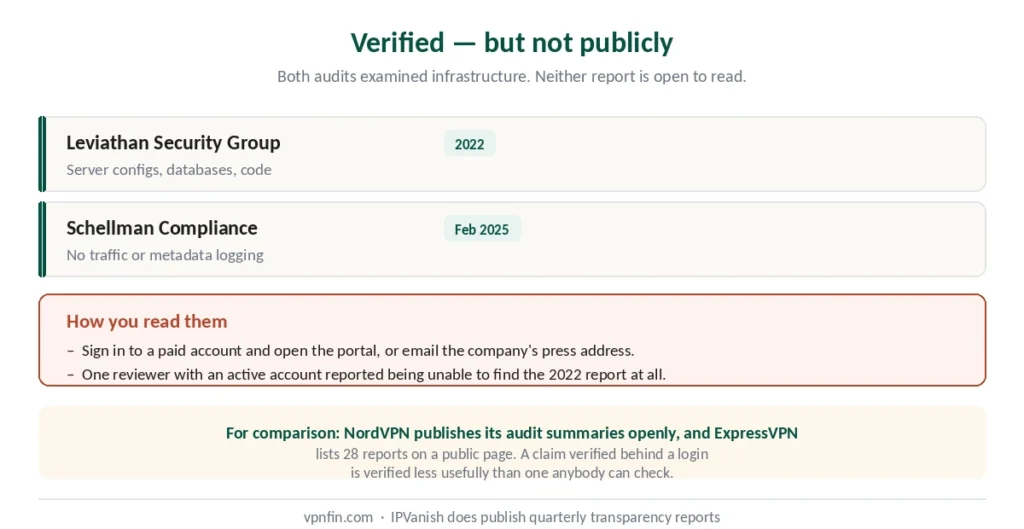
Leviathan Security Group, 2022. Examined server configurations, databases and code rather than interviewing staff. Concluded the infrastructure was operationally consistent with the published no-logs policy.
Schellman Compliance, February 2025. Reaffirmed the no-logs implementation. Confirmed IPVanish doesn’t log internet traffic or metadata, doesn’t inspect traffic or service usage, and applies the same handling across all users.
⚠️ You can’t read either report. Published reviews describe them as accessible only from inside a paid account portal, or by emailing the company’s press address. One reviewer with an active account reported being unable to locate the 2022 report at all.
Why this matters. NordVPN publishes its audit summaries openly. ExpressVPN lists twenty-eight reports on a public page. A no-logs claim verified behind a paywall is verified less usefully than one anybody can check.
IPVanish also publishes quarterly transparency reports, which is more than most providers do.
Its sibling under the same owner has never been audited — IPVanish against StrongVPN.
The Ownership Question
Worth a paragraph, because it’s specific to IPVanish and almost nobody mentions it.
Ziff Davis owns IPVanish. Ziff Davis also owns PCMag — a publication that reviews VPN services, including this category.
We’re not alleging anything. PCMag discloses its ownership, and editorial independence at large media groups is a normal arrangement.
But it’s the same structural situation we flagged with Kape Technologies, which owns both ExpressVPN and CyberGhost while those brands compete in reviews. When you read a VPN ranking, checking who owns the publication is as reasonable as checking who owns the product.
Speed, Streaming and Protocols
Protocols: WireGuard by default, plus OpenVPN and IKEv2/IPsec. PPTP was discontinued in 2024 and L2TP has also been dropped — both were obsolete, and removing them is the right call.
Encryption: AES-256 with SHA-256 authentication and RSA-2048 handshake, plus ChaCha20 as an alternative.
Network size: sources disagree, citing anywhere from 2,400 to 3,200 servers across 90 to 110 countries. IPVanish’s own figures sit at the higher end.
Streaming. Published 2026 testing reports reliable access to Netflix US and UK, BBC iPlayer, ITVX, Disney+, Hulu and Sky Go. There are no dedicated streaming servers, so you may need to switch locations when one stops working — our streaming guide covers why that’s normal rather than a fault. Surfshark opens more libraries at the same device count.
⚠️ Speed sits in the solid middle. IPVanish doesn’t appear in the major comparative benchmark rounds the way the top five do, so we can’t place it precisely against them — an absence worth noting rather than filling with guesswork.
Pricing: Read the Renewal Line
Essential — the VPN itself:
Monthly           $12.99
1 year            $39.99 first year  (~$3.33/mo)
2 years           ~$2.19/mo
Advanced adds Threat Protection Pro, Secure Browser, cloud backup, file sync, phone support and more eSIM data, from about $3.29 a month on the two-year plan.
The renewal. The one-year Essential plan renews at $89.99 a year — more than double the first year. That’s still below NordVPN’s $139.08 and ExpressVPN’s $99.95, but well above CyberGhost’s $56.94.
⚠️ The refund window has a condition. Thirty days applies to annual and multi-year plans bought directly from IPVanish. Monthly plans get no refund at all. A seven-day free trial exists, but only through the Google Play and Apple app stores.
What We Don’t Love
US jurisdiction. IPVanish operates from the United States, a founding member of Five Eyes with no legal barrier to compelled assistance. Providers in Panama, the British Virgin Islands or Romania sit outside those arrangements — our Australia guide explains why the distinction has practical weight.
Audits behind a login. Covered above. It’s the single easiest thing IPVanish could fix.
No dedicated streaming servers, unlike CyberGhost’s platform-labelled ones.
The interface divides opinion. One published review rated IPVanish 4.8 overall while marking down the experience category specifically, describing the interface as overwhelming and outdated.
How We Research
This review draws on published testing and analysis from named sources including WizCase, VPNCompare, CyberInsider, Security.org, VPNpro and PrivacyJournal, TorrentFreak’s 2018 reporting on the DHS case, and IPVanish’s own pricing and policy pages — cross-checked and verified at publication. We don’t run our own speed tests and don’t claim to. Where sources disagreed — on server counts and on renewal pricing — we’ve said so rather than picking the flattering number. Our full approach lives on the About Us page.
IPVanish FAQ
Its no-logs policy has been independently audited twice — by Leviathan Security Group in 2022 and Schellman Compliance in February 2025 — with both examining server configurations and code rather than interviewing staff. The caveat is that neither report is published openly; access requires a paid account or an email request.
Under its then-owner Highwinds Network Group, IPVanish supplied the Department of Homeland Security with a user’s real name, email address, source IP and connection timestamps during a child-abuse investigation. This contradicted the no-logs policy advertised at the time. TorrentFreak reported the case in 2018, and IPVanish has changed ownership twice since.
Unlimited, on every plan including the cheapest. That matches Surfshark and Private Internet Access, and beats NordVPN’s 10, CyberGhost’s 7, and ExpressVPN’s tier-dependent 10 to 14. For households with several phones, laptops, TVs and consoles, this is the strongest reason to consider it.
The one-year Essential plan is $39.99 for the first year and renews at $89.99 annually. Monthly billing runs $12.99 for Essential and $14.99 for Advanced. The 30-day money-back guarantee applies to annual and multi-year plans bought directly — monthly plans are not covered.
Published 2026 testing reports reliable access to Netflix US and UK, plus BBC iPlayer, ITVX, Disney+, Hulu and Sky Go. IPVanish has no dedicated streaming servers, so switching locations is sometimes necessary when one stops working — normal behaviour across the category rather than a fault.
It depends on your threat model. The US founded the Five Eyes intelligence-sharing alliance and has no legal barrier to compelled assistance, which is why several competitors incorporate in Panama, the British Virgin Islands or Romania. For most everyday privacy needs it makes little practical difference; for anyone concerned about state-level demands, it’s a real consideration.
The Short Version
Unlimited devices at a low price is the reason to consider IPVanish, and it delivers that better than almost anyone.
Two independent audits exist — Leviathan in 2022, Schellman in February 2025 — and both examined infrastructure rather than taking the company’s word. Neither is published openly.
The 2016 incident happened under a previous owner, and the current architecture has been examined since. Whether that settles it is your call.
And check the renewal. The first year at $39.99 becomes $89.99 after that.
IPVanish
The Verdict
The best unlimited-device deal in the category, backed by two independent audits that IPVanish keeps behind a login. Strong product, weaker transparency than the leaders — and a 2016 incident under a previous owner that has never been publicly explained.