
Disclosure: VPNFin is reader-supported. If you buy a VPN through links on this page, we may earn a commission at no extra cost to you. This never affects our ratings — here’s our full disclosure.
Mostly not. A study in 2025 tested eighteen airlines. Fourteen of them showed identical fares regardless of where the connection came from.
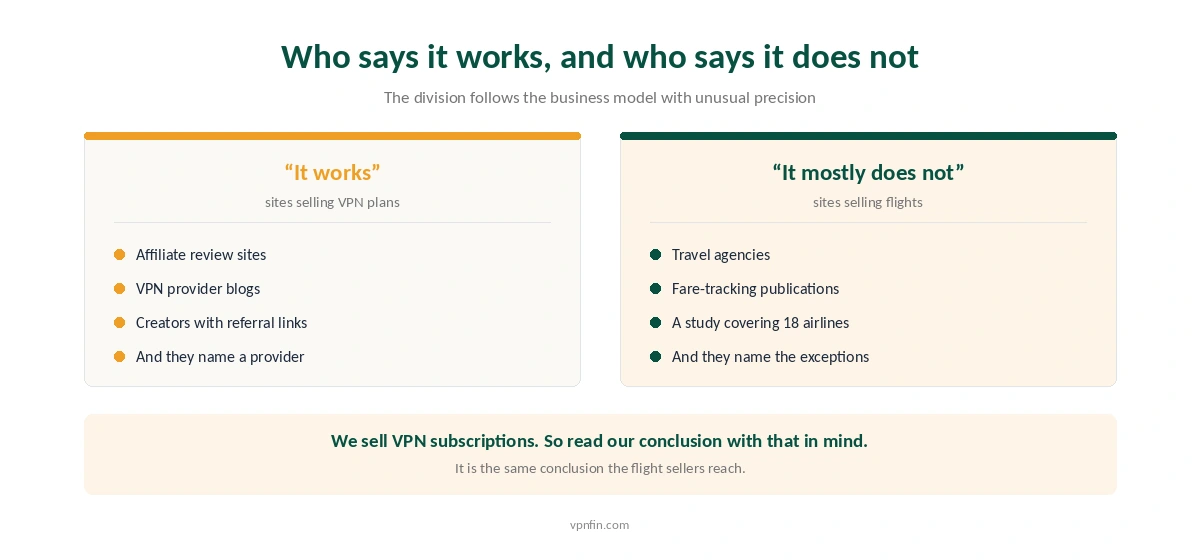
And the evidence splits in a revealing way. Sites that sell VPN subscriptions say the trick works. Sites that sell flights say it does not.
⚠️ We sell VPN subscriptions. So read our conclusion knowing that. It happens to match what the flight sellers found.
Who Says What, and Why That Matters
On the yes side: affiliate review sites and provider blogs. They describe testing, then name a provider to buy. One large technology site concluded with a specific recommendation.
On the no side: travel agencies and fare-tracking publications. They have no VPN to sell. And they are specific about what does move prices.
One travel agency puts it plainly. Airlines do not raise prices because of an address, and any saving comes from currency differences rather than from hiding a location.
⚠️ That division is the strongest signal on this page. When the answer tracks the business model this closely, the business model is doing the work — as our ownership page shows for reviews generally.
What the Testing Found
Eighteen airlines, fourteen unchanged. A 2025 methodology paper tested fares from different connection locations. Most carriers priced by route and demand instead.
One independent test across six airlines found the same. British Airways showed identical fares from any address. Lufthansa differed, but by origin city rather than by the viewer’s location.
Researchers checked the browsing-history myth years ago. Consumer Reports examined thousands of flights in 2016. Incognito mode made no difference, and a tunnel is not private browsing either.
⚠️ So the mechanism people imagine is largely absent. Airlines price by seats sold, route competition and timing — none of which a tunnel touches.
Why the Apparent Saving Vanishes
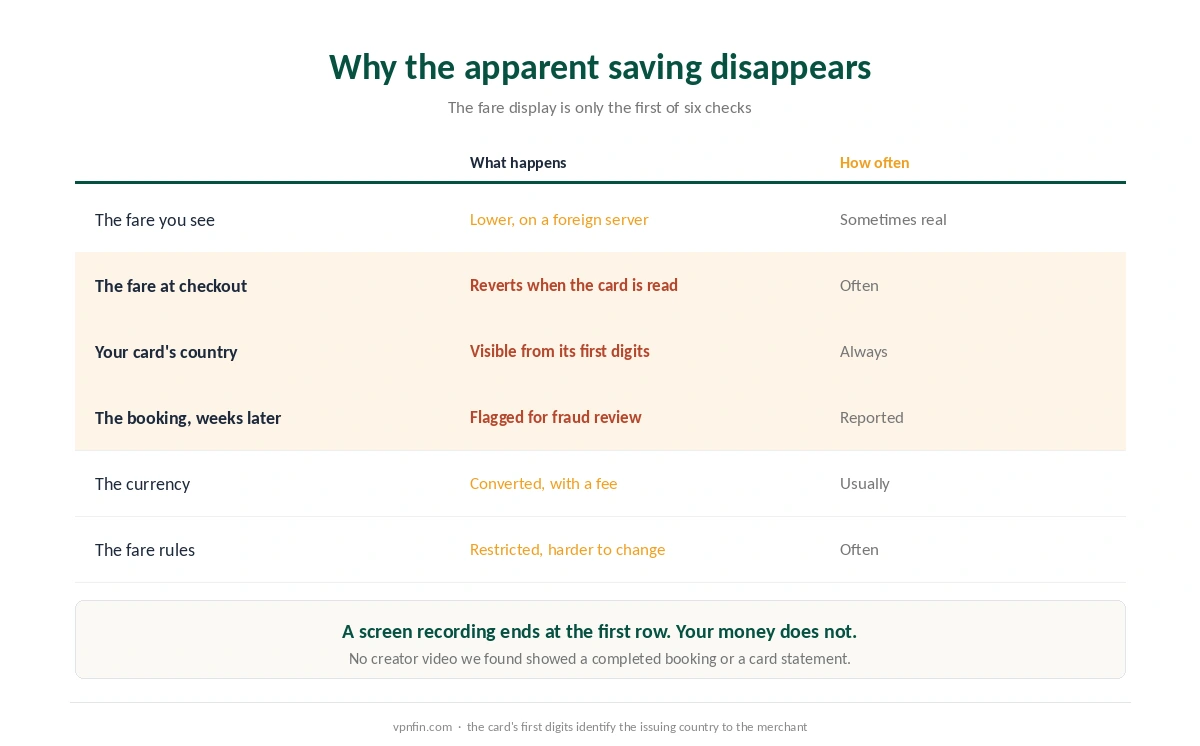
Your card names your country. The first digits of any payment card identify the issuing bank and its country. Merchants read that at checkout.
So the fare often reverts. You see one price on a foreign server, then a different one when the card is entered.
And some bookings get flagged later. Published accounts describe fares jumping at checkout, or reservations cancelled weeks afterwards for fraud review.
⚠️ Besides, the currency changes. A foreign fare gets converted, usually with a fee, and the fare rules are often more restrictive — which is the same structure as the card-country check we found on HBO Max.
How the Myth Spread
Through screen recordings. A creator searches a fare, switches server, and the price drops on camera. That part is often real.
The video then ends. You never see the completed booking. Nor a card statement. And never a confirmation email showing what the airline actually charged.
⚠️ One travel publication describes exactly this pattern across creator videos between 2021 and 2023. Nobody volunteered the disconfirming half.
The display price is the easiest thing to change. And a recording can show nothing else.
The Narrow Cases Where It Does Differ
Domestic subsidised fares. Some carriers sell cheaper in local currency to local bookers. Indian airlines are the example published accounts name most often.
Origin-city pricing. A ticket starting in Frankfurt can cost less than the same route starting elsewhere. However, that depends on the route rather than on your address — and nothing about it is a legal question.
Hotels and booking platforms are reported to vary more than airlines do. Affiliate sources claim substantial differences, and we would want independent testing before repeating a figure.
⚠️ All three carry the same catch. The payment method must match, or the earlier problems return — the same wall we described for AI services.
What a VPN Genuinely Helps With Here
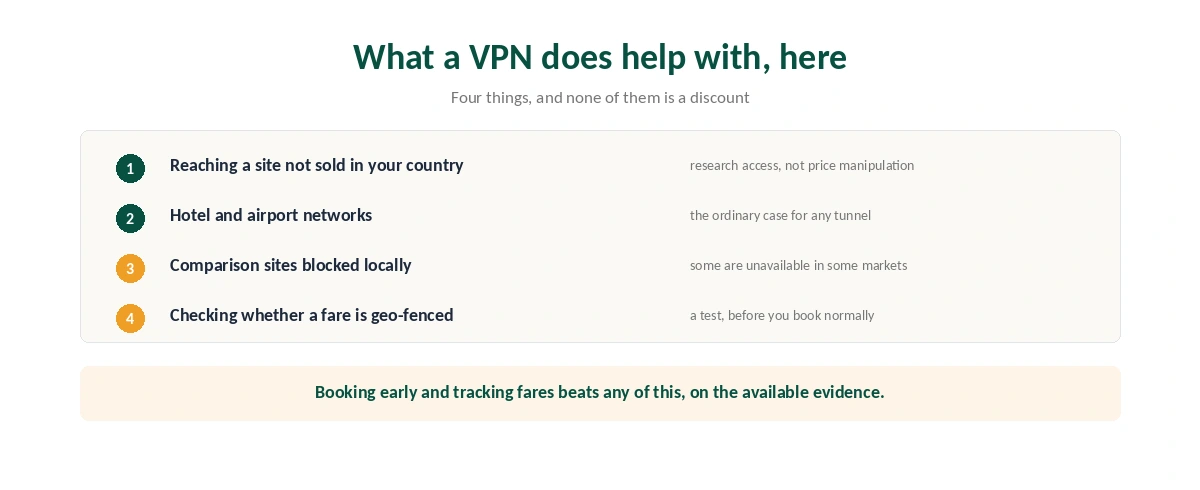
Reaching a booking site not sold in your country. That is research access rather than price manipulation.
Hotel, airport and café networks. Entering card details on a shared network is the one case where the benefit is unambiguous.
Testing whether a fare is geo-fenced at all. Check from two locations, then book normally from wherever the fare is real — and a refund window is long enough to run that test.
⚠️ Booking early and tracking fares beats all of it. On the available evidence, that is where the money is — and our travel page covers what a VPN is actually for on a trip.
How We Research
For the finding that fourteen of eighteen airlines priced identically, this guide draws on a 2025 methodology paper cited by an Indian travel publication, which also documented the creator-video pattern. For the mechanism by which a card reveals its issuing country, and for reports of fares reverting at checkout, it draws on published travel guides with no VPN to sell. The Consumer Reports study of 2016 covers the separate incognito claim. We have named which sources sell VPN subscriptions and which sell flights, because the conclusions divide along that line. Where an affiliate source claims a specific saving on hotels, we have not repeated the figure. We do not run our own tests. Our method lives on the About Us page.
Cheaper Flights FAQ
Mostly no. A 2025 test of eighteen airlines found fourteen priced identically regardless of connection location. Carriers price by route, demand, seat availability and timing. Some domestic subsidised fares are an exception, and origin-city pricing differs for reasons unrelated to your address.
Because your payment card names your country. The first digits identify the issuing bank and its country, and merchants read that at checkout. So a fare shown to a foreign address often reverts once the card is entered.
No. Consumer Reports examined thousands of flights in 2016 and found no difference. The idea that repeated searching raises your price is the most persistent myth in this area, and the testing does not support it.
Published accounts describe reservations flagged for fraud review and cancelled weeks later, where the payment details did not match the apparent location. Airline and booking-site terms generally prohibit misrepresenting your location, so this is a contractual risk rather than a legal one.
Not at all, just not as a discount. It helps on hotel and airport networks where you are entering card details, and it can reach booking sites unavailable in your country. Neither of those is a price trick.
The Verdict
Fourteen of eighteen airlines priced the same. That is the clearest number available, and it points away from the trick rather than towards it.
The display price is the easy part. Your card names your country, the fare often reverts, and some bookings get reviewed weeks later.
And notice who says otherwise. The sites promising savings sell VPN subscriptions. We sell them too, and we are telling you it mostly does not work.