
Disclosure: VPNFin is reader-supported. If you buy a VPN through links on this page, we may earn a commission at no extra cost to you. This never affects our ratings — here’s how we research.
VPNs are legal in Brazil. The Marco Civil da Internet doesn’t prohibit them, and no statute restricts personal use.
But Brazil is the one country in this series where using a VPN carried a documented penalty. In August 2024, when the Supreme Federal Court suspended the platform X nationwide, it imposed fines of R$50,000 per day on anyone caught using a VPN to bypass the block.
That situation ended in October 2024, and X has been accessible in Brazil without any VPN ever since. But it illustrates something specific about how Brazil works: the courts intervene directly, and they have done it before.
The Short Answer
Legal for privacy, security and geo-unblocking. The 2024 fines applied to circumventing a specific court order, not to VPN use generally.
Marco Civil requires logging. Your ISP stores connection records for a year; platforms store access logs for six months.
Globoplay is unusually aggressive at VPN detection, and providers stay blocked for weeks at a time.
What Marco Civil Actually Requires
Two articles matter, and the distinction between them is useful.
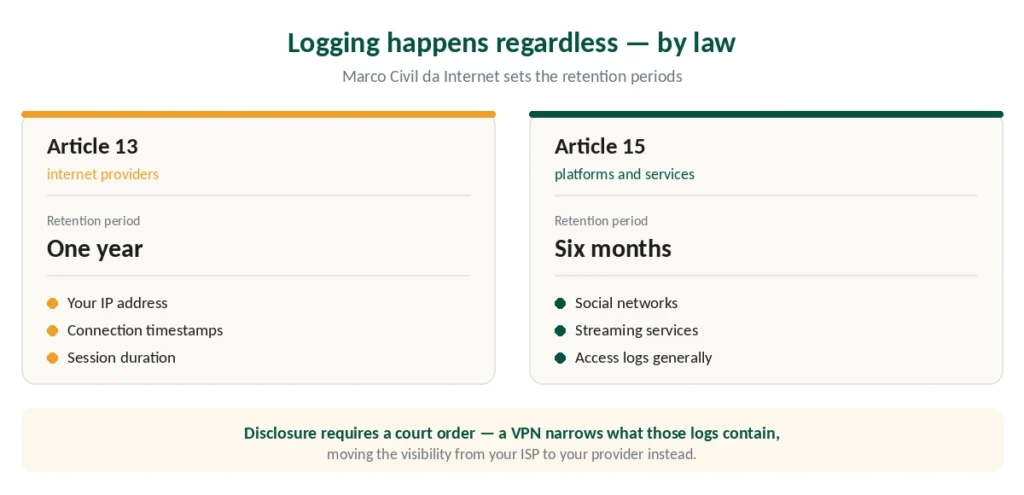
Article 13 — internet providers. ISPs must store connection access logs for one year. These records include your IP address, timestamps and session duration.
Article 15 — application providers. Social networks, streaming services and similar platforms must store access logs for six months.
Disclosure requires a court order in both cases, except where the user gives express consent.
What a VPN changes: your ISP still logs that you connected and when, but no longer which sites you visited — that visibility moves to your VPN provider. What a VPN actually hides covers the distinction precisely, and it’s why jurisdiction and audit records matter.
⚠️ Brazil also has the LGPD, its data protection law modelled partly on European rules, enforced by the ANPD. Published analysis notes it establishes baseline rights against private companies but doesn’t extend to state-ordered restrictions.
The 2024 Case, and What It Means
Worth setting out properly, because it’s the single most important precedent for VPN users in Brazil.
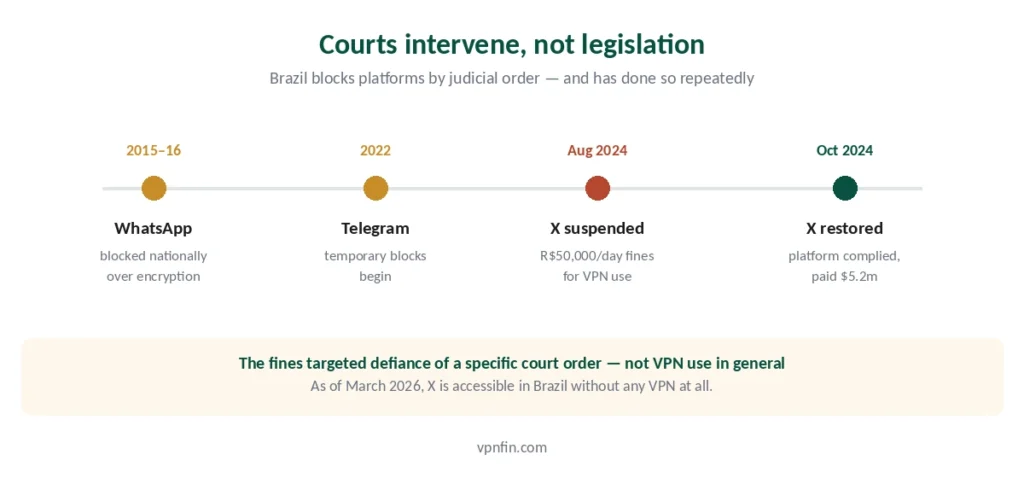
What happened. In August 2024 the Supreme Federal Court suspended X nationwide, and attached a daily fine of R$50,000 to anyone using a VPN to keep reaching it. Access was restored that October after the platform complied. The full account is on our legality page, including which half of the order was withdrawn and whether anyone was ever fined.
Why it matters now. The fines targeted circumvention of a specific judicial order rather than VPN use in general. But Brazil’s courts have blocked platforms before — WhatsApp nationally in 2015 and 2016 over encryption disputes, Telegram temporarily since 2022 — and the pattern is judicial intervention rather than legislative censorship.
The practical reading: a VPN in Brazil is legal and useful for privacy and content access. Using one specifically to defy an active court order is the documented exception.
Globoplay and Brazilian Streaming
The main reason expats and diaspora viewers want a Brazilian IP, and the hardest platform to reach.
Globoplay uses aggressive VPN detection, and published reports describe providers remaining blocked for weeks at a time rather than hours.
Other Brazilian services — Record TV, SBT, SporTV, Telecine and Claro Video — restrict access similarly, though generally with less determination.
For football specifically, expats following Campeonato Brasileiro Série A need the same Brazilian IP routing.
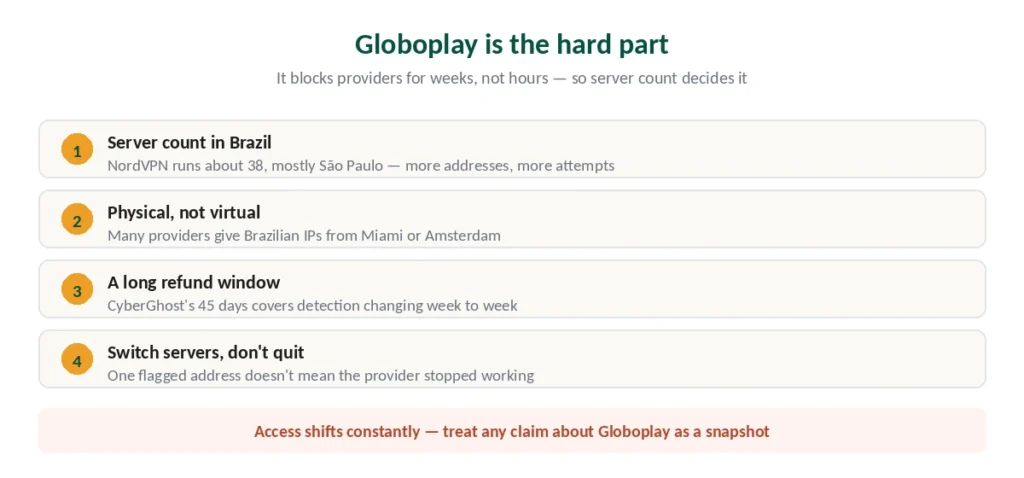
What helps: a provider with many Brazilian servers, since one flagged address doesn’t end the attempt. NordVPN operates around 38 in Brazil, most in São Paulo.
⚠️ Watch for virtual servers. Published testing notes that many providers offer Brazilian IP addresses from machines physically in Miami or Amsterdam. That works for unblocking but adds real latency — our Argentina guide covers the distinction in detail.
What Else a VPN Handles Here
ISP visibility. Marco Civil requires the logging; a VPN narrows what those logs contain.
Public networks. The usual case, unchanged by geography.
International catalogues. Brazilian Netflix differs from the US library, and the calculation runs both ways — our streaming guide covers which providers open the most regions.
Jurisdiction as a consideration. Published analysis notes that Brazilian users often choose providers incorporated outside Brazilian jurisdiction, since an encrypted tunnel plus a verified no-logs policy puts distance between activity and court orders. All five providers we rank are incorporated elsewhere.
Which Provider to Choose
For Globoplay: server count in Brazil matters more than anywhere else, given the detection. NordVPN’s 38 gives you the most alternatives.
Speed matters if you’re outside Brazil, since distance is real, and NordVPN posted the best result in independent benchmark testing.
For households: Surfshark’s unlimited connections, with Brazilian coverage.
Want the longest test window? CyberGhost gives 45 days on longer plans — useful when a platform’s detection changes week to week.
⚠️ Verify before committing. Globoplay access shifts constantly, and any claim about it — including in this article — is a snapshot rather than a guarantee.
How We Research
This guide draws on reporting on the 2024 X suspension, the text of the Marco Civil da Internet and LGPD, published testing from named sources including Cybernews, TheBestVPN and PrivacyJournal, and our own full reviews of the providers we rank — cross-checked and verified at publication. Several sources carry commercial interests in VPN services and were used only for claims confirmed elsewhere. This is not legal advice, and Brazilian court decisions can change the position quickly. Our full approach lives on the About Us page.
Brazil VPN FAQ
Often, if you are outside the country. Brazilian financial apps commonly reject foreign IP addresses, and a Brazilian server restores access. Be aware that fraud detection watches for location changes too, so connect to the same city consistently rather than switching. VPN use itself is legal in Brazil.
Under Article 13, internet providers must retain connection access logs for one year — your IP address, timestamps and session duration. Under Article 15, application providers such as social networks and streaming services store access logs for six months. Disclosure requires a court order unless the user consents.
Globoplay uses unusually aggressive VPN detection, and published reports describe providers staying blocked for weeks rather than hours. Switching to a different Brazilian server is the first fix. Providers with more Brazilian servers give you more attempts — NordVPN operates around 38, mostly in São Paulo.
On 30 August 2024, Justice Alexandre de Moraes ordered X suspended nationwide after it declined to appoint a Brazilian legal representative and reinstate court-ordered account suspensions. The court also fined individuals R$50,000 a day for using VPNs to reach it. X complied, paid $5.2 million, and access was restored on 8 October 2024.
It varies by provider, and published testing notes that many offer Brazilian IP addresses from machines physically located in Miami or Amsterdam. Both give you a Brazilian address as far as websites are concerned, but a virtual server adds real latency. Check the provider’s server list before subscribing.
Partly. Brazil’s data protection law, enforced by the ANPD, establishes baseline privacy rights against private companies and requires consent for data collection. Published analysis notes it doesn’t extend to state-ordered communications restrictions, and enforcement has been inconsistent — which is why the encrypted tunnel still matters.
The Short Version
Legal, with one documented exception. The R$50,000 daily fines in 2024 applied to bypassing a specific court order, not to VPN use generally, and that situation ended in October of that year.
Marco Civil means logging happens regardless. A year of connection records at your ISP, six months of access logs at platforms. A VPN narrows what those records contain rather than preventing them.
Globoplay is the hard part. It detects VPNs aggressively and blocks providers for weeks, so server count in Brazil matters more than the usual feature comparisons.