
Disclosure: VPNFin is reader-supported. If you buy a VPN through links on this page, we may earn a commission at no extra cost to you. This never affects our ratings — here’s our full disclosure.
Brazil has no VPN law. There is no licensing regime, no registration, no retention rule aimed at providers, and nothing in the criminal code that mentions the technology.
And for thirty-nine days in 2024, using one carried a daily fine of R$50,000.
Both statements are true, which is what makes this country worth reading about rather than skipping. The fine came from a court order about a single website, it applied to individuals rather than companies, and — as far as anyone can establish — nobody ever paid it.
Is a VPN Legal in Brazil?
Yes. No Brazilian statute restricts VPN use, and millions of people run one for banking, streaming and privacy without any legal question arising. The 2024 episode was a court order attached to one platform block, not a change in the law. It has expired, and nothing equivalent is in force today.
What Actually Happened in 2024
The sequence matters, because the headlines compressed it badly.
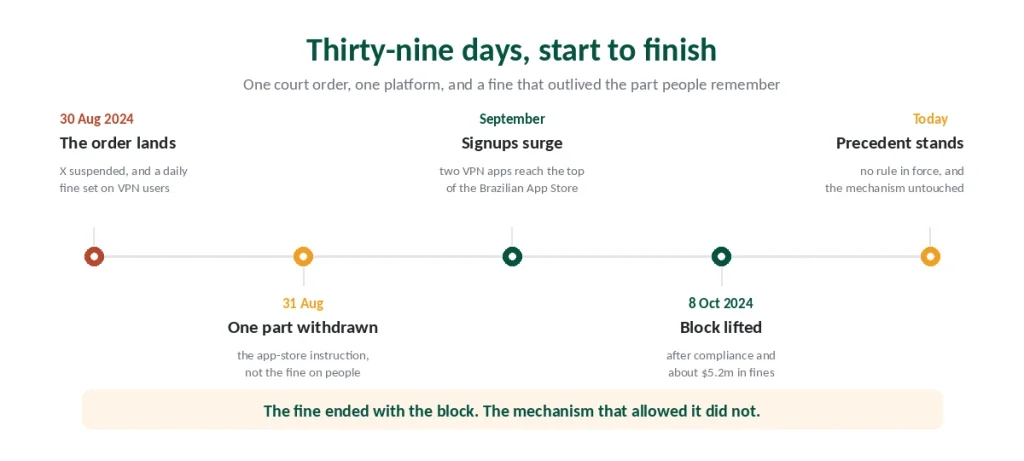
On 30 August 2024, Justice Alexandre de Moraes ordered X suspended across Brazil. The dispute had run for months and concerned accounts linked to the January 2023 attacks in Brasília, along with the platform’s refusal to name a legal representative in the country.
The order went further than the platform. It set a daily fine of R$50,000 — roughly $8,900 — on individuals and legal entities using what it called technological subterfuges, naming VPNs explicitly, to keep reaching X.
Anatel directed internet providers to filter the traffic, and carriers used deep packet inspection to identify connections heading for the platform.
The block ran until 8 October, thirty-nine days, ending after X paid around $5.2 million in fines, appointed a local representative and complied with the content orders.
⚠️ Put the number beside the country’s income and it stops sounding abstract. Brazil’s GDP per head sits around $11,350. A single day of the fine came to roughly three quarters of that. A spokesperson for one major provider described it at the time as one of the first restrictions of its kind in the history of internet restrictions, and that assessment has held up.
The Part That Was Withdrawn, and the Part That Was Not
This is where most coverage went wrong, and the distinction still matters.
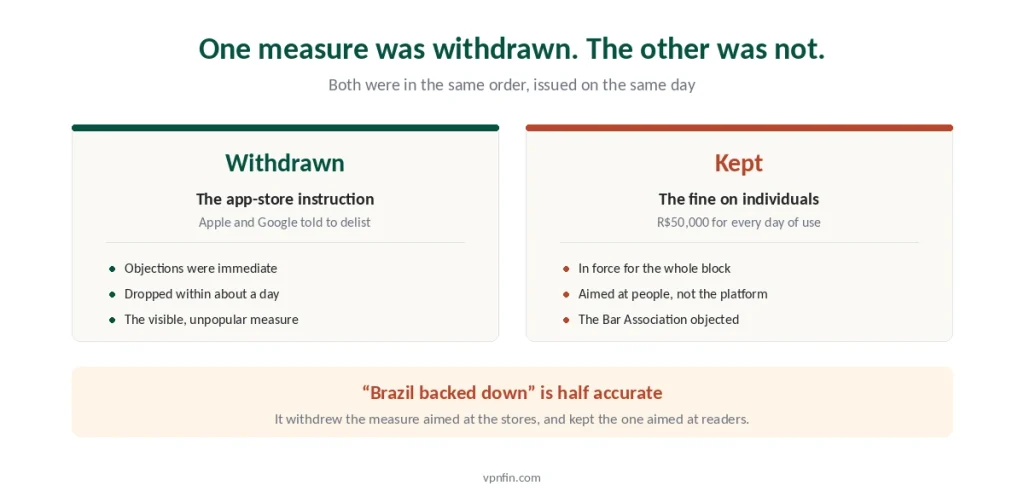
The same order told Apple and Google to remove VPN applications from their Brazilian stores. That instruction drew immediate objections and was dropped within about a day.
The fine on individual users was not dropped. It remained in the order for the duration of the block.
So “Brazil backed down” is half accurate. The court withdrew the measure aimed at the app stores — the one that would have been visible, unpopular and simple to challenge. The measure aimed at ordinary people stayed.
⚠️ The Brazilian Bar Association objected formally, writing to the Supreme Court that applying a daily fine to individuals and legal entities in a broad and generalised way was a serious affront to constitutional rights. That objection came from the country’s own legal profession rather than from the platform or its owner.
Was Anyone Actually Fined?
We looked, and the answer appears to be no.
No reported case exists of an individual in Brazil being fined for using a VPN during the block. If one occurred, it did not reach the press.
Analysts said so at the time. Identifying which specific person used a VPN to reach one specific site is not something an internet provider can straightforwardly produce, and commentators pointed this out within days.
Meanwhile the opposite happened. VPN signups surged. NordVPN and Proton VPN both reached the top of the Utilities category in the Brazilian App Store, and one provider’s own censorship monitor recorded the spike beginning the day the order landed.
⚠️ So the measure functioned as an announcement rather than an enforcement mechanism. That is worth stating plainly in both directions: nobody was penalised, and nobody could have been confident of that in advance. Deterrence does not require a single prosecution to work on a population.
Why This Still Matters in 2026
The fine expired with the block. The mechanism did not.
It has been used twice. When Brazil moved against Telegram in 2022, the same element appeared, with the figure set at twice the amount.
It sits inside judicial discretion rather than legislation. No parliament debated it, no statute defines it, and no threshold governs when it applies. A single justice attached it to a platform block, and the precedent now exists in Brazilian practice.
Which reframes the question for a reader. “Is a VPN legal in Brazil” has a simple answer and a short shelf life. The more useful question is whether the tool could become temporarily prohibited for one destination again, and the record says it could.
⚠️ This is general information about published court orders and reporting, not legal advice. Brazilian judicial decisions can move quickly and are not always translated. If your situation is specific, ask someone qualified in Brazilian law.
What the Law Says the Rest of the Time
Away from that episode, the picture is unremarkable, and that is the honest headline.
No licensing. Nothing requires you to register a VPN or seek permission.
No retention rule aimed at providers. Brazil’s internet framework, the Marco Civil da Internet, imposes obligations on connection and application providers, and nothing in it targets VPN services the way India’s directive does.
No penalty attached to the software. Banking, streaming, remote work and travel are all ordinary reasons to run one, and none of them has ever been in question here.
And illegal acts stay illegal, as everywhere. A VPN changes nothing about the conduct underneath it — what a VPN actually hides is narrower than most people assume, and it was never a defence to anything.
| Country | What the rule aims at | Reaches the user? |
|---|---|---|
| Turkey | The tunnel — ISPs must block | No |
| The UAE | Conduct behind an address | No |
| India | The provider's records | Not nationally |
| China | Provider, tunnel and user | Yes |
| Brazil | Nothing, until a court acts | For 39 days |
| Indonesia | Paperwork — registration | No |
| The UK | The destination you visit | No, and ministers said so |
| The US | The platform, state by state | No, in all twenty-seven |
| Russia | The search, not the tool | Only if you went looking |
| Australia | The platform, and the tunnel itself | No — platforms must detect it |
| France | The VPN provider itself | No, the orders bind five companies |
| Italy | The provider, by regulator order | No, but one VPN left the market |
| Spain | The provider, by injunction without a hearing | No, and only two firms were named |
| Germany | The provider's logfile, for three months | No, and the courts twice removed it |
How Brazil Compares
Every framework in this series aims somewhere different.
Turkey regulates the tunnel. Internet providers must block VPN services, so reaching one is the obstacle. Nothing penalises use.
The UAE regulates conduct. The statute never names VPNs; it reaches what you do behind a masked address.
India regulates the company. Five years of subscriber records, which emptied the country of physical VPN hardware.
China regulates all three — the provider through licensing, the tunnel through the firewall, and the user through an administrative fine.
Brazil regulates none of them, and then occasionally regulates all of them at once for a few weeks. It is the outlier: permissive by default, with a judicial mechanism that can suspend that permission for one destination on short notice. Our wider legality guide covers why “legal or illegal” answers this question badly almost everywhere.
For anyone travelling there, none of this changes the practical advice: install before you fly, since connectivity rather than law is the usual obstacle, and read our Brazil guide for what actually works on the ground. Free services deserve the usual caution — only three free tiers are worth trusting anywhere, and a jurisdiction that has once taken an interest in who uses a VPN is a poor place to test the rest.
If the provider’s own record matters to you, Proton VPN publishes five annual audits in full, and NordVPN’s servers hold nothing between reboots.
How We Research
This page draws on the text of the 30 August 2024 order as reported by named outlets, contemporaneous coverage of the app-store instruction and its withdrawal, the Brazilian Bar Association’s published objection, Anatel’s role in implementing the block, and reporting on the 8 October 2024 restoration after X’s compliance. Where we say no individual appears to have been fined, that reflects an absence of reported cases rather than a confirmed absence of enforcement, and we say so rather than claiming more than we found. We are not lawyers and this is not legal advice. We don’t run our own speed tests, and we do not publish methods for reaching platforms a court has ordered blocked. Our full approach lives on the About Us page.
Brazil VPN Legality FAQ
No. Brazil has no VPN legislation, no licensing requirement and no penalty attached to the software. Millions of people use one for banking, streaming and privacy. The 2024 fine came from a court order tied to a single platform block, and it ended when the block did.
No reported case exists. Analysts pointed out at the time that identifying which individual used a VPN to reach one specific site is not something providers can straightforwardly produce. Meanwhile signups surged, with two VPN apps reaching the top of the Brazilian App Store’s Utilities category.
No. The suspension ran from 30 August to 8 October 2024, thirty-nine days. It ended after the company paid its fines, appointed a legal representative in Brazil and complied with the content removal orders. Access has been normal since, and no VPN is needed for it.
The mechanism exists. It appeared in the 2022 action against Telegram at twice the amount, and again in 2024. It sits within judicial discretion rather than legislation, which means no statute sets a threshold for when it applies or how much it can be.
No. The Marco Civil da Internet places obligations on connection and application providers, but nothing in it targets VPN services the way India’s 2022 directive does. No provider has withdrawn servers from Brazil for regulatory reasons.
The Verdict
Using a VPN in Brazil is legal, and nothing currently restricts it. No licensing, no registration, no retention rule, no penalty attached to the software.
The 2024 episode was real and is over. For thirty-nine days a court order set a daily fine of R$50,000 on individuals using a VPN to reach one blocked platform. The block ended on 8 October 2024 and the fine ended with it.
Two details are worth carrying forward. The instruction to remove VPN apps from the stores was withdrawn; the fine on users was not. And no reported case exists of anyone paying it.
What remains is a precedent rather than a rule. The same mechanism appeared against Telegram in 2022 at twice the amount, which makes it a pattern rather than an aberration — and the practical answer for a traveller or a resident is unchanged by any of it.