
Disclosure: VPNFin is reader-supported. If you buy a VPN through links on this page, we may earn a commission at no extra cost to you. This never affects our ratings — here’s our full disclosure.
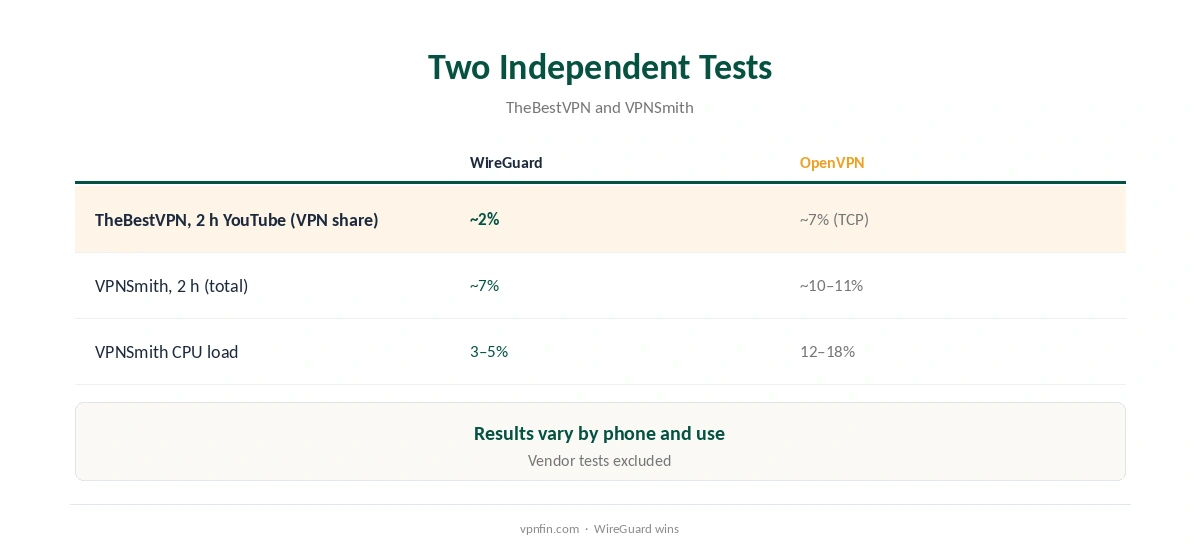
VPN battery drain is real but modest with modern protocols. TheBestVPN’s 2026 test streamed YouTube for two hours on a Samsung Galaxy: the phone used 10% without a VPN, 12% on WireGuard and 17% on OpenVPN TCP, so the VPN itself took about 2% on WireGuard and 7% on OpenVPN. VPNSmith measured about 7% over two hours on WireGuard against 10 to 11% on OpenVPN. The protocol matters more than the provider.
This guide covers why VPNs use battery, what the tests show and how to cut the drain.
Why a VPN Uses Battery
Every packet is encrypted and decrypted, and the app keeps the tunnel alive in the background. VPNSmith puts WireGuard at about 3 to 5% CPU on a modern phone against 12 to 18% for OpenVPN, which explains most of the difference.
VPN Battery Drain by Protocol
TheBestVPN found WireGuard typically uses under 1% of battery per hour in normal use, and that OpenVPN roughly doubles the overhead. Its streaming test put the VPN’s share at about 2% on WireGuard and 7% on OpenVPN TCP over two hours. Our WireGuard vs OpenVPN guide explains the protocols.
Cutting the Drain
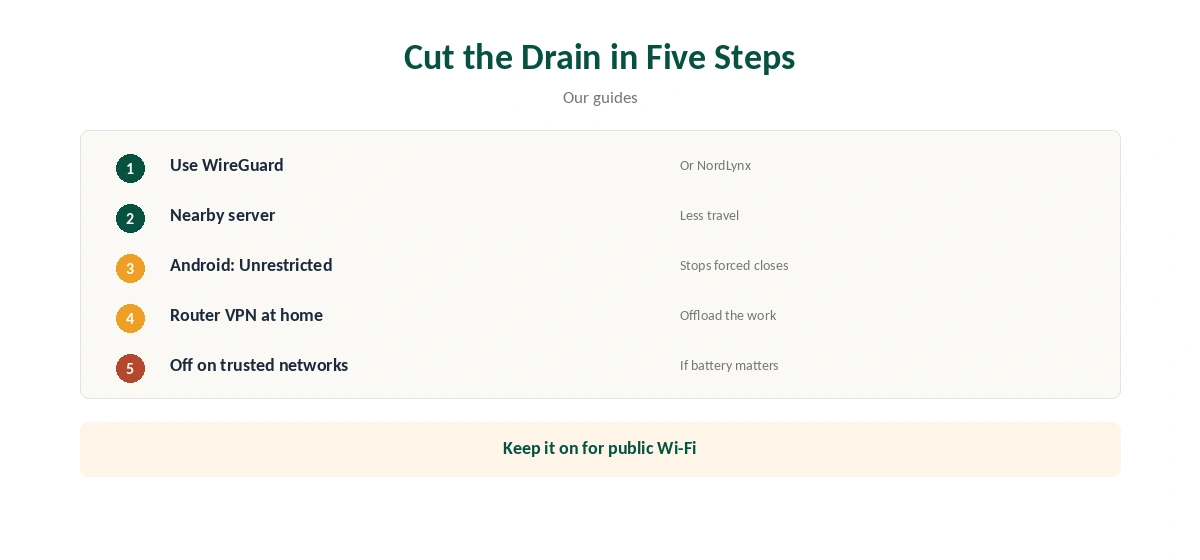
Switch to WireGuard or a WireGuard-based protocol such as NordLynx. Use a nearby server so packets travel less. Connect only on untrusted networks if battery matters more than constant protection. At home, a router VPN moves the work off the phone entirely, TheBestVPN notes.
Android Battery Savers
Android’s battery optimisation can close VPN apps in the background, which looks like disconnection rather than saving. Proton’s support advises setting the app’s battery use to Unrestricted. Our Proton VPN disconnection guide covers the setting.
Router VPNs
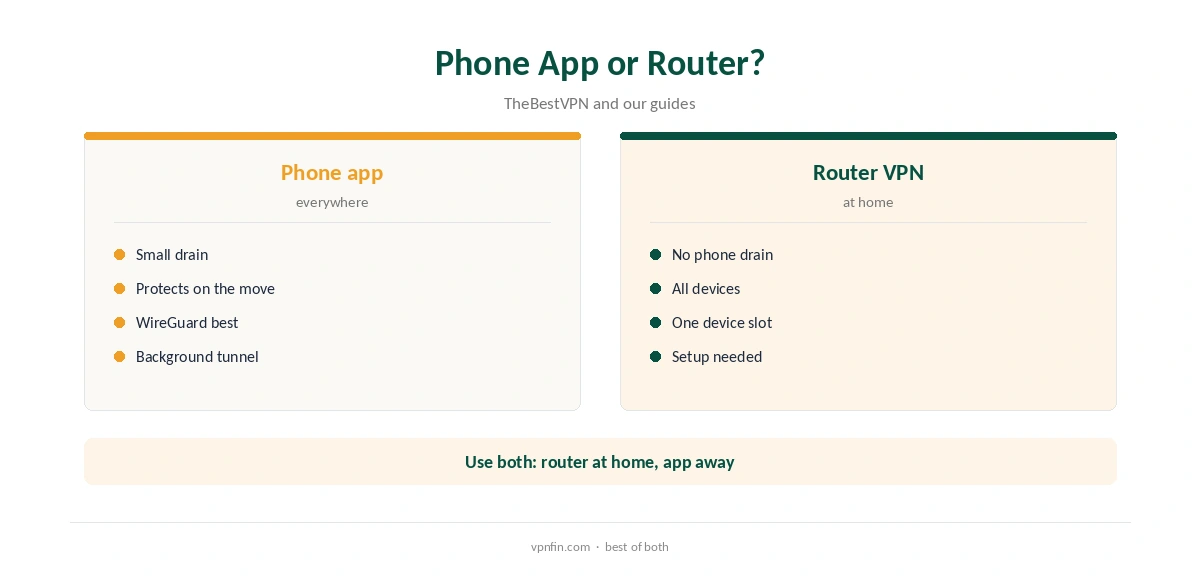
A router running the VPN encrypts traffic for every device, so phones and tablets spend no battery on it at home. Our router setup guide explains the trade-offs.
iPhone
On iPhone, WireGuard-based apps keep the tunnel light. Proton removed IKEv2 and OpenVPN from its Apple apps, so it now runs WireGuard and Stealth there. Our iPhone VPN guide compares apps.
Streaming and Downloads
Heavy data use raises the cost, since more packets need encrypting. TheBestVPN’s streaming test is the worst case for most users; browsing and messaging cost less.
Mobile Data or Wi-Fi
Test on both Wi-Fi and mobile data, since results differ by network and signal strength.
Checking Your Phone
Android and iOS both list app power use in their settings. Compare the app’s share over a normal day with and without the tunnel to see your own figure.
Obfuscation Costs More
Stealth-type protocols wrap traffic in extra layers to get past blocks. Use them only where needed, since they add processing and Proton notes Stealth is slower than its other protocols.
Kill Switch and Always-On
Always-on modes keep the tunnel up through network changes, which costs a little more power than connecting only when needed. Weigh protection against battery for your own routine.
Old Phones
Older phones lack the processing headroom of new ones, so the same protocol may cost them more. On an older device, WireGuard matters even more.
Quick Check
Run your usual day once with the tunnel on and once with it off, then compare the app’s power share in settings.
VPN Battery Use in Standby
TheBestVPN’s figures show modest drain during normal use on WireGuard. If your phone loses charge overnight with the tunnel on, check for an app stuck reconnecting, which wastes power, and update it.
Split Tunnelling
Routing only some apps through the tunnel means less traffic to encrypt. Use split tunnelling for apps that do not need protection, such as a local banking app on home Wi-Fi.
Quick Rule
WireGuard first, nearby server second, router at home third. Turn the tunnel off only where you trust the network.
Is VPN Battery Drain Worth Worrying About?
For most phones on WireGuard, no: TheBestVPN concluded the drain is not something to worry about. On OpenVPN or an older phone, it is worth switching protocol.
Smart Protocol Choices
Apps with automatic protocol selection may pick OpenVPN or a Stealth mode on difficult networks. Check which protocol connected if battery suddenly drops.
Tablets
Tablets have larger batteries than phones, so the same tunnel costs a smaller share of charge. The protocol advice is the same: WireGuard first.
Low Power Mode
Phones’ low-power modes may limit background activity, including reconnection. After turning one on, check that the tunnel still connects when you change network, so protection does not quietly lapse on the next café Wi-Fi.
Laptops
Laptops show the same pattern on a larger battery: WireGuard costs little, OpenVPN more. Close the app when on a trusted home network if you need every minute.
Is It Worth It?
A few per cent over hours of streaming buys encryption on public Wi-Fi. Our public Wi-Fi guide explains why that matters.
How We Research
This page draws on TheBestVPN’s 2026 battery test, VPNSmith’s WireGuard vs OpenVPN measurements and Proton’s Android support guidance. We cross-checked these sources against each other, and where they conflict or something can’t be verified, we say so in the text rather than guessing. We checked time-sensitive figures, including prices in US dollars, on 8 October 2026. The main source we relied on is TheBestVPN’s battery test. Our full approach lives on the About Us page.
VPN Battery FAQ
A little; about 2% over two hours of streaming on WireGuard in TheBestVPN’s test.
WireGuard; OpenVPN roughly doubles the overhead.
Battery optimisation can close it; set battery use to Unrestricted.
Yes; the router does the encryption at home.
Only on trusted networks; keep it on public Wi-Fi.
The Verdict
VPN battery drain is small on WireGuard and larger on OpenVPN. Pick WireGuard, a nearby server and, at home, a router VPN.