
Disclosure: VPNFin is reader-supported. If you buy a VPN through links on this page, we may earn a commission at no extra cost to you. This never affects our ratings — here’s our full disclosure.
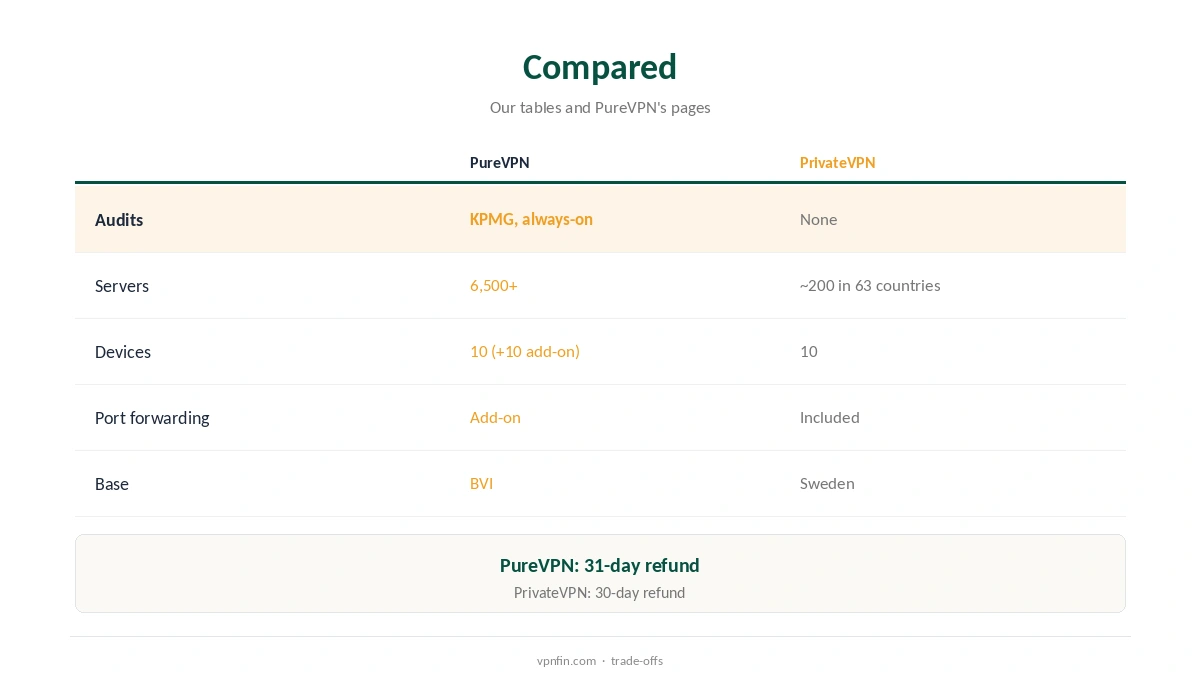
PureVPN vs PrivateVPN compares two budget services that charge for features differently. PureVPN is run by GZ Systems in the British Virgin Islands. It reportedly handed logs to the FBI in 2017 despite a no-logs promise, then joined KPMG’s always-on audit programme. Its Standard plan costs $58.20 for 27 months, then $47.95 a year, for 10 devices, with a 31-day refund. PrivateVPN, based in Sweden, has no independent audit in our table and runs about 200 servers in 63 countries on disk. It bundles port forwarding, a SOCKS5 proxy and, on one plan, a dedicated IP, at around $2 a month on three years.
This guide compares them on privacy, extras, network, price, streaming and fit.
PureVPN vs PrivateVPN on Privacy
PureVPN carries a 2017 black mark: it reportedly gave the FBI logs in a cyberstalking case while promising none. Since then it has joined KPMG’s always-on programme, which allows unannounced checks. Its fourth audit by 2024 found no logging of source or assigned VPN IPs, our tables record.
PrivateVPN has a clean public record but no audit, and its servers use disks rather than memory. Our VPN audit tracker compares providers.
Extras: Bundled or Paid
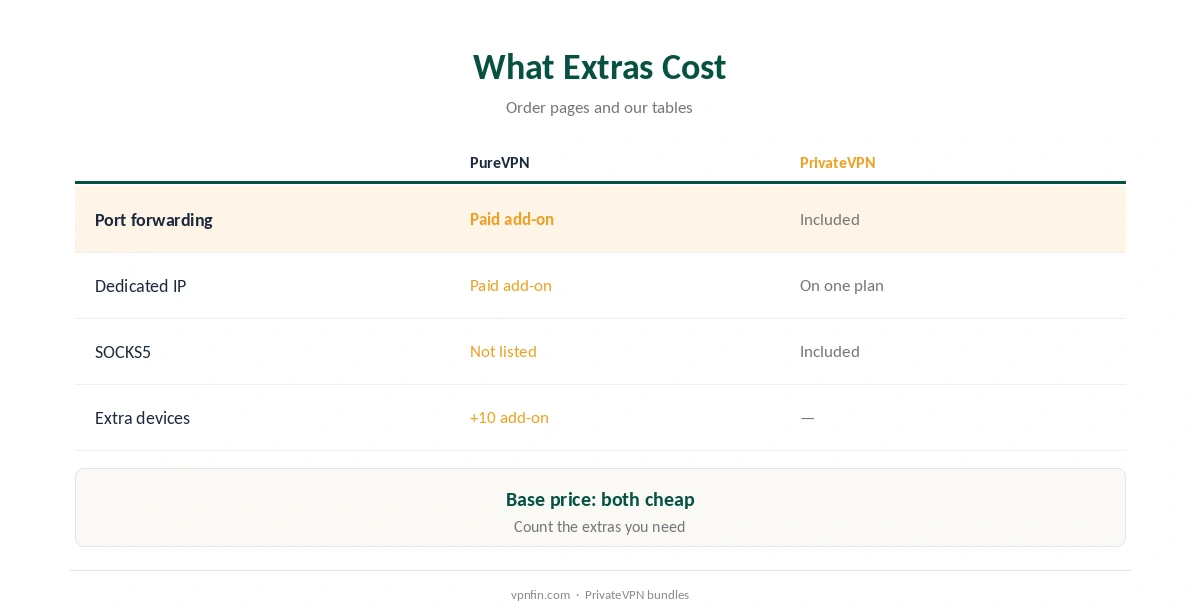
PrivateVPN includes port forwarding and SOCKS5, plus a dedicated IP on one of its plans. PureVPN sells port forwarding and a dedicated IP as paid add-ons, and offers a multi-login add-on for 10 more devices, its order page lists.
If you need these tools, PrivateVPN’s bundle is cheaper; if you do not, PureVPN’s base price is competitive and its network larger.
Network Size and Torrenting
PureVPN’s Linux app lists 88-plus locations and more than 6,500 servers, its Snap listing says. PrivateVPN runs about 200 servers in 63 countries, our tables record.
PureVPN’s larger network gives more choice of cities and spare capacity when servers are busy in the evening.
Price, Refunds and Devices
PureVPN’s Standard plan costs $58.20 for 27 months, then $47.95 a year, with 31 days for refunds on new purchases but not renewals. PrivateVPN costs around $2 a month on three years with a 30-day refund.
Both are cheap on long plans; PureVPN’s renewal price is clearer in our tables. Check PrivateVPN’s renewal at checkout before committing to three years.
Both allow 10 devices at once, and PureVPN sells 10 more as an add-on. A router running either counts as one device.
Large households have more room on PureVPN with the add-on, at extra cost.
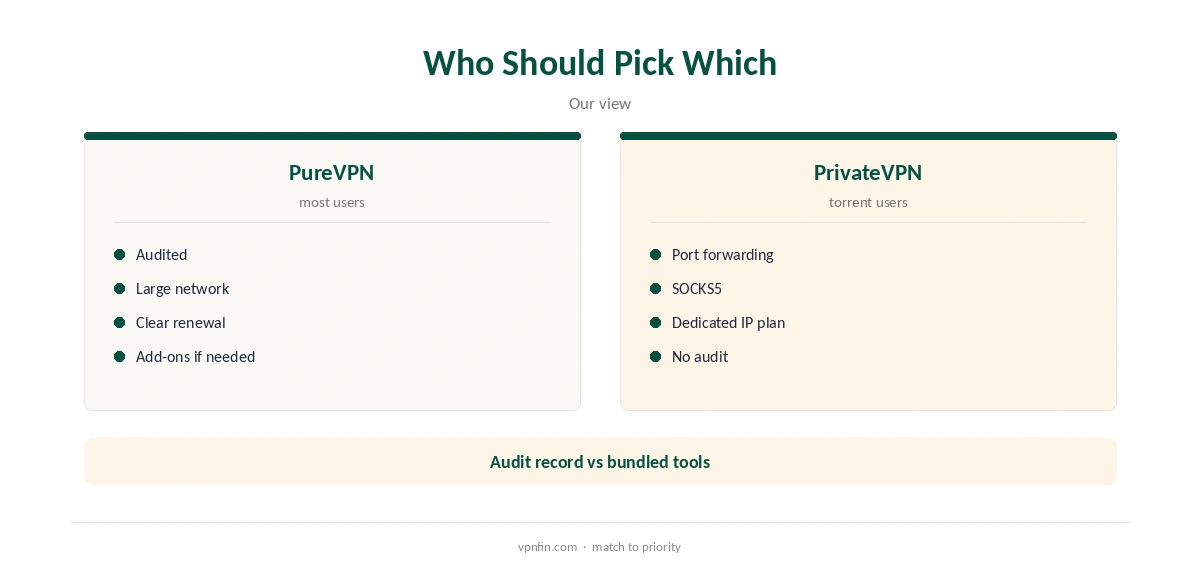
PrivateVPN’s built-in port forwarding and SOCKS5 suit torrent users who want open ports and a fast proxy for their client. PureVPN allows P2P and sells port forwarding separately.
Our torrenting VPN guide compares other providers.
Jurisdiction, Ownership and Streaming
PureVPN sits in the British Virgin Islands under GZ Systems; PrivateVPN in Sweden, part of the Fourteen Eyes. Audits matter more than location, which favours PureVPN today.
Neither belongs to Kape or Nord Security. Our VPN ownership guide explains why owners matter.
PureVPN advises switching to a streaming-optimised server when Netflix shows its proxy error, its blog says. PrivateVPN’s smaller network offers fewer locations to try when a service blocks one.
Test your own streaming services within each refund window before committing to either.
Trials, Testing and PureVPN’s Tiers
PureVPN offers a seven-day trial for $0.99 that becomes a full plan unless cancelled before it ends, its trial page says; renewals after a trial are not refundable.
PrivateVPN’s 30-day refund gives a similar window, so test torrenting, streaming and your usual networks on both.
PureVPN sells Standard, Plus and Max tiers, its order page lists. Standard adds a tracker blocker, Plus a password manager, and Max data removal, dark web monitoring and a 3 GB eSIM allowance.
For a like-for-like comparison with PrivateVPN, Standard is the tier to weigh; the others add non-VPN extras.
Why Disk Servers Matter
A server that boots from disk can keep data unless the provider sets it up not to, while memory-only servers lose everything on restart. PrivateVPN uses disk servers and has no audit, so its no-logs claim depends on trust; PureVPN’s audits check its practices directly.
For torrent users, that trade-off is worth weighing carefully against PrivateVPN’s bundled tools.
Linux, Routers and Leak Checks
PureVPN offers a Linux app with a graphical interface and a command-line tool, purevpn-cli, and guides for Synology NAS devices using OpenVPN, its help pages show. For routers and other devices, both providers support manual setups with configuration files.
Our CyberGhost vs PrivateVPN page covers PrivateVPN against another large provider.
Check the kill switch setting in each provider’s app before relying on it, since defaults differ by platform. After setup, run a DNS leak test and switch Wi-Fi off and on to confirm traffic stops when the tunnel drops. Our PureVPN vs hide.me comparison sets the two side by side.
Repeat the checks after app updates, which can reset settings.
How We Research
This page draws on PureVPN’s order, refund and blog pages and Snap listing, and our PrivateVPN, audit and price tables. We cross-checked these sources against each other, and where they conflict or something can’t be verified, we say so in the text rather than guessing. We checked time-sensitive figures, including prices in US dollars, on 8 October 2026. The main source we relied on is PureVPN’s refund policy. Our full approach lives on the About Us page.
PureVPN vs PrivateVPN FAQ
PureVPN for audits and network size; PrivateVPN for bundled torrent tools.
Not in our table; PureVPN has KPMG audits.
It reportedly handed logs to the FBI in 2017, before its audits.
PrivateVPN includes it; PureVPN sells it as an add-on.
Both allow 10; PureVPN sells 10 more.
The Verdict
PureVPN vs PrivateVPN: PureVPN for audited privacy and a bigger network; PrivateVPN for port forwarding, SOCKS5 and a dedicated IP without add-on fees.