
Disclosure: VPNFin is reader-supported. If you buy a VPN through links on this page, we may earn a commission at no extra cost to you. This never affects our ratings — here’s our full disclosure.
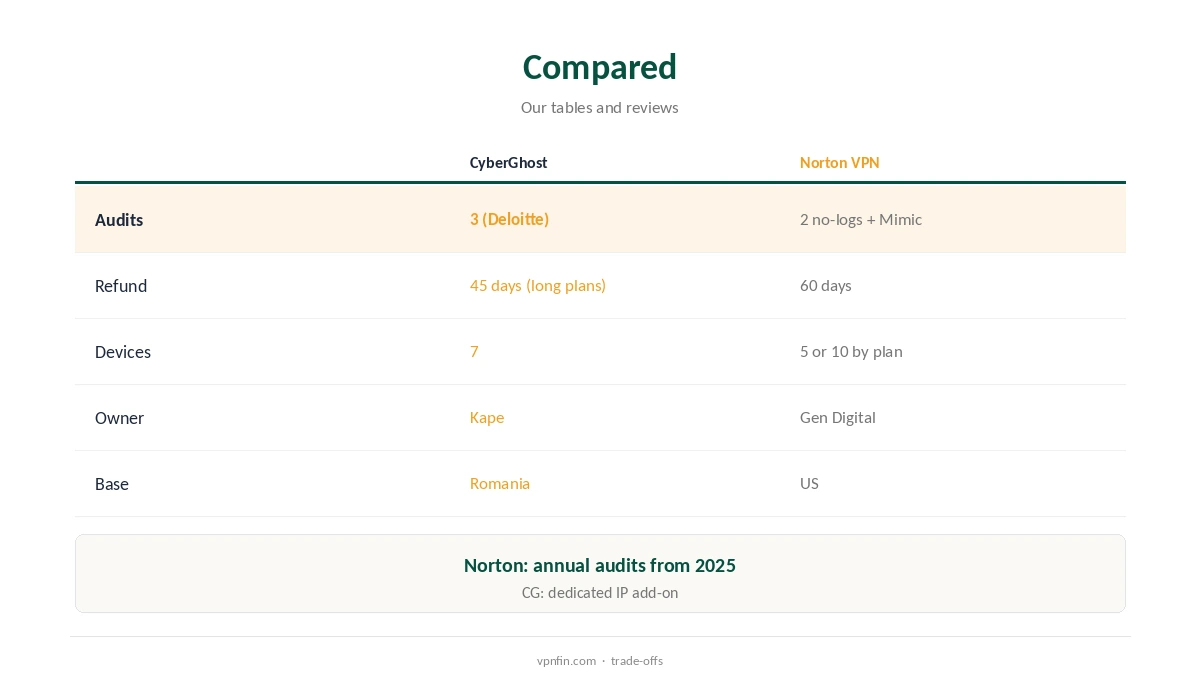
CyberGhost vs Norton VPN pairs two VPNs from large security groups. CyberGhost, owned by Kape and based in Romania, has three Deloitte no-logs audits in our table and allows seven devices. It costs $56.94 for its first 26 months, then $56.94 a year, with 45 days to ask for a refund on longer plans. Norton VPN, from Gen Digital in the US, has had two no-logs audits, the latest in October 2025. It offers a 60-day refund and sells Plus at $29.99 for the first year, Tom’s Guide reports.
This guide compares owners, evidence, refunds, devices, protocols, streaming and fit.
Two Big Security Groups
Big owners bring resources for audits and apps. They also bring wider data policies, so read the fine print.
Kape owns CyberGhost along with ExpressVPN, PIA and review sites including vpnMentor and Wizcase, CyberInsider reports. Gen Digital owns Norton alongside Avast, Avira, AVG, CCleaner and LifeLock, and Norton’s privacy policy allows sharing data with partners inside the group, Security.org notes. Our PIA vs Norton VPN comparison sets the two side by side.
Both groups sell antivirus or security tools as well, so read each privacy policy. Our VPN ownership guide explains why owners matter.
CyberGhost vs Norton VPN on Evidence
CyberGhost has three Deloitte no-logs audits, from 2022, 2024 and late 2025. Norton had its no-logs policy audited in 2024 and again in October 2025, and says this will now happen every year. Its Mimic protocol was audited in December 2025, Tom’s Guide reports.
CyberGhost’s record is a little longer; Norton’s is catching up. Our VPN audit tracker compares them.
Refund Windows
Use the window to test streaming, speed and every device you plan to cover; ask for a refund in writing before it ends.
Norton’s 60-day refund is among the longest, and it adds a seven-day free trial. CyberGhost gives 45 days on plans of six months or more and 14 days on monthly plans; app-store purchases follow the store’s rules.
Both give generous time to test; Norton’s is longer.
CyberGhost vs Norton VPN on Cost
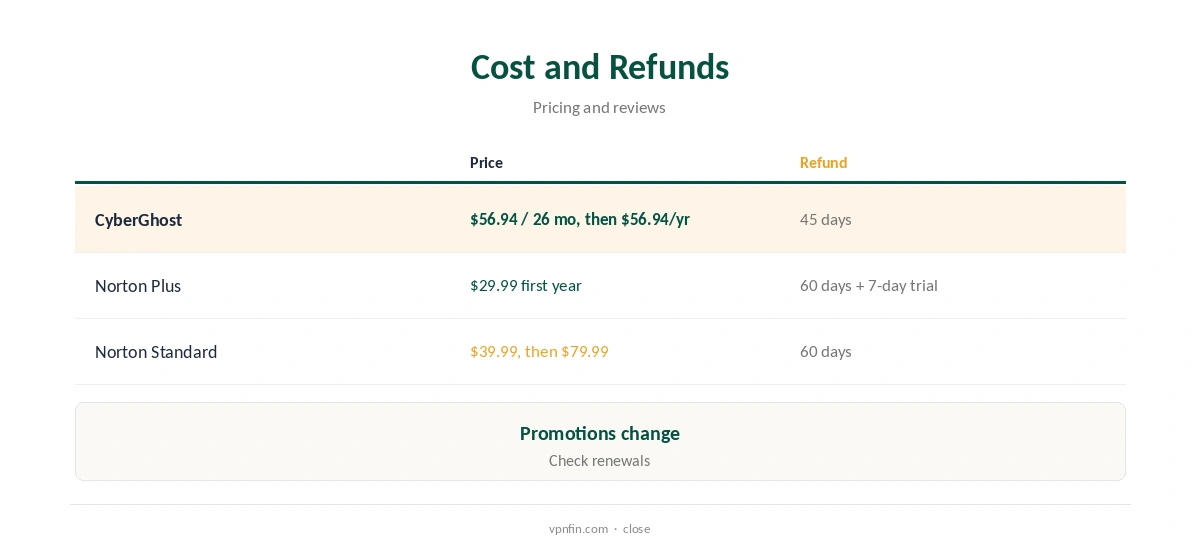
CyberGhost costs $56.94 for its first 26 months, then $56.94 a year, one of the lowest renewals among big brands. Norton Plus costs $29.99 for the first year, Tom’s Guide lists, while Security.org lists Standard at $39.99 for the first year, renewing at $79.99.
Norton is cheaper in year one; CyberGhost is cheaper after renewal. Our renewal price guide compares.
Devices
Count phones, laptops, tablets, TVs and streaming sticks before choosing a plan.
Remember that a router running the VPN counts as one device and covers everything behind it, which can stretch either limit.
CyberGhost allows seven devices. Norton’s Standard and Plus plans allow five, and Ultimate allows 10, Security.org lists.
For six or seven devices, CyberGhost fits without upgrading.
Protocols and Censorship
At home, WireGuard is the fast default on both. Mimic matters mainly when a network blocks ordinary VPN traffic.
Norton offers WireGuard, OpenVPN, IPSec and its Mimic protocol, which disguises VPN traffic as HTTPS and reached iOS in June 2025. Its Mac app lacks WireGuard and OpenVPN, though. CyberGhost offers WireGuard, IKEv2 and OpenVPN on Windows, its support pages say.
For filtered networks, Norton’s Mimic is the more specialised tool.
Streaming and Extras
CyberGhost also includes its ID Guard monitoring at no extra cost and sells a Windows security suite, its pricing page lists.
CyberGhost groups servers by streaming service in its apps, Gizmodo notes, and sells a dedicated IP from $5 a month. Norton adds IP Rotation and Double VPN, and comes bundled in Norton 360 suites.
Streamers may prefer CyberGhost’s labelled servers; Norton 360 users may already have a VPN.
Who Each Is For
Both are easy for beginners. Neither asks you to configure anything to get started.
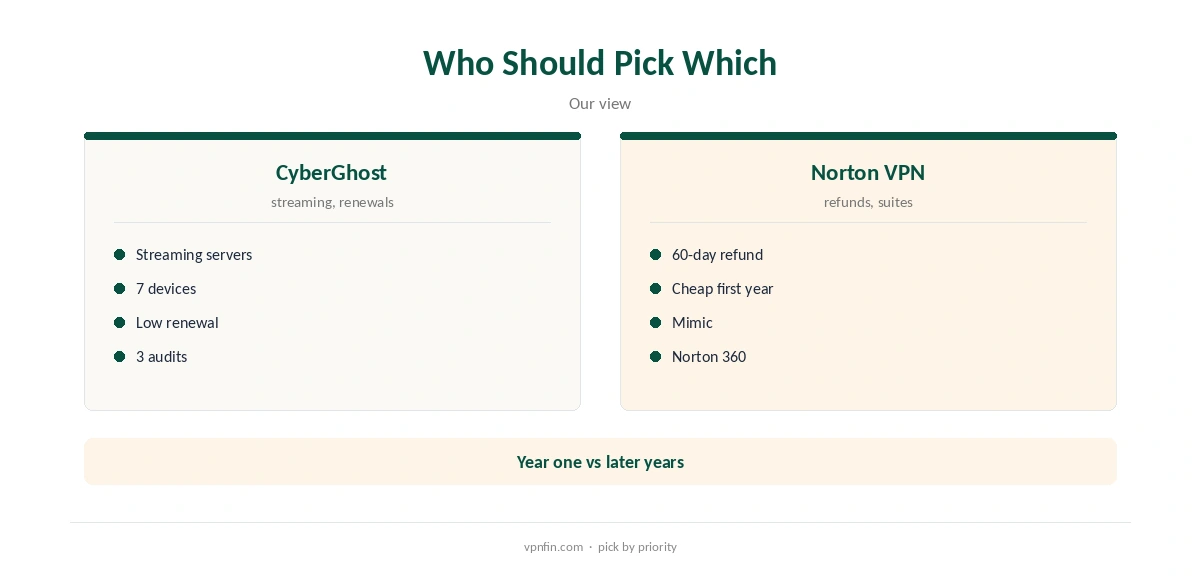
CyberGhost suits streamers and households of up to seven devices who want low renewals and three audits. Norton suits Norton 360 users and anyone who wants a cheap first year, a 60-day refund and Mimic for restrictive networks.
If you already pay for Norton 360, check whether a VPN is included.
Trials
A trial shows how the apps feel. A refund window lets you test streaming and speed for weeks.
Norton offers a seven-day free trial alongside its 60-day refund, Experte notes. CyberGhost offers 24 hours free on Windows and macOS, seven days on iOS and three on Android, its trial page says.
Use a trial to check apps before paying; use the refund window for longer testing.
Apple Devices
On Windows and Android, both services offer a fuller set of features.
Norton’s apps have fewer features on Apple devices, Tom’s Guide notes, and its Mac app lacks WireGuard and OpenVPN. Check CyberGhost’s Mac and iPhone features against what you need. For a head-to-head, see our PureVPN vs Norton VPN comparison.
Mac users should compare protocol lists before buying.
How We Research
This page draws on Tom’s Guide’s reports on Norton VPN’s 2025 changes, Security.org’s Norton coverage, CyberInsider’s report on Kape, Gizmodo on CyberGhost and our audit and price tables. We cross-checked these sources against each other, and where they conflict or something can’t be verified, we say so in the text rather than guessing. We checked time-sensitive figures, including prices in US dollars, on 8 October 2026. The main source we relied on is Tom’s Guide on Norton VPN’s 2025 changes. Our full approach lives on the About Us page.
CyberGhost vs Norton VPN FAQ
CyberGhost for streaming and renewals; Norton for refunds and a cheap first year.
CyberGhost, with three; Norton has two no-logs audits plus a Mimic audit.
Norton, with 60 days.
CyberGhost allows seven; Norton allows five or 10 by plan.
Kape owns CyberGhost; Gen Digital owns Norton.
The Verdict
CyberGhost vs Norton VPN: CyberGhost for streaming, seven devices and low renewals; Norton for a long refund, a cheap first year and Mimic.