
Disclosure: VPNFin is reader-supported. If you buy a VPN through links on this page, we may earn a commission at no extra cost to you. This never affects our ratings — here’s our full disclosure.
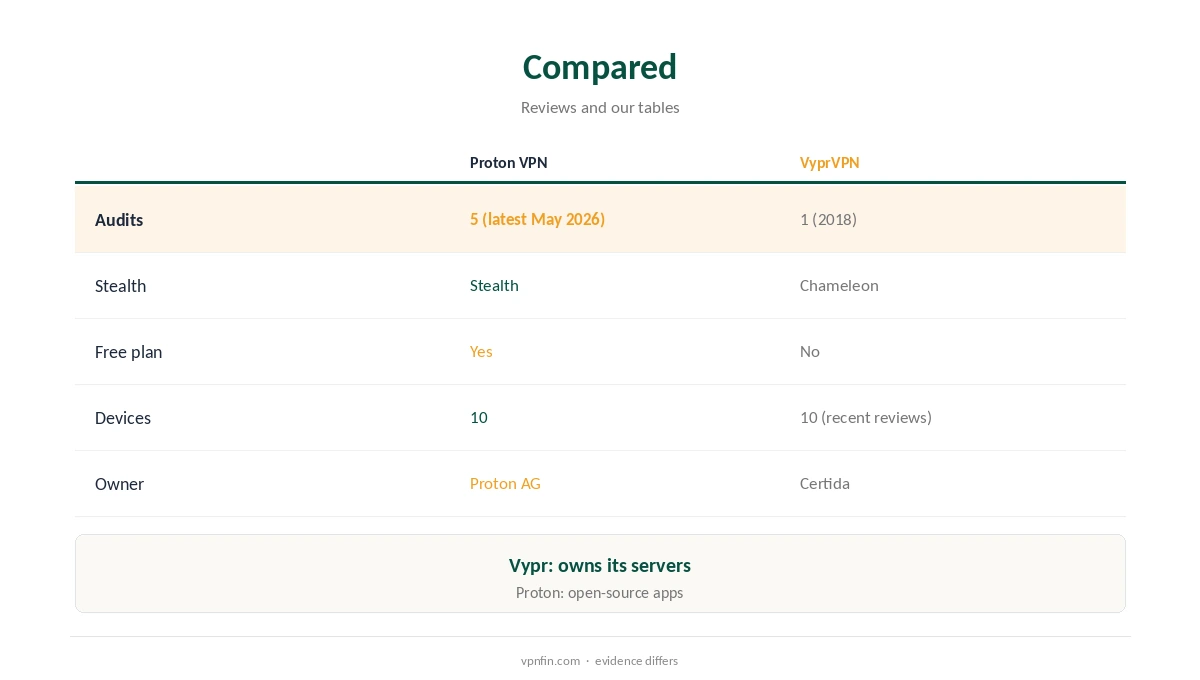
ProtonVPN vs VyprVPN compares providers that both offer a stealth protocol but differ sharply on recent evidence. Proton VPN, from Proton AG in Zurich, passed its fifth yearly no-logs audit by Securitum in May 2026, CyberInsider reports. It costs $2.99 a month on two years, $71.76 in total, for 10 devices, and offers a free plan with no data cap. VyprVPN, now owned by Certida, owns its servers and offers its Chameleon protocol, but its only independent audit was by Leviathan in 2018, before the change of ownership, fahimai notes; it costs about $3 a month on two years.
This guide compares audits, censorship tools, devices, price, free use and fit.
ProtonVPN vs VyprVPN on Audits
Proton’s fifth Securitum audit, in May 2026, examined servers from both its free and paid plans and found no records linking users to activity, CyberInsider reports, while noting it is a point-in-time review. VyprVPN was one of the first VPNs to publish a no-logs audit, in 2018, but has had none since, including after Certida took over.
For current evidence, Proton is far ahead. Our VPN audit tracker compares providers.
ProtonVPN vs VyprVPN: Stealth Protocols
Neither is needed on an ordinary home connection.
VyprVPN’s proprietary Chameleon protocol scrambles packet metadata so networks find it harder to detect or block VPN traffic, Impulsec notes. Proton’s Stealth protocol serves the same purpose and is available on all plans, including the free one, a 2026 review notes.
Both are built for restrictive networks; test either from the network you will use.
Free Use
The free plan also lets you test Proton’s Stealth protocol on a filtered network before paying.
Proton’s free plan has no data cap and no ads, with one device and servers in eight countries as of October 2025, Tom’s Guide reports, and no streaming support. VyprVPN has no free plan.
For a free start, ProtonVPN is the only option here.
Price
Introductory prices hide the real cost. Compare what each charges after the first term.
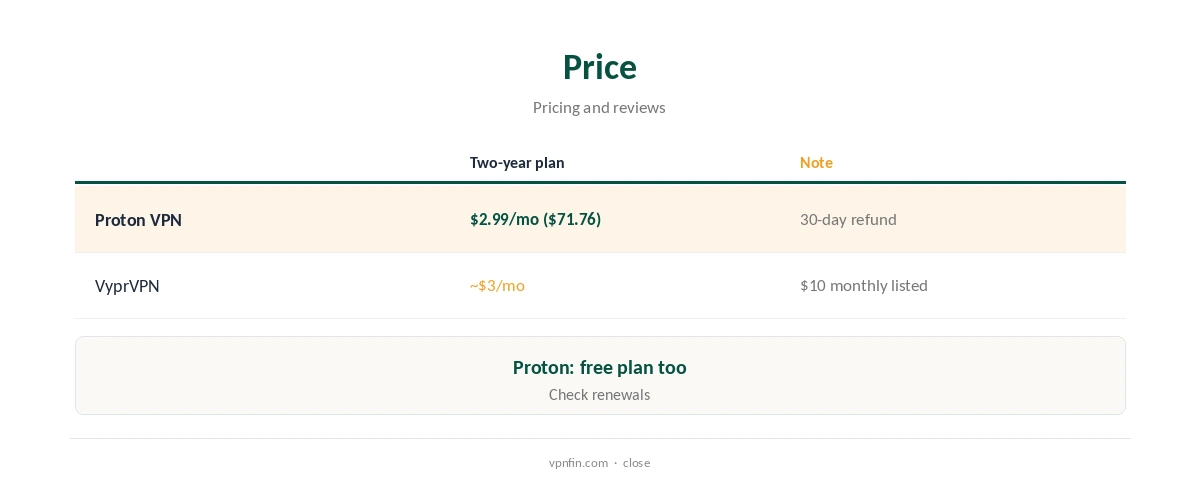
Proton costs $2.99 a month on two years, $71.76 up front, then renews higher. VyprVPN costs about $3 a month on two years, and some sites list $10 monthly or $60 a year, fahimai notes.
Both are similar on long plans; confirm renewal prices at checkout. Our renewal price guide explains why.
Devices
Check the limit at checkout, since sources differ.
A router covers TVs and consoles as one device.
A router running either VPN counts as one device and covers the TVs behind it.
Proton allows 10 devices on paid plans. Recent reviews list 10 devices for VyprVPN, while older ones mention 30, so check the current limit at checkout.
For most households, either covers the essentials.
Servers, Ownership and Open Source
Ownership changes can shift priorities, which is why fresh audits matter.
VyprVPN owns its servers rather than renting them, fahimai notes, which gives it physical control of the hardware. Securitum’s 2025 review covered Proton-owned bare-metal servers, one 2026 review notes. Proton AG is a Swiss company; Certida owns VyprVPN.
Our VPN ownership guide explains why ownership changes matter.
Readers who value transparency should weigh this.
Open code does not replace an audit of servers, but it lets anyone check the apps.
Proton’s apps are open source, so outside experts can read how they handle data. We found no comparable claim for VyprVPN’s apps in our sources.
For transparency, Proton offers more to inspect.
Who Each Is For
Both work on filtered networks; evidence decides.
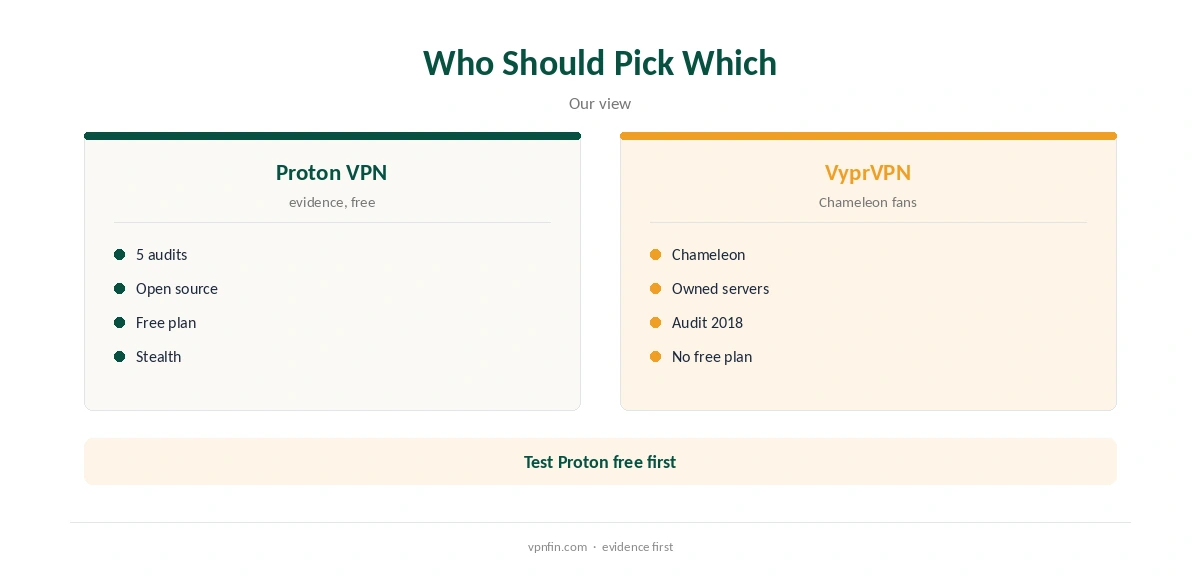
ProtonVPN suits people who want current, repeated audits, open-source apps and a free plan. VyprVPN suits people who specifically want Chameleon and owned servers, and accept an audit record that stops at 2018.
Start with Proton’s free plan to test its Stealth protocol before paying.
Protocols and Refunds
Test stealth modes from the network you will use.
VyprVPN supports WireGuard, OpenVPN, IKEv2 and Chameleon, Impulsec notes. Proton supports WireGuard and OpenVPN alongside its Stealth protocol and a Smart mode that picks a protocol automatically.
At home, WireGuard is the fast default on both; keep the stealth options for filtered networks.
Ask in writing before the window closes.
Proton refunds paid plans in full within 30 days of the first purchase, once per user, its terms say. VyprVPN offers a 30-day refund on first purchases across its plans, our tables record. We put the two side by side in our Mullvad vs VyprVPN comparison.
Both give a month to test; Proton’s free plan adds a no-cost option first.
Proton’s Free Countries
Paid plans also add Secure Core and NetShield.
Streaming needs a paid plan.
Proton’s free plan picks a server for you in the US, Canada, Norway, Japan, Singapore, the Netherlands, Poland or Romania, Tom’s Guide listed in October 2025. Paid plans open well over 100 countries, Security.org notes. For a head-to-head, see our Hotspot Shield vs VyprVPN comparison.
For most free users, one of those countries will be close enough for browsing.
How We Research
This page draws on CyberInsider’s report on Proton’s 2026 audit, Tom’s Guide’s report on Proton’s free servers, Security.org’s Proton coverage, Impulsec’s and fahimai’s VyprVPN coverage and our price tables. We cross-checked these sources against each other, and where they conflict or something can’t be verified, we say so in the text rather than guessing. We checked time-sensitive figures, including prices in US dollars, on 8 October 2026. The main source we relied on is CyberInsider on Proton’s 2026 audit. Our full approach lives on the About Us page.
Proton VPN vs VyprVPN FAQ
Proton for current audits and a free plan; VyprVPN for Chameleon.
In 2018, by Leviathan.
Yes, with no data cap, one device and about eight countries.
Yes: Proton’s Stealth and VyprVPN’s Chameleon.
Certida.
The Verdict
ProtonVPN vs VyprVPN: Proton for current audits, open apps and a free plan; VyprVPN for Chameleon and owned servers.