
Disclosure: VPNFin is reader-supported. If you buy a VPN through links on this page, we may earn a commission at no extra cost to you. This never affects our ratings — here’s how we research.
Most VPN reviews weigh audit counts. This one starts with court records.
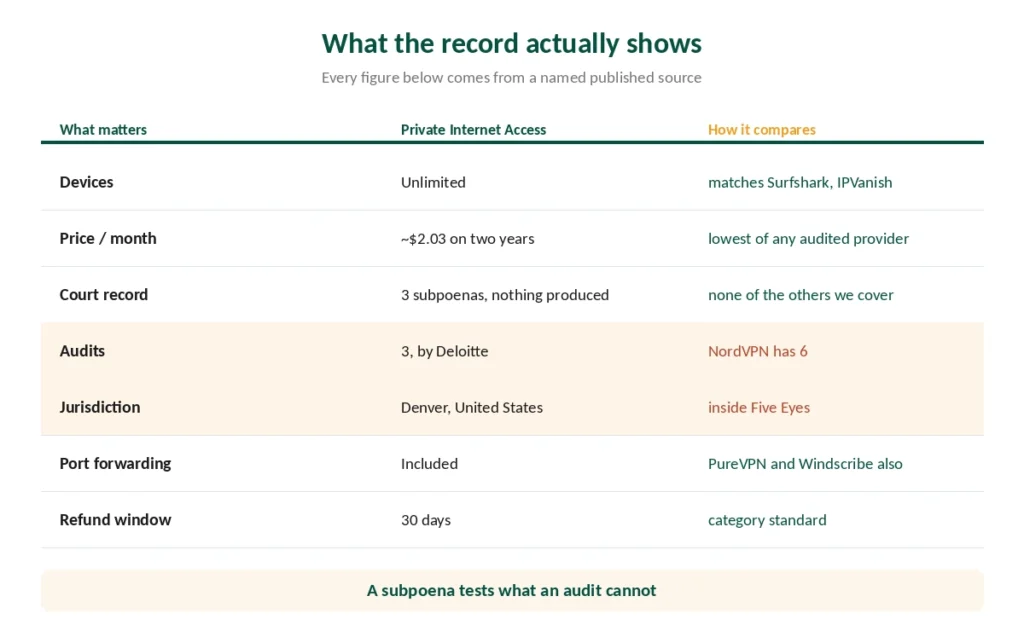
Private Internet Access has been subpoenaed by US federal authorities on at least three occasions — including an FBI request for connection logs in a 2016 criminal case in Virginia. Each time, the company produced nothing useful, because nothing existed to produce.
That is stronger verification than any scheduled audit, and it happened before the industry started competing on audit counts.
This PIA review covers those cases, the three Deloitte audits that followed, the unlimited device policy, and an ownership situation that deserves a section of its own.
Verdict at a Glance
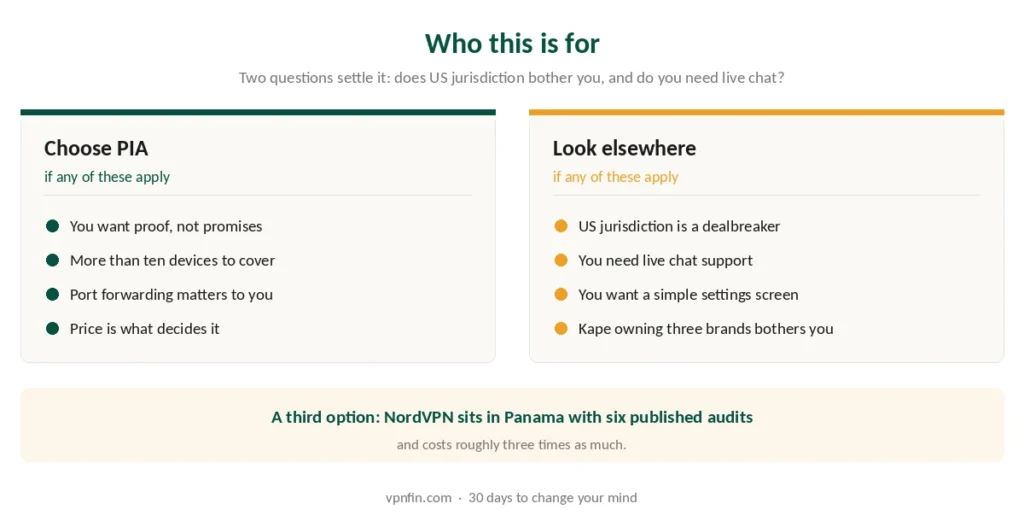
Buy it if you want the strongest evidence of a no-logs claim available in this category, unlimited devices, port forwarding, or the lowest price among audited providers.
Skip it if US jurisdiction is a dealbreaker, or if you need live chat support.
The short version: the privacy record is exceptional, the price is low, and the company sits inside Five Eyes with a parent that owns two competitors and several review sites.
The Court Cases: What Actually Happened
Three documented instances, and they’re the reason to consider PIA at all.
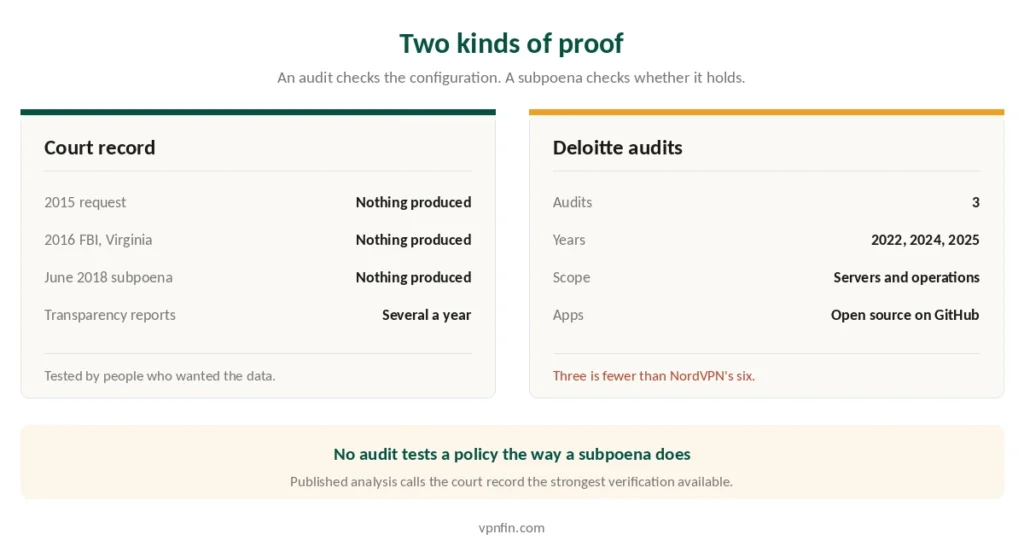
2015. US authorities requested data in a case involving a cyber attack on a media organisation. PIA could not comply.
2016, Virginia. The FBI requested connection logs for a specific user in a criminal case. PIA handed over nothing useful, because nothing had been retained.
June 2018. US authorities again demanded logs for a criminal investigation. The general counsel of the parent company testified that the service intentionally retains no activity logs, precisely so none can be produced in response to a subpoena.
⚠️ Why this outranks an audit. An audit examines configuration at a point in time. A subpoena tests whether the configuration holds when a government asks. Published analysis calls this the most credible possible verification of a no-logs claim. Swedish police searched Mullvad’s offices in 2023 and left with nothing, for the same reason.
PIA also publishes transparency reports several times a year, documenting every legal request received and how it responded.
Three Deloitte Audits
The court record came first. The formal verification came later.
Deloitte has audited the no-logs policy three times — in 2022, 2024 and 2025. Each engagement covered server infrastructure and operational practices, and each returned clean results.
The same firm audits NordVPN and Surfshark, which makes the reports comparable in a way audits by different firms usually aren’t.
And the apps are open source. Windows, macOS, Linux, iOS and Android clients are published on GitHub, so the code can be inspected by anyone rather than only by a hired auditor. Only Proton VPN matches that on both counts, with open-source apps and five audit reports anyone can download.
⚠️ Three audits is fewer than NordVPN’s six. The court record is what closes that gap, and reasonable people weigh those differently.
The Ownership Question
This needs stating plainly, because it’s more complicated than it first looks.
PIA is owned by Kape Technologies, which also owns ExpressVPN and CyberGhost. Three of the providers we cover answer to one parent.
Kape was previously called Crossrider, and in that incarnation distributed adware. Published analysis addresses this directly rather than avoiding it: the company operates differently now, and the audit record across all three brands supports that — ExpressVPN’s is the deepest of the three, though its exact size is disputed.
⚠️ But there’s a second layer most reviews don’t mention. At least one prominent VPN review site discloses that it belongs to the same ownership group as PIA. That site says so openly in its own editorial note, which is the correct behaviour — but it means some of the reviews you’ll read about PIA are written by a sibling company.
We have no such relationship, and we’re flagging it because we raised the same structural point about IPVanish, whose owner also publishes a technology review outlet — and again with Hotspot Shield, whose parent owns Comparitech.
Unlimited Devices, and Every US State
Unlimited simultaneous connections on every plan, matching Surfshark, IPVanish and Windscribe.
Servers in all 50 US states — no other provider we’ve examined offers that. It matters for accessing state-specific services, local sports blackouts and regional streaming rights.
⚠️ Network size is where sources fall apart. Published figures range from “thousands across 91 locations” to 10,000-plus to 35,000-plus. That thirty-fold spread suggests different counting methods rather than different networks, and we can’t resolve it.
What’s consistent: coverage across roughly 50 to 91 countries depending on the source, with RAM-only servers throughout.
Another provider faced a lawsuit rather than a subpoena and settled by changing what it offered — TorGuard against Private Internet Access.
Speed, Streaming and Torrenting
Speed. One 2026 test recorded 874 Mbps with 14 ms local latency. Another reported holding 85–90% of baseline on nearby servers, with expected drops on long hops to Australia.
Streaming. Netflix US, UK and German libraries unblocked reliably in published testing, with one reviewer scoring streaming 9.2 out of 10. Occasional server switching is needed — normal across the category, as our streaming guide explains.
Torrenting is where PIA is genuinely strong. P2P allowed across the network, port forwarding included, plus SOCKS5 proxy support. Among providers we cover, PIA, PureVPN, Windscribe and Proton VPN offer port forwarding, while Mullvad removed it in 2023 — our torrenting guide explains who actually needs it.
Plus PIA MACE, a built-in ad and tracker blocker that works at DNS level.
Pricing
Around $2.03 a month on the two-year plan, with some sources citing $1.79 on longer terms. That’s among the lowest prices for any independently audited provider.
Every plan includes the same features — unlimited connections, port forwarding, MACE, all servers. No tier gating.
30-day money-back guarantee on all plans.
⚠️ Renewal pricing isn’t well documented in published sources, which is itself worth noting. Check the figure at checkout rather than assuming the intro rate continues — our cheap VPN guide covers why that’s the single most useful habit in this category.
What We Don’t Love
US jurisdiction. PIA operates from Denver, Colorado — inside Five Eyes, with no legal barrier to compelled assistance. The court record is the counter-argument, and it’s a strong one, but the structural position remains.
Support is thin. No live chat. Published reviews describe the options as a labyrinthine wiki or an email ticket, neither helpful at a time-sensitive moment.
The settings menu overwhelms beginners. PIA exposes more configuration than most, which power users like and newcomers don’t.
Third-party payment processing. One review flags that PIA relies heavily on outside parties to handle customer data and payments — anonymised, but more potential failure points than necessary.
And the Kape question won’t satisfy everyone, regardless of what the audits show.
How We Research
This review draws on published testing and analysis from named sources including Gizmodo, SafetyDetectives, CyberInsider, PrivacyJournal, StreamFix and TheBestVPN, alongside court reporting on the subpoena cases and PIA’s own documentation — cross-checked and verified at publication. We don’t run our own speed tests. Where a source disclosed shared ownership with PIA, we’ve noted that in the text rather than quoting it as independent. Server counts vary so widely between sources that we present the range rather than a figure. Our full approach lives on the About Us page.
Set against NordVPN, the gap is narrower than the price suggests. Our comparison covers the audit count, the Kape ownership and the renewal figure that published sources cannot agree on.
The ExpressVPN comparison is the one worth reading next. They share a parent company, they score the same on our scale, and the price difference is roughly two to one.
Surfshark is the closest thing to a like-for-like rival. Both offer unlimited devices at roughly the same price, so the comparison turns on jurisdiction, streaming and what counts as proof.
Against PureVPN the court record does the deciding. The prices are within a few dollars, so the comparison rests on what each company produced when investigators asked.
CyberGhost is the closest thing to a sibling. Same parent, same auditor, same number of audits — the only real differences are a country and a courtroom.
PIA FAQ
More thoroughly than most. US federal authorities subpoenaed PIA on at least three occasions — in 2015, in a 2016 FBI case in Virginia, and again in June 2018 — and each time the company produced nothing useful because nothing had been retained. Deloitte has separately audited the policy three times, in 2022, 2024 and 2025.
The jurisdiction is a genuine consideration: Denver, Colorado sits inside Five Eyes with no legal barrier to compelled assistance. The counter-evidence is that authorities have actually tried, three times, and got nothing. RAM-only servers and open-source apps published on GitHub support that. Whether it satisfies you depends on your threat model.
Unlimited simultaneous connections on every plan, with no tier that adds more. That matches Surfshark, IPVanish and Windscribe, and beats NordVPN’s 10, ExpressVPN’s 10 to 14 by tier, and CyberGhost’s seven.
Yes, and it’s one of the stronger options. P2P is allowed across the network, port forwarding is included — which only PureVPN and Windscribe also offer among providers we cover — and there’s SOCKS5 proxy support. The court-tested no-logs record matters here more than in most use cases.
Kape Technologies, which also owns ExpressVPN and CyberGhost. Kape was formerly called Crossrider and distributed adware in that incarnation. Published analysis addresses this directly: the current operation differs, and the audit record across all three brands supports that. Some VPN review sites also belong to the same group and disclose it.
Around $2.03 a month on the two-year plan, with some sources citing $1.79 on longer terms — among the lowest prices for any independently audited provider. Every plan includes the same features with no tier gating, and all come with a 30-day money-back guarantee. Renewal pricing is poorly documented, so check it at checkout.
The Short Version
The court record is the reason to consider it. Three federal subpoenas, nothing produced, because nothing was retained. No audit tests a policy that way.
Three Deloitte audits back it up, alongside open-source apps anyone can inspect.
Unlimited devices, port forwarding and every US state at around $2 a month makes it the cheapest audited provider we’ve examined.
And it sits in Denver, Colorado, owned by a company that also owns two of its competitors.
Private Internet Access
The Verdict
The strongest evidence of a no-logs claim in this category — three federal subpoenas that produced nothing, plus three Deloitte audits and open-source apps. Unlimited devices, port forwarding and servers in every US state at around $2 a month. The jurisdiction is Denver, Colorado, and the parent company owns two competitors.