Disclosure: VPNFin is reader-supported. If you buy a VPN through links on this page, we may earn a commission at no extra cost to you. This never affects our ratings — here’s our full disclosure.
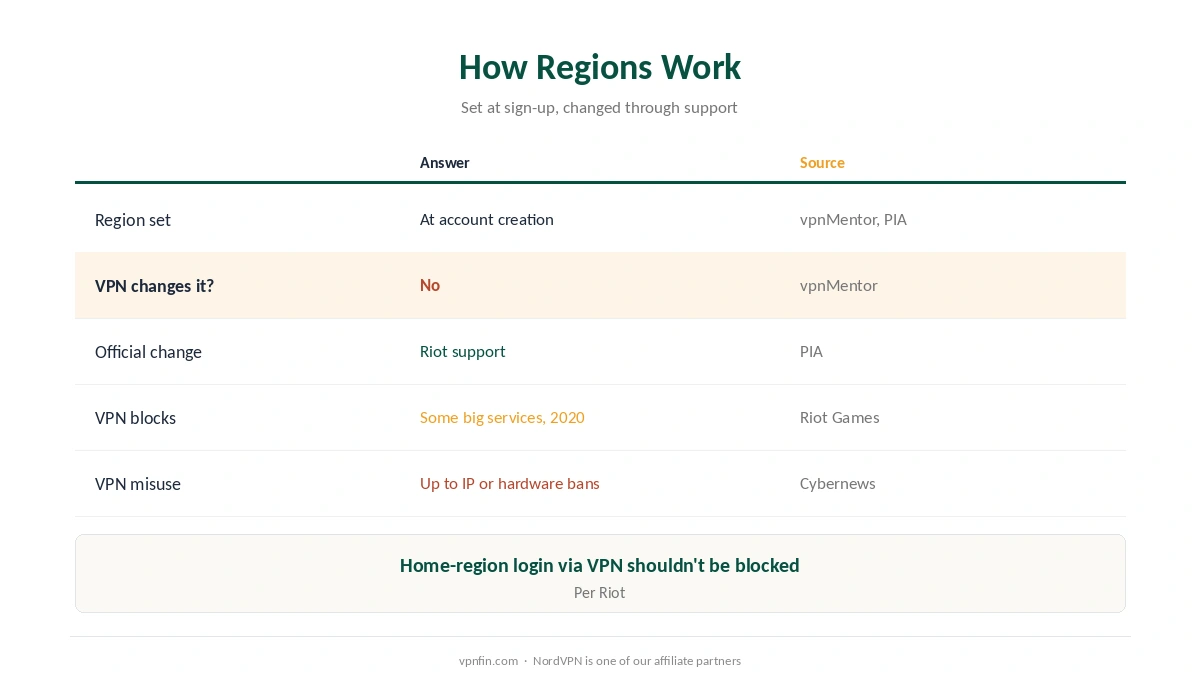
Does a VPN work with Valorant? For playing on your own account, yes, mostly. Riot hasn’t banned VPNs outright, Cybernews notes, but in November 2020 it cut off several of the highest-volume VPN services for cross-region play, because VPN players caused lag and language problems for everyone. Riot said at the time that logging into your home region through a VPN shouldn’t be blocked. And a VPN won’t move your account: Valorant fixes your region when you create the account, vpnMentor explains.
This page covers how Valorant’s regions work, the official way to change region, what Vanguard means for VPN users, and what a VPN is actually good for here.
VPN for Valorant: How Regions Work
| Question | Answer | Source |
|---|---|---|
| When is my region set? | When you create the account, from your IP | vpnMentor, PIA |
| Does a VPN change it later? | No; an EU account won’t see NA servers | vpnMentor |
| Can I change it officially? | Yes, through Riot support | PIA |
| Does Riot block VPNs? | Some high-volume services, since 2020 | Riot Games |
| Can Riot act on VPN misuse? | Yes, up to IP or hardware bans | Cybernews |
Riot’s 2020 block targets volume, not privacy. Riot said most VPN users wouldn’t notice and that it might add more services to the list, its announcement explains. Our guide to why services block VPNs covers the pattern.
Moving Country? The Official Route
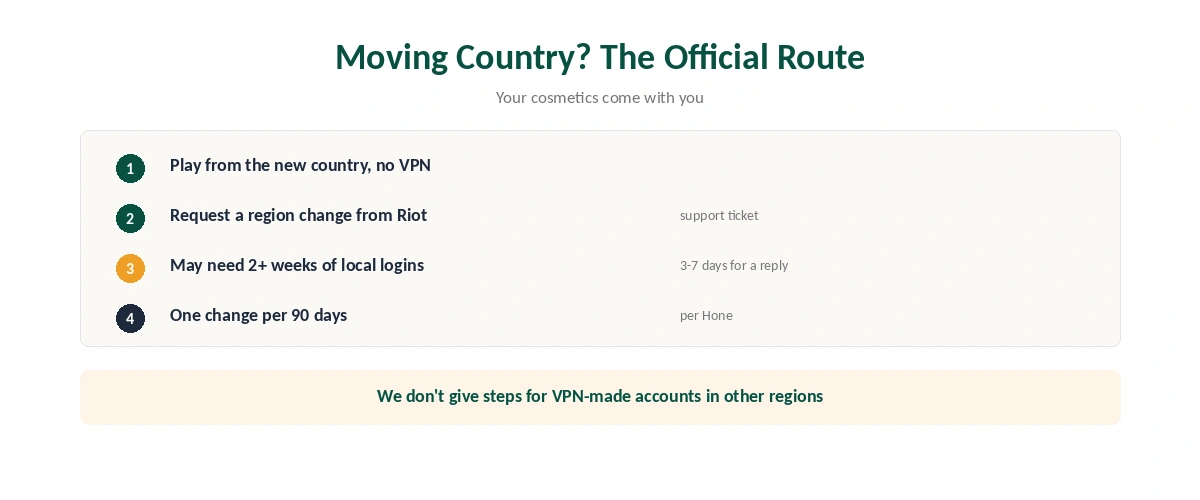
| Step | What to expect |
|---|---|
| 1 | Move and play from your new country without a VPN |
| 2 | Request a region change through Riot support |
| 3 | Riot may ask for two weeks or more of logins from the new location |
| 4 | Manual tickets take about 3 to 7 days for a first reply |
| 5 | Your skins and cosmetics transfer; changes are limited to one per 90 days |
This keeps your progress, with no VPN for Valorant needed. The official change transfers cosmetics, Hone notes, and PIA says Valorant allows it free of charge, with your IP in the new region. Timings come from Hone’s guide and can vary.
We don’t give steps for creating accounts in other regions through a VPN. It sits in a grey area of Riot’s rules, and Riot is also bound by US sanctions law, which restricts access from some countries, Marix notes.
What a VPN Is Good For in Valorant
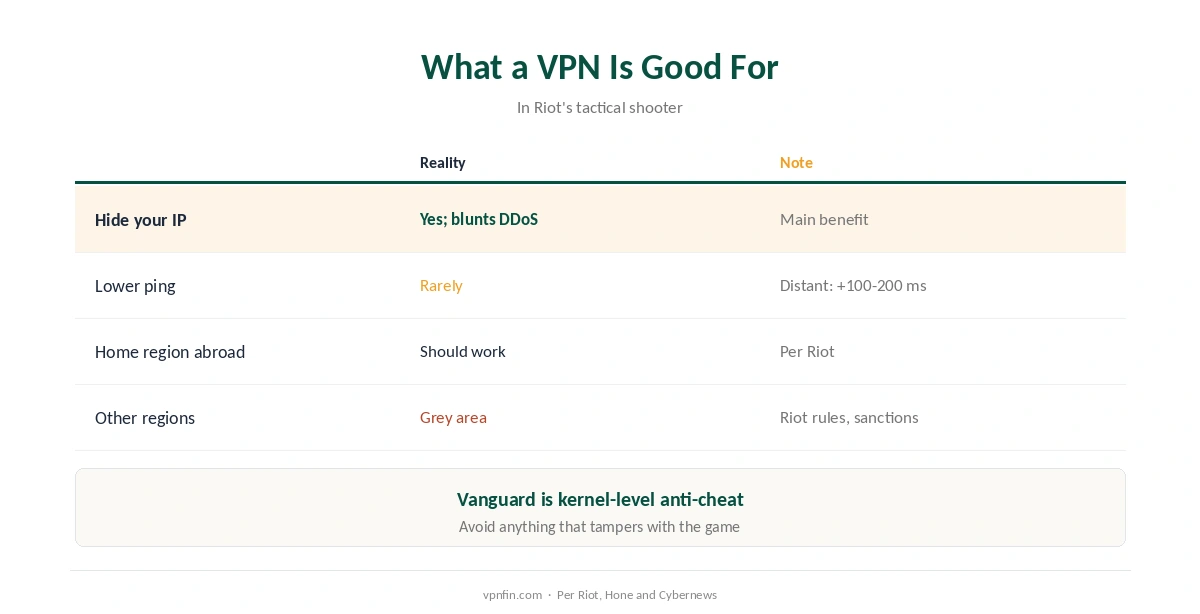
Hiding your IP is the main benefit of a VPN for Valorant. Other players can’t aim a DDoS at your home connection if they only see a VPN address, as our guide to what a VPN hides explains. Travelling? Riot says logging into your home region through a VPN shouldn’t be blocked, and our travel guide covers hotel networks.
Ping rarely improves. A distant server can add 100 to 200 ms, Hone notes, which hurts in a tactical shooter; even a nearby VPN server adds a hop. Our gaming guide explains when routing can help.
Vanguard is kernel-level anti-cheat. It runs deep in Windows, so avoid anything that tampers with the game or your hardware identity; a mainstream VPN app on its own is a different matter. Our NordLynx guide covers a low-overhead protocol, and our not-connecting guide helps if the VPN itself fails.
Ping and Server Choice
A VPN adds a step between you and Riot’s servers, so expect slightly higher ping. Choose a VPN server near the Valorant region you play on. WireGuard-based protocols usually add the least delay.
Our guide to VPN speed explains where the extra milliseconds come from.
Anti-Cheat and Accounts
Riot’s Vanguard anti-cheat runs at system level. A VPN does not change that, and frequent location changes can trigger account checks. Keep one consistent server rather than hopping between countries.
Protection From Attacks
Streamers sometimes face attacks aimed at their home IP. A VPN hides that address, which is a stronger reason to use one than chasing lobbies. Use split tunnelling if other apps need full speed.
Choosing a VPN for Valorant
Look for WireGuard support, servers near your Valorant region and split tunnelling. Test at your usual play times within the refund window: 30 days for NordVPN and Surfshark, 45 days for CyberGhost on longer plans.
A Quick Rule
Want lower ping? Play on your nearest region without a VPN. Facing DDoS? A VPN helps. Moving country? Use Riot’s official route. Keep one region and one server for consistency. Our guide to ExpressVPN for Valorant covers ping, Vanguard and the right settings.
How We Research
Riot’s VPN block and home-region assurance come from Riot’s November 2020 announcement; account regions from vpnMentor and PIA; region-change timings and ping from Hone; the rules position from Cybernews; sanctions from Marix. PIA and Marix sell products, which we flag. Riot’s announcement is at riotgames.com. We read all sources on 28 September 2026. NordVPN is one of our affiliate partners. Our full approach lives on the About Us page. Our page on NordVPN for Valorant covers Riot’s region lock and what a VPN is still for.
VPN for Valorant FAQ
Riot doesn’t ban VPNs outright, but it blocks some high-volume VPN services and can act against accounts that use a VPN to break its rules.
No. Your region is set when you create the account. To change it, request a region change through Riot support.
Rarely. It adds a hop, and distant servers can add 100 to 200 ms.
Riot blocked several of the highest-volume VPN services in 2020. Try another server or disconnect the VPN.
Vanguard is anti-cheat that targets cheating and tampering. Riot’s VPN blocking is a separate, network-level measure.
The Verdict
A VPN for Valorant is useful for hiding your IP, not for switching regions or lowering ping.
If you move country, use Riot’s official region change; your progress comes with you.