
Disclosure: VPNFin is reader-supported. If you buy a VPN through links on this page, we may earn a commission at no extra cost to you. This never affects our ratings — here’s how we research.
These two have opposite problems with transparency, and both are worth understanding before you pick either.
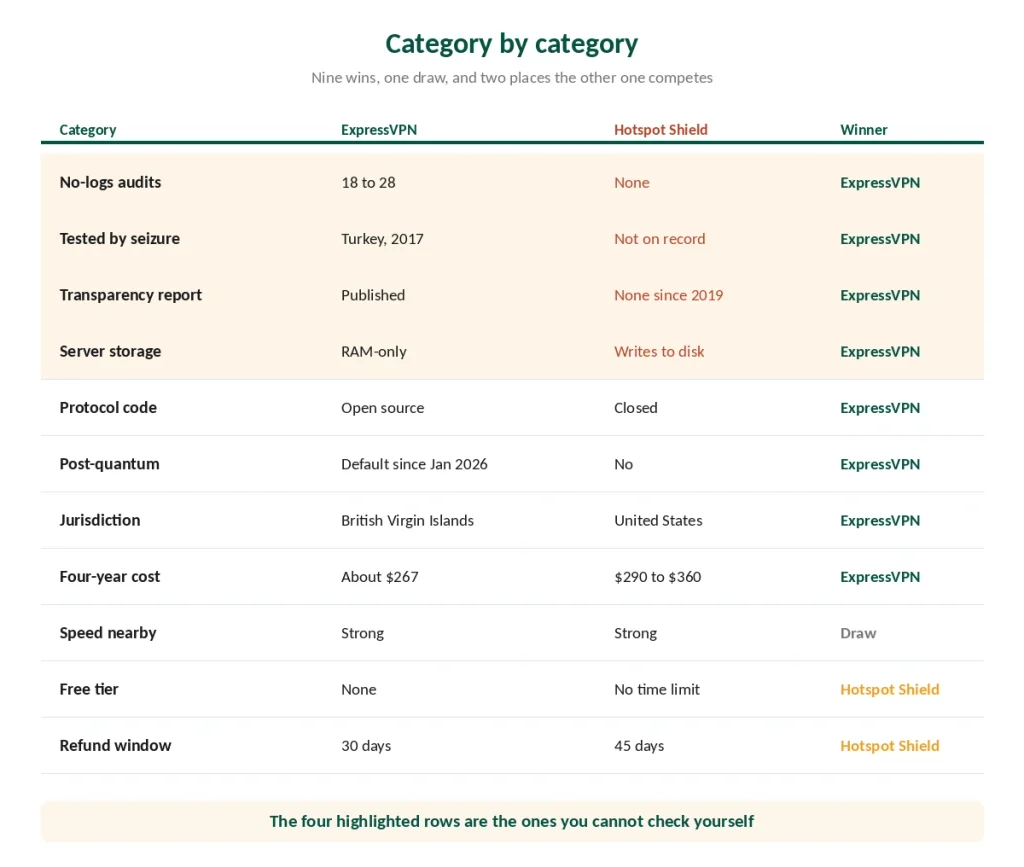
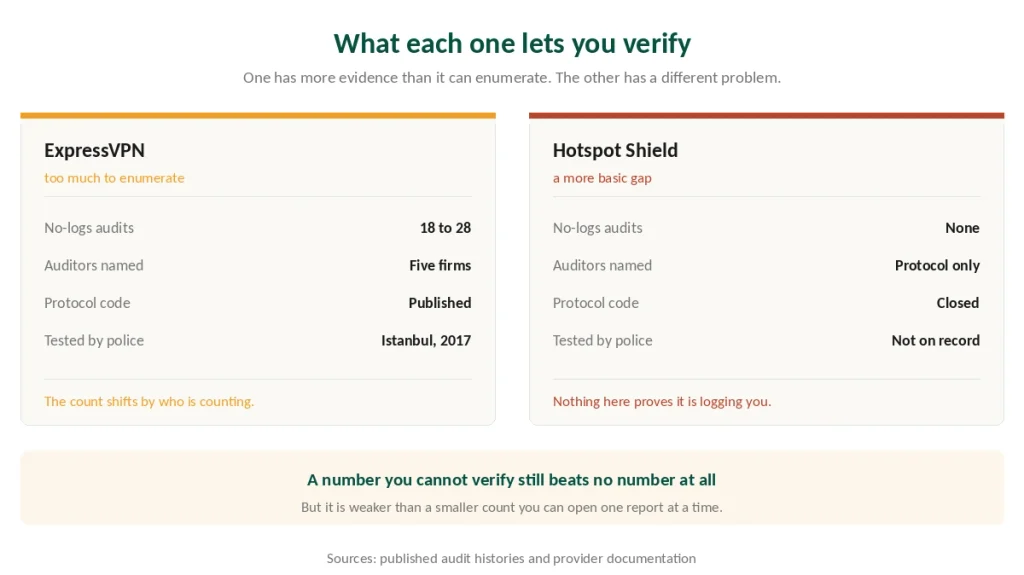
ExpressVPN’s trust center lists 28 independent audit reports, with dates and named auditors — PwC Switzerland, KPMG, Cure53, F-Secure and Praetorian. Published reviews cite anywhere from 18 to 28, because each counts a different subset, but the primary list is there to read.
Hotspot Shield has no audit of its no-logs policy at all, and has published no transparency report since 2019.
We rate them 4.5 and 3.4. They cost about the same. This comparison is mostly about what that gap in verification is worth.
The Short Answer
ExpressVPN wins. A deep audit record whatever its exact size, a server seized by police that produced nothing, BVI jurisdiction, post-quantum encryption by default, and the widest streaming access we track.
Hotspot Shield’s case is a free tier and 45 days. Its Catapult Hydra protocol is fast on short routes, and the free plan has no time limit.
The prices are close enough to ignore, which removes the usual reason to accept a lower-rated product.
Head to Head
| ExpressVPN | Hotspot Shield | |
|---|---|---|
| No-logs audits | 28, listed with dates | None |
| Tested by seizure | Turkey, 2017 | Not on record |
| Transparency report | Published | None since 2019 |
| Server storage | RAM-only | Writes to disk |
| Protocol | Lightway, open source | Hydra, closed |
| Post-quantum | Default since Jan 2026 | No |
| Jurisdiction | British Virgin Islands | United States |
| Owner | Kape Technologies | Point Wild |
| Devices | 10 on Basic | 5 or 10, disputed |
| Streaming | 20+ Netflix regions | Inconsistent |
| Free tier | None | Yes, no time limit |
| Refund window | 30 days | 45 days |
| Four years | ~$267 | $290 – $360 |
| Our rating | 4.5 | 3.4 |
Two Opposite Transparency Problems
Worth taking both seriously, because neither is ideal.
ExpressVPN’s record is deep and the count is confusing only second-hand. Its trust center lists 28 reports with dates and auditors; published reviews cite 18, 19, 27 and 28 because each counts a different subset. The engagements are verifiable, and none has returned a critical finding.
⚠️ A number you cannot verify is a weaker claim than a smaller number you can. Mullvad publishes more than ten reports you can open individually; that is a different kind of evidence.
Hotspot Shield’s problem is more basic. There is no independent audit of its no-logs policy. Its Catapult Hydra protocol has been examined, which the company points to — but a protocol audit asks whether the tunnel is built correctly, while a no-logs audit asks whether the company keeps records of what goes through it.
And its transparency reporting stopped in 2019. ExpressVPN publishes.
⚠️ The difference in kind matters more than the difference in count. One provider has more verification than it can enumerate; the other has none of the specific kind that matters most.
Winner: ExpressVPN, and not narrowly.
The Test Neither Company Scheduled
Turkish investigators seized an ExpressVPN server in 2017 during the inquiry into the assassination of the Russian ambassador. They examined the hardware and recovered nothing usable, because the TrustedServer architecture holds no persistent data.
That is stronger evidence than any audit, for a simple reason: a scheduled inspection examines a system that knows it is being examined, while a seizure does not give notice.
Among providers we cover, three have been tested this way — ExpressVPN, Mullvad’s 2023 police search, and PIA’s three federal subpoenas. All three produced nothing.
Hotspot Shield is not among them. Its servers also write to disk rather than running from RAM, so a comparable seizure would have something to find.
Winner: ExpressVPN.
Protocols: Both Proprietary, One Published
An unusual place where these two look similar and are not.
Both built their own protocol rather than shipping WireGuard or OpenVPN alone. ExpressVPN has Lightway; Hotspot Shield has Catapult Hydra.
Lightway is open source. It was rewritten in Rust in 2025, uses wolfSSL, and has carried ML-KEM post-quantum protection by default since January 2026. Anyone can read it, and outside auditors have.
Catapult Hydra is closed. Its security properties rest on the company’s own account of them, and there is no post-quantum equivalent.
⚠️ A proprietary protocol name is not a reason to choose a provider. It is a reason to ask whether anyone outside the company has examined it — our protocol guide covers why that matters more than the name.
Winner: ExpressVPN.
Speed and Streaming
Hotspot Shield is genuinely fast on nearby servers. Testing on a 250 Mbps line found it among the quickest available on European and US East routes, with gigabit throughput. Results drop noticeably at distance.
ExpressVPN lost 18% of baseline in CNET’s testing, which is a full-network average rather than a best case, and slower than NordVPN’s 2.9% in the same round.
⚠️ These are not directly comparable — different labs, different baselines. On short routes Hotspot Shield may well be quicker; across a full test set ExpressVPN is the measured figure.
Streaming is not close. ExpressVPN unblocks 20 or more Netflix regions and ships MediaStreamer for devices that cannot run an app. Published assessments describe Hotspot Shield’s streaming as inconsistent — our streaming guide covers why snapshots go stale.
Winner: a draw on nearby speed, ExpressVPN on streaming and consistency.
Ownership: Two Holdings, One Awkward Overlap
Neither provider is independent, and the structures differ.
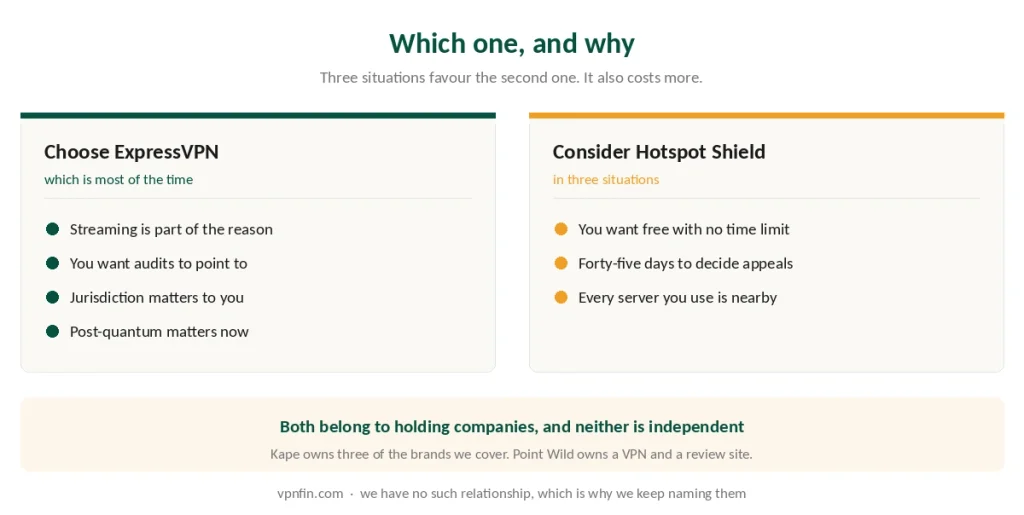
ExpressVPN belongs to Kape Technologies, alongside CyberGhost and Private Internet Access — three brands we cover under one board. Kape was previously Crossrider and distributed adware in that incarnation, which it has moved away from.
Hotspot Shield belongs to Point Wild since December 2024, after a chain running from AnchorFree through Pango and Aura. ⚠️ Point Wild’s own press release lists its brands, and two sit oddly together: Hotspot Shield and Comparitech, a website that reviews VPNs.
Jurisdiction favours ExpressVPN. The British Virgin Islands sit outside every intelligence-sharing arrangement with no data-retention law. Hotspot Shield operates from the United States, inside Five Eyes.
⚠️ We keep naming these because the pattern repeats, and our own position is that we have no such relationship.
Winner: ExpressVPN on jurisdiction, and neither on independence.
Price: Close Enough to Remove the Argument
ExpressVPN Basic runs about $3.59 a month on the 28-month plan, then renews at $99.95 a year. Across four years, roughly $267.
Hotspot Shield’s annual plan works out near $7.99 a month, with the regular rate reported at $95.99. Across four years, $290 to $360 — a range because published prices for the same plan differ across six sources.
So even at the lower bound Hotspot Shield costs more, while rating 3.4 against ExpressVPN’s 4.5.
⚠️ When a lower-rated product is also dearer, the usual defence disappears. Across nine providers we found price and rating unrelated, and this is another case where the relationship runs backwards.
⚠️ Hotspot Shield’s 45-day refund window is the longer one, fifteen days more than ExpressVPN’s.
Winners by Category
| Category | Winner |
|---|---|
| No-logs verification | ExpressVPN |
| Tested by seizure | ExpressVPN |
| Transparency reporting | ExpressVPN |
| Server architecture | ExpressVPN |
| Protocol openness | ExpressVPN |
| Post-quantum encryption | ExpressVPN |
| Jurisdiction | ExpressVPN |
| Streaming | ExpressVPN |
| Four-year cost | ExpressVPN |
| Speed nearby | Draw |
| Free tier | Hotspot Shield |
| Refund window | Hotspot Shield |
| Corporate independence | Neither |
When to Choose Hotspot Shield Instead
You want a free VPN with no time limit and accept that location data from free users funds it.
Forty-five days matters more than anything above. For someone unsure whether they want a VPN at all, the longest available window is a reasonable way to find out.
Every server you use is nearby, in which case Hydra’s speed advantage is real and the distance penalty never applies.
⚠️ Outside those three the comparison is not close, and it costs more.
How We Research
This comparison draws on our full reviews of both providers, where every figure was verified against named primary sources at the time of writing — ExpressVPN’s published audit history and reporting on the 2017 Turkish server seizure, Point Wild’s December 2024 merger announcement as carried by the wire services, published speed testing including CNET’s, and each provider’s own pricing terms. We don’t run our own speed tests. Where a figure is genuinely disputed, as ExpressVPN’s audit total and Hotspot Shield’s pricing both are, we give the range rather than picking one. Our full approach lives on the About Us page.
ExpressVPN vs Hotspot Shield FAQ
Nobody agrees. Reviews published in 2026 credit it with 18, with more than 19, with 27 and with 28, and several of the higher figures trace back to the company’s own materials. The named engagements are verifiable — Cure53, KPMG, PwC, F-Secure and Praetorian — but the running total shifts by what each source counts.
Its Catapult Hydra protocol has been examined by outside parties, but there is no independent audit of its no-logs policy, and no transparency report since 2019. A protocol audit asks whether the tunnel is built correctly; a no-logs audit asks whether the company keeps records of what goes through it.
Hotspot Shield on nearby servers, where Catapult Hydra reaches gigabit throughput on European and US East routes. ExpressVPN lost 18% of baseline in CNET’s testing, which is a full-network average rather than a best case. Different labs and baselines, so treat it as directional.
ExpressVPN, at roughly $267 against Hotspot Shield’s $290 to $360. Even at the lower bound Hotspot Shield costs more while rating 3.4 against 4.5, which removes the argument that usually rescues a lower-rated product.
ExpressVPN belongs to Kape Technologies, alongside CyberGhost and Private Internet Access. Hotspot Shield belongs to Point Wild since December 2024, whose own announcement lists Comparitech — a VPN review website — among its brands. Neither provider is independently owned.
The Verdict
ExpressVPN takes it on everything except the free tier and the refund window, and it costs less than the lower bound of its rival’s price range.
Both have transparency problems, and they are not equivalent. One has more audits than anyone can count. The other has none of the kind that matters most, and has published nothing since 2019.
Hotspot Shield’s speed is real on short routes, and so is its free plan, and so is 45 days.
What none of those buy is the ability to check anything — which is what separates 4.5 from 3.4, and why the price comparison settles the rest. Against Surfshark it faces the same objection at a wider price gap.