
Disclosure: VPNFin is reader-supported. If you buy a VPN through links on this page, we may earn a commission at no extra cost to you. This never affects our ratings — here’s how we research.
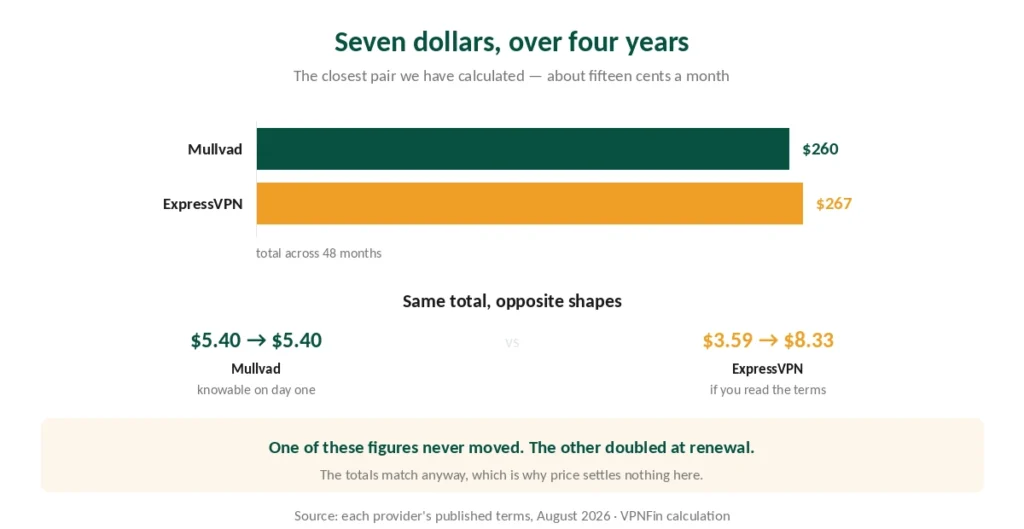
Across four years, ExpressVPN costs about $267 and Mullvad about $260. Seven dollars, over four years, between a premium brand and a service that has never run a discount.
That is the closest pair we have calculated, and it removes the argument most comparisons lean on. So this Mullvad vs ExpressVPN comparison has to be settled on something else.
Conveniently, they share a second unusual property. Both have had their no-logs claims tested by police rather than by auditors — ExpressVPN when Turkish investigators seized a server in 2017, Mullvad when Swedish police arrived with a warrant in 2023. Neither produced anything. That is where the useful comparison starts.
The Short Answer
ExpressVPN wins for most people, at 4.5 against 4.2 in our ratings. More devices, vastly more servers, streaming that works, Smart DNS for televisions, and post-quantum encryption shipping today.
Mullvad wins if you would rather not be known to the provider. No email address, cash accepted by post, more than ten audits you can actually count, and no parent company.
Head to Head
| Mullvad | ExpressVPN | |
|---|---|---|
| Sign-up | A 16-digit number | Email address |
| Payment | Cash by post accepted | Card, PayPal, crypto |
| Owner | None | Kape Technologies |
| Audits | 10+, countable | 18 to 28, disputed |
| Tested by seizure | Sweden, 2023 | Turkey, 2017 |
| Devices | 5 | 10 on Basic |
| Servers | ~700, 40+ countries | 105+ countries |
| Streaming | Not promised | 20+ Netflix regions |
| Smart DNS | None | MediaStreamer |
| Post-quantum | None shipping | Default in Lightway |
| Four years | ~$260 | ~$267 |
| Our rating | 4.2 | 4.5 |
Two Seizures, Two Results
Start here, because it is the rarest thing either of them has.
Istanbul, 2017. Turkish investigators seized an ExpressVPN server during the inquiry into the assassination of the Russian ambassador. They examined the hardware and recovered nothing usable, because the TrustedServer architecture holds no persistent data.
Sweden, April 2023. Police arrived at Mullvad’s offices with a search warrant seeking customer data. Staff explained that none existed. The officers left without seizing anything.
Both are stronger evidence than an audit, and for the same reason: a scheduled inspection examines a system that knows it is being examined, while a warrant does not give notice.
⚠️ Among providers we cover, three have been tested this way. These two, plus PIA’s three federal subpoenas. All three produced nothing.
Winner: a draw, and it is the most flattering draw either of them will get.
Audits: Ten You Can Count Against Twenty-Something You Cannot
Here the two diverge sharply, and the number is not the interesting part.
Reviews published in 2026 credit ExpressVPN with 18, with more than 19, with 27, and with 28 audits. Several of those figures come from sources quoting ExpressVPN itself. The named engagements are verifiable — Cure53, KPMG, PwC, F-Secure, Praetorian, covering the protocol, servers, apps and extensions — but the running total shifts depending on what gets counted.
Mullvad has more than ten, by Cure53 and Assured AB, each published in full with the findings intact rather than summarised.
⚠️ Breadth against countability. ExpressVPN commissions more third-party review than anyone in this category, and no engagement has returned a critical finding. Mullvad publishes fewer reports and you can open every one of them. Which matters more depends on whether your question is “is the software sound” or “is the company telling the truth” — and set against a provider with no no-logs audit at all, the argument looks different again.
Winner: ExpressVPN on breadth, Mullvad on countability.
What Each Company Knows About You
This is the difference no feature list closes.
ExpressVPN holds an email address, a payment record and a subscription history. Ordinary, legal, and a set of records that exists whether or not anyone asks.
Mullvad holds a sixteen-digit number. No email, no username, no password, no recovery. Cash sent by post works as payment, which removes the processor from the chain entirely.
Ownership compounds it. ExpressVPN belongs to Kape Technologies, alongside CyberGhost and Private Internet Access — three brands we cover under one board. Mullvad has no parent company at all.
⚠️ A no-logs policy and a no-account architecture answer different questions. The first describes what a company chooses not to record about your activity; the second describes what it cannot record about your identity. What a VPN actually hides sets out where each claim stops.
Winner: Mullvad.
Everything the VPN Actually Does
The direction reverses completely, and it reverses hard.
Devices: ten on ExpressVPN’s Basic tier against five. Higher tiers raise it further. Mullvad sells no add-on.
Servers: 105-plus countries against roughly 40. Mullvad argues that physical servers in the countries listed beat a padded count of virtual locations, which is fair — though it does not put a server where there isn’t one.
Streaming: ExpressVPN unblocks 20 or more Netflix regions and ships MediaStreamer, its Smart DNS, which reaches consoles and older televisions that cannot run an app at all. Mullvad maintains no streaming servers and does not claim it will work. Our streaming guide covers why access shifts monthly for everyone.
Protocols: Lightway was rewritten in Rust, is open source, and has carried ML-KEM post-quantum protection by default since January 2026. Mullvad supports WireGuard exclusively, having retired OpenVPN in the same month — faster and simpler, with no post-quantum equivalent and no path for routers that only speak OpenVPN, as our protocol guide explains.
Neither offers port forwarding. Mullvad removed it in 2023; ExpressVPN has never had it. Our torrenting guide covers who that affects.
Winner: ExpressVPN, comfortably.
Price: The Closest We Have Calculated
ExpressVPN Basic runs about $3.59 a month on the 28-month plan, billed at roughly $100.58 upfront, then renews at $99.95 a year.
Mullvad charges €5, about $5.40, and has since 2009. No promotional rate, no annual discount, no increase.
Across four years: roughly $267 against $260. Seven dollars, or about fifteen cents a month.
⚠️ The shapes differ even though the totals do not. Mullvad’s cost was knowable on the day you signed up. ExpressVPN’s required you to notice the renewal figure, which is the pattern our renewal price table exists to make visible.
⚠️ Refunds differ too. ExpressVPN gives 30 days. Mullvad bills monthly and returns unused time, so the question barely arises.
Winner: a draw, at fifteen cents a month.
Jurisdiction
The British Virgin Islands sit outside the 14 Eyes arrangement with no data-retention law, and nothing about that is changing.
Sweden sits inside it, which reads badly on a chart. Mullvad’s answer is architectural: an intelligence-sharing agreement cannot share records that were never created, and the 2023 raid demonstrated exactly that.
⚠️ One has a good address. The other has a bad address and a design that makes it irrelevant. Our legality guide covers how much jurisdiction decides in practice, which is less than most marketing suggests.
Winner: ExpressVPN on paper, closer than it looks in practice.
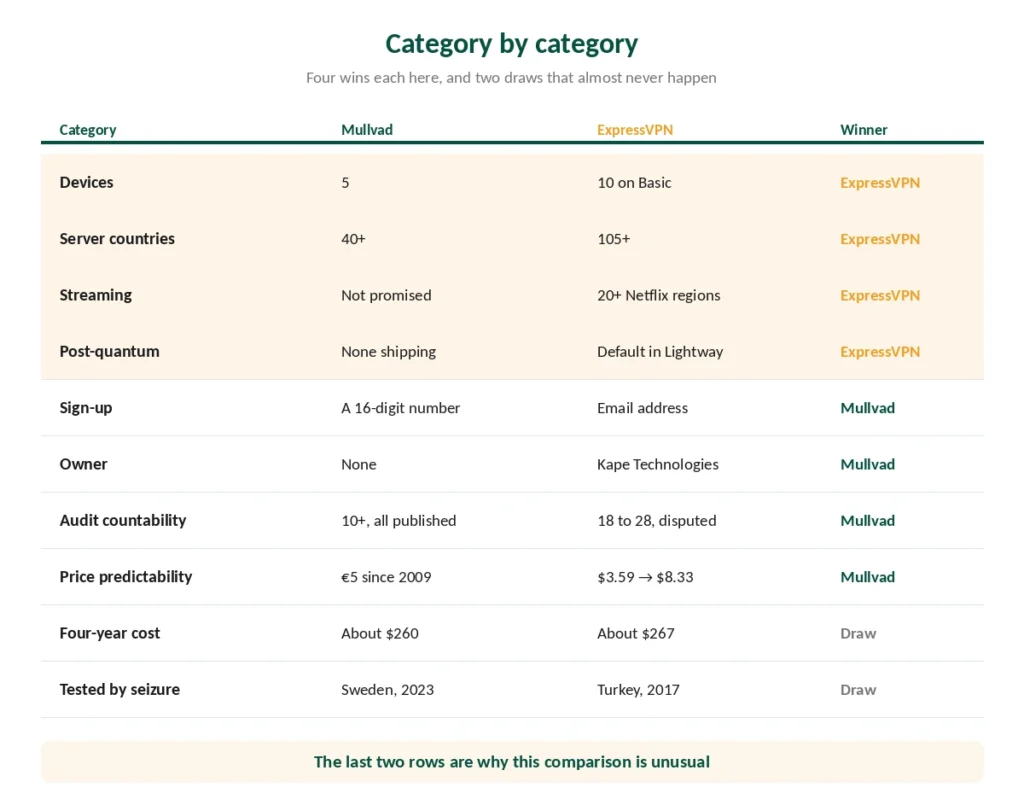
Winners by Category
| Category | Winner |
|---|---|
| Devices | ExpressVPN |
| Server coverage | ExpressVPN |
| Streaming and Smart DNS | ExpressVPN |
| Post-quantum encryption | ExpressVPN |
| Jurisdiction on paper | ExpressVPN |
| Anonymity from the provider | Mullvad |
| Corporate independence | Mullvad |
| Audit countability | Mullvad |
| Price predictability | Mullvad |
| Four-year cost | Draw — $7 apart |
| Tested by seizure | Draw — both, nothing found |
When to Choose Mullvad Instead
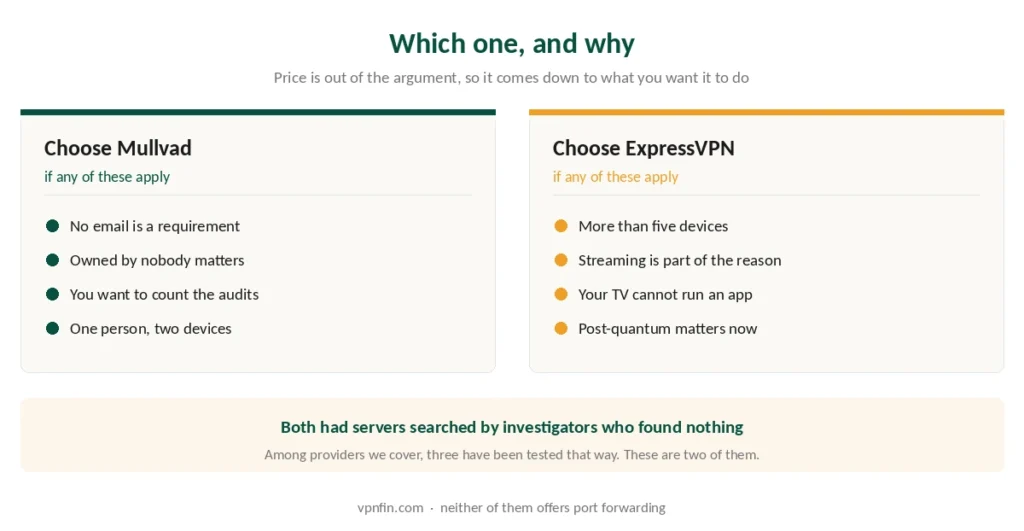
No email is a requirement rather than a preference. Nothing on ExpressVPN’s side addresses this.
You would rather not fund a three-brand group. Kape owns ExpressVPN, CyberGhost and PIA; Mullvad is owned by nobody.
You want to count the audits yourself. Ten reports you can open beat a total nobody agrees on.
You are one person with a phone and a laptop. Five devices stops being a limitation, and the price never moves.
How We Research
This comparison draws on our full reviews of both providers, where every figure was verified against named primary sources at the time of writing — Mullvad’s published Cure53 and Assured AB reports and contemporaneous coverage of the April 2023 police search, ExpressVPN’s published audit history and reporting on the 2017 Turkish server seizure, and each provider’s own checkout terms for pricing. We don’t run our own speed tests, and we have not restated any claim here that was not already sourced in those reviews. Where a figure is genuinely disputed, as ExpressVPN’s audit total is, we give the range rather than picking one. Our full approach lives on the About Us page.
Mullvad vs ExpressVPN FAQ
Neither, meaningfully. ExpressVPN comes to roughly $267 and Mullvad to about $260, a gap of seven dollars or fifteen cents a month. That is the closest pair we have calculated, which means price cannot decide this comparison the way it decides most others.
Yes, and both produced nothing. Turkish investigators seized an ExpressVPN server in 2017 during a criminal inquiry and recovered no usable data. Swedish police searched Mullvad’s offices with a warrant in April 2023 and left without taking anything, because no customer records existed.
ExpressVPN, though nobody agrees how many. Reviews published in 2026 credit it with anywhere from 18 to 28, since each source counts a different set of components. Mullvad has more than ten by Cure53 and Assured AB, and publishes every report in full.
ExpressVPN allows ten simultaneous connections on its Basic tier, with higher tiers raising the limit further. Mullvad allows five and sells no add-on. For a single user five is adequate; for a couple with phones, laptops and a tablet it is not.
Kape Technologies, which also owns CyberGhost and Private Internet Access — three of the providers we cover under one parent. Mullvad has no parent company, being owned by its Swedish operator and funded entirely by subscriptions.
The Verdict
ExpressVPN takes it, and the margin comes from capability rather than trust. Twice the devices, far wider coverage, streaming that works, Smart DNS for hardware that cannot run apps, and post-quantum encryption today.
Mullvad takes the two things that cannot be added later. It does not know who you are, and it does not answer to anyone. ExpressVPN could match every feature Mullvad has; it could not stop holding your email or stop being owned by Kape without becoming a different company.
And notice what price did not decide. Seven dollars across four years is the smallest gap we have found between two providers, which means the usual argument is unavailable and you have to choose on what you actually want. Against NordVPN, Mullvad makes the same case against a faster opponent.