
Disclosure: VPNFin is reader-supported. If you buy a VPN through links on this page, we may earn a commission at no extra cost to you. This never affects our ratings — here’s how we research.
The honest range is $2 to $13 a month, and where you land inside it depends almost entirely on how long a term you commit to rather than on what you get.
That much is easy to look up. The harder question is whether paying more buys you more, and we are in an unusual position to answer it: we have rated nine providers on the same five criteria and calculated what each costs across four years using the same method.
We compared the two columns. The correlation is 0.02 — which in practice means none. Providers costing more than average score 4.30; providers costing less score 4.25.
The Short Answer
Expect $2 to $3 a month on a two or three-year plan, and $10 to $13 if you pay monthly. That is the same product at both ends.
Then check the renewal figure, because the first-term price is not what you will pay for long — our renewal price table has all ten side by side.
Budget $150 to $340 across four years, which is where the real differences live.
And do not treat price as a quality signal. It is not one, and we have the numbers.
What You Actually Pay, by Term
The single biggest factor is commitment length, and the spread is larger than most people expect.
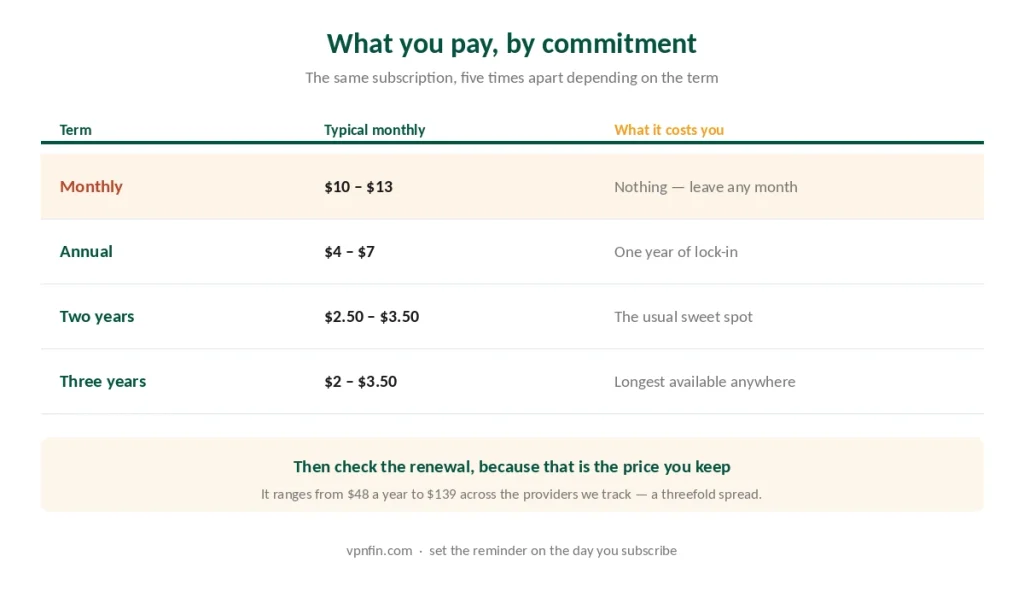
| Term | Typical monthly | What it costs you |
|---|---|---|
| Monthly | $10 – $13 | Freedom to leave any month |
| Annual | $4 – $7 | One year of lock-in |
| Two years | $2.50 – $3.50 | The usual sweet spot |
| Three years | $2 – $3.50 | Available at some providers |
The same subscription costs roughly five times more monthly than on a long plan. That is not a discount for volume in any meaningful sense — it is a customer-acquisition cost recovered later, which is why the renewal figure matters more than the headline. Month to month the ranking inverts entirely, and the provider that never discounts becomes the cheapest.
⚠️ A long plan holds the promotional rate for its full duration, which is the only legitimate way to keep it. The risk is committing to a provider you may want to leave.
The Comparison Nobody Publishes
Here is our full dataset. Four-year cost calculated as longest promotional term at the promotional rate, then standard renewal, to 48 months. Ratings are our own, averaged across five equally weighted criteria.
| Provider | Four years | Our rating |
|---|---|---|
| PureVPN | $148 | 4.1 |
| CyberGhost | $152 | 4.3 |
| TunnelBear | $160 | 4.0 |
| Surfshark | $205 | 4.6 |
| Proton VPN | $240 | 4.6 |
| Mullvad | $260 | 4.2 |
| ExpressVPN | $267 | 4.5 |
| Hotspot Shield | ~$325 | 3.4 |
| NordVPN | $335 | 4.8 |
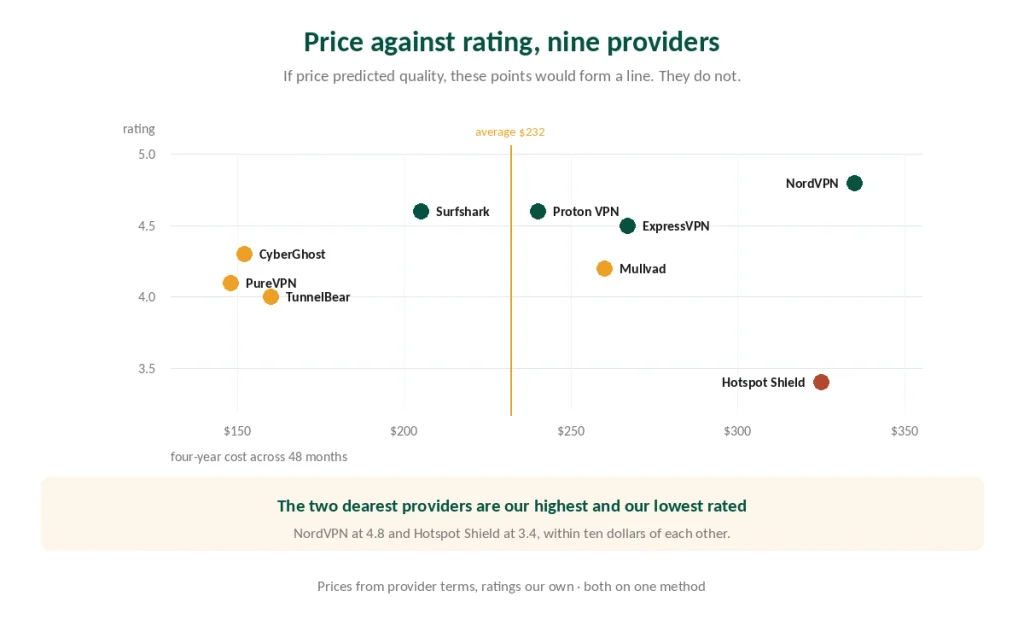
Read the last two rows together. They cost within ten dollars of each other across four years, and we rate one 4.8 and the other 3.4 — the widest gap in our rankings, at effectively the same price. Set the same provider against Surfshark and it is dearer while rating lower.
Now read the fourth row. Surfshark scores 4.6 at $205, matching Proton VPN at $240 and beating ExpressVPN at $267.
⚠️ The statistical result is 0.02, which is as close to no relationship as a small sample produces. Providers above the average price of $232 score 4.30 on average. Providers below it score 4.25.
Why Price and Quality Come Apart
Three reasons, and none of them is a scandal.
Price is set by marketing spend, not by cost of service. Bandwidth and servers cost roughly the same for everyone. What differs is how much a provider pays to acquire each subscriber — advertising, affiliate commissions, app store fees — and that is recovered through the renewal.
The expensive features are cheap to run. More servers, more devices, obfuscation modes: these cost engineering time once, not money per subscriber. A provider can add them without the price moving.
And the things that would justify a premium are not priced in. Published audits, RAM-only servers, a jurisdiction outside intelligence-sharing arrangements — the providers that have these do not systematically charge more for them. Mullvad costs $260 and never runs a discount; Hotspot Shield costs about the same with no no-logs audit at all.
What the Money Actually Buys
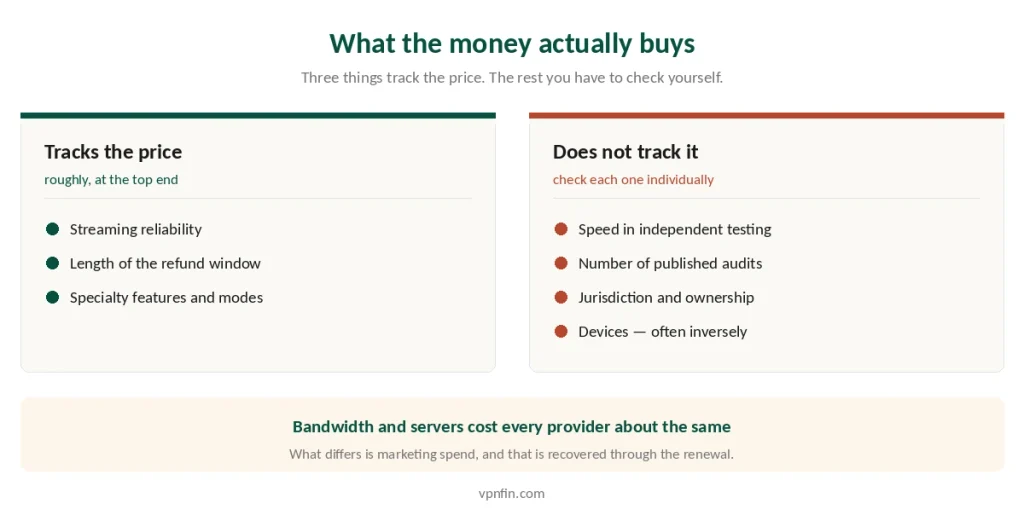
Since price does not track quality, here is what does vary with it.
Devices. From five at Mullvad to unlimited at Surfshark and TunnelBear, and the relationship to price is inverse rather than direct.
Streaming reliability. This one genuinely correlates with price at the top end, because maintaining working addresses costs ongoing effort.
Refund window. 30 days at most providers, 45 at CyberGhost and Hotspot Shield, and none at all at TunnelBear — which is the cheapest way to lose money in this category.
Nothing else reliably tracks the number. Speed does not. Audit count does not. Jurisdiction does not.
What Free Costs
A separate answer, and it is not zero.
Proton VPN’s free tier has no data cap, one device, ten countries the app assigns, and no streaming. It is the only free tier we recommend without qualification, and it exists because paid subscriptions fund it.
Most other free services are paid for in data. Hotspot Shield states in its own terms that location data from free users may be used for ad targeting, which is disclosed rather than hidden — and it means the tier is paid for in a currency other than money. Our free VPN guide covers which are safe.
⚠️ The gap between free and cheap is smaller than it looks. PureVPN across four years works out at about $3.08 a month, and CyberGhost at $3.17. For a coffee every six weeks you remove the entire question of how the free tier is funded.
How to Pay Less Without Getting Less
Four things, in order of effect.
Buy the longest term you are confident about. It is the only legitimate way to keep the promotional rate, and it accounts for most of the spread in this article.
Set a calendar reminder for the renewal date on the day you subscribe. Auto-renewal is on by default everywhere, and the charge arrives at a figure you last saw two years ago.
Cancel and resubscribe as a new customer when the term ends. Promotional pricing is for new subscriptions, providers know people do this, and none of them prevent it.
Use the refund window as a trial. Buy, run the five verification tests, test your own streaming services, and request the refund if it disappoints.
⚠️ What does not work is waiting for a better deal. Prices in this category move within a narrow band, and the difference between a good sale and an ordinary one is a few dollars across two years.
How We Research
Every price here comes from our own reviews and comparisons, where each figure was verified against the provider’s published terms at the time of writing and recorded with its source. We calculated the four-year totals ourselves on a single consistent basis: longest advertised term at the promotional rate, followed by standard renewal, to 48 months. Ratings are our own, averaged across five equally weighted criteria published on our About page. The correlation figure is our calculation across the nine providers listed, and a sample that size supports a direction rather than a precise coefficient. We don’t run our own speed tests. Our full approach lives on the About Us page.
VPN Cost FAQ
Between $2 and $13, and the difference is almost entirely term length rather than product. Two and three-year plans run $2 to $3.50 a month; annual plans $4 to $7; month-to-month $10 to $13. The same subscription costs roughly five times more if you pay monthly.
Not according to our own numbers. We compared four-year cost against our ratings across nine providers and found a correlation of 0.02. Providers costing above the $232 average score 4.30; those below score 4.25. The most expensive and the lowest-rated are within ten dollars of each other.
Renewal prices range from about $48 at PureVPN to $139 at NordVPN, which is a threefold spread. That figure matters more than the introductory rate, because it is what you pay for as long as you keep the subscription.
Often, yes. CyberGhost costs about $152 across four years and rates 4.3; Surfshark costs $205 and rates 4.6. Both sit below the category average price. What you should check is the renewal figure and the refund window rather than the headline rate.
Annually or longer, if you are reasonably sure. Monthly costs roughly five times more for the same product. The trade is commitment: a long plan holds the promotional rate throughout, which is the only legitimate way to keep it, but you are locked in.
The Verdict
Budget $2 to $3 a month on a long plan, and expect $150 to $340 across four years depending on which provider and which renewal.
Read the renewal figure before the advertised one. It is the price you will live with, and it varies by more than three times across the providers we track.
And stop using price as a shortcut for quality. We ran the numbers on nine providers and the relationship is 0.02. The most expensive and the lowest-rated cost within ten dollars of each other.
What price does buy is devices, streaming reliability and the length of your refund window. Everything else — speed, audits, jurisdiction, ownership — you have to check individually, which is what the rest of this site is for.