
Disclosure: VPNFin is reader-supported. If you buy a VPN through links on this page, we may earn a commission at no extra cost to you. This never affects our ratings — here’s our full disclosure.
Every free VPN pays for itself somehow. Usually the answer is advertising, a data cap, or an upgrade prompt.
Urban VPN’s answer was documented in December 2025 by researchers at Koi Security, and it is more specific than any of those: since a silent update in July, its browser extension had been capturing what users typed into ChatGPT, Claude, Gemini and five other AI assistants — along with the replies — and sending it to the data broker that owns the company.
What We Do Not Earn Here
We hold no affiliate relationship with Urban VPN and are not seeking one. Nothing on this page earns us anything from the service it reviews — the alternatives we name at the end are a different matter, and our disclosure covers them.
That is deliberate. A review whose subject is how a company monetises its users would be worth nothing if we were monetising them alongside it.
What the Researchers Found
The account below is Koi Security’s, published in December 2025 and reported by several security outlets. The company did not respond to a request for comment.
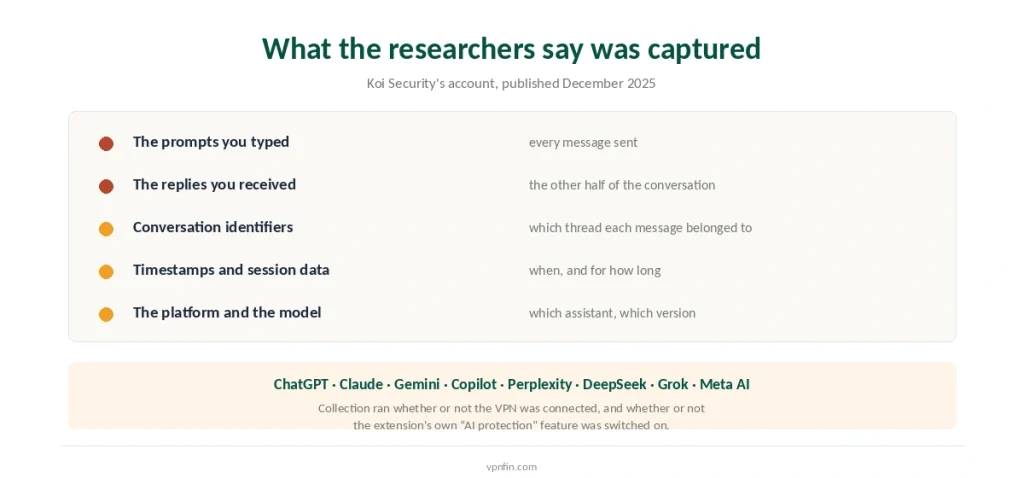
Version 5.5.0, released on 9 July 2025, introduced code that intercepts conversations on eight platforms: ChatGPT, Claude, Gemini, Microsoft Copilot, Perplexity, DeepSeek, Grok and Meta AI.
It captures both sides. Prompts and responses, plus conversation identifiers, timestamps, session metadata, and which platform and model were used.
It works by injecting a script into the page, so every network request and response passes through the extension’s code first.
⚠️ It runs whether or not the VPN is connected. The researchers found the collection operates independently of the VPN function and of the extension’s own privacy settings.
Existing users were not asked. Browser extensions update automatically, and anyone who had installed it before July received the new behaviour without a fresh consent prompt.
The Part That Is Hard to Read Charitably
One detail turns an unpleasant business model into something else.
The extension advertises an “AI protection” feature. It checks your prompts for personal data and warns you before you send them to an AI company.
The researchers found that feature runs separately from the harvesting. The warning appears; the conversation is exfiltrated regardless, including when the protection is switched off.
⚠️ Koi’s lead researcher put it plainly: the extension warns you about sharing your email with ChatGPT while sending your entire conversation to a data broker.
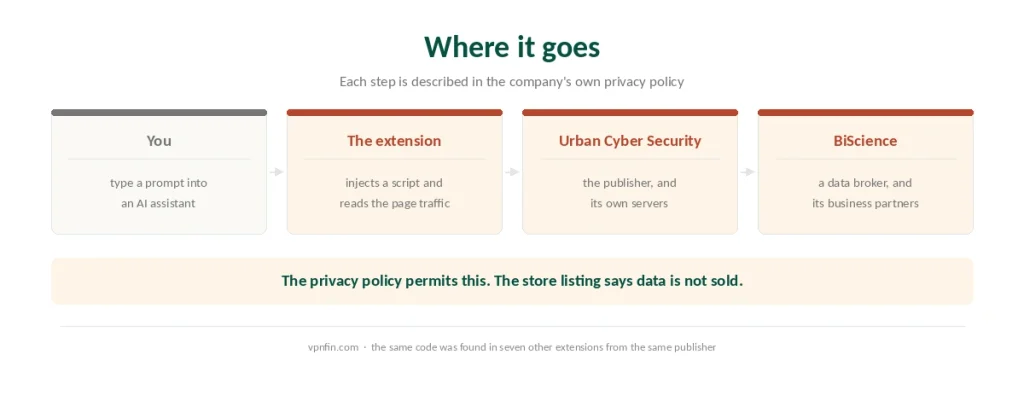
The store listing and the privacy policy do not agree either. The Chrome listing states that data is not sold to third parties. The privacy policy describes sharing browsing data with BiScience, with “Business Partners”, and for marketing analytics.
Who Owns It
Worth stating, because it explains everything above.
Urban VPN is operated by Urban Cyber Security Inc., affiliated with — and by some accounts owned by — BiScience, registered as B.I Science (2009) Ltd.
BiScience describes itself as a data broker. Independent researchers have previously documented its collection of re-identifiable clickstream data, monetised through products sold to advertisers and brand-monitoring clients.
⚠️ So the VPN is not a product with a data problem. It is a data collection channel with a VPN attached, which is a different thing — and ownership is the first question we ask about any provider for exactly this reason.
The same code was found in seven other extensions from the same publisher, across Chrome and Edge, with a combined user base above eight million.
The Network Itself
Separate from the extension, and troubling on its own terms.
Free users do not connect to company servers. Urban VPN runs a peer-to-peer network: your traffic routes through another user’s device, and theirs routes through yours.
Your address becomes a shared resource. Whatever a stranger does through your connection appears to originate from you — the same arrangement Hola sold commercially, and the reason that model keeps resurfacing.
The browser extensions do not encrypt. Reviewers describe them as proxies rather than VPNs — a distinction worth understanding, and one the marketing does not make.
⚠️ Paying removes both problems. The Premium tier uses dedicated servers instead of the peer network and lets you opt out of data collection. That is the clearest possible statement of what the free tier is: the data collection is the product, and the subscription is how you leave it.
Everything Else, Briefly
No independent audit, of the privacy policy or anything else — and what an audit is actually worth is a low bar this does not clear.
No kill switch on the free tier, no RAM-only infrastructure, no private DNS.
Streaming mostly fails. Reviewers report Netflix, Prime Video and Hulu blocking it, with Disney+ and Max working sometimes.
Free on desktop with no data cap, capped at roughly 100 MB a day on Android, and paid-only on iOS.
No account required, which is the one genuinely user-friendly decision in the product.
⚠️ It carries Google’s “Featured” badge on the Chrome Web Store, and the researchers chose not to report it to Google because the behaviour arguably falls inside the platform’s stated policies. That is a statement about the policies as much as about the extension.
What to Do If You Have It Installed
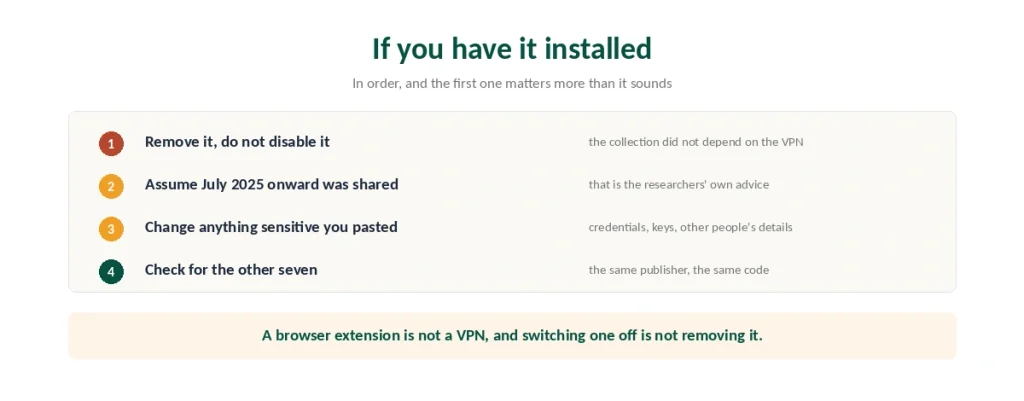
Remove the extension rather than disabling it — switching a browser extension off is not the same as removing it. The collection the researchers describe does not depend on the VPN being connected.
Assume anything you typed into an AI assistant since July 2025 has been shared, if the extension was installed during that period. That is the researchers’ own recommendation.
Change anything sensitive you pasted into a chatbot. Credentials, keys, personal details of other people.
Then check what else is installed. Seven other extensions from the same publisher carried the same code — and a browser extension is not a VPN in the first place.
What to Use Instead
Proton VPN has the free tier we recommend most. Unlimited data, five audits published in full, and a non-profit foundation in control.
PrivadoVPN gives ten gigabytes with server choice, which is more generous in the ways that matter for a specific task, though it has never been audited either.
Hide.me asks for no email and no card, and holds a 2024 audit.
⚠️ All three are funded by paying customers rather than by their free users. That distinction is the whole of free VPN safety, and it is checkable before you install anything.
How We Research
This review draws on Koi Security’s December 2025 report for the technical findings, the version number and date, the list of eight affected AI platforms and the behaviour of the “AI protection” feature, and on Infosecurity Magazine, Dark Reading, TechRadar, The Hacker News, Malwarebytes, CSO Online and Inc. for independent coverage of it. We checked that report against those outlets before using it, because a single source making specific allegations about a named company is exactly the pattern we decline to repeat elsewhere. BiScience did not respond to Dark Reading’s request for comment, and we have described the findings as the researchers’ account throughout. Product details come from Gizmodo, Security.org, vpnMentor, VPNOverview and SafetyDetectives — the last of which discloses that it is co-owned with companies it lists. We do not run our own tests. Our method lives on the About Us page.
Urban VPN FAQ
Researchers at Koi Security reported in December 2025 that its browser extension had been capturing conversations with eight AI assistants since a July update and sending them to an affiliated data broker. Its free tier also routes traffic through other users’ devices rather than company servers.
According to the researchers’ report, yes — prompts and responses from ChatGPT, Claude, Gemini, Microsoft Copilot, Perplexity, DeepSeek, Grok and Meta AI, together with session metadata. The behaviour was introduced in version 5.5.0 on 9 July 2025 and enabled by default. The company did not respond to press requests for comment.
Through data. Its privacy policy permits sharing browsing information with BiScience, the affiliated data broker, and with business partners for marketing analytics. The paid tier removes both the data collection and the peer-to-peer routing, which describes the free product accurately.
One with no servers of its own. Your traffic routes through another user’s device and theirs routes through yours, which means your address is used by strangers and theirs by you. Anything they do through your connection appears to come from you.
Remove it rather than disabling it, since the reported collection does not depend on the VPN being connected. Assume anything typed into an AI assistant while it was installed has been shared, and change any credentials or sensitive details you pasted into a chatbot.
Urban VPN
Summary
Genuinely free, genuinely easy, and no account required. Against that: a peer-to-peer network that makes your address an exit node for strangers, browser extensions that proxy rather than encrypt, a privacy policy permitting data sharing with an affiliated broker, no independent audit, and a documented 2025 case of AI conversation harvesting enabled by silent update.
Final Verdict
This is the lowest score we have given, and the reasoning is not the price. Free tiers can be honest; three of the ones we recommend are.
It is that the product and the data collection are the same thing. The peer network turns your connection into somebody else’s exit node, the extension captured what people typed into AI assistants, and the company that receives it describes itself as a data broker.
And the feature that warned users about sharing data with AI companies ran alongside the code sending it. Whatever the privacy policy permits, that combination is the reason this page exists.