
Disclosure: VPNFin is reader-supported. If you buy a VPN through links on this page, we may earn a commission at no extra cost to you. This never affects our ratings — here’s our full disclosure.
Almost every review of this provider published in 2026 calls it Swiss. So does one of the pages on its own website.
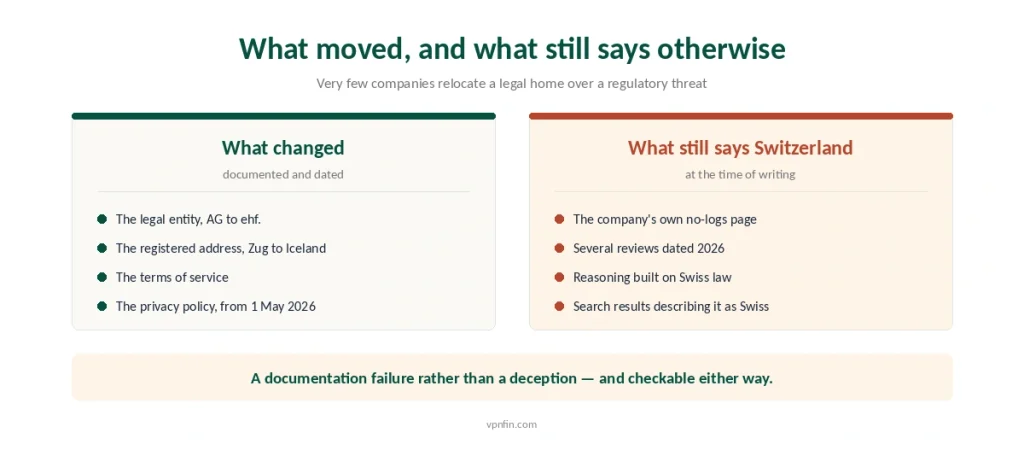
It is not. Privado Networks AG of Zug has been replaced by Privado Networks ehf., headquartered near Reykjavík, and the privacy policy naming the Icelandic entity took effect on 1 May 2026.
Is PrivadoVPN Any Good?
The free tier is the best we have examined. Ten gigabytes a month, thirteen locations you choose yourself, a kill switch, split tunnelling, an ad blocker and P2P permitted — none of which is normal at zero cost.
The paid plan is among the cheapest that is not disreputable, at roughly $1.11 to $1.99 a month on the two-year term with ten simultaneous connections.
⚠️ And it has never been audited. Six years of operation, no published no-logs report, no transparency report, no warrant canary, and no court test. That single gap defines the service.
The Move Nobody Reported Properly
Worth starting here, because it is the most important fact about the company and the one most often stated wrongly.
Switzerland proposed extending surveillance duties to VPN providers. We covered that proposal in full: identification of users, six months of retention, decryption on request where keys are held.
PrivadoVPN did not wait for the outcome. It relocated its legal home to Iceland, replaced the Swiss company with an Icelandic one, and updated its terms of service to match.
That deserves credit. Proton said it would leave and began moving infrastructure. PrivadoVPN completed the corporate move. Very few companies in any industry change jurisdiction over a regulatory threat.
⚠️ Its own no-logs page still describes Swiss law. The marketing page explaining why your data is safe cites a jurisdiction the company has left. That is a documentation failure rather than a deception, and it is exactly the sort of thing a reader should be able to check before trusting a privacy claim.
Most published reviews are stale on this. Several dated 2026 still place the company in Zug and reason from Swiss data protection law throughout.
The Free Tier, Which Is Genuinely Unusual
This is the part worth the page for most readers.
Ten gigabytes every thirty days, on the same infrastructure paid customers use, with no protocol throttling below the cap.
Thirteen locations you pick yourself, including the United States, the United Kingdom, Brazil and Argentina.
P2P traffic is not blocked, which is close to unheard of on a free plan.
The kill switch, split tunnelling and the DNS blocker are all included, rather than held back as upgrade bait.
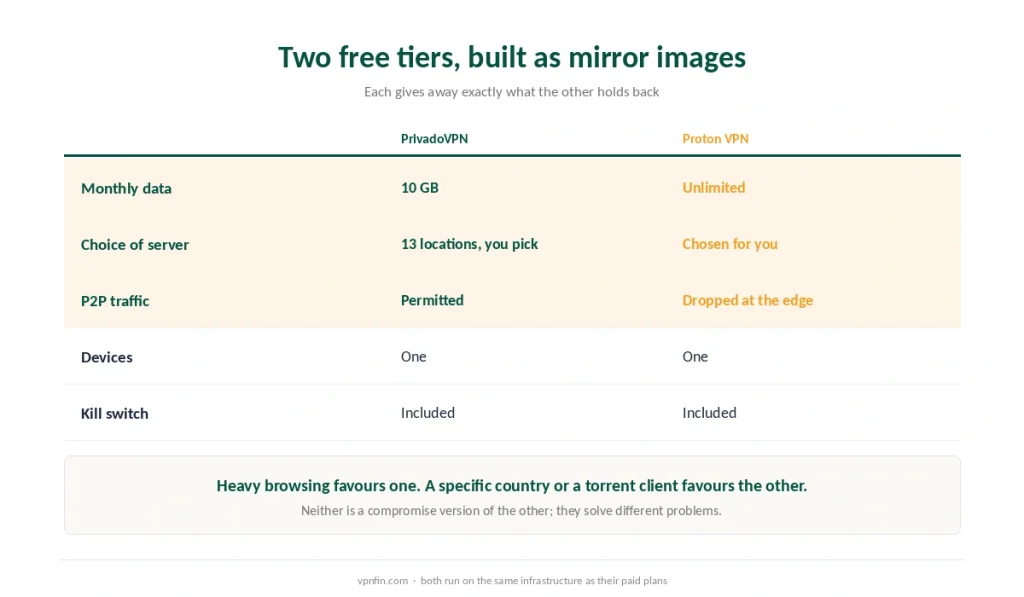
⚠️ Compare that with Proton VPN’s free tier and the design is a mirror image. Proton gives unlimited data but chooses your server for you and drops P2P at the network edge. Privado caps the data and gives you everything else.
Which is better depends entirely on what you are doing. Heavy browsing favours Proton; a specific country or a torrent client favours Privado — and our free VPN guide names three services as safe, a list this one has a reasonable claim to join.
The Gap That Defines It
Everything above is undercut by one absence.
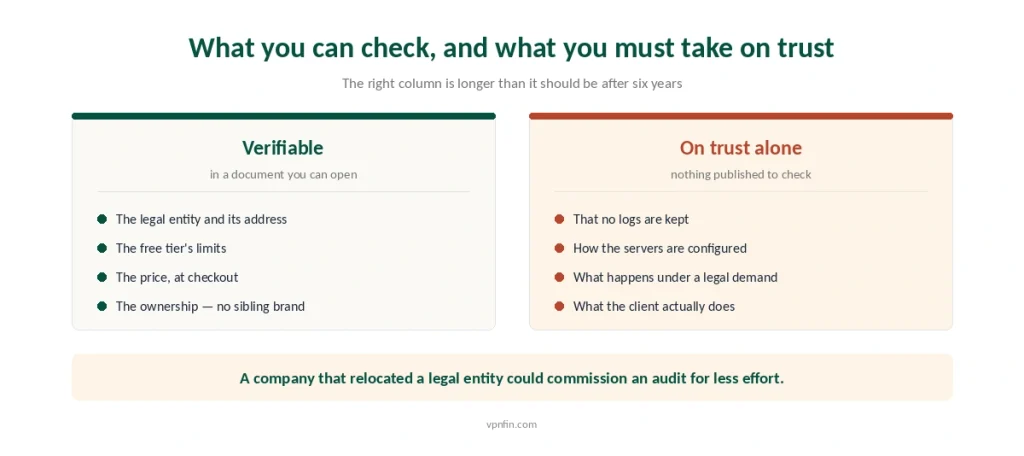
No independent no-logs audit exists, in six years of operation. Not a limited one, not an old one.
No transparency report and no warrant canary. Both are cheap to publish and both are missing.
No documented court test. Unlike the providers that have actually been asked, nothing here has been demonstrated under pressure.
The clients are closed source, and reporting describes the servers as conventional rather than RAM-only.
⚠️ So the entire privacy case rests on a jurisdiction and a policy document. Iceland is a genuinely good jurisdiction — outside the intelligence-sharing arrangements and outside EU retention rules — but a jurisdiction is a policy that governments rewrite, as this company knows better than most.
| Provider | No-logs audits | Auditor | Jurisdiction |
|---|---|---|---|
| NordVPN | 6 | PwC, Deloitte | Panama |
| Surfshark | 2 | Deloitte | Netherlands (9 Eyes) |
| ExpressVPN | 3 | KPMG | British Virgin Islands, Kape-owned |
| CyberGhost | 3 | Deloitte | Romania, Kape-owned |
| PureVPN | 4 | KPMG | BVI, operated from Pakistan |
| IPVanish | 2 | Leviathan, Schellman | United States (Five Eyes), Ziff Davis-owned |
| Windscribe | 1 | Packetlabs, production infrastructure | Canada (Five Eyes); Greek case dismissed, no data to give |
| Proton VPN | 5 | Securitum | Switzerland, moving infrastructure to EU |
| Private Internet Access | 3 | Deloitte | United States (Five Eyes), Kape-owned |
| Mullvad | 10+ | Cure53, Assured AB | Sweden (14 Eyes) |
| TunnelBear | Annual since 2017 | Cure53 | Canada (Five Eyes), US parent |
| Norton VPN | 2 | VerSprite | United States (Five Eyes) |
| Hotspot Shield | 0 | protocol audited, policy not | United States (Five Eyes) |
| AirVPN | 0 | none — the client is open source instead | Italy (14 Eyes) |
| IVPN | 8, annual since inception | Cure53 | Gibraltar (status disputed) |
| Hide.me | 1 modern, in 2024 | Securitum, though one source names Altius IT | Malaysia (outside the alliances) |
| PrivadoVPN | 0 | none in six years of operation | Iceland (moved from Switzerland, 2026) |
| TorGuard | 0 | none; settled a lawsuit without disclosing records | United States (Five Eyes) |
| FastestVPN | 1, in 2023 | Altius IT | Cayman Islands (outside the alliances) |
| StrongVPN | 0 | none in over two decades | United States (Five Eyes), Ziff Davis-owned |
| VyprVPN | 1, in 2018 | Leviathan Security, before the 2023 sale | United States (Five Eyes), Certida-owned since 2023 |
| PrivateVPN | 0 | none; support says there is nothing to audit | Sweden (14 Eyes), ownership disputed |
| ZoogVPN | 0 | none; support describes one as planned | Greece (outside the alliances), run from Ukraine |
What It Costs
Around $1.11 a month on the two-year plan, though published figures vary.
⚠️ Sources disagree. The same plan is reported at $1.11 and at $1.99 by different reviewers in the same year. Check the checkout page — renewal pricing is where this category hides its real numbers.
The monthly plan runs $10.99, which is the usual penalty for not committing.
Ten simultaneous connections and a thirty-day refund window.
Everything Else, Briefly
Protocols: WireGuard, OpenVPN and IKEv2, with AES-256 and an obfuscation mode for restrictive networks.
Features: per-app kill switch, SmartRoute split tunnelling, the Control Tower DNS blocker, SOCKS5 proxy support and browser extensions.
Network: reported at 1,600 or more servers across 66 countries, which is mid-sized.
Streaming: described consistently as reliable with Netflix, which is not something we say often about budget providers — our streaming guide treats access as a moving target regardless.
Who It Is For
Take the free tier if you want a specific country or a torrent client, and accept the ten-gigabyte ceiling.
Take the paid plan if price is the deciding factor and your threat model is casual: public networks, geo-restrictions, an internet provider you would rather not inform.
Look elsewhere if you need verification. Mullvad publishes audits annually and had police leave empty-handed; IVPN publishes eight consecutive Cure53 reports. Both cost more and both can show their work.
⚠️ Ownership is clean, at least. It belongs to no conglomerate — unlike most of the market — and has no sibling brand competing for the same customer.
How We Research
This review draws on VPNCompare and VPN Scorecard for the relocation to Iceland, the replacement of Privado Networks AG by Privado Networks ehf. and the privacy policy effective 1 May 2026, on VPN Scorecard’s source list for the observation that the company’s own no-logs page still references Switzerland, on VPNRating for the free tier’s infrastructure and its contrast with Proton VPN’s restrictions, on vpn.com, Security.org, vpnMentor and VPNOverview for pricing, protocols and feature detail, and on our own tables for the comparison figures. Several of those sources still describe the company as Swiss, which is why we checked the jurisdiction against the terms of service rather than against the reviews. Every one of them earns commissions from providers they name. We do not run our own tests. Our method lives on the About Us page.
PrivadoVPN FAQ
No. It relocated its legal home to Iceland in early 2026, replacing Privado Networks AG of Zug with Privado Networks ehf. near Reykjavík, and its privacy policy naming the Icelandic entity took effect on 1 May 2026. Many published reviews, and one of the company’s own pages, still describe it as Swiss.
It is the most generous we have examined. Ten gigabytes a month, thirteen user-selectable locations, a kill switch, split tunnelling, an ad blocker and permitted P2P traffic. Proton VPN’s free tier offers unlimited data instead but chooses your server and blocks P2P entirely.
No. In six years of operation it has published no independent no-logs audit, no transparency report and no warrant canary, and no court case has tested the claim. The privacy case rests entirely on the jurisdiction and the written policy.
Published figures for the two-year plan vary between $1.11 and $1.99 a month depending on the source, with a monthly plan at $10.99. It allows ten simultaneous connections and offers a thirty-day money-back guarantee.
It sits outside the Five, Nine and Fourteen Eyes arrangements and outside EU data retention rules, which makes it a strong answer on paper. As Switzerland demonstrated, a jurisdiction is a policy rather than a permanent property, which is why we weight audits above flags.
PrivadoVPN
Summary
A ten-gigabyte free tier with user-selectable servers and permitted P2P, a paid plan among the cheapest that is not disreputable, and a company that relocated to Iceland rather than accept a proposed surveillance law. Against that: no audit in six years, no transparency report, no warrant canary, no court test and closed-source clients.
Final Verdict
PrivadoVPN did the thing the industry only talks about. Faced with a proposed surveillance law, it moved its legal home rather than issuing a statement, and Iceland is a better answer than the one it left.
Its free tier is the most generous we have examined, and the design choices behind it are deliberate rather than accidental.
And it still cannot show you anything. Six years, no audit, no transparency report, no canary, no court record. A company that relocated a legal entity over a privacy principle could commission an audit for a fraction of that effort, and has not.