
Disclosure: VPNFin is reader-supported. If you buy a VPN through links on this page, we may earn a commission at no extra cost to you. This never affects our ratings — here’s our full disclosure.
People search for what Reddit thinks about free VPNs because they don’t trust review sites. That is a reasonable instinct, and we say so as a review site that earns commission.
Here is what that community actually concluded, based on published analyses of its discussions: three free VPNs get a pass, everything else gets suspicion, and the most common advice once a thread gets going is not to use a free VPN at all — but to spend two or three dollars a month instead. This guide covers the shortlist, the evidence behind the warnings, and why the paid alternative costs less than it looks.
The Short Answer
Proton VPN Free is the consensus pick — unlimited data, verified no-logs, run by the Swiss company behind Proton Mail. Even privacy hardliners give it a pass. It’s also the only free option that works on a Firestick, and only on older models.
Windscribe Free is the alternative for occasional use — 10 GB a month across servers in 10 countries.
hide.me Free is the lesser-known third option that the community treats as legitimate.
Everything else is treated with suspicion, and the data supports that.
The Rule That Separates Safe From Dangerous
There is one principle underneath the community’s shortlist, and it works better than any list.
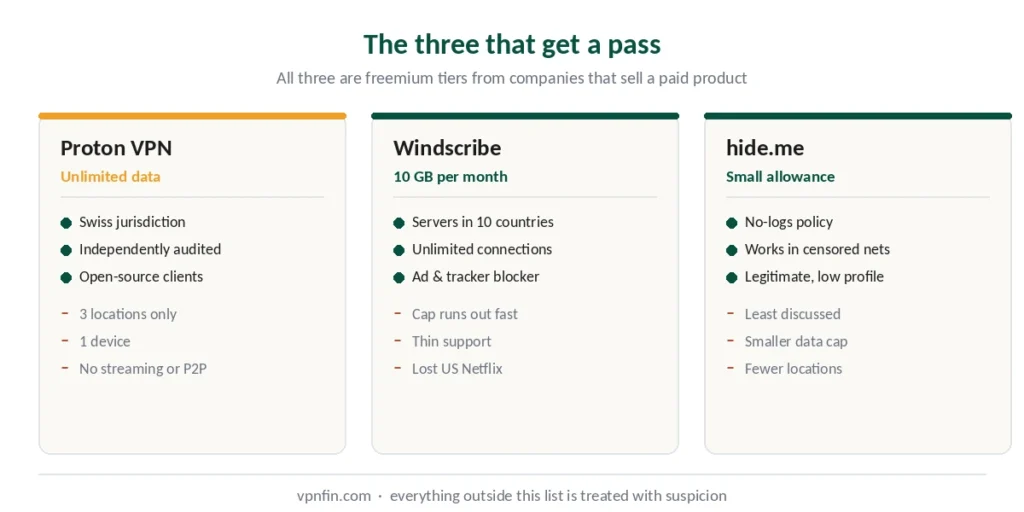
Safe free VPNs are freemium tiers from companies that sell a paid product. Proton, Windscribe and hide.me all make money from subscriptions. The free tier is a demonstration — deliberately limited to make you upgrade. Their business model does not depend on you.
Standalone “100% free” apps have to make money somehow, and there is no subscription revenue to do it. That leaves advertising, data brokerage, or worse. In India the calculation is worse still, because regulation there specifically rewards keeping logs.
⚠️ Browser extensions make the trade easier to see. A free proxy add-on needs permission to read and change your data on every site you visit, which you can check yourself before installing — and check again on anything already there. Some of these networks go further and route paying customers’ traffic through their free users’ machines.
Apply that rule to any free VPN you encounter and you will get the right answer most of the time without needing anyone’s recommendation. The same arithmetic breaks lifetime deals, where the payment happens once but the costs never stop.
The Evidence Behind the Warnings
Two numbers give the warnings substance.
84% of free VPNs leak user data in some form, according to published studies, and many contain some variety of malware. Documented incidents show what that looks like in practice: 1.2 terabytes in 2020, 360 million records in 2023, and AI conversations harvested through a browser extension in 2025. That figure covers the free VPN market broadly rather than the three reputable options above — which is exactly why the distinction matters.
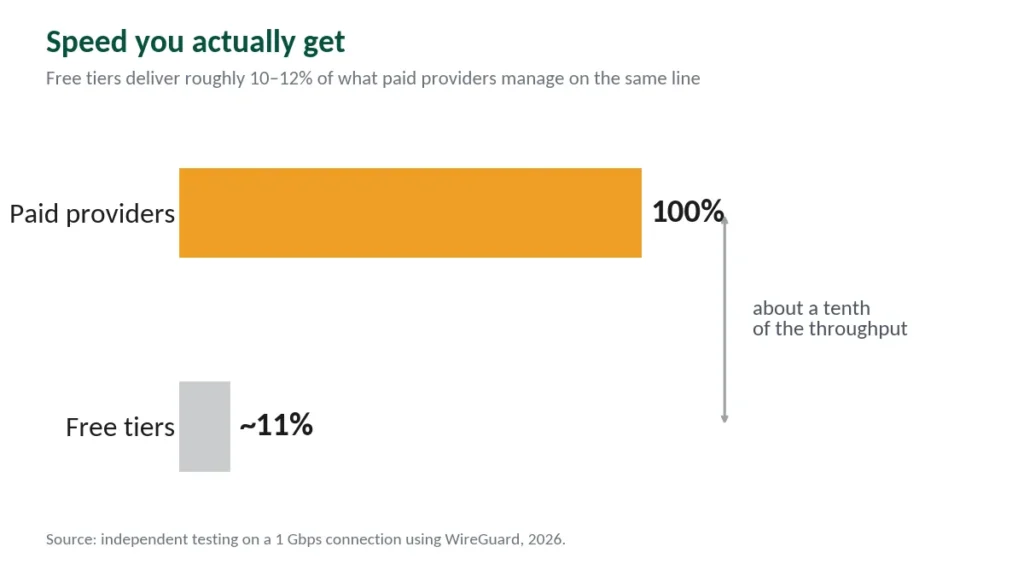
Free tiers deliver roughly 10–12% of the speed that premium paid services achieve on the same connection, in independent testing on a 1 Gbps line. Not 10% slower. About a tenth of the throughput.
The second number is not a safety issue. It is the reason most people who try a free VPN stop using it within a fortnight.
What the Three Approved Options Actually Give You
Proton VPN Free
The only free VPN with unlimited data, which is genuinely rare. Swiss jurisdiction, independently audited, open-source clients — the reasons the privacy-focused corners of the internet tolerate it. Our full Proton VPN review covers the five published audits and what the paid tier adds.
The limits: servers in ten countries that the app assigns rather than lets you pick, one device, no streaming, no P2P, and noticeably slow at peak hours. Japan is among them, but a free tier won’t unblock anything there — our Japan guide explains why free ranges get flagged fastest. It’s also the free tier worth knowing about on ChromeOS, with the same limits.
Windscribe Free
10 GB a month after email confirmation, servers in 10 countries, and unlimited simultaneous connections — more generous than Proton on devices, less generous on data.
Includes R.O.B.E.R.T., a customisable domain and IP blocker for ads and trackers. The limits: the data cap disappears quickly, support is thin, and it lost US Netflix access. Our full Windscribe review covers the paid tiers, including a pricing model where you buy countries individually. Against NordVPN the free tier is its clearest advantage.
hide.me Free
The least discussed of the three and the one most often described as a legitimate option that nobody talks about. No-logs policy audited in 2024, useful in censored networks, and no email or card at signup. Its data allowance is the one figure nobody can agree on — recent sources give 10 GB a month and unlimited, and we could not settle it. A fourth candidate has since appeared: PrivadoVPN gives 10 GB with server choice and permitted P2P, though it has never been audited. A fourth provider passes the same rule without appearing on the shortlist: TunnelBear gives 2 GB a month with no card, funded by its paid tier in exactly the way the rule describes.
Britain showed in one afternoon what happens when this page is not read. Hours after a new law took effect in July 2025, half the ten most downloaded free apps in the country were VPNs — and only the one at the top of that chart belongs on this list.
What No Free VPN Will Do
Four things, and they apply to all three of the above. A fourth free tier exists and is deliberately absent from that list: Hotspot Shield’s is usable, but location data from its free users may be used for ad targeting.
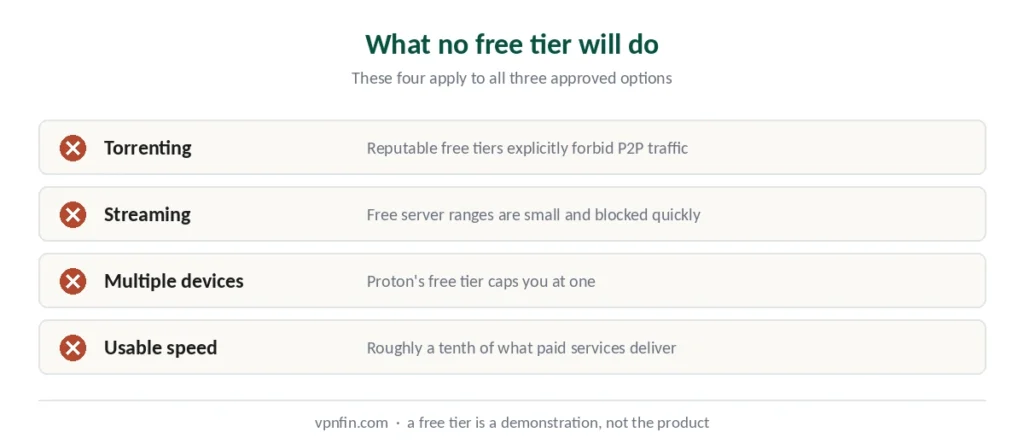
Torrenting. Free tiers from reputable providers explicitly forbid P2P. Attempting it on a less reputable free service is worse — those are the ones most likely to log your IP address. Our torrenting guide covers what to look for instead.
Streaming. Netflix, Disney+ and the rest detect and block free VPN server ranges quickly, because those ranges are small and heavily used. Working around this is a paid feature almost everywhere — our streaming guide covers which providers do it reliably.
Multiple devices, at least with Proton, which caps the free tier at one.
Speed you would choose. At a tenth of paid throughput, large downloads and video calls become an exercise in patience.
The Advice Threads Actually End On
Read past the first few replies in any of these discussions and the recommendation shifts. The pattern published analyses describe: use Proton Free if you genuinely cannot pay, but if you can spare two or three dollars a month, buy a proper subscription instead.
The maths supports it. A two-year plan from a mainstream provider runs about $2.15 to $2.49 a month — our cheap VPN guide breaks down what each actually costs over four years including renewals. For roughly the price of a coffee per month you get full speed, every server, streaming that works, P2P allowed, and a policy that has been audited.
Against a free tier at a tenth of the speed with three locations and no streaming, that is not a close comparison.
Try Paid Without Paying
If the objection to a paid VPN is committing money to something untested, there are two ways around it that do not involve a free tier.
A no-card trial. CyberGhost gives 24 hours on Windows and macOS, three days on Android and seven on iOS, with no payment details entered at any point — full product, every server, no restrictions. Among the providers we rank, it is the one offering a no-card trial of the full paid product.
A refund window. Every provider we cover offers at least 30 days, and CyberGhost gives 45 on longer plans. Buy, use the real product for a month, request the refund if it disappoints. Our free trial guide covers the three conditions that determine whether you get your money back.
Both give you the full product rather than a demonstration of it.
How We Research
This guide draws on published analyses of community discussions from named sources including ZeroToVPN, VPN Tier Lists and iplocation.net, alongside independent testing from TechRadar and Top10VPN and our own full reviews of the providers we rank — cross-checked and verified at publication. We do not quote individual Reddit posts or claim to speak for that community; we report what published summaries of it describe. We also do not run our own speed tests. Our full approach lives on the About Us page.
Free VPN FAQ
Published analyses of those discussions consistently identify three: Proton VPN Free as the main pick for its unlimited data and Swiss jurisdiction, Windscribe Free for occasional use with 10 GB a month, and hide.me Free as a legitimate lesser-known option. Everything outside that shortlist is treated with suspicion.
The three above are, because they are freemium tiers from companies that sell paid subscriptions. The broader free VPN market is not — studies have found 84% leak user data in some form, and many contain malware. The rule that works: if a provider has no paid product, ask how it makes money.
Independent testing puts free tiers at roughly 10–12% of the speed premium paid services achieve on the same connection. Free servers are few, heavily shared, and deliberately deprioritised — providers limit them to encourage upgrades. It is a business decision rather than a technical limit.
No. Reputable free tiers explicitly forbid P2P traffic, and attempting it on a less reputable free service is worse, since those are the most likely to log your IP address. Torrenting requires a paid provider that permits P2P.
Almost never. Streaming platforms detect and block free VPN server ranges quickly because those ranges are small and heavily used. Windscribe unblocks more than most free options but has lost US Netflix access. Reliable unblocking is a paid feature.
For basic private browsing, yes — it is the free tier with unlimited data and it is independently audited. The limits are real though: ten countries you don’t get to choose between, one device, no streaming, no P2P, and slow speeds at peak times. If any of those matter to you, a cheap paid plan costs about $2–3 a month.
The Uncomfortable Version
Reddit’s shortlist is real and it is short: Proton VPN Free, Windscribe Free, hide.me Free. Those three are safe, and if paying is genuinely not an option, Proton is the one to take.
But the honest summary of what those threads conclude is that a free VPN is a compromise everyone involved recognises as a compromise. A tenth of the speed, a handful of servers, no streaming, no torrenting, and for the free tiers outside that shortlist, an 84% chance of leaking something.
We sell subscriptions and we would say that anyway. The difference is that the community with no commercial interest arrived at the same conclusion first.