
Disclosure: VPNFin is reader-supported. If you buy a VPN through links on this page, we may earn a commission at no extra cost to you. This never affects our ratings — here’s our full disclosure.
Obfuscation makes VPN traffic look like ordinary web traffic, so that systems inspecting the connection cannot tell a tunnel is there.
It does not make the tunnel more private. Encryption already covers the contents; obfuscation covers the fact that encryption is happening. That distinction decides whether you need it, and most people do not.
What It Actually Solves
Networks that block VPN traffic by recognising it. Deep packet inspection identifies the handshake patterns of standard protocols and refuses the connection — corporate networks, university networks, some hotel systems and some national filters all do this.
Providers that throttle VPN traffic specifically. If a connection is only slow when the tunnel is up, that is the shape of the problem.
Nothing else. One published guide states it plainly: obfuscation exists to keep a connection available, not to make it safer.
⚠️ It is explicitly not for streaming. Platforms identify VPNs by looking up addresses in databases of known datacentre ranges, not by inspecting packets. Obfuscation does nothing about that and costs you speed for the privilege.
The Two Architectures
Almost every implementation is one of two things, and the difference is more interesting than the branding.
Wrapping. The VPN session is placed inside something ordinary-looking — usually a TLS connection over port 443, the same port and protocol as every HTTPS website. An inspection system sees TLS and stops looking.
Modifying. The protocol itself is altered so its distinctive patterns disappear, rather than being hidden inside another layer.
⚠️ The five largest providers use wrapping. As of 2026, none of NordVPN, Proton VPN, Mullvad, ExpressVPN or Surfshark has adopted the modified-protocol approach, which is available mainly through smaller services.
What Each Provider Calls It
The names are all different and the mechanisms mostly are not.
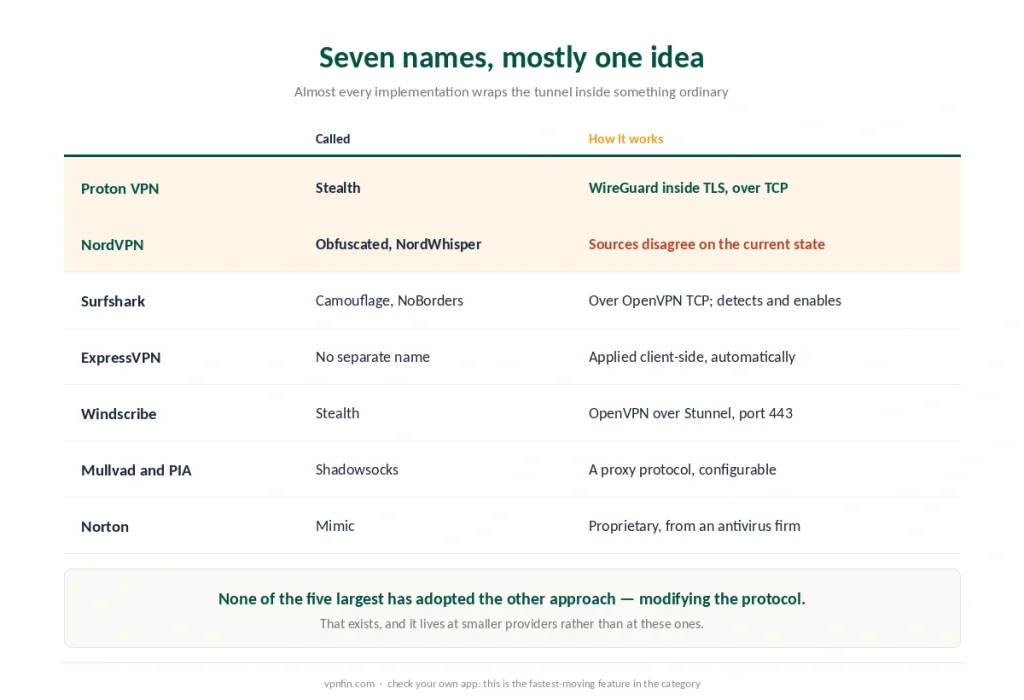
Proton VPN — Stealth. A WireGuard session wrapped in an obfuscated TLS connection over TCP, which is the most widely available commercial implementation of WireGuard-based obfuscation. Documented for Windows, macOS, Android, iOS and Android TV; Linux support was on the 2026 roadmap and had not shipped.
NordVPN — obfuscated servers, and now NordWhisper. Reporting describes the company moving obfuscation off OpenVPN onto its own protocol during 2026, citing speed and coverage.
⚠️ Sources contradict each other on the current state. Some describe the obfuscated-server toggle as available only when OpenVPN is selected and hidden under NordLynx; others describe the move to NordWhisper as complete. Check the app rather than any guide, ours included.
Surfshark — Camouflage and NoBorders. Two things: obfuscation applied over OpenVPN TCP, and a mode that detects a restricted network and enables itself. The automatic behaviour is the right default for anyone who does not know what this feature is.
ExpressVPN — automatic, with no separate list. Obfuscation is applied client-side when needed rather than through a stealth server category.
Windscribe — Stealth, and unusually well documented. OpenVPN over Stunnel on port 443, described in the company’s knowledge base in more detail than anyone else offers, and available on free accounts as well as paid.
Mullvad and Private Internet Access — Shadowsocks. An open proxy protocol built for this purpose, offered as a configurable option rather than a headline feature.
Norton — Mimic. A proprietary protocol, which is unusual for a company better known for antivirus.
The Part Nobody Can Verify
Here is the honest problem with this entire category.
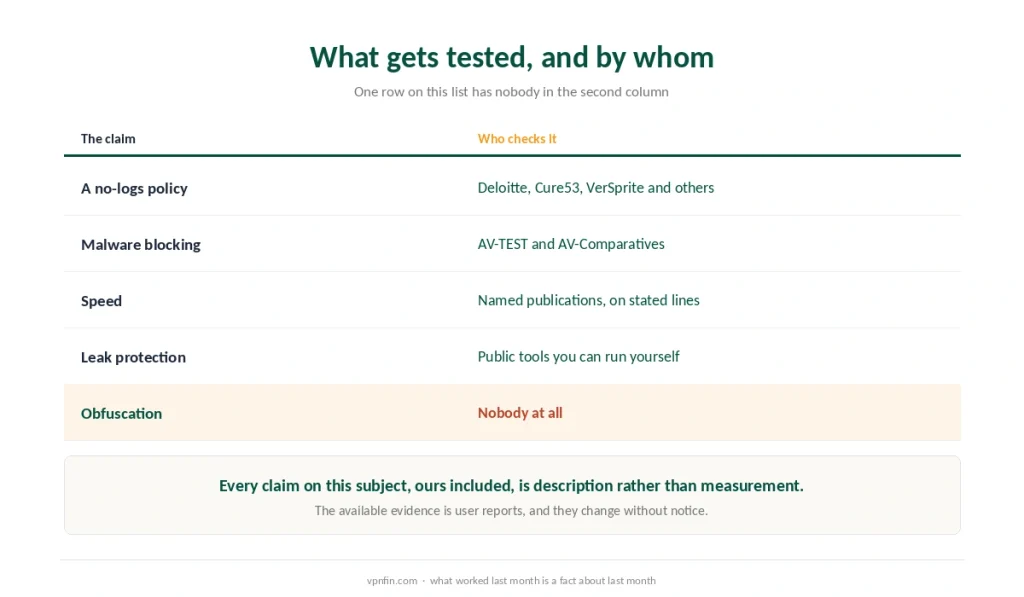
No independent laboratory tests obfuscation. Audits examine logging practices. AV-TEST and AV-Comparatives measure malware detection. Published speed testing measures throughput. Nothing measures whether a stealth protocol survives a given inspection system.
The available evidence is user reports from the places where it matters, which change without notice when the other side updates.
Providers describe what their implementation should do. That is a design claim, not a result, and we cannot check it the way we check an audit — which is the standard our privacy ranking applies to everything else.
⚠️ So treat every claim on this subject as provisional, including the descriptions above. What worked last month is a fact about last month.
What It Costs You
Speed, always. Wrapping a tunnel inside another layer adds work at both ends, and TCP-based obfuscation loses more than UDP protocols — our speed page explains why the transport matters.
Connection time. Handshakes take longer and reconnection after a drop is slower, which interacts badly with a kill switch that blocks traffic while it waits — the setting is worth understanding first.
Compatibility. Not every protocol supports it, and enabling obfuscation often forces you off the fastest option available — as does split tunneling, in the opposite direction.
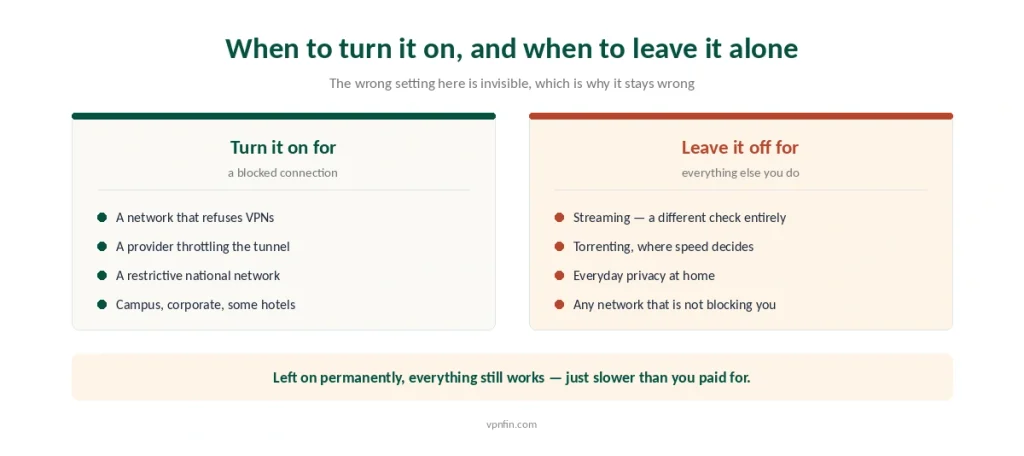
⚠️ Which is why it should be off unless a network requires it. Leaving it on permanently is a common configuration mistake, and it is invisible: everything works, just slower than it should.
The Legal Position
In most countries obfuscation is entirely lawful, as is the VPN it hides — the legal-or-illegal framing answers this badly nearly everywhere, and our country pages set out where restrictions actually exist.
A handful of jurisdictions restrict VPNs themselves. Where that is the case, the relevant question is the local law rather than the protocol, and we cover those individually rather than offering a general recipe.
We do not publish country-by-country circumvention instructions. Explaining how a technology works is a different thing from writing a manual for a specific filter, and the second is not what this site is for.
When You Actually Need It
On a network that blocks VPNs outright. Campus wifi, corporate networks, some hotels. If a standard connection refuses and a different server does not help, this is the setting.
When a provider throttles the tunnel. Slow only with the VPN on, at any server, is the signature.
On a restrictive national network, where availability rather than privacy is the problem, and where local law is the first thing to establish.
Not for streaming, not for torrenting, and not for everyday privacy — our main ranking scores the things that do matter for those, and obfuscation is not among them.
How We Research
This guide draws on provider documentation for Proton VPN’s Stealth protocol, Surfshark’s Camouflage and NoBorders modes and Windscribe’s Stunnel-based implementation, on published technical write-ups for the distinction between wrapping and protocol modification and for the status of AmneziaWG among the largest providers, and on 2026 reporting for NordVPN’s move from OpenVPN to NordWhisper. Where sources contradict each other on NordVPN’s current implementation, we have said so rather than choosing. No independent laboratory publishes obfuscation testing, so nothing on this page is a measured result — that limitation is stated in the article rather than in this note alone. We do not run our own tests. Our method lives on the About Us page.
VPN Obfuscation FAQ
A technique that makes VPN traffic look like ordinary web traffic, usually by wrapping it in a TLS connection on port 443. It prevents systems inspecting the connection from identifying a tunnel and blocking it. It does not add privacy — encryption already covers the contents.
Only if a network blocks VPN connections or your provider throttles them. Campus, corporate and some hotel networks do this, as do a few national filters. On an ordinary home connection it costs speed and buys nothing.
No. Streaming platforms identify VPNs by checking your address against databases of known datacentre ranges, not by inspecting packet patterns. Obfuscation addresses a different detection method entirely and slows your connection while failing to help.
Proton VPN calls it Stealth, Surfshark uses Camouflage and NoBorders, NordVPN offers obfuscated servers and moved to its NordWhisper protocol during 2026, ExpressVPN applies it automatically, Windscribe calls it Stealth, and Mullvad and Private Internet Access offer Shadowsocks. Norton has its own protocol called Mimic.
No, and that is the honest weakness of the whole category. Audits examine logging, laboratories test malware detection and speed, and nothing measures whether a stealth protocol survives a particular inspection system. The available evidence is user reports that change without notice.
The Verdict
Obfuscation keeps a connection available; it does not make it private. Encryption already protects what you send. This hides that you are sending it through a tunnel.
Leave it off unless a network forces the issue. It costs speed and connection time, and on a network that does not block VPNs it buys you nothing.
And nobody can prove it works. There is no independent testing of this feature anywhere, which makes it the one part of a VPN where every claim — including the ones on this page — rests on description rather than measurement.