
Disclosure: VPNFin is reader-supported. If you buy a VPN through links on this page, we may earn a commission at no extra cost to you. This never affects our ratings — here’s our full disclosure.
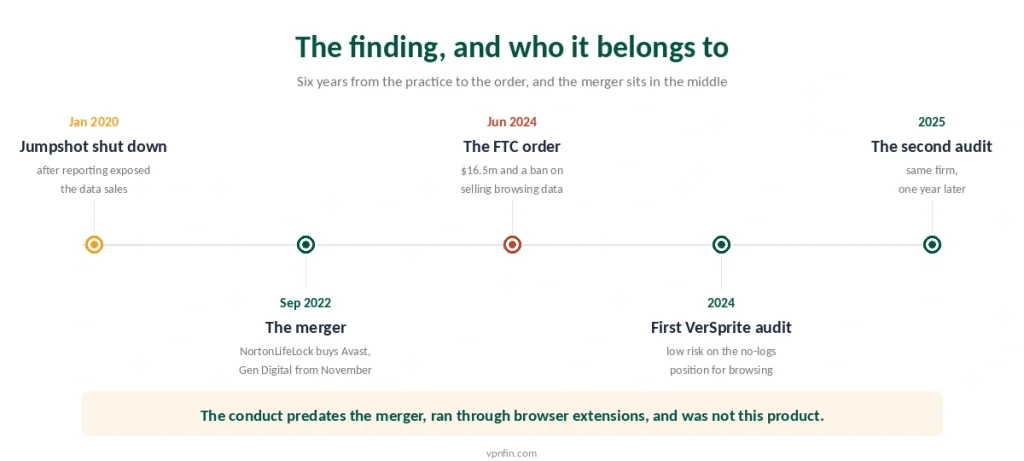
Norton VPN is owned by Gen Digital, the company formed when NortonLifeLock merged with Avast in 2022. In June 2024 the Federal Trade Commission finalised an order against Avast: a $16.5 million payment, a ban on selling browsing data for advertising, and mandatory deletion of what had already been transferred.
That is the most important sentence in any honest review of this product, and it is also not evidence against Norton VPN. The conduct was Avast’s, it ran through browser extensions rather than a VPN, and it happened before the merger.
Both things are true. Most reviews pick one and stop, which is why this one starts there and then does the work.
Is Norton VPN Any Good?
Yes, with a specific caveat about where it sits. Two independent no-logs audits by VerSprite, a 60-day refund window on annual plans, the longest of any provider we cover, and speeds that hold 74–90% of baseline on nearby servers. The caveat is jurisdiction: Gen Digital is US-headquartered, inside Five Eyes, and the renewal price roughly doubles.
At a Glance
What works:
- Two independent no-logs audits, by VerSprite in 2024 and again the following year
- A 60-day money-back window on annual plans, against 45 at CyberGhost and 30 at most others
- Renewal prices published openly on Norton’s own site rather than buried
- WireGuard, OpenVPN and Mimic, Norton’s own obfuscation protocol
- No IP, DNS or WebRTC leaks in published leak testing
- A Trustpilot score of 4.6 across more than 54,000 reviews
What does not:
- US headquarters places it inside the Five Eyes arrangement
- Renewal roughly doubles: Standard goes from $39.99 to $79.99
- Five simultaneous devices on Standard and Plus, against ten or unlimited elsewhere
- Much of the country count comes from virtual locations rather than physical servers
Who Actually Owns It
Worth establishing precisely, because precision is what this subject usually lacks.
Gen Digital was created in two steps. NortonLifeLock acquired Avast in September 2022, and the combined company took the Gen Digital name that November. It is dual-headquartered in Prague and Tempe, Arizona, and also owns AVG, Avira and LifeLock.
The Jumpshot affair belongs to Avast. Its subsidiary collected detailed browsing data through Avast’s antivirus and browser extensions and sold it onward. Reporting exposed it in 2020, Avast shut Jumpshot down that January, and the FTC order followed in June 2024.
Three separations matter. The conduct predates the merger. It concerned antivirus and browser-extension data, not VPN traffic. And it was Avast’s product, not Norton’s.
⚠️ Norton has its own history to account for, and it is smaller but not nothing: a cryptocurrency miner bundled into its antivirus in 2022, since discontinued, and a January 2023 breach notification affecting roughly 925,000 accounts.
⚠️ So what does this actually tell a buyer? That the corporate group has been caught monetising user data before, which raises the standard of evidence a privacy product from that group should meet. The right response is not to dismiss the service — it is to ask whether this specific service has been independently checked. It has, twice.
Speed and Performance
Solid rather than exceptional, and the numbers come from published testing rather than from us.
Nearby servers retain roughly 74–90% of baseline throughput in published measurements, with many connections exceeding 100 Mbps.
WireGuard is available on Windows and Android, which is where the better figures come from. Mimic, Norton’s obfuscation protocol, costs more speed in exchange for looking less like VPN traffic.
That places it mid-field. Our speed guide covers what these percentages mean in practice, and the honest summary is that anything above 70% is invisible during normal use.
⚠️ We do not run our own speed tests, so every figure here carries a source rather than our name. That matters more with a provider whose parent has a data-monetisation finding against it, because independent measurement is the only kind worth citing.
Streaming and Torrenting
The weakest area, and the one where a bundled VPN usually shows its priorities.
Published testing reports access to BBC iPlayer, Disney+, HBO Max and Paramount+, with Netflix results varying by library and by test.
A dedicated Netherlands server handles P2P. That is a single designated location rather than the broad torrenting support specialists offer, and our torrenting guide covers when one designated server is enough and when port forwarding is the thing you need.
Streaming access changes monthly for everyone, which is why we treat any provider’s list as a snapshot — our streaming guide covers how quickly these results move, and our Netflix guide explains why the failures are usually not the VPN.
Security and Privacy
The strongest part of the case, and the reason the ownership question has an answer.
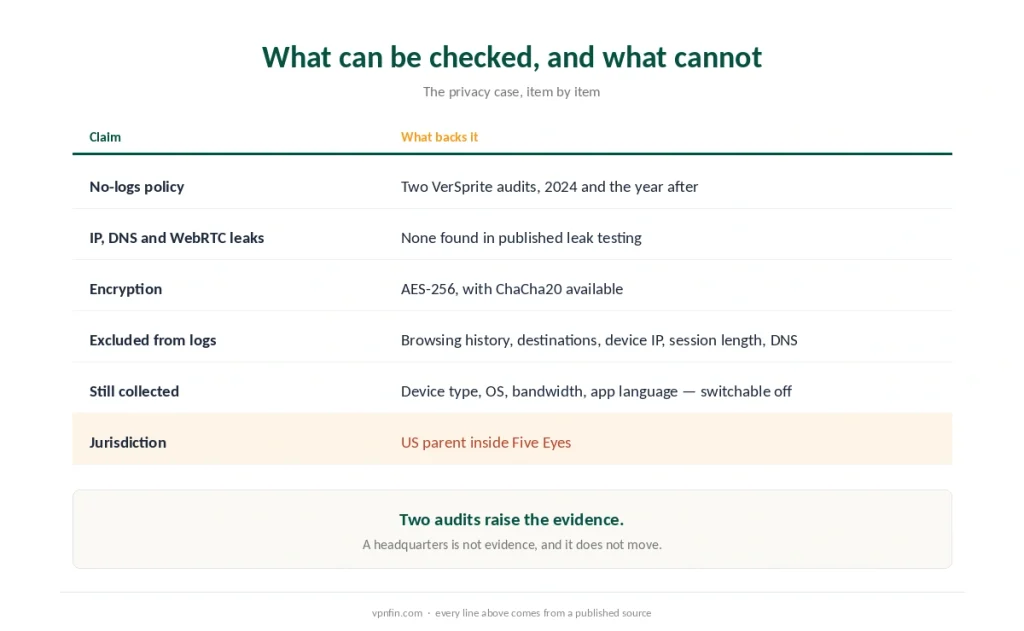
Two independent no-logs audits. VerSprite conducted the first in 2024, reporting low risk and supporting Norton’s no-logs position on browsing activity, and returned the following year.
Encryption is AES-256 with ChaCha20 available, alongside a kill switch, split tunnelling and tracker blocking.
Published leak testing found no IP, DNS or WebRTC exposure. Running those checks yourself takes about ten minutes and is worth doing on any provider.
The stated policy excludes browsing history, traffic destinations, device IP addresses, session length and DNS requests. Anonymised operational data — device type, operating system, bandwidth, app language — is collected, and the app lets you switch off usage sharing.
⚠️ Jurisdiction is the real weight against it. Gen Digital’s US headquarters places it inside Five Eyes, which is why we rank providers on privacy evidence separately, and weigh jurisdiction less than most rankings do. Two audits reduce how much that matters, because a provider that holds nothing has less to be compelled for. They do not remove it.
Features and Tiers
Three standalone tiers, and the differences are mostly outside the VPN.
Standard is the VPN plus tracker blocking, covering up to five devices.
Plus adds antivirus, a password manager, dark web monitoring and 10 GB of cloud backup, still on five devices. Unlike the filters VPN companies call antivirus, this one comes from a security company and scans files — the distinction that decides whether a bundle replaces anything.
Ultimate adds parental controls, 50 GB of backup and up to ten simultaneous connections in the US.
⚠️ Five devices is below the field. NordVPN allows ten, and Surfshark places no limit at all — the comparison our Surfshark review covers in detail. For a household, the device cap is the constraint you will meet first.
Mimic deserves a mention. Norton built its own obfuscation protocol, which is unusual for a company better known for antivirus, and it is the feature that makes this service viable on the kind of network our China page describes.
Pricing, and the Number Most Reviews Skip
Here is where Norton does something we rarely get to praise.
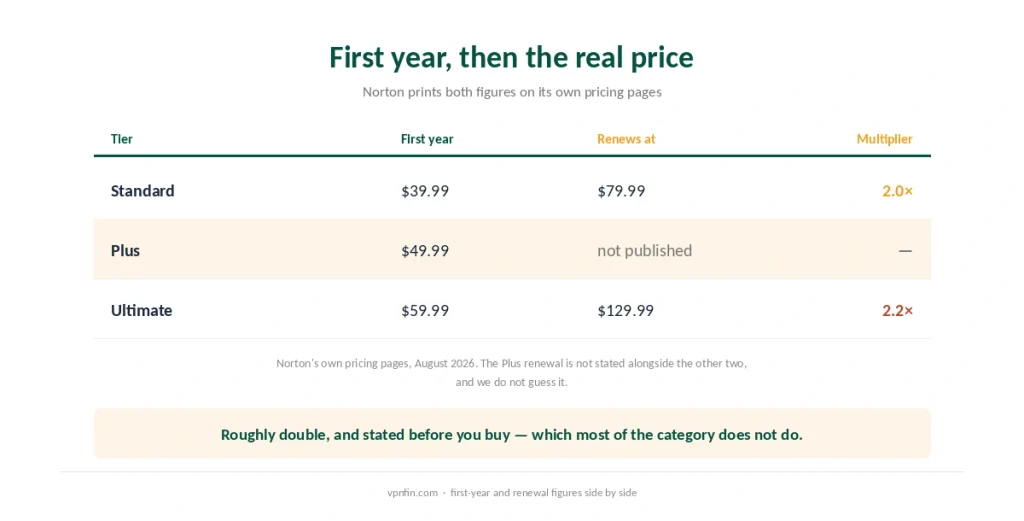
First-year standalone pricing runs $39.99 for Standard, $49.99 for Plus and $59.99 for Ultimate.
Renewal roughly doubles. Standard goes to $79.99, and Ultimate to $129.99 — multipliers of about 2.0 and 2.2.
Norton publishes those renewal figures on its own website. Most providers do not, which is the entire reason our renewal price guide exists and why the multipliers in it range from 1.0 to 3.4.
⚠️ A doubling renewal is mid-table, not scandalous. What is above average is telling you in advance. We would rather pay a 2.0 multiplier that was disclosed than a 1.6 that was hidden, and so, we suspect, would you.
The 60-day refund window is the standout. Annual plans carry it; monthly billing carries fourteen days. That is longer than CyberGhost’s 45 and double the thirty days most providers offer, and it is enough time to test the service through a full billing cycle before committing.
What We Don’t Love
Three things, stated plainly.
The jurisdiction. A US-headquartered parent inside Five Eyes is the wrong starting point for a privacy product, and no audit fully offsets it.
The virtual locations. Much of the 60-to-65-country figure comes from virtual servers rather than hardware in those countries. That is a legitimate technique and a soft number, and Norton is not alone in presenting it as a hard one.
The device cap. Five connections on two of three tiers is genuinely restrictive in 2026.
How We Research
This review draws on published independent testing of Norton VPN’s speeds and leak behaviour, the VerSprite audit summaries as reported by named outlets, Norton’s own published pricing and renewal pages, the FTC’s June 2024 order against Avast, and contemporaneous reporting on the Jumpshot affair, the 2022 miner bundling and the 2023 breach notification. We do not run our own speed tests, so every performance figure here is attributed to whoever produced it. Where a corporate history is relevant to a privacy product, we set out what it does and does not establish rather than using it as a verdict. Our full approach lives on the About Us page.
Norton VPN FAQ
Gen Digital, formed when NortonLifeLock acquired Avast in September 2022 and renamed itself that November. The group also owns AVG, Avira and LifeLock, and is dual-headquartered in Prague and Tempe, Arizona. That US presence places it inside the Five Eyes intelligence-sharing arrangement.
No. The Federal Trade Commission’s June 2024 order concerned Avast’s collection and sale of browsing data through its antivirus and browser extensions, conduct that ended in 2020 and predates the merger. It is relevant context for a privacy product from the same group, but it is not a finding about Norton VPN.
Yes, twice. The security firm VerSprite conducted an independent no-logs audit in 2024, reporting low risk and supporting Norton’s position on browsing activity, and carried out a further audit the following year. Published leak testing separately found no IP, DNS or WebRTC exposure.
Roughly double. Standard renews at $79.99 against a $39.99 introductory price, and Ultimate at $129.99 against $59.99. Norton publishes these figures on its own pricing pages, which is more than most providers do — multipliers across the market range from 1.0 to 3.4.
Sixty days on annual plans, the longest of the providers we cover as of August 2026. Monthly billing carries fourteen days instead. That is double the thirty days most providers offer and enough to test the service through a complete billing cycle before deciding.
Norton VPN
The Verdict
Two independent VerSprite audits, no leaks in published testing, and the longest refund window of the providers we cover. The costs are a US parent inside Five Eyes, five devices on two of three tiers, and a renewal that roughly doubles.
Final Verdict
Norton VPN earns 4.0, and the number is held down by its address rather than its engineering.
The technical case is sound. Two independent audits, no leaks in published testing, competitive speeds on WireGuard, an obfuscation protocol most rivals lack, and the longest refund window of the providers we cover.
The corporate case is complicated and worth stating precisely. Gen Digital’s Avast subsidiary was fined $16.5 million for selling browsing data, before the merger, through products that were not this one. That raises the evidential bar for anything privacy-branded from the group. Two audits clear that bar; a US headquarters keeps the score where it is.
Choose it if you already pay for Norton 360, want antivirus and a VPN under one login, or value a 60-day window to make up your mind.
Skip it if jurisdiction is your first criterion. Proton VPN operates from Switzerland with five published audits, and NordVPN from Panama with six.
Mullvad issues an account number instead of asking for an email, and all three start from a better place on the question this review spends most of its length on.