
Disclosure: VPNFin is reader-supported. If you buy a VPN through links on this page, we may earn a commission at no extra cost to you. This never affects our ratings — here’s our full disclosure.
Is a VPN legal in Pakistan? Yes. In November 2024 the government came close to restricting unregistered VPNs, then backed away. The Interior Ministry asked the Pakistan Telecommunication Authority (PTA) to block illegal VPNs, VOA reported. The Council of Islamic Ideology called using them to reach blocked content un-Islamic. Then, according to local reports, the Ministry of Law said the government had no legal power to ban VPNs under existing laws.
What remains is registration, not prohibition. This page explains what the law says, what registration involves, and where the real limits sit.
Is a VPN Legal in Pakistan? The Short Answer
Using a VPN is legal. No law criminalises personal VPN use; the Prevention of Electronic Crimes Act (PECA) punishes acts such as unauthorised access or fraud, not the tool, VPN vendor Veilock notes.
Registration is the catch. The PTA runs a free registration process aimed at businesses and freelancers. Providers can throttle unregistered traffic during enforcement drives, but we found no reported penalty or prosecution of an individual.
What you reach still matters. Blocked content remains blocked, and PECA offences stay offences with or without a VPN. Everyday uses such as securing public Wi-Fi or banking abroad raise no issue. Our guide to a VPN for Pakistan covers what is blocked and what works.
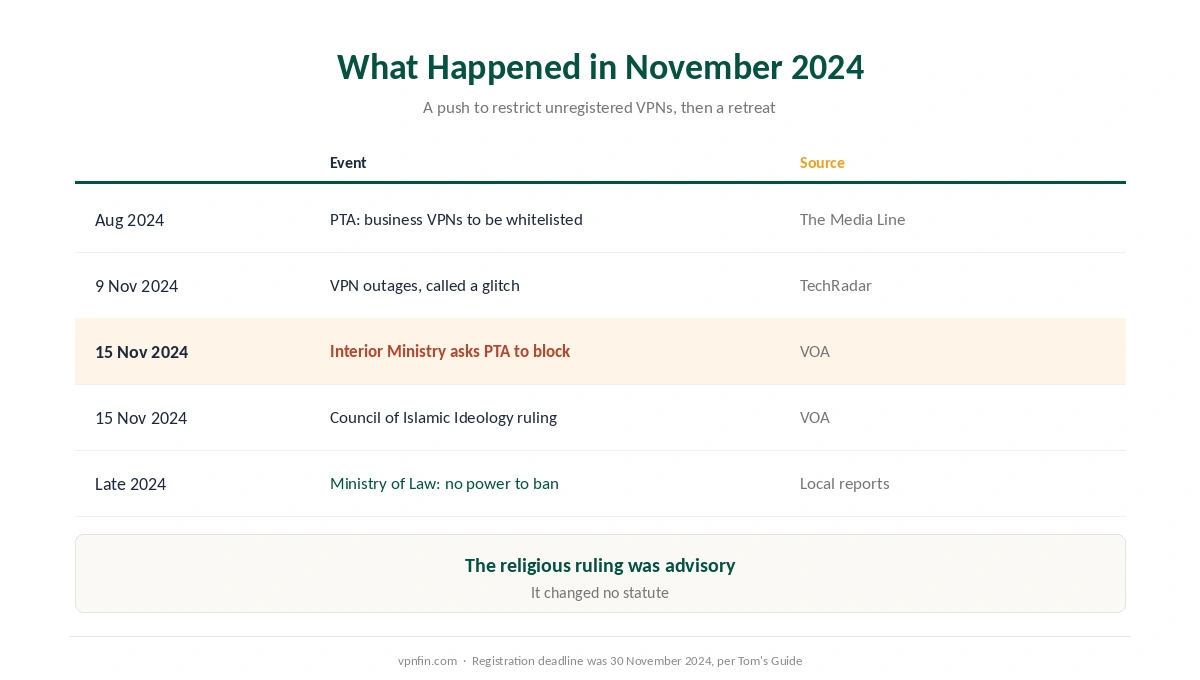
What Happened in November 2024
| Date | Event | Source |
|---|---|---|
| August 2024 | PTA chair tells a Senate committee business VPNs will be whitelisted | The Media Line |
| 9 November 2024 | VPN outages, later called a technical glitch | TechRadar |
| 15 November 2024 | Interior Ministry asks PTA to block illegal VPNs; Council of Islamic Ideology calls use for blocked content un-Islamic | VOA |
| 30 November 2024 | Registration deadline | Tom’s Guide |
| Late 2024 | Ministry of Law: no legal authority to ban VPNs | Local reports |
| December 2024 | Ban push withdrawn | Venclikovi review |
The religious ruling had no legal force. The Council of Islamic Ideology advises parliament; its chairman, Raghib Naeemi, said using VPNs to access blocked or illegal content was against Islamic law, VOA reported. That opinion did not change any statute.
The legal ruling mattered more. Reports at the time said the Ministry of Law told the government it lacked the power to ban VPNs under existing laws. The Interior Ministry’s request was then to be withdrawn. PECA lets the state block content, not tools, one 2026 review summarises.
What Registration Involves
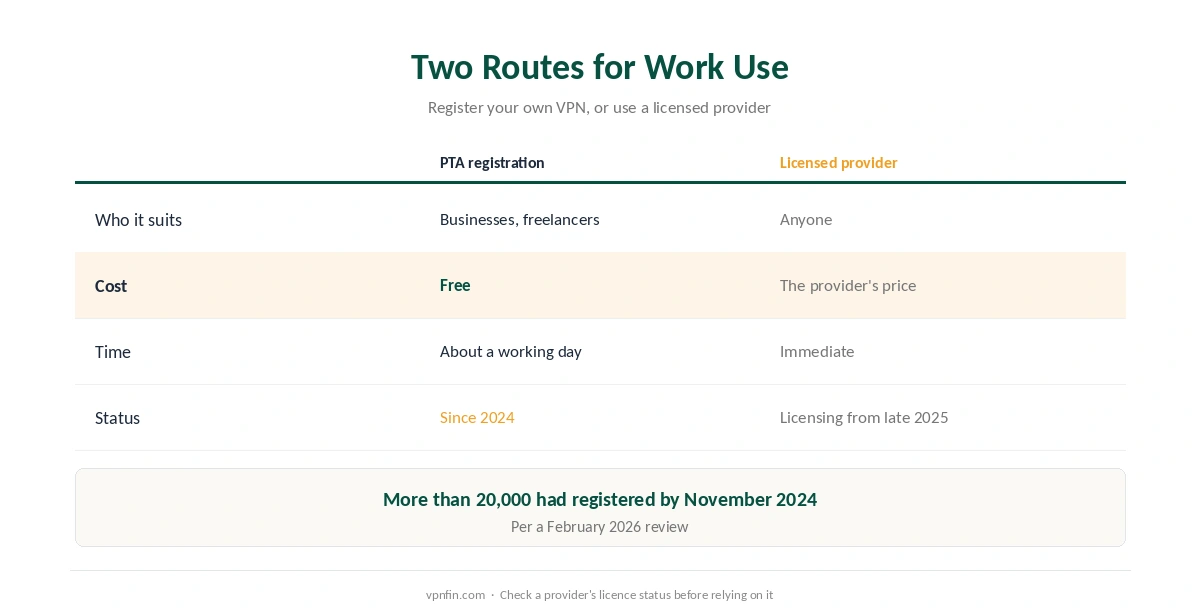
If you ask whether a VPN is legal in Pakistan for work, registration is the practical answer. It is free through the PTA portal and usually takes about a working day, according to local guides. More than 20,000 companies and freelancers had registered by November 2024, one review reports.
The PTA designed it for businesses and freelancers. Pakistan’s IT export economy depends on freelancers reaching foreign clients. That is why the PTA chair promised in August 2024 that business VPNs would be whitelisted, The Media Line reported.
Licensed providers are the other route. TechRadar reported a new licence category for VPN providers, and reviews describe a formal licensing regime from late 2025. Using a PTA-licensed service is the alternative to registering your own VPN; check a provider’s licence status before relying on it.
Is a VPN Legal in Pakistan if Unregistered?
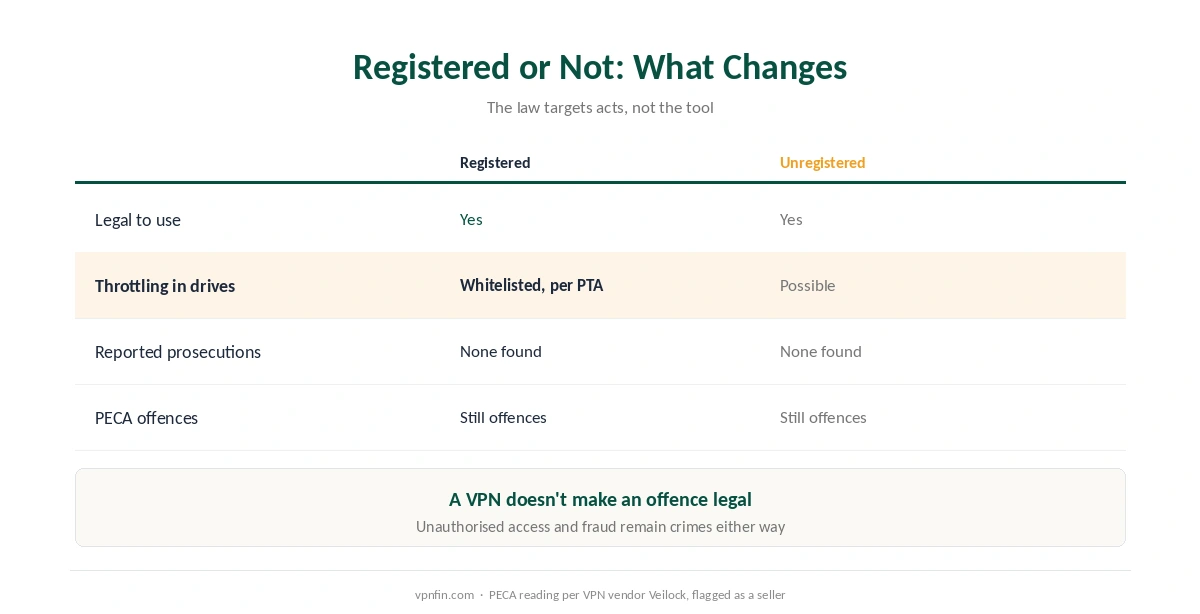
No law makes an unregistered VPN a crime, and we found no reported prosecution of an individual for using one. The practical risk is throttling: local guides report that providers slow or block unregistered traffic during enforcement windows.
Technical blocking has grown. Outbyte reported in January 2026 that deep packet inspection recognises OpenVPN handshakes and throttles them, which is why obfuscation and protocols such as WireGuard come up in Pakistani guides.
PECA still covers what you do online. A VPN does not make an offence legal, as our guide to what a VPN hides explains.
How Pakistan Compares
Is a VPN legal in Pakistan on the same terms as its neighbours? Broadly, yes: the tool is allowed and the content is policed.
India also allows VPNs but places logging duties on providers, as our India legality page explains. Egypt goes further, treating VPN access to blocked sites as a possible crime, as our Egypt legality page sets out.
For the wider picture, our country-by-country legality guide compares every country we cover, and our travel guide covers visiting restricted countries.
How We Research
The November 2024 events come from VOA, Tom’s Guide, TechRadar and The Media Line, and the Ministry of Law’s position from local reports summarised on the PakPassion forum. Registration and licensing details come from local guides and a February 2026 review, and the PECA reading from VPN vendor Veilock, which we flag as a seller. We are not lawyers, and this is not legal advice. We name each source where used; all were read on 27 September 2026. Our full approach lives on the About Us page.
Pakistan VPN Legality FAQ
Yes. No law criminalises personal VPN use. A 2024 push to block unregistered VPNs was withdrawn after the Ministry of Law said the government had no legal authority to ban them.
The PTA aims registration at businesses and freelancers, and it is free. No penalty applies to individuals who skip it, though providers may throttle unregistered traffic.
No. The Interior Ministry asked the PTA to block illegal VPNs in November 2024, but the push was withdrawn after the Ministry of Law’s advice.
The Council of Islamic Ideology said using VPNs to access blocked or illegal content is against Islamic law. It is an advisory body; its opinion is not a law.
Not for the VPN itself. Offences under PECA, such as unauthorised access or fraud, remain offences whether or not a VPN is used.
The Verdict
A VPN is legal in Pakistan, and the 2024 attempt to restrict unregistered ones ended without a ban.
Freelancers and businesses should register through the PTA to avoid throttling. For everyone else, the limit is what you do online, not the tool; choose a provider with an audited no-logs policy, such as NordVPN, as our no-logs guide explains.