
Disclosure: VPNFin is reader-supported. If you buy a VPN through links on this page, we may earn a commission at no extra cost to you. This never affects our ratings — here’s our full disclosure.
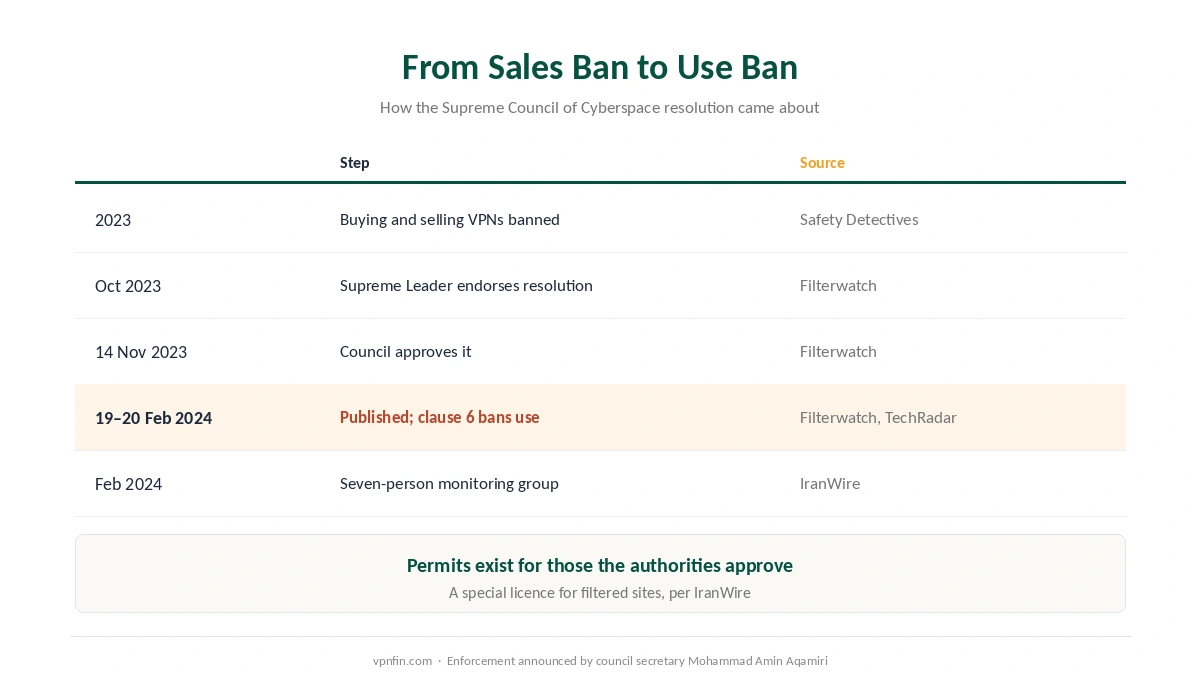
Is a VPN legal in Iran? No, not without a permit. In February 2024 Iran’s Supreme Council of Cyberspace published a resolution whose clause 6 prohibits using VPNs, except for those holding a legal permit. Iran had already banned buying and selling VPNs in 2023, Safety Detectives reported. The resolution carried the endorsement of the Supreme Leader.
Yet Iranian legal experts argue the ban does not make VPN use a crime, because the council cannot define crimes and the resolution sets no penalty. This page explains what the rule says, why lawyers dispute it, and what has happened since.
Is a VPN Legal in Iran? The Short Answer
Using a VPN without a permit is prohibited. The Supreme Council of Cyberspace’s resolution bans it, RFE/RL reported, with permits for those the authorities approve.
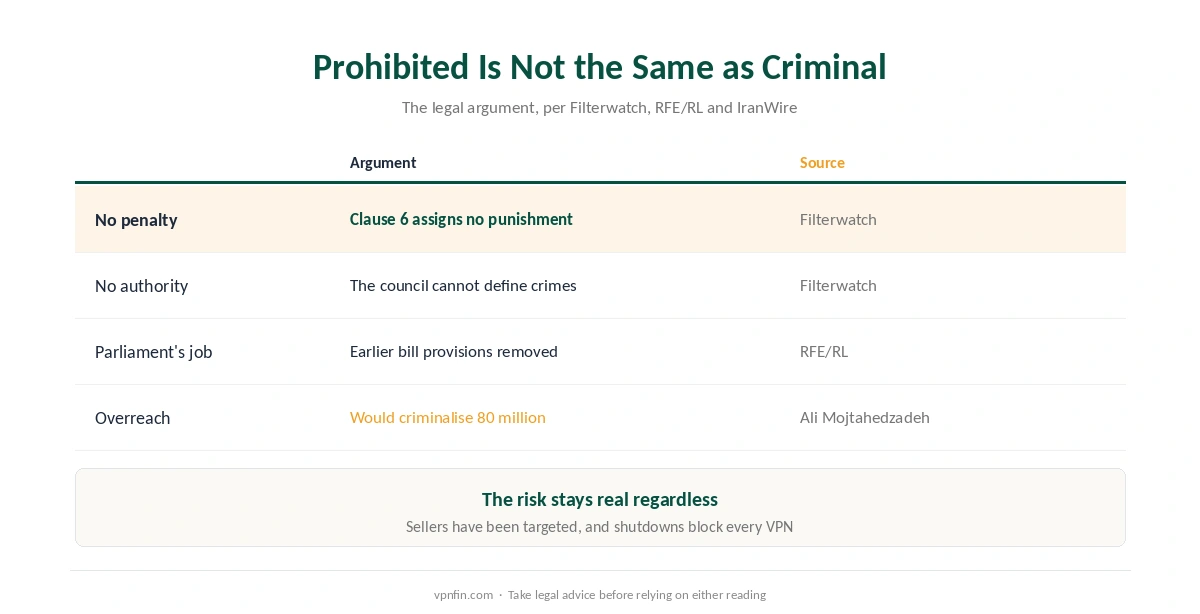
Prohibited is not the same as criminal. Filterwatch, a digital rights monitor, argues the resolution names no punishment, and the council has no power to legislate. RFE/RL noted criminalisation was absent from the decree because that is parliament’s job.
The risk is still real. Selling VPNs has been treated as an offence, and access to the wider internet has been cut repeatedly, including a blackout from January 2026. Our guide to a VPN for Iran covers filtering and shutdowns.
What the 2024 Resolution Says
| Date | Step | Source |
|---|---|---|
| 2023 | Buying and selling VPNs banned | Safety Detectives, IranWire |
| October 2023 | Supreme Leader endorses the resolution | Filterwatch |
| 14 November 2023 | Supreme Council of Cyberspace approves it | Filterwatch |
| 19–20 February 2024 | Published and enforced; clause 6 bans use without a permit | Filterwatch, TechRadar |
| February 2024 | Seven-person working group set up to monitor VPN use | IranWire |
The resolution’s title describes its aim: increasing the share of domestic traffic and counteracting anti-censorship tools, Filterwatch translates. Mohammad Amin Aqamiri, the council’s secretary, announced its enforcement, RFE/RL reported.
Permits exist for those the authorities approve, so the honest answer to whether a VPN is legal in Iran depends on holding one. IranWire reported that individuals would need a special licence to access filtered websites and social networks.
Why Lawyers Say It Is Not a Crime
No penalty, no crime. Filterwatch argues that under the principle of legality, an act is only a crime if the law assigns it a punishment. Clause 6 prohibits VPN use but names no penalty.
The council cannot legislate. The Supreme Council of Cyberspace is a policy-making body without authority to define crimes, Filterwatch says. RFE/RL added that parliament had previously removed criminalisation provisions from proposed legislation.
A lawyer called it overreach. Ali Mojtahedzadeh argued the council was exceeding its mandate and would criminalise 80 million Iranians, including top officials who rely on VPNs, IranWire reported.
What Has Happened Since
A blackout in 2026. Iran’s internet went almost entirely dark from January 2026, with partial restoration on 25 May, Cybernews reported. NewsNation reported in April that a black market was selling VPN access at high prices during the blackout.
Filtering continues. Instagram, X, YouTube and Telegram are officially blocked, Safety Detectives noted, alongside thousands of other sites. Some foreign services also block Iranian users from their own side, often for sanctions reasons, as our guide to country-restricted AI services explains.
For visitors, the rules apply on arrival. Anyone asking whether a VPN is legal in Iran for a trip should assume the permit rule applies to them too; our travel guide covers restricted destinations generally.
The legal question now matters less than access. During a near-total shutdown, no VPN works at all, as the guide above explains. We do not give instructions for bypassing filtering.
Is a VPN Legal in Iran Compared With Its Neighbours?
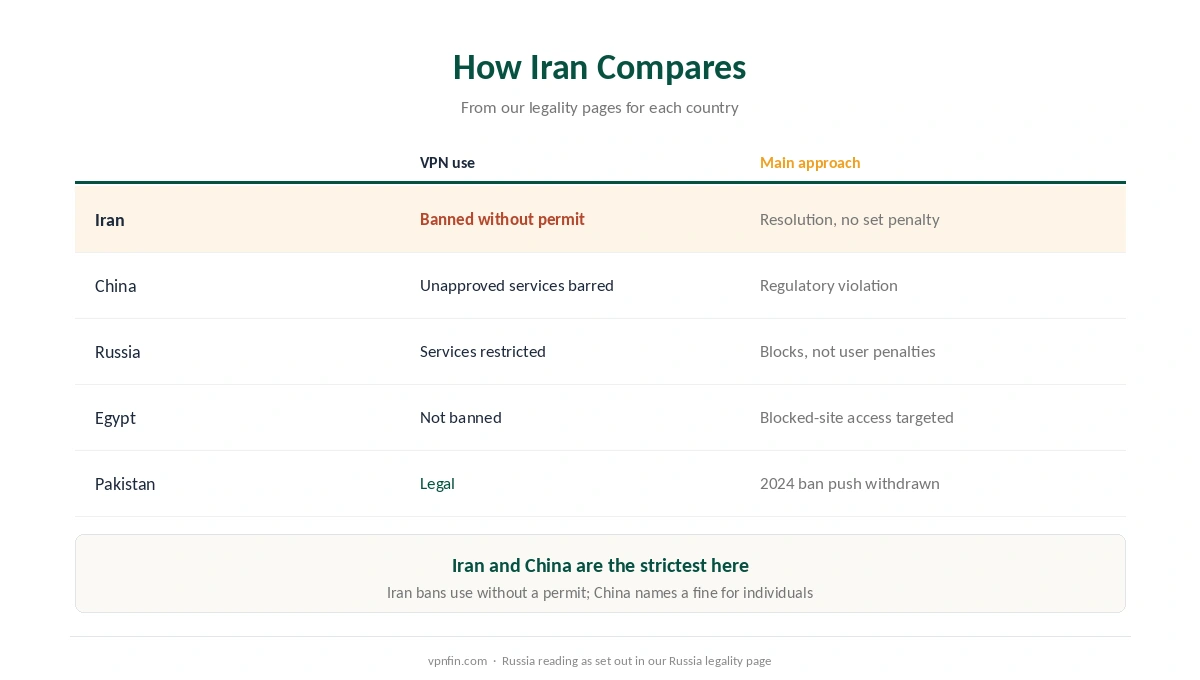
Iran is stricter than most. Russia restricts VPN services but, in our reading, does not penalise users, as our Russia legality page explains. China treats unapproved services as a regulatory violation, as our China legality page sets out.
Pakistan and Egypt sit elsewhere on the scale. Pakistan dropped its 2024 push to restrict unregistered VPNs, and Egypt targets access to blocked sites rather than the tool.
In the Gulf, the UAE tolerates the tool but punishes misuse, as our UAE guide explains. Our country-by-country guide compares every country we cover.
What a VPN Does and Does Not Hide
A VPN hides which sites you visit from your provider, but not the fact that you use a VPN, as our guide to what a VPN hides explains. In a country that monitors for anti-censorship tools, that distinction matters.
Logging policies matter too. A provider that keeps no records has nothing to hand over, which is why audited no-logs claims are worth checking, as our no-logs guide explains. Our NordVPN review covers one audited provider.
How We Research
The resolution’s text and legal analysis come from Filterwatch, RFE/RL and IranWire, the earlier sales ban from Safety Detectives, and the 2026 blackout from Cybernews and NewsNation. We are not lawyers, and this is not legal advice. We name each source where used; all were read on 27 September 2026. Our full approach lives on the About Us page.
Iran VPN Legality FAQ
Not without a permit. A February 2024 resolution of the Supreme Council of Cyberspace prohibits VPN use except for those holding a legal permit.
Legal experts dispute it. Filterwatch argues the resolution names no penalty and the council cannot define crimes, so the use is prohibited but not criminalised.
No. Buying and selling VPNs was banned in 2023, before the ban on use.
Those the authorities approve. IranWire reported that individuals would need a special licence to access filtered sites and social networks.
No. During a near-total shutdown, such as the one from January 2026, no VPN can connect.
The Verdict
A VPN is not legal in Iran without a permit, under the Supreme Council of Cyberspace’s 2024 resolution.
Whether that makes use a crime is disputed by Iranian lawyers, but the practical risk and the shutdowns are real. Take legal advice before relying on either reading.