
Disclosure: VPNFin is reader-supported. If you buy a VPN through links on this page, we may earn a commission at no extra cost to you. This never affects our ratings — here’s our full disclosure.
Is a VPN legal in Egypt? Owning and using one is not banned, but using one to reach a blocked website can be a crime. That is how Andersen, a law firm with an Egyptian office, reads Article 14 of the country’s 2018 cybercrime law, Law No. 175. It says the article makes it illegal to use tools such as VPNs to access blocked sites, with at least a year in prison and a fine of EGP 50,000 to 100,000.
The law itself never names VPNs, and sources describe the penalty differently. This page sets out what the text says, how it is read, and where ordinary VPN use sits.
Is a VPN Legal in Egypt? The Short Answer
Using a VPN is not illegal in itself. Andersen states plainly that VPN use is not outright banned, even as it warns about blocked sites.
Using one to reach a blocked site is the risk. Article 14 covers access to prohibited information systems, and lawyers and journalists have read that as covering VPN access to blocked websites since the law passed in 2018.
Everyday uses are a different matter. Protecting a connection on public Wi-Fi or reaching a work network does not touch a blocked site. Our guide to a VPN for Egypt covers what is blocked and what still works, and our UAE guide the nearest comparison in the region.
What Law 175 Actually Says
The law was ratified in August 2018 and has 45 provisions, the Library of Congress reported. It came into force on 15 August 2018, according to a Lexology client alert.
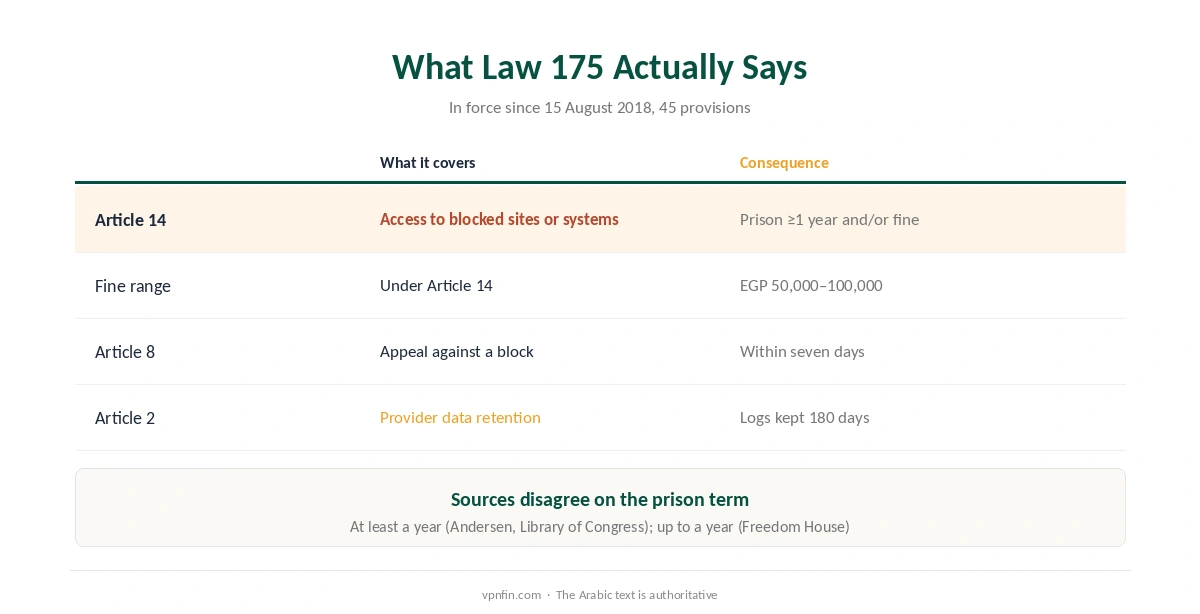
Article 14 is the relevant one. According to the Library of Congress, it penalises anyone who gains access to or hacks a website, private account or prohibited information system, whether intentionally or unintentionally. Its summary gives no less than a year in prison and/or a fine of EGP 50,000 to 100,000.
Nowhere does the text use the word VPN. That link comes from interpretation: Andersen reads the article as covering tools used to reach blocked sites, and Egyptian media drew the same conclusion when the law passed.
| Provision | What it covers | Penalty |
|---|---|---|
| Article 14 | Access to a prohibited information system or blocked site | Prison of at least a year and/or EGP 50,000–100,000 |
| Article 8 | Right to appeal a blocking decision | Appeal within seven days |
| Article 2 | Data retention by telecom providers | Logs kept for 180 days |
| Blocking powers | Sites deemed a threat to national security | Blocked on authorities’ order |
Sources Disagree on the Penalty
Andersen and the Library of Congress say at least a year. Both describe the prison term under Article 14 as a minimum of one year.
Freedom House says up to a year. Its 2022 Freedom on the Net report describes the law as punishing people who visit banned websites with up to one year in prison.
That difference matters, and we cannot settle it from English sources. Only the Arabic text is authoritative, so when asking whether a VPN is legal in Egypt, the safe reading is the stricter one: a VPN used to reach a blocked site carries a real risk of prison, as our country-by-country legality guide notes for other strict regimes.
What Your Provider Keeps
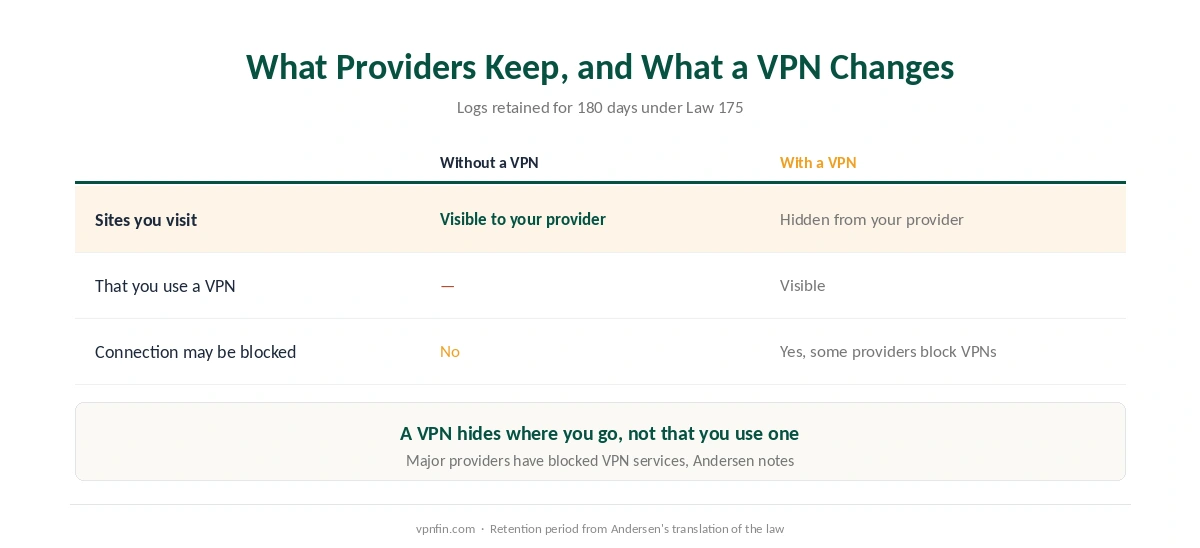
Egyptian telecom providers must retain logs. Our no-logs guide explains why retention matters on the VPN side too. Andersen’s translation of the law sets the period at 180 days for information system logs and related data, and Article 2 sets the retention duty, the Library of Congress notes.
A VPN changes what those logs show, which is why the question of whether a VPN is legal in Egypt matters. Your provider sees a connection to a VPN server rather than the sites you visit, as our guide to what a VPN hides explains. It does not hide that you use a VPN.
Andersen also notes that major providers block VPN services. Some connections may fail outright, which is where obfuscation comes in.
Is a VPN Legal in Egypt for Everyday Use?
Public Wi-Fi. Encrypting your connection in a café or hotel does not involve a blocked site. Our public Wi-Fi guide explains the risk it addresses.
Work and banking. Company VPNs and secure access to your bank are routine, as our online banking guide explains. Business travellers using a company VPN are in the same position, and our travel guide covers the practical side.
Blocked news and messaging services. This is where Article 14 applies. Freedom House rates Egypt’s internet as not free, and blocked sites have included news outlets. We do not give instructions for reaching them.
How Egypt Compares
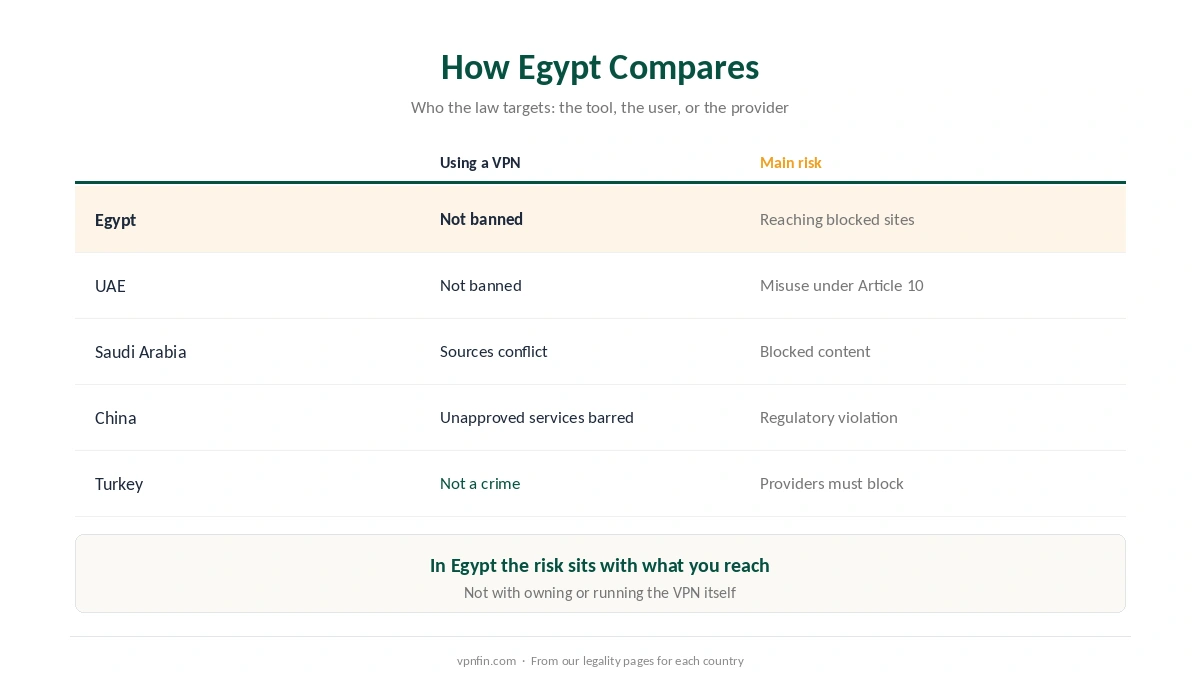
The UAE and Saudi Arabia take similar approaches, where the tool is tolerated but its use to reach blocked content is not, as our UAE legality page explains. Our Saudi Arabia guide covers the kingdom.
China goes further, treating unapproved VPN services as a regulatory violation in themselves, as our China legality page sets out. Turkey, by contrast, blocks services rather than punishing users.
How We Research
The legal text and its summary come from the Library of Congress, Lexology and Andersen’s translation of Law 175. The VPN interpretation comes from Andersen Egypt, and the conflicting penalty description from Freedom House’s Freedom on the Net 2022. We are not lawyers, and this is not legal advice. We name each source where used; all were read on 27 September 2026. Our full approach lives on the About Us page.
Egypt VPN Legality FAQ
Using a VPN is not banned in itself, according to Andersen Egypt. Using one to access blocked websites can be an offence under Article 14 of Law 175 of 2018.
Andersen and the Library of Congress describe at least a year in prison and/or a fine of EGP 50,000 to 100,000. Freedom House describes up to a year.
No. Article 14 covers access to prohibited information systems. Law firms and media read it as covering VPN access to blocked sites.
Protecting your connection does not involve a blocked site, so it falls outside what Article 14 targets. Check current rules before you travel.
Andersen reports that major providers and mobile carriers have blocked VPN services, so some connections may fail.
The Verdict
A VPN is legal to use in Egypt, but using it to reach a blocked site is the risk, with at least a year in prison in the stricter reading of Article 14.
For privacy on public Wi-Fi, work access or banking, a VPN stays on the right side of the law. Take legal advice for anything beyond that.